

Alexander Grabovetskiy, woodcarver, School of Woodcarving · Published 2020
What does a wood carver mean by "cleanup"?
Quick answer: Cleanup is the word I said near the end of Venice Room 85.12, after I left a chunk standing: "So maybe just a little cleanup." In other lessons I use it for a preliminary pass, a final pass, one left for later, and one done off camera.
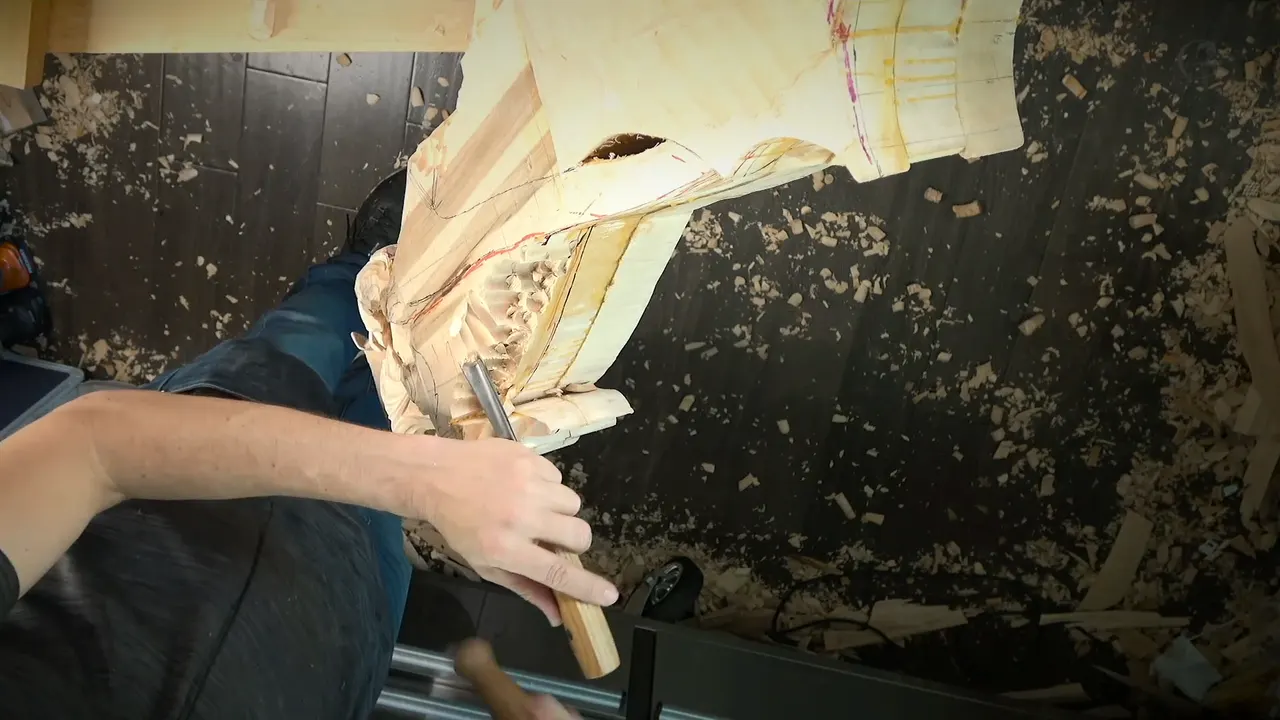

Cleanup is the word I said near the end of Venice Room 85.12, over a chunk of wood that I had left standing. My other videos use it for a preliminary pass and for a final pass, and also for work I leave for later or do off camera.
Have you ever stopped carving because you did not know yet how tall a part should stand? Did you keep some extra wood there and plan to tidy it later? Then you know the spot where I said it. Below is that moment in workshop 85, then my cleanup lines from wood carving lessons across my courses, each with its own link.
Six short lines from part 12 of workshop 85
- My tool was the same #9 as before, three-quarter of an inch, 20 millimeters.
- Not rushing that section too much was the plan, and I probably should be less aggressive in one area.
- Later on, I would establish the right movement, and for now I would just get whatever chunk I was working on.
- I called myself safe there because I knew my drop would go downhill that way.
- A chunk stayed because I needed to find out where something goes and how tall it will be.
- The last line is "Clean up uphill."
Where did I say cleanup in workshop 85, part 12?
Late in the part, though it opens on the tool. The way you will do it, I said, is exactly the same as before. "Same tool, three-quarter of an inch, 20 millimeters, and number nine." Then came "Let me get this corner first."

After the corner, "By the way, I know right away how this chunk also has to be lowered down, so I'm safely actually able to get some of that material, too." After that came a plan not to rush that section too much.
My plan came next. "Later on, I'll just establish the right movement, but for now, I'll just get whatever the chunk I'm working on." The first frame shows a gouge against the block.

Further on came "And again, I probably should be less aggressive in this area." Later came "So I cannot be off too much." Between the two I knew the final depth at one spot and was not sure yet about something in the middle.
Then a movement. Right there, I said, would be a really interesting movement, and in the frame one finger points along the block.

Next, a plan for depth. "I know I can at least get that to the certain point, and I'll check my computer how deep it's supposed to be." The device in that plan is a computer.
Then an angle. "But as of now, I'll just do on angle. Okay? So it's not going to be true 90 degrees." A reason to feel safe followed, "Although, I'm safe right here because I know my drop going to go downhill this way."
Then came a tool and a line. "Okay, I know I indicated this boundary, so I can probably just use number three for now just to get a really nice line." Then "I'll always reference this line later on." A green mallet sits in the lower right of the frame below.

The chunk had a reason. I needed to find out its place and its height. "So that's why I left that chunk, and I'm going to leave some of that. Right?" Then the line this page is named for, "So maybe just a little cleanup."

The last line of the part is "Clean up uphill." The word comes as a maybe, after I gave the reason for the chunk.
What do the two parts before it show?
Both come before it in the same workshop. Part 10 has "Again, it doesn't have to be super clean because I need to remove chunk." The reason sits in the same line.
Part 11 names number seven at 14 millimeters (0.55 in), with "I can get a little closer to the final line." Further on came "There you go," and "I left approximately one millimeter to the line." One millimeter is about 0.04 in.
What followed was "And then get number three and clean a little more." In part 12 number three comes up again, and in part 11 the piece is called my corbel.
When was a cleanup not final?
Venice Room 69 opens its first video with "Well, I've done some cleanup. It's not final, but still, you can see the overall development." A flower was still to come.

Another one sits in video 10 of that lesson. One line there is "let me use a twist little bit to the right and clean slightly this side." Then "Although it's not the final cleanup because I still have to make it somewhat round-y." Later in the same stretch came "Same idea" and "Little by little."

Venice Room 121, video 1, puts two words side by side. "Okay, number 11 again, and preliminary cleanup. Again, just preliminary, like I said." Then "There is no reason to create final, final cleanup yet, because we have to establish some details on inside."

My Grinling Gibbons class in Maine, lesson 7, has the pair too. The plan was number 11 at 3 millimeters (about 0.12 in) and "give us some kind of cleanup job." Then "Well preliminary cleanup," and it would not be the final cleanup.

Over in Carving Hazelnuts, lesson 6, my plan was a big number seven, "about an inch and a quarter or so, or maybe a little more." That is about 32 mm. Next, "But maybe 30 millimeters, I'd say," which is about 1.2 in.
I would go perpendicular to the grain, with "I don't want anything to break on me." I kept an eye on a line we had left, and called what comes at that line "the final, final cleanup." Then "You don't want to go all the way to that line. Not at this point yet."
When did a cleanup need to look better?
Look at Venice Room 35, video 2. It is a maybe again, this time about a better one: "a little better cleanup job right here, because right now it just looks all choppy, and that's not nice." The next words are "I could probably use number one. It's actually number two in England. Just a skew."
Then Venice Room 34, video 6, adds a long bend number 11 "or even smaller actually. I could use just like a quarter inch" (roughly 6 mm). Then "Get really nice cleanup job."
What did I say before a final cleanup?
Before the last pass, Venice Room 98, video 12, has "now I'm going to establish my outline before I going to give a final cleanup."
Another comes from Venice Room 103, video 4. It reads "the last thing what I want to show you before I going to do my final cleanup," and it was the direction of "like veins on a leaf."
Off camera comes up in Venice Room 124, video 1. "I don't have to create any videos how I going to clean it off-camera," I said, and "I'll do my final cleanup right here."
Why leave a cleanup for later?
Slope work comes up in Venice Room 36, video 5. The slope was "gradually going down, down, down." Then "Yes, a couple spots I can see that it's not right slope, and I can always clean it little more." And "But all that cleanup could be happening a little later with no problems here."

Holding back appears in Venice Room 70, video 12. The lines are "I need to clean up little bit," and "I'll use, again, just number 11 and 7 millimeters" (about 0.28 in). Then I held off on "too extreme cleanup right now." My reason was that once the development of that detail came I would have a better chance, and "right now it's just too chunky."

The scene in Venice Room 149, video 2, has a line still showing, and I was "about maybe one millimeter or so above my line." With the line right there I could take it all the way and be okay. "But I'll keep it slightly above, about one mil or so." I added "I still have my line visible, so which gives me about one millimeter or so for cleanup."

Lily Box lesson 10 has "can't go too extreme." Then "And now just the cleanup. Cleanup, and I'll take, let me think, number seven and maybe quarter inch for the beginning." The quarter inch (about 6 mm) is a maybe.
In my furniture panel course, the eleventh video of lesson 18 says "Almost final depth, okay? So I still have some room to clean. Okay, I left a little bit for cleanup." The lesson page is open to everyone, under Furniture Panel 18.
Which cleanups stayed off camera?
At an edge in Venice Room 145, video 2, I said "I need 2 millimeters or 1 millimeter even. That's what I need." That is about 0.08 in, or half that. Then "1 millimeter and attack that until everything is clean and nice and smooth."

After it came "But all the cleanup I can always do off-camera. It doesn't really have to be boring." Later I planned to see how it looked from above, and meant to take some rasps and rasp it.
A plain line sits in Venice Room 158, video 1. "Obviously, a lot of cleanup needs to be done yet. And some of the cleanup I'm not going to do on a camera because there's nothing special." And Venice Room 40, video 9, says "So a lot of cleanup needs to be done. But that is not a big deal. I can do that off camera."
In the same video I named what it was, "Cleaning inside, taking care of the mess, and so on." Then "But you should see the main development, the main idea."
Another reason from the camera comes in Venice Room 59, video 11. I had gone deep, "But not too deep, because I still have to clean from opposite direction." Then "Again, you don't see most of what I'm doing underneath." And "I don't want to change the position of the camera. I really don't. It's going to slow me down, and all it is just a cleanup job." Then "Nothing special. Just cleanup job."

In Venice Room 100, video 10, I said I did not want to spend too much time showing the cleanup process. "It's just the same process over and over." My passes would be more concentrated and finer.

What does a little cleanup look like where the spot will show?
In Venice Room 76, video 1, I had "really deep excavation." Little cleanup, because the spot would be visible. "Not as much, but still," I said. Next came "But see? It casts beautiful shadow already."

You really don't see too much of it in that camera position, and I had "kind of deep excavation," maybe about a quarter inch in (about 6 mm).
A cleanup cut sits in Venice Room 159, video 2. I had said "it is better to attack actually from outside inward," since the edge was really close. Then, with the inward pass in, "so now I can just do a cleanup cut." Right after, "I have to keep an eye on my grain of the wood." A flat chisel sits beside carved leaves in the frame.

Which lessons say cleanup, and in what words?
| Lesson where I said it | What I said |
|---|---|
| Workshop 85.12, at a chunk I left standing | a little cleanup |
| A flower still to come, lesson 69, video 1 | I've done some cleanup |
| One side not yet round, lesson 69, video 10 | not the final cleanup |
| Details still to set inside, lesson 121, video 1 | preliminary cleanup |
| Grinling Gibbons class in Maine, lesson 7, planning a number 11 | some kind of cleanup job |
| Hazelnuts lesson 6, close to a line left earlier | final, final |
| Slope work, lesson 36, where it looked off in spots | happening a little later |
| A chunky detail, lesson 70, not yet developed | too extreme |
| A visible line, lesson 149, seen from the side | about one mil or so |
| Edge work, lesson 145, with a millimeter or two left | do off-camera |
| Underneath work, lesson 59, out of the camera's view | just cleanup job |
| A simple detail, lesson 100, video 10 | the cleanup process |
| Deep excavation, lesson 76, video 1 | little cleanup |
| Choppy wood, lesson 35, video 2, near a skew | a little better cleanup job |
| Outline work, lesson 98, video 12 | a final cleanup |
Is there a spot on your piece where you do not know the height yet? Could you leave a chunk there and plan a light tidy with your hand tools for later? Workshop 85 waits inside one tuition plan with the rest of the Part 7 workshops, and this page starts at the corbel, with the word cleanup.
How it's done
- Start at the corner. In part 12 I took the same tool as before, number nine at 20 millimeters, and said, let me get this corner first.
- Go lighter near an open spot. My words were that I probably should go lighter in one area, since something in the middle was still ahead.
- Mark the boundary. Once the boundary was indicated, I could probably use number three for now to get a nice line.
- Keep the line. I would reference this line afterward, with the height still to find out.
- Leave the chunk. I left that chunk on purpose, and my plan was to keep some of it.
- Plan a small tidy. A maybe, a little cleanup, came first, then the line to clean uphill.
Frequently asked questions
What did you leave standing in workshop 85, part 12?
A chunk of wood. I wanted to know where something would sit and what height it would have, and I would leave some of it. The part closes on two short lines about cleaning.
Is a preliminary cleanup different from a final one?
Lesson 121, part 1, says preliminary, with a number 11, and says there is no reason yet to do the final one. Lesson 69 calls one cleanup not final, since a side still needed to be made somewhat round-y.
Do you show every cleanup on camera?
Not every one. Lesson 145, part 2, says all the cleanup can happen off-camera, and lesson 158, part 1, says a share of it stays off the camera because there is nothing special about it.
What to carve next