
Alexander Grabovetskiy, woodcarver, School of Woodcarving · Published 2020
What does a wood carver mean by "not exactly"?
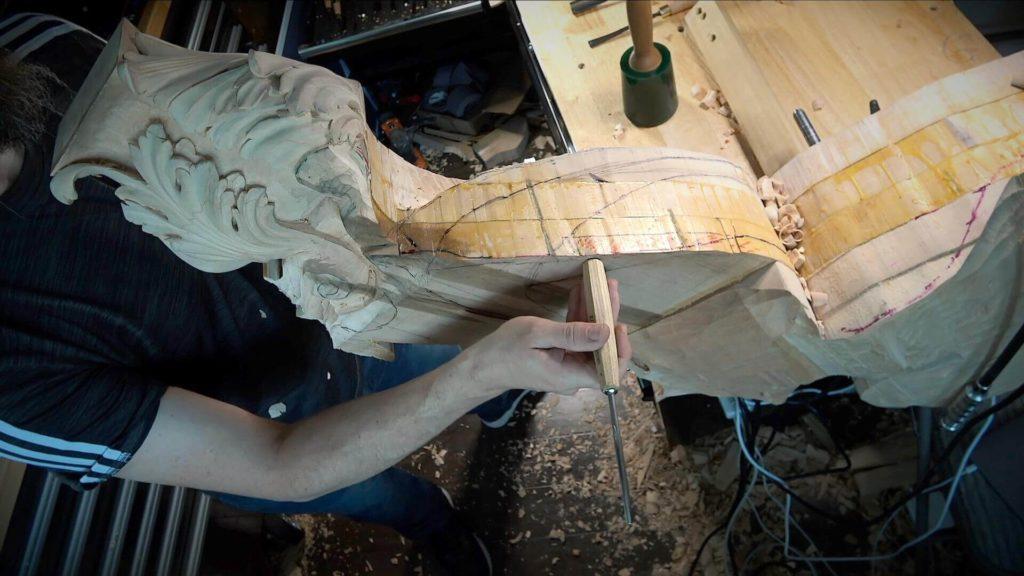
Quick answer: "Not exactly" is my flag that a size, an angle or a line is near the mark and still off it. In Venice Room 85.6 it was a corbel side, a little off the right angle. In other videos it sits beside gouge sizes, a slope, a drawn line and a finish I was not ready to call done.
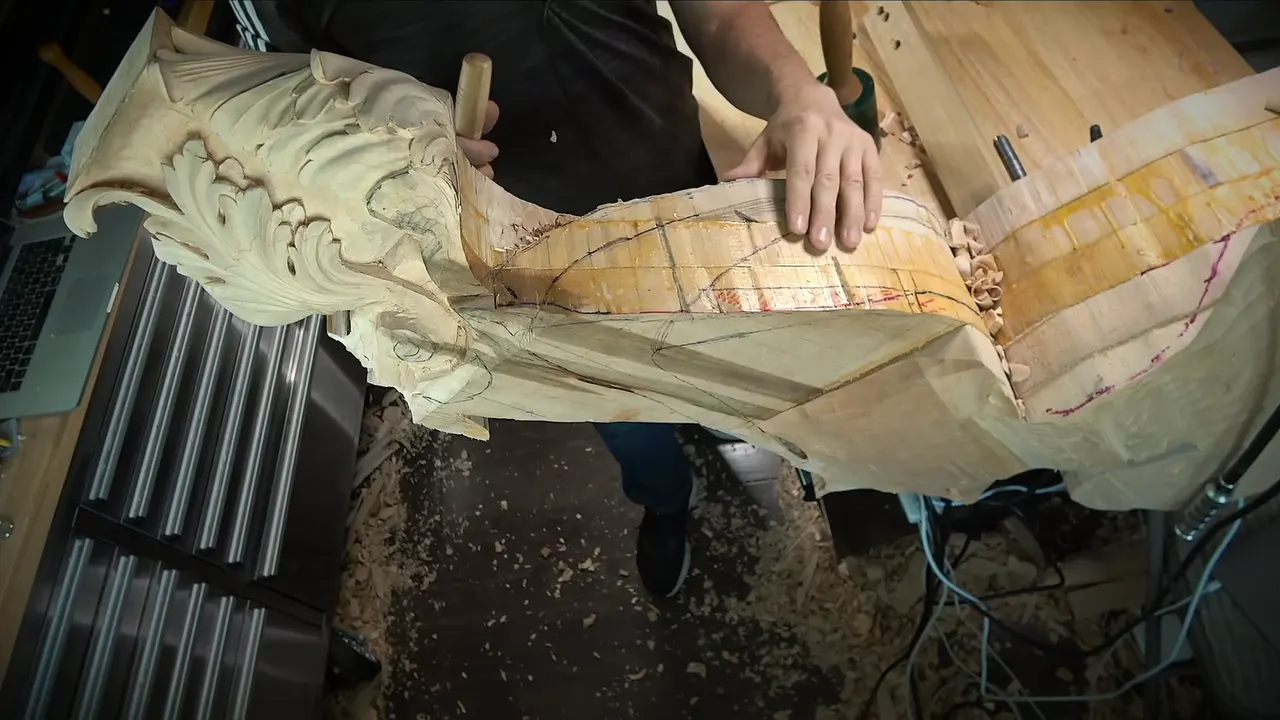

"Not exactly" is my plain way of saying a size, an angle or a line is close to where I want it and still off the mark. Venice Room 85.6 has me calling a side of my corbel a little off 90 degrees, because I really wanted to be careful. The same two words turn up in my other videos, and they do not always mean the same thing.
Have you ever set a gouge beside a pencil line and known you were near it but not on it? Did a gouge ever measure smaller in your hand than the number on it said? Follow the phrase through my wood carving videos, from a corbel side and a gouge size to a slope, a drawn line and a result that was not finished yet.
Six short lines from part 6
- One corbel side sat a little off 90 degrees, and I said so.
- Going inward with my tool would be a big mistake, I told the camera.
- To approximate 90 degrees was my way to hold the boundary.
- The work was near what I wanted, and I left the cleaning for later.
- Cleaning waited, since an undercut was still to come.
- Other lessons use the same words for sizes, a slope and a line.
What did "not exactly" mean in workshop 85, part 6?
The video opens on it. About one side of the corbel I said, "Again, that is not exactly 90 degrees, but a little off because I really want to be careful how I do that." I eased it with "But that's pretty close, but not exactly, okay?"
Part 5 of the workshop carries the thought behind it. Of two areas I said they were "supposed to be a really nice 90 degrees area, so I have to be really careful." My rule for the tool followed: "it's better to just be a little off."

Next came a second line. I needed to do exactly the same there, I said, though it was "not really necessary" and would become "just a part of a drop."
Why stay off the inside of the line?
Going inward means undercutting. My words were "I want to make sure I'm not undercutting. I'm not placing my tool inward," followed by "So that would be big mistake." The shape still to come was my reason: "we still have to shape like 3D that drop all around."

Further on I put it in one breath. I wanted to approximate 90 degrees, "just not to lose the boundary," and that was "the only reason I'm doing it right there." So the word "approximate" sits right beside the other phrase in this part of the video.
Which jobs did I leave for later in part 6?
One stretch was "close to what I want to see," and some time later I said a plain "Okay, that is good. That is good."

I also said why I left it alone: "you could clean this if you wanted to, but there's no need for it because I still have to undercut later on." It would end in "deep shadow," I said. Twice I told the camera "I'm approximately at the place I want to be."
My next move was a plan: to "indicate right away this movement," since a shadow line would sit right behind it. With a number 11 I could probably take about three millimeters (0.12 in) and create a preliminary cut, so that idea would not be lost.

The other face came next. "Now I am ready to attack that opposite side," I said. The camera could not get there, so I planned to do it off camera, with the idea "exactly the same," getting rid of a corner on that side.
The part ends on a width still to be set. "Also, right here," I said, and that spot would be "lowered down to the same level what I have on this side." Measuring came first, then going down for that wrap around, and I called it "my final how wide it's going to be."

Which gouge sizes were a little off?
Outlining an acanthus in Venice Room 4, part 9, I would probably use a smaller number 9 gouge, since I had a lot of movements. My tool was about a half inch, approximately 14 millimeters, and I called that "not exactly 14 millimeters." A half inch is 12.7 millimeters, and 14 mm is about 0.55 in. So one tool got two sizes.

Number 11 at 15 millimeters comes up in Venice Room 50, part 2, as about five-eighths. Next: "not exactly five-eighths of an inch, but approximately." Five-eighths is 15.9 mm. After that I planned to relieve my separations.

For a side in workshop 90, part 3, I planned a width: "let me also do five-eighths of an inch. Maybe about 17 millimeters, I'd say," and then "not exactly five-eighths. One millimeter more." Seventeen millimeters is about 0.67 in, 1.1 mm past 15.9, so words and arithmetic agree.

Floral and Molding lesson 10, part 1, brings a straighter gouge to clean the opposite side of a cut. The number two at 12 millimeters was my plan, and "It's not exactly half an inch, but pretty close." Twelve millimeters is 0.7 mm under 12.7, or about 0.03 in.

In Furniture Panel lesson 21, part 13, I said I would use probably a number 8 to fix a curve. I called its width approximately a half inch, "maybe 14 millimeters," and no more exact than that. Soon after: "It does not have to be 14 millimeters. Whatever fits."

My reason came next. "Because yours is going to be maybe slightly different. I mean, I'm talking about your panel." I went on to say it depends on what tools you have.
Hashemi Flowers lesson 21, part 4, turns it around. I reached for just 5 millimeters and called it "not exactly 5 millimeters," then "actually less." The tool said something else: "It's marked 6 millimeters, but it's not." By its size, I said, it was "more like 3/16 of an inch, like 5 millimeters," which is 4.8 mm.
My reason was this: "manufacturers, when they mark the tools, they're not too accurate about it." Marks on a tool carry some tolerance. I judged this one by the size of it.
A skew chisel had the same trouble in The Tray of Blessing 4, part 2. Someone asked, "What size skew is that?" I answered, "a one inch, well, not exactly one inch, but 25 millimeters." One inch is 25.4 mm, so I was off by about 0.4 mm.

How close is a measurement to the figure I said?
I check myself, too. Lesson 1 of the panel's floral set shows it in part 2: I marked a height and guessed about a half inch, then said "But I can measure it." After I measured, it looked about the same and "Slightly less."

I even put a number on the gap: "It's maybe about 1/32, little less than half an inch," and that would be close enough. One thirty-second of an inch is 0.8 mm. Close enough was my call once I had measured.
A depth got the same treatment in Floral and Molding lesson 4, part 1: "I have to go about 10 millimeters, about three-eighths of an inch." Next, "Maybe not exactly three-eighths of an inch, but pretty close." Three-eighths is 9.5 mm. After that I said, "I've got that spot I'm going to drill."
The beginner course, workshop 1, part 5, has me setting up the first steps for practice, where we had to subdivide an equal space. My figure was "three quarters exactly," or you can use 20 millimeters, and "three quarter is not exactly 20 millimeters, but still very close." Three-quarters of an inch is 19 mm.
The dining table apron lesson has me checking how wide the original part was, "about three and a half wide," and then "Not exactly three and a half, but somewhat closer." A little after, I said I needed four pieces of "21 inches by 3 and a half inches" (533 mm by 89 mm).
Where else did an angle come out a little off?
The macaroni tool in Furniture Panel 18, part 10, made me apologize. I had said it gives a true perfect 90 degrees wall, and now: "not exactly 90, okay? It has a little taper, but it does give me 90 degrees if I lean a little bit." Then, "But it has a slight taper."

A taper is a wall that leans a little. I did not stop there. Next I would try to get my router plane in: "I doubt, but let me try." A little bit went in, so I knew "this is my final depth, and I can always work toward it."
A slope in workshop 87, part 8, was not in my plan. "Originally, I didn't plan to have that slope, but I think it's going to give me really nice movement, a really beautiful transition." I named the angle as "approximately, I don't know," not exactly 45 degrees, and "it's still angled."
What does it mean when I stop short of a line?
In Acanthus over Moldings, lesson 1, part 2, I would use a small mallet, "like 12 ounces" (340 g). My plan was to set my gouge "straight, like 90 degrees, pretty close to the line, but not exactly right on the line." My goal was my marking, "a little above probably."

The space left was for cleaning: "I'm still going to have some space for cleaning, and I'm not going to take big chunks." Almost on the line was the aim, leaving "maybe about 1/16 of an inch, maybe a little more than 1/16." That is 1.6 mm.
Part 1 of that lesson gives my reason in one line. "I don't want to go exactly to the line because I want to use a different tool to make my final surface." The next tool I planned was a router plane.
Carving Hazelnuts, lesson 7, part 3, uses a clock. My plan was to clean "with my flute to approximately 2:45," and I said "Not exactly three o'clock because it's impossible with the stem and this angle." Getting at it from the side would come after this, I said, "but for now, I am limited."

The butterflies plate final assessment has it for a center. While I marked the back of a plate with calipers, I said a compass works too, and about the center "Approximately, not exactly to the center, but approximately," before I would create a few scratches.

When does a result fall short of the mark?
A shape in Venice Room 61, part 8, was not there yet. The outside was not exactly where I wanted it: "Pretty close, but I want to do more pronounced concaves right here." I added that it would look like a wave, and I planned to undercut it.

A blend in Venice Room 14, part 8, left the same feeling. "Okay, that is better blending mode, but still not exactly what I want to see yet." Twice I said it, and then a spot needed fixing because "it just doesn't look right at all."

In Furniture Panel 27 I left some of the work not finished and gave the reason, a magnifying lamp I did not want to stick in front of the camera. "It doesn't look too bad, but still not exactly what I wanna see." I would finish the blending off camera.
And in Venice Room 2, part 10, an outline that was not exactly how I planned got an easy answer: "it is okay." The work followed: "I need to fix it right here because it doesn't look good."
Where does each of my lines sit?
| Where I said it, by lesson | My words |
|---|---|
| Workshop 85.6 leaves a corbel side shy of the right angle | pretty close |
| The first Venice course, lesson 4, gives a number 9 gouge an approximate size | it's approximate |
| Venice 50.2 sets 15 mm near the five-eighths mark | but approximately |
| Workshop 90.3 puts a side at about 17 mm | maybe about 17 |
| Floral panel 10 pairs a number 2 with a half inch | pretty close |
| Panel course 21 picks a number 8 that fits the panel | whatever fits |
| Hashemi 21 reads a gouge as smaller than its mark | actually less |
| Panel course 18 calls a macaroni wall slightly tapered | a slight taper |
| Slope work in 87 stops short of 45 degrees | still angled |
| The moldings course, lesson 1, stops short of a drawn line | a different tool |
| Hazelnuts 7 cleans a flat to a clock position | approximately 2:45 |
| Lesson 61 of the Venice course wants a wave on the outside of a shape | more pronounced concaves |

Is there a line on your piece that you are close to but not on? Could a number on a tool, or a ruler, tell you how close? The whole Venice Room is open on one tuition plan, and workshop 85 is waiting in it with the rest of the corbel.
How it's done
- Keep the tool outward. In 85.6 I kept the tool from going inward, since that would undercut and be a big mistake.
- Approximate the angle. I worked close to a right angle, and I said the only reason was the boundary.
- Look at the stretch. One stretch was close to what I wanted to see, and I called it good.
- Leave the clean up. I did not clean it, because an undercut was still ahead and would make deep shadow.
- Plan the next cut. Number 11 could take about 3 mm (0.12 in) for a preliminary cut, I said.
- Repeat on the other side. The opposite side was a job for off camera, with the same idea, and a second spot was to be lowered to the same level after measuring.
Frequently asked questions
How did I describe the angle in workshop 85.6?
A corbel side was a little off, and I wanted to be careful with it. I called it pretty close, and the reason I gave for a rough 90 degrees was the boundary.
Why not put the tool inside the line?
Inward would be undercutting, a big mistake. The drop still had to be shaped in 3D all around, I said, and the boundary was worth protecting.
How far off is 12 mm from a half inch?
In the panel's floral lesson 10 I called a 12 mm number 2 close to that size. A half inch is 12.7 mm, so the gap is about 0.7 mm (0.03 in).
Can a gouge marked 6 mm be smaller?
What to carve next
- Venice Room 85
- Venice Room Part 7
- Venice Room 4
- Venice Room 50
- Venice Room 90
- Floral and Molding 10
- Furniture Panel 21
- Hashemi Flowers 21
- The Tray of Blessing 4
- Floral and Molding 1
- Floral and Molding 4
- Beginner workshop 1
- Carving Dining Table Apron
- Furniture Panel 18
- Venice Room 87
- Acanthus over Moldings 1
- Carving Hazelnuts