

Alexander Grabovetskiy, woodcarver, School of Woodcarving · Published 2020
What does a wood carver mean by "split"?
Quick answer: On the block of Venice Room 85.5 I looked at the way my grain runs and warned that a tool put straight down, or placed another way, can break the wood apart and leave a mess. My answer was a pass across the grain with the tool angled.
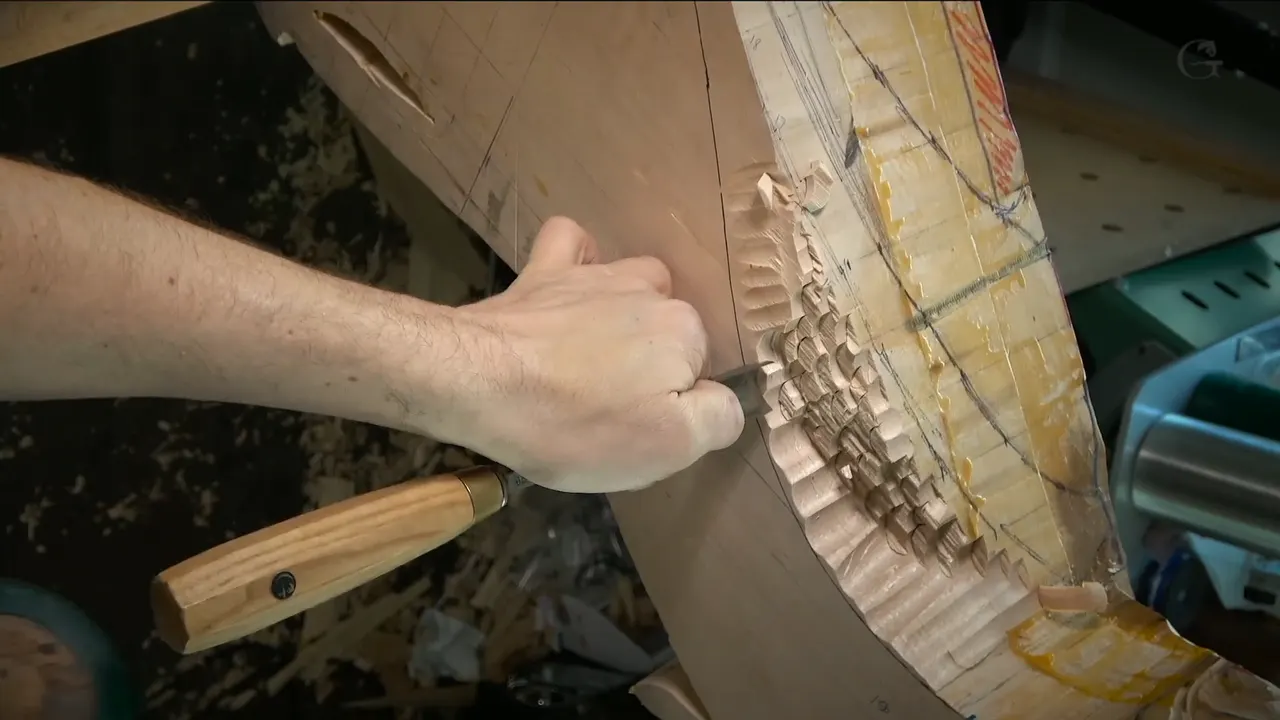

In Venice Room 85.5 I said that the grain on my block runs one direction, and that a tool put straight down, or placed another way, can split the wood and leave a mess. My answer was to cross the grain.
Ever carved toward a line and felt the wood start to give? Does your piece have a knot, a thin wall or curly grain? Follow one word of mine, split, from a heavy block in workshop 85 through a lily box, a furniture panel, hazelnuts and a Greek acanthus leaf.
Six short lines on the word split
- A small bite, which I called a sweet spot.
- More force, deeper cut.
- Grain direction, and two ways the tool can cause a split.
- A pass at an angle.
- A 90 degree area, and a tool kept off the inside.
- Last, a flatter gouge, close to the line.
What did I say about split in workshop 85, part 5?
The part opens on the size of each bite. I take about six millimeters at a time, I said, and "About a quarter inch, three-sixteenths sometimes, about five millimeters, six millimeters." Six millimeters is 0.24 in, a quarter inch is 6.35 mm, and three-sixteenths is 4.76 mm. My word for that size: "It's like a really sweet spot."

Force is the one thing to watch. The only thing to keep an eye on, in my words, is how much force I apply, and much more force can get "a much deeper cut." The whole job, I called a really, really easy process, pretty much.
At the end of that stretch came a line about stopping: "That's pretty much the area I have to stop and let me start again on this side and get a little closer." Right after, a hedge about method: "Maybe let me see. Some of it I can probably remove this way."

The title line comes next. It names the direction of my grain and then two ways to split the block: "I also can split and make a mess." How I deal with it: "if the grain runs that direction, I'll just go across the grain. In my case, I have to just angle it about 45 degrees or so."

One more area asked for care. That area and the one beside it were "supposed to be a really nice 90 degrees area", so I needed to be careful. My rule for the tool: "So I never place the tool on the inside, so it's better to just be a little off." That way, I added, I will know I am not messed up, and I can measure.

A flatter gouge closes the part. Probably, I said, like maybe number three, to get really close to the line, and I was leaving approximately one millimeter (0.04 in), no more than that. The reason I gave: "I just don't want to spend too much time on it."
What do its neighbors add?
A warning sits in part 4 of workshop 85. Attacking one way splits the wood, I said, and I can crack those fibers and "lose my backside". Relieving it somehow was my need there.

The inside of a line is the subject in part 6. Undercutting, a tool placed inward, was a big mistake in my words. My reason there is short: "we still have to shape like 3D that drop all around."
Where else do I say split?
My wood carving videos use the word in many lessons. Each video below links to its lesson page, grouped by what the word sat next to.
How does grain split in a lily box?
The lily box videos put the word beside grain, a weak spot and curly grain. The plainest warning is in Lily Box 2, part 5. With that type of wood, I said, "it's easy to make a split." That goes for the fibers and for the grain, and the mistake is "impossible to fix."

A split can sit in the wood before any tool arrives. At one weak spot in Lily Box 4, part 9, I pointed inside and said "I can see there's a split in the grain." I added that my approach needed care.

Physics comes into Lily Box 8, part 3. A splitting of my grain was what I did not want to see. I was "working against the physics right now", and tools, of course, must be really, really sharp.

Curly grain gets its turn in Lily Box 13, part 2. It is the olive lesson. Sometimes, going one direction, the wood starts splitting. Attack from another side and "it still splits because the grain of the wood", so you have to try to find the best spot to approach it.

A visible spot raised the stakes in Lily Box 11, part 12. "It just splits my grain of the wood, of course." That area, I said, is going to be really visible, looked at from the top, and I have to be mindful of it. Later in that video: "I see it splits the grain. I don't want to do that."
Next to that, Lily Box 12, part 6, offers another line about a cut that follows the grain: "I'm kind of afraid of splitting grain." Then: "Looks like I'm safe."
What about a knot or thin wood in the furniture panel?
The furniture panel course has the word in several lessons. Furniture Panel 18, part 1, begins with a small knot and a router plane. "when you see a knot, your grain splits a lot easier." About the plane I left it open: "Maybe I'm not even going to go with the router plane in. We'll see."

Thin material comes up in Furniture Panel 17, part 10, where the material itself is only 10 millimeters (0.39 in). Tap too heavily and "if you tap too deeply, you can actually split." Care with that method was the follow-up.

A shorter line sits in part 6 of that lesson. "Got to be really careful", I said, because splitting my grain is what I want to avoid. A whole operation with just the gouges, if you need to, is also possible without a router plane.
A single line sits in Furniture Panel 16, part 8. Working along the grain is "a dangerous position", since you can dig inside the wood and split it. And if you need to relieve a little more, just do it.

Part 3 of that lesson turns to direction. The grain looked like it wants to split if I use the tool in that direction, away from myself, and splits were no longer wanted. "now I got to be really careful how I approach this area."
Furniture Panel 15, part 11, moves closer to a line. Closer to it, I said, "the grain could split, and you're going to have a deeper line." A deeper line is a result I want to avoid.
What happens when the tool pushes straight in?
A router plane push in Furniture Panel 26, part 3, went at 45 degrees, almost. It was not like a straight push, I said: you can catch the grain, and "that's gonna split."
In Greek Acanthus Leaf 6, part 1, the knife gets its turn: I liked the result the knife left, yet pushing it further would split the grain and make a mistake. Rotating and refining my cut is what I have to do.

Hazelnuts carry a rule about direction. In Hazelnuts 1, part 2, I said "Don't be tempted to attack along the grain like this." Catch it and you split. "It's no bueno." Part 1 of that lesson gives my plan from all sides: remove the material perpendicular to the grain, from outside toward the inside, and "I'm not going to attack with the grain's direction".

Cutting one way is not good, I said, in Acanthus over Moldings 2, part 1. I said "the grain runs the direction they're going to catch it." Then: "we're gonna split so that is not good." Another approach was open to me, and there are a lot of different ways to get to the same result.
One side was starting to split in Roman Acanthus 4, part 2. Attacking it from the other side would be much cleaner, but I did not worry about it too much, since "it's not my final cut yet."

When do I change position or back off?
Moving the piece is an answer too. In my words in Venice Room 88, part 4, the position needed a change, since carrying on would split it and put me in "big mess."

Another move like it turns up in Venice Room 2, part 1. Continue the cut and it splits, and that is not good, so I remove it and jump to another location. After that, my plan was an attack from the opposite direction.

In part 4 of that lesson I named my number seven again and said I needed care, because it looks like I'm splitting all the way down. That was not what I wanted, and my plan was to attack from two sides.
A name turns up in Venice Room 5, part 12. I kept an eye on the grain so it is not splitting the wrong direction, and that is why I sometimes pull backward. "So I make my cut, then I pull, then cut again", and "I call it the pulling cut, just like that."
The direction had to change in Venice Room 21, part 7, I said, because I saw my grain of wood starting to split, and I did not really want to see that.
Force comes with it in Venice Room 1, part 13. Force it, and it can split. I can damage this end. "it's better to back off and just start all over."

Lesson 129 of the Venice Room, part 1, holds a plan, so it stays one. Force it and I have a problem. If that split continues I lose the edge, so my smart move would be a big number seven, taking all that waste off first.

A short line from Venice Room 62, part 9: the grain was trying to split on me, and I wanted no split. A spoon veiner was next on my list to get, I said.

Which ways do I call safer?
Two videos of workshop 75 use the word, and its lesson page links both. In part 2 I called what I was doing "not the safest way", and said you really have to keep an eye where it splits, since a split on the inside of the design is really bad.
A depth comes from workshop 75, part 4. Do not go all the way through, or you split and damage the backside. I left approximately 10 millimeters (0.39 in) before I hit too hard, and "It will be much safer."

A way I called not the safest is in Venice Room 96, part 3, with the reason I used it anyway. When the grain runs in that direction, a split can remove too much wood, but "in my case, it's OK because there's a lot of material that needs to be removed." The best way, normally, is to go across it.

End grain gets one line in Hashemi Flowers 41, part 1, where I was wiggling a little bit, and "I want to make sure it's not going to split on me."

Does a sharp tool change the worry?
In an April 2020 livestream I said the movements of a carving depend on the grain, and on "what tools you have, if it's sharp or not." With sharp tools, in my words, "really doesn't matter." You can go against the grain or along it and not split.
The next words hold the other side. If you cannot sharpen your tools all the time, but you still have to do some beautiful work, then you have to be mindful of the grain.
The Q and A on carving with the grain gives a bowl as an example, one I called an exaggeration: when you start carving, the grain changes direction. Keep going and "you're going to split." The fix I gave was to attack from both sides. And "the only way you can do that, sharp tools."
Where does each split sit?
| Lesson | Beside it |
|---|---|
| Workshop 85, part 5 | Crossing the grain with the tool tipped |
| Lily Box 2, part 5, with that type of wood | A good reference |
| Weak spot, Lily Box 4, part 9 | A careful approach, with a split already inside |
| Physics, Lily Box 8 | Tools that must be sharp |
| Olives, Lily Box 13, part 2, with curly grain | The best spot |
| A leg in Lily Box 11, part 12 | A visible area, and a thin leg to think about |
| Panel 16, part 8, a dangerous position | A little relief |
| Panel 17, part 10 | A careful tap, because the material is thin |
| A knot, Panel 18 | A router plane I may leave out |
| Greek Acanthus 6, part 1, and a knife | Rotate and refine the cut |
| Hazelnuts 1, part 2, a rule about direction | No temptation to attack that way |
| Roman Acanthus 4, part 2, with one side beginning to split | Not much worry, since it was not the final cut yet |
| Venice Room 129, part 1 | A big number seven, my plan |
| Venice Room 88, part 4, and the mess to avoid | A change of position |
| Workshop 75, part 4, with the depth I left | A margin left under the cut |
Do you have a spot on your own piece with grain that runs one way, and wood that starts to give? Is there a line where staying a little off feels safer than going straight at it? The whole Venice Room sits on one tuition plan, and workshop 85 waits in it next to the corbel drop and the rest of the lesson.
How it's done
- Take small bites. I called the size of my bite a really sweet spot.
- Watch the force. More force digs deeper, so I look at how hard I push.
- Check the grain direction. I watched the direction my grain runs.
- Angle the tool. If the grain runs that way, I go across it and angle the tool.
- Keep the tool off the inside. On a 90 degree area it is better to be a little off, and I can measure.
- Close in with a flatter gouge. Probably a flatter gouge, like maybe number three, near the line, with approximately one millimeter (0.04 in) left.
Frequently asked questions
How does force play into a split?
Force is the one thing I told you to watch in part 5. Pushing harder gets a deeper cut. My approach needs care, too. Another lesson adds that a forced cut can split and damage the end.
Where did a split already sit in the wood?
At one weak spot of a lily box, a split was already inside, in the grain. I had to be careful about my approach. In another lily box lesson I named the grain as something to watch, at a spot that would be looked at from the top.
How did I react when a cut was about to split the piece?
One lesson has me remove the cut and jump to another location, then attack from the opposite direction. Another changes my position. A third plans a number seven for the waste first.
What to carve next