

Alexander Grabovetskiy, woodcarver, School of Woodcarving · Published 2020
What does a wood carver mean by "razor"?
Quick answer: Razor is the word I said in Venice Room 85.10 about a gouge after a short strop. In other videos I use it for a honing wheel, for the blade my grandfather shaved with, for a scraper and for a blade that erased a drawing.
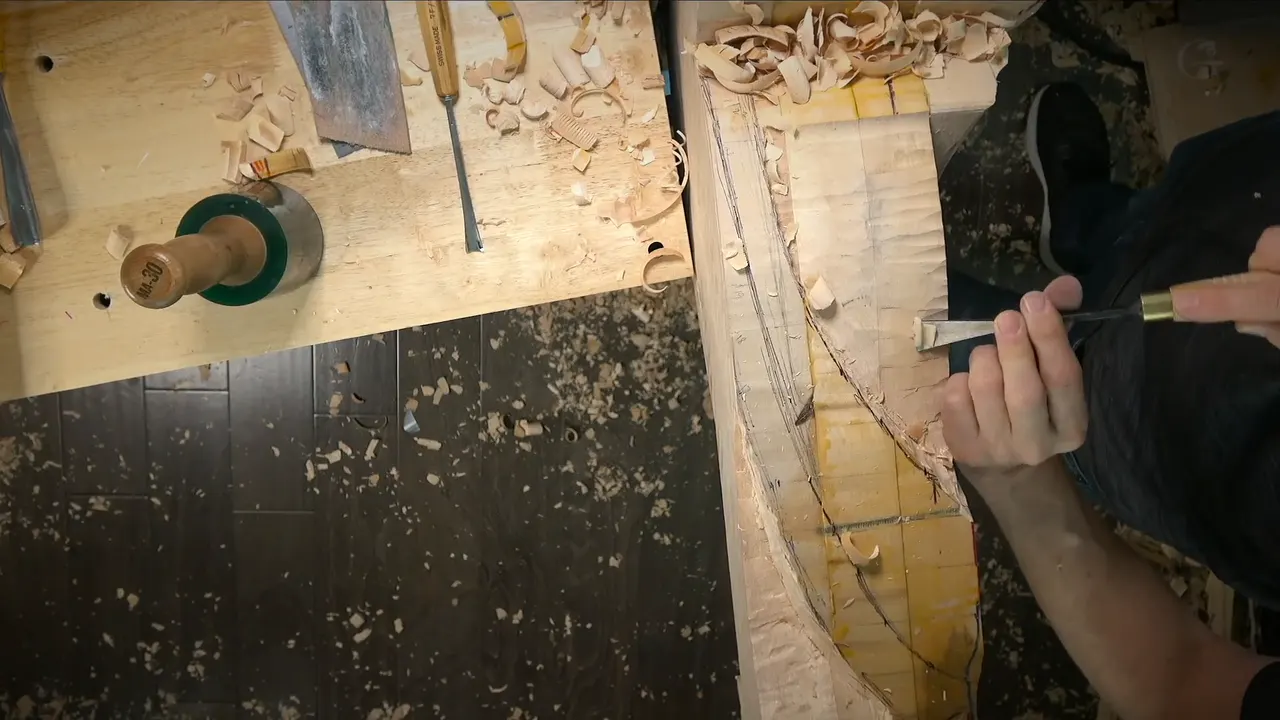

Razor is the word I said in Venice Room 85.10 when a gouge came off a short strop and left no trails. My other videos use the same word for a honing wheel, my grandfather's shaving blade, a scraper, and a blade that erased a drawing.
Has a tool ever dragged in the wood and left a faint line behind it? Did you stop, run it over a strop for a few seconds, and go on? Then you know the spot where I said it. Below is where the word turns up in workshop 85 and across my wood carving videos, and what I was talking about each time.
Six short lines from part 10 of workshop 85
- My gouge became a little dull, and I said so.
- I was really close, the edge became really dull, and a strop of a couple of seconds was my plan.
- After the strop the edge was a razor, and no trails were left.
- The face did not need to be super clean, I said, because a chunk still had to come off.
- The final depth had an easy way, to measure and check, and I said "Yep."
- All the way down stayed open, because the middle line was not figured out yet.
Where did the razor line come up in workshop 85, part 10?
The video opens on "Check," and then comes "Very close, but still not there yet." My next line was "And my gouge became a little dull." The next "Check" brought "It's good right there."

Next I talked about height. "And I'm a little too high right at this point," I said, and then "Angle it this way." And "A little too high, but I don't really have to worry about it, I can reference from the backside later on, and that's not the final cut yet."
The distance came next. "I'm really close now, I'm really close, actually, just about 1/32 of an inch or so." One thirty-second of an inch is about 0.8 mm.

Next: "You know what, it became really dull, let me just strop it for a couple seconds, perhaps I shouldn't do that, I guess." That was a plan. The lines after it show the result, "Here you go, it's like a razor right now, it doesn't leave any trails anymore."
Then, about English steel: "That's what I like about English steel, it's not too hard, and it's not too soft, but easily I can just strop it and bring that to the sharpness I'm after." The lines that follow come from my Carving Tool Sharpening course.
What did I do with the edge once it was back?
Right away I said "Again, it doesn't have to be super clean because I need to remove chunk," and then "And yes, I'm really, really right on the money, there's not even a gap."
Then I said "So that is going to be removed to that line, it's almost invisible, and that's going to expose this section of the drop, all right?" I also said I needed to restore the line. "What I mean by that, if you remember, I mentioned that this point is important."
Two ways followed. "Well, there's an easy way, of course, and there's a complicated way," I said, and then "The easy way, I can always measure it, and check it, and check, yep." "Here you go, that's the final depth," I said.
Then "And see, it's going to become lighter, it's going to become much lighter." And "So all of that is waste." And I could "easily just take a big gouge again," I said, and "start my process."
The last words in this part are "I don't think I'm going to go all the way. Maybe yes, maybe no. Because I need to figure out what is going on in the middle line because I've got some high ridge, but I'm going to preliminary just indicate the movement and then change the position and see where I'm at."
What do the parts on each side of it show?
Neither part 9 nor part 11 says the word. They sit on each side of it in the same workshop, and the gouge work shows in both. Part 9 opens with "Okay, I'll take flatter gouge." "I can see that is not really 90 degrees yet," I said. Then "it's always a good idea to check that with some kind of device, just use a speed square, and I'll see exactly what is going on." The device was a speed square.

The reading: "I see that I'm approximately about five millimeters, 3/16 off in this point." Three-sixteenths of an inch is 4.8 mm. About that I said "pretty much on purpose," and "better not to be 90 degrees at the beginning, to that surface you want to be, and then just get little by little to the final depth."
Further along in part 9 came "about a millimeter and a half is what I have left, like about 1/16 of an inch." One sixteenth is 1.6 mm. The 0.8 mm figure from above belongs to part 10.
In part 11 the opening line is "Again, I'm removing perpendicular to the grain, it is always the safest way." Further on I said I would take number seven at 14 millimeters (0.55 in), and could get a little closer to the final line. Then "There you go, that is going to be my corbel, and I left approximately one millimeter to the line, and then get number three and clean a little more." One millimeter is 0.04 in.
A plan for color came in part 11 as well: "let me get orange color for myself, for me, it would be a lot easier to see." The picture here shows a hand with an orange pen at the corbel.

Where else did I call an edge razor sharp?
In the seventh stropping video of the sharpening course, I said "if you are afraid of soft felt, there is a solution for you." The solution was a wheel with honing sandpaper: "you can buy extra wheel, and there's a honing sandpaper."

About the grits I said "3,600, and 6,000 sandpaper, I wrote that with the marker for I would know, but it's actually not sharpening, it's a honing." Two more lines followed. "You don't have to charge that, please don't." And "it's a sandpaper, and it lasts long time."
In my words it gives "the same effect as a leather" when the hand stays really steady, and "exactly the same bevel all the time" with a jig on the bar. The line with the word came after that: "it's actually 6,000 grit, you can go up to 12,000 if you wish, but this gives you razor sharp edge, razor sharp edge."

The same words are in my April 2020 live stream. In the fifth stropping video I named the wheels of a machine, "yellow, green, blue, and red."
Which edge did I test on my own carving?
Of the first two wheels I said "yellow and the green wheel, they are softer, and that's actually pressed paper." The blue and red were "harder," and "you're actually safer on the harder."

Paste came into it as well: "the second wheel, the red one, I'm charging with the blue, and that's a really fine diamond paste, and that just gives me super sharp edge, super sharp, see, it becomes black." The black came from some metal being taken out, I said.
I said I would show how sharp it is on my carving. Afterward I said "I'm not creating any pressure pretty much, but it's already super sharp." And "I'm not even pushing because it's just that razor sharp, a lot sharper than some doctor's tools, surgeon tools, and all it took like couple seconds for me to do."

How was I introduced to stropping?
The first video opens on a story: "let me tell you the history, how I actually was introduced to stropping." I went on with "the stropping is actually one of the stages of sharpening, some people use, some people don't."
My grandfather had an old style razor for shaving. "He had just a razor, the old style, and he would just take a leather," like a hide, and strop it. I did not know what he was doing. But "he did that every day pretty much, and he shaved himself."
The razor, I said, was one of the scariest things in his toolbox, "because it was so sharp." And "it was so sharp, I was afraid to take it, and he was afraid, actually, I would take it and then start shaving." He was taught by his grandfather, I said, "his grandfather by his grandfather, and so on." The live stream carries the same story.
Is a razor blade a scraper for a carving?
In my videos a razor blade does the scraping, and I said so in the Venice Room, the furniture panel and the butterflies plate. Venice Room 28, part 6, finds me grabbing rasps. "I'm still feeling guilty every time when I'm grabbing those rasps or sandpaper," I said. Then "Some furniture makers, even in the past, they used some kind of techniques like that, either scraping or something else, but they did it."

The blade came next. "Just use a razor blade," I said, "just a normal razor blade," the kind you buy at local lumber yards in the United States. "You don't have to buy specialty tools for this," and it gives "really nice results."
Furniture Panel 28, part 1, has me saying "just that little thing with the razor blade," and then "what I like about that technique with the razor blade, so you can just use the edge of it." With it, in my words, you could "just slightly create, you know, small cuts and just blend it really nicely." I added "it's not what I would like to do today."

In part 3 of that lesson I planned to grab my "18th century scraper, just the razor blade." On the blend I said "all I have to do just pretty much blend those cuts," and "I can almost shave it."
Next, "I can work my way in," and "until this edge is really blending in." After that I could "take care of inside with the different type of tool."

The butterflies plate, workshop 9, part 3, has "you could use a razor blade, or if you do have some small scrapers made for that, that would help also, but even razor blade will work, so just whatever the utility knife, razor blade."
Next the grain: "make sure you see the direction of the grain and you scrape with the direction of the grain." Then "we need to get rid of pencil marks." My result: "just scrape it, but see, it's already giving a really good, nice result."

Later I said "make sure you're doing it with the grain, okay, just with the grain." Sandpaper came up as well, a choice that would also work. The cabinet scraper and utility knives have plain pages for anyone who wants the names.

Did a razor ever erase a drawing for me?
Workshop 104, part 1, holds a story about a paper drawing. The project was "About 10 feet long" (about 3 m), and "just like a headboard." I used no technology, "just a piece of paper," and "it took me about a couple weeks to develop all the details, all the acanthus leaves, and so on, on that piece of paper."
The client asked for a change to an acanthus leaf, "I want to get that higher." I answered "Yes, I can." The next line was "And I had to take a razor and erase everything and get rid of whatever I just drew and spent hours and hours of drawing, and then redraw and submitted that." The client called back and asked to move it toward the right, and I redrew it. I called the whole thing "back and forth, back and forth."
In Venice Room 151, part 2, I said "I don't like the position of this division." Then "let me get a razor, if I can find a razor." And "so I think I want to do my division below, right here."

Which lessons say razor, and in what words?
| Lesson where I said it | What I said |
|---|---|
| Workshop 85.10, with a dull gouge, about its steel | English steel |
| Honing talk in the seventh stropping video, about one wheel | razor sharp |
| My own carving, in the fifth stropping video, as a test | doctor's tools |
| A shaving story in the first stropping video | his razor |
| Scraping instead of rasps, sixth video, workshop 28 | a normal razor blade |
| Furniture panel lesson 28, first video, at a carved panel | use the edge of it |
| Same lesson, third video, at a carved scroll | just the razor blade |
| Pencil marks on a plate in the third butterflies video | razor blade will work |
| A client's drawing, first video, workshop 104 | erase everything |
| A division line, second video, workshop 151 | if I can find a razor |
Is there a line on your piece that a dull edge would blur? Could a few seconds on a strop bring it back? Workshop 85 is waiting inside one tuition plan with the rest of the Part 7 workshops, and the corbel is where this page starts, with a razor line.
How it's done
- Say what is close. Very close, I said, but still not there yet, and my gouge had become a little dull.
- Name the edge. Really dull, I said. A strop for a couple seconds was my next move, though I wondered if I should.
- Read the result. Afterward I called the edge like a razor, with no more trails.
- Look at the face. A clean face was not needed, since a chunk still had to come off.
- Find the final depth. Measuring was the easy way. After the checks I said it was the final depth.
- Leave a question open. On the way down, maybe yes, maybe no, since the middle line needed figuring out.
Frequently asked questions
How did the gouge feel after the strop in workshop 85?
I compared the edge to a razor and said it left no trails anymore. Then I praised English steel, not too hard and not too soft, with a strop bringing it back easily to the sharpness I'm after, in part 10 of workshop 85.
Which video said razor sharp about sandpaper?
The honing video of my sharpening course. I called the wheel 6,000 grit and said you can go up to 12,000 if you wish. That edge is razor sharp, I said, and the paper needs no paste to charge it.
Whose razor was stropped on a leather every day?
My grandfather's. His old style razor for shaving went over a leather like a hide, every day pretty much. I was afraid to take the razor, and he was afraid I would start shaving. I told it in the first stropping video of my sharpening course.
What to carve next