

Alexander Grabovetskiy, woodcarver, School of Woodcarving · Published 2020
What does a wood carver mean by "pronounced"?
Quick answer: In my second video of workshop 85 the concaves would be "less pronounced," I said, and then I talked about a bigger tool. The same word turns up across other Venice Room workshops, in a Hashemi lesson and in a grape vase lesson.
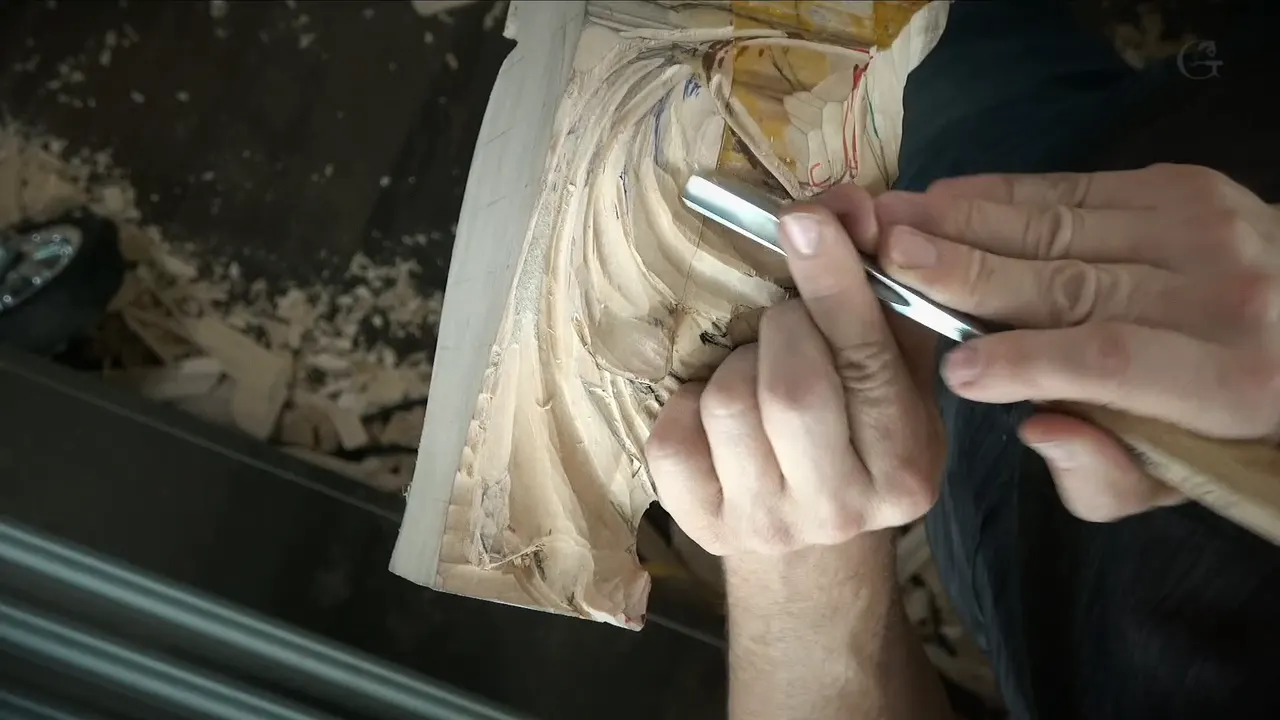

In Venice Room 85.2 I said the concaves would be less pronounced and, a little later, "a more pronounced cut, I should say." In other videos of mine that word sits beside pipes, ridges, shadows and curls.
Ever carved a groove that sank back into the wood? Does one side of a leaf need to be carved deeper than the other? Follow one word of mine through my corbel and a furniture panel, then on to a lily box and a grape vase.
What I said in six short lines
- A cut that would go uphill, and a rule I broke.
- My blending tool was a number 3 turned over, 10 mm (about 3/8 in).
- Concaves got a softer word.
- A stronger cut came next, then a pipe and an eye, then the middle line and a letter S.
- Other videos use the word for pipes, ridges, shadows and curls.
- Some cuts get stronger, and some stay quiet.
What did I say in workshop 85, part 2?
The video opens in the middle of an answer about the grain. You don't see it, I said, but the grain direction is "just like that," and the spot is uphill, "way uphill." Then, about the risk: "I can easily break it."
So I carve it "with the grain." My words were "So that's why I am breaking the rule, which I encourage you not to." I also said "I guess everyone breaks the rules. You have to."

Right after that came the concaves: "a lot less pronounced concaves." The detail could wait, and I wanted to "just blend this side."
I named my blending tool, a number 3. "And I'll do my blending with number three upside down." For size I said "Ten millimeters. That's what I'm using," and "About three-eighths of an inch."
On tool size I said, "And I think I'll be able to use an even bigger tool." What followed was "Create a little better cut," and right after it "A more pronounced cut, I should say."

The number 3 came back with "Again, number three." Then I said "And here you go," and then "That's going to be my pipe." Right behind it came "And now I can probably create an eye."
My verdict on one spot was plain: "This, I need to probably clean because it doesn't look too good." The number 11 followed, with "Number 11 again, and create little better movement," and then "Although, this number 11 needs to be sharpened."

Near the end I called what I had "the preliminary form." I added "Yeah, I know it doesn't look too appealing yet, but it will look good." A plan to choose came with it: "So let me decide, make the decision."
The layout lines came last. My middle line stays "right there," and "So obviously, I'm not going to change it." Following that: "But I'm going to create the letter S movement like this. And then separation and separation."
One section was undecided. "I'm not sure if I want to do another separation right here or not. Maybe yes, maybe no. But let me get those separations done, and we'll see what I'm going to do about that big section." My last words were "I'm not really sure yet what I want to do."

What did the other videos of workshop 85 add?
relief cuts are on my list: "I need to create the relief cuts with the number 11 in those triangles." It had "A couple concaves," one running "all the way like this" and another "this way," blending "somewhere right here at this point." For the tool, "Let me take seven millimeters" and "I'll try with the seven first," a bit over 1/4 in.
Video three brings a bigger tool: "I can probably just get much quicker result with that number 7, 14 millimeters." That is 0.55 in. Since I already have relief cuts, I said, I can probably just start chopping. Movement comes up as well, with "It has to have a movement the right way," and "another S curvature" that I might do.

Where else does the word show up?
The word shows up across my wood carving videos: in the Venice Room, in my Hashemi flowers, in a Byzantine acanthus lesson, in a lily box and on a grape vase. Each passage below comes from one of those videos, with the lesson linked so you can read the page around it.
How does a concave change across the piece?
Venice Room workshop 57, part 2, plans a U shape and a lean to the right-hand side: "So it is concave, but it's not really pronounced concave. Not pronounced toward the middle line." On the end ridge, on the left-hand side, it would be "a lot more pronounced." Of the result I said "See? And it gives me pretty much clean cut out of the chisel, how I would call it."

Over in workshop 29, part 12, I take the flatter side of a gouge: "I'm using the flatter gouge side, like number three on this side." Because the cut is a U shape, the closer I get to the pipe the more the cut stands out. Then: "More pronounced concave, I should say." The cut can go "almost all the way, like that," and the other side gets the same, with "Almost flat on one side and more pronounced on the other side."

A number 11 comes up in workshop 30, part 11, to be laid on its side. I can give a slight concave there, a really slight one, because "I don't want to lose that convex feel." The plan was a cut more pronounced near the pipe and "less pronounced to that ridge," and I would probably have to start little by little somewhere right here. Then: "that's a much deeper ridge on this side."
What do I say about a pipe?
Workshop 74, part 9, shows a little updated version: "Two big pipes, really thick and pronounced pipes." Beside them sits "a convex that's a lot less pronounced." Five total convexes, I said, two main ones out of the eyes and three secondary inside each division.

In a closer look I said "those two pipes, really thick and pronounced," the main convexes, and less pronounced "on the side of the divisions itself."
On excavating: "I'm using number 5. I'm sorry, number 11 and 5 millimeters, 3/16 of an inch." Next: "Just like that. Upside down." That tool was "little too big of a tool," so the next one would be 3 millimeters, one-eighth of an inch, with maybe a mallet to "excavate little by little."

In part 10 of workshop 84 one pipe needs more: "it's still not pronounced pipe. So pipe has to be more pronounced." It needed "much deeper cut right here." Then: "Let me check. Yeah, I think it makes more sense right now. And I need to do another concave cut on another side of that pipe." My tool pick: "let me do with the 7 millimeters right away," which is 0.28 in. In the same video: "So I've got really pronounced pipe now. That is good."

Byzantine Acanthus lesson 4, part 1, covers how to hold the tool: "You just hold it on an angle. Okay? You don't push it, remember." On depth I said "if you need to dig deeper a little bit on the left side, it's okay, as long as you see really pronounced pipe." I asked "See that pronounced pipe?"

When does a cut stay quiet in my videos?
Workshop 47, part 3, has a ridge I did not like: "And yes, that is not too good. Don't like that ridge to be too pronounced." I would "just take it out slightly." In part 2 of that workshop a coming cut would be "a slight concave," and I said "Not really pronounced concave, but slight."
From this same Part 7 course comes workshop 80, part 1: "I have no problem of seeing somewhat rough side. It's not the final look yet." Then: "And by the way, I'm not creating concave pronounced right away. I'm talking about I'm not creating a finished look yet." For me, I said, "it's better just to create straight line first, almost straight line, and then create a final movement."

In Lily Box lesson 4, part 5, I said I'd use a number 11 again to make my groove cut. It "should not be too pronounced at the high spot," and "No more than one millimeter, I'd say" (0.04 in), with "I'm not going too deep with this cut."
Later in that video: "Okay, let me recreate the groove." And then "I do not want to create a too pronounced groove, just indication. But still, this transition, I would like to see a smooth transition, okay?" Last: "Okay, and I'm happy with this side."
Furniture Panel lesson 28, part 3, has a concave at a center line that I said was "not gonna be a super, super duper pronounced one." I could do it with the micro tool again, 3 millimeters (0.12 in), a number 8, about an eighth of an inch. I'd get pretty close to the edge, but "I'm not gonna touch that edge because that edge supposed to be a high spot."
In workshop 58, part 8, a concave closer to one groove "has to be more pronounced." It was "not like a true concave, although it's almost like a true concave," and I named a number 6 of 25 millimeters, about one inch. Smaller tools would come "later on," and the cut would stay "really pronounced."

What do I say about depth and a pronounced cut?
The Hashemi Flowers course, lesson 12, part 3, shows both sides of depth. I called it "kind of deep," then: "The deeper you go, the more shadow you create." Right after: "But also, on the other hand, the deeper you go, the more fragile it becomes."
Later I said "Okay, looks like I'm no more than 1/16 of an inch" (1/16 in is 1.6 mm), "I'm talking about thickness right here," and "I can't take anymore." Still: "But I'm still going to make that curl really pronounced." Of the curl: "That is a really, really pronounced curl going this direction."
The grape vase, lesson 2, part 9, has a number 11 of 4 millimeters (0.16 in) and "a little deeper cut closer to the pipe on one side." I added "Just kind of make more pronounced, okay?" Next: "I could go even deeper if I wanted to closer to the center and get an even more pronounced shadow. Okay? See, it's already casting a shadow."

Over in workshop 48, part 10, I lost a concave: "But I lost pronounced concave. All right, so I need to use something else, because I really want to get that concave pronounced. Again, because it's going to be visible from the bottom." After it came "A little more of a concave."
In Furniture Panel lesson 20, part 1, I said "kind of blend that concave and go a little deeper right here, less pronounced." Next I planned to grab a number 11 at one millimeter (0.04 in) and clean it. On another convex: "Maybe I can actually use number seven right here because I really want to make this one as really pronounced, I should say." I planned to use it "just upside down."

On the Tray of Blessing, lesson 3, part 2, I said "carefully go up and up and up." Next came "I really want see that pipe pronounced," and I planned to take a number 7 and "place it upside down and carefully create that convex."
Where does each pronounced line sit?
| Where I said it, by workshop or lesson | Words I said |
|---|---|
| Video two of workshop 85 starts on a spot where the wood could break | way uphill |
| The same video names a number 3 turned over for blending | Ten millimeters |
| Two big pipes in workshop 74 sit beside a smaller convex | the main convexes |
| One pipe in workshop 84 has to show more | still not pronounced pipe |
| Venice 57 plans a U shape that changes across the cut | Not pronounced toward the middle line |
| Number 3 in Venice 29 is the flatter gouge side near a pipe | almost flat on one side |
| A number 11 in workshop 30 lies on its side beside a pipe | less pronounced to that ridge |
| A ridge in Venice 47 is going to come out slightly | not too good |
| Part 1 of workshop 80 prefers an almost straight first line | not the final look yet |
| Lily Box 4 wants a groove that is only a hint | just indication |
| Furniture Panel 28 plans a concave at a center line | super, super duper pronounced |
| Furniture 20 thinks about a number 7 for one convex | as really pronounced |
| Hashemi 12 wants a curl to show even where the wood is thin | really, really pronounced |
| A grape vase shows what a deeper cut near the center could give | even more pronounced shadow |

Do you have a spot on your piece where the cut should show more than it does? Is there another spot where a ridge should stay quiet? The whole Venice Room is open on one tuition plan, and workshop 85 is waiting in it with the rest of the corbel.
How it's done
- Check the grain. At one spot in 85.2 the cut would go way uphill, and I could break it going that way.
- Carve along it there. At that spot I had to carve with the grain, breaking a rule.
- Blend one side first. Detail could wait. I wanted to blend this side.
- Name the tool. My pick for blending: number 3, upside down, 10 mm (3/8 in).
- Think about a bigger tool. I said I thought I could use an even bigger tool, and said it would create a little better cut.
- Set the middle line. The middle line stays, I said, and I planned the letter S movement and then separations.
Frequently asked questions
Which tool did I name for blending in 85.2?
My tool for blending was a number 3 upside down, 10 millimeters (0.39 in). I wanted that side blended before any detail. Later came "Again, number three," and then a number 11 that needed sharpening.
Why did I break a rule in 85.2?
One spot was "way uphill," and I said I could easily break it. So the carving had to go the other way. I call that breaking a rule, and I encourage you not to.
Which word did the concaves get in 85.2?
Their word was "less pronounced." Detail could come later, and for that moment I wanted to blend one side. A little further on I mentioned a bigger tool.
What to carve next