

Alexander Grabovetskiy, woodcarver, School of Woodcarving · Published 2020
What does a wood carver mean by "the logic"?
Quick answer: In workshop 90, part 4, I spoke of a wall of 90 degrees and a slope that goes in. Then: "So that's why I have to just follow logic how I do it." In other lessons "the logic" sat beside a perpendicular carve, a movement, a division, an overlap, a leaf and a reason.
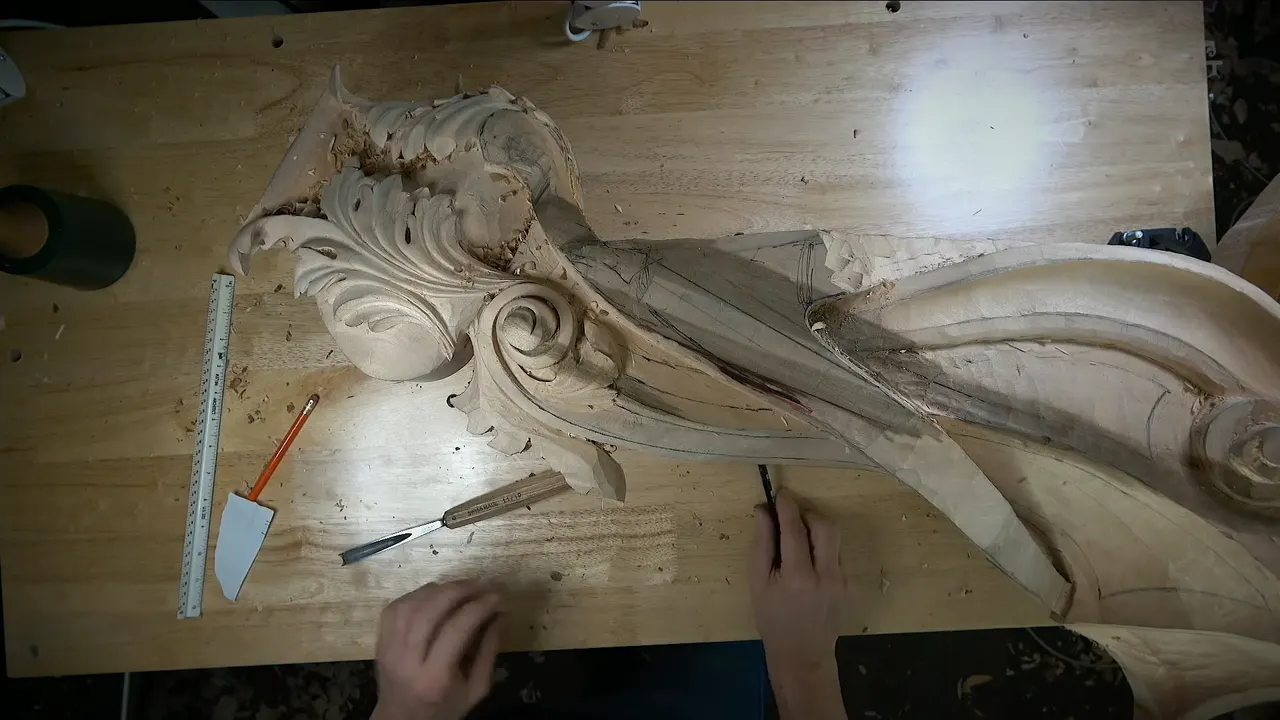

In Venice Room 90, video 4, I said "Really follow the logic" while I talked about a wall and a slope that goes in. Other lessons of mine put "the logic" next to a perpendicular carve, a movement, a division, an overlap and a reason. Each lesson below has its link.
Ever stood at a drawn line with a gouge in your hand, wondering which way the wall beside it should lean? Then you know the spot I was in during part 4 of workshop 90. First come the words I said there, and after that the same word in lessons from my other courses on wood carving.
What happens in 90.4?
- Planned depth: a quarter inch for the section, which is 6 mm.
- A number 11, 10 millimeters (3/8 in).
- A wall planned at 90 degrees, with the slope going in.
- A warning about the grain, and a second one about the lines.
- A depth near six millimeters (a quarter inch).
- The plan: one millimeter left for later.

What did I say about the wall and the slope?
The part opens with "And I'm just eyeballing it," and then "I hope it's going to look good." Farther on: "So this, I can take care a little later, but you should get an idea what's going to happen."
The depth: "about one quarter of an inch deep" (6 mm). The tool: "let me take number 11 and 10 millimeters, and I'm going to create preliminary cut" (10 mm is about 3/8 in).
Then the wall. "If this is my slope, so my cut, my wall is going to be 90 degrees." Next: "so my slope going to go in, 90 degrees inside like this." Straight after it: "So that's why I have to just follow logic how I do it."

Part 5 of the same workshop has a neighbor to that line. With a furniture maker's tool, "I can create a really nice 90 degrees almost. It's not 90 degrees, but almost 90 degrees wall." In that part too: "this corbel is unique to the Venetian style."
What else did I plan in part 4?
"I still have to clean everything." Also: "it has to be about a quarter inch deep, but I need to outline first." The light gets moved: "Let me move my light out," and later "Okay, move my light again."
The grain gets its own warning. "I have to be careful because I am doing it against the grain right now, and I'm okay with that, but be careful." Then: "For me, it's really important not to rush it."
Next, the bigger tool. "So that is approximately the boundary, my preliminary cut, and now what I have to do is just actually create the cuts across the grain like this. But I need to do it with the bigger tool. When I use this one, I can actually use number seven."

Two lines get a warning: "not to hit this line because it would be big mistake. This line or that line. It's going to be rugged." Part 5 has the other side of it: "I can undercut underneath of my acanthus, but I cannot undercut underneath this line."
"And yes, you hear my granddaughter in the background." Next, a depth: "about six millimeters deep, so I should be safe." Six millimeters is a quarter inch, near enough.
The next tool is "10 millimeters, number 11," for "a little deeper excavation, deeper cut." One more spot: "Also here, but it's against the grain. It's not good." Later on in this section, a design will go inside, with some acanthus movements too.

The depth plan: "maybe about five millimeters in." One millimeter is to wait "for later." Then "3/16 of an inch first," and "a quarter inch little later." Five millimeters is 0.2 in, 3/16 in is 4.8 mm, and a quarter inch is 6.4 mm.
Where else did I use the logic?
Each passage below sits in its own lesson, linked, with the words around it. The quotes are mine, word for word, and my own lines say where each one comes from.
Did a right angle come with the logic?
A perpendicular carve sits right after it in workshop 57, part 10: "the logic, okay? It has to be perpendicular to the surface cut. So 90 degrees to the surface." Next: "So it should not be same angle how you attacked it."
Later in that part: "Again, keep your logic. You have to establish the right angle toward whatever the movement is." And a tool, as a plan: "I could take, let me see, about four millimeters number seven." Four millimeters is about 5/32 in.

Which movements carried the logic?
One movement carried it in workshop 64, part 6: "of this movement." Next to it: "Okay? So I can just create little deeper excavation on this side." Right after that, a question and an answer: "Again, do I have to? No, I don't."
The tool talk: "millimeter and a half, 16th of an inch, number 11. And maybe even smaller. Maybe I can just use a 1 millimeter now." One millimeter is about 1/25 in. The stop: "I can get carried away, but I really don't have to." Then: "I'm really happy actually right now with the outcome."
Next in that part, the divisions: "Because without the divisions, it doesn't make any sense."

A section gets its logic in part 2 of that workshop: "the logic of this section is such, okay?" After that: "I have wrapping going on, okay? This part wraps on inside and wraps beyond that piece." A second wrap is named too: "a secondary wrap, which is this one."
Over in workshop 83, part 11, comes a line about movements: "They supposed to follow logic." Before it: "I'm not going to repeat exactly what I designed. Approximately, okay?" After it: "I do have to make the decision." The question that follows is how many big divisions, "same like what I had on this side."

An S curve gets it in workshop 82, part 3: "the S curvature is supposed to be that way and that way. It has to just follow the movement. Okay? Again, right there. So that is the logic." A bit later: "I don't want to work on the small details without logic behind."
In Hashemi Flowers 12, part 2, the V tool is "Same V tool what we used before, #16 and 6 millimeters" (a quarter inch, near enough). Then: "maybe it's a good idea that the movement, that curl follows the inside concave." The sentence ends "carefully just follow the logic right here."

Furniture Panel 12, part 2, ties "the logic of movement" to leaves: "Now I need to develop some leaves or leafage." Then: "my main flow. Let's say this line. And that means my leaves are going to also kind of follow that direction, although not all of them, but still."

Lesson 29 of Furniture Panel Part 2, video 3, brings it up for a petal: "I can actually expose a small section right here and bring that part down underneath to this line." The phrase there is "the logic of unfolding." And: "I cannot go too deep on this petal because of the molding." Then: "half a millimeter number 11," about 1/50 in.

How did the logic go with divisions and overlaps?
Carving Hazelnuts 3, part 2, goes with a count: "One, two, three, four, and I need to introduce one more." Then: "we can curl it later on, but I want to make sure it still follows the logic. So I'm going to do this cut."
More from that part: "One part is going to overlap another part, and so on. It is just preliminary, like establishing the borders, if you wish." And: "There is absolutely no reason yet."

Grape Onlay 8, part 1, gives the logic a straight-on view: "how it supposed to look, if you look straight to it, okay?" Next: "I have to recreate on this side also some kind of subdivision, something like that."

The Cabernet Sauvignon tray puts it to light. In lesson 3, part 2: "how the light going to hit, what's gonna be above and where I wanna see that shadow." Then: "do I wanna overlap this one on top of this one?" About the light: "especially at the evening time on the dining table from above." One lobe: "I see this one is kind of dull. It doesn't give me a really good motion."

Lesson 5 of that tray, part 2, has "So the logic is, so you've got five main lobes, okay?" Later: "inside of those subdivisions, we are gonna also create some kind of separations."
In lesson 6, part 1, the words go with a start: "where it's supposed to start. So that's a beginning stage." Before it, a tool plan: "bigger for now and then switch to a smaller one." After it, another plan: "with my number nine."

Does a leaf shape have a logic of its own?
Workshop 83, part 12: "the logic I follow always, all acanthus leaves or any leaves, pretty much it's like shape of the main leaf." Then: "it's still just a normal leaf, which you see every day." And: "shape of a boat, fisher's boat. That makes it much easier." Seven millimeters (9/32 in) came just before that, with "number 11," then "let me also outline this side."
In Grape Onlay 9, part 3, a number 11 at four millimeters (5/32 in) goes with veins: "by the way, how the veins supposed to look." Afterward: "I created an extra shadow spot, small shadow spot." And: "Pretty much we are painting with the shadow."

Furniture Panel 29, part 2, sets the logic beside petals: "the petals supposed to have the middle part raised up." Then: "I'm gonna do two concave cuts right there." And: "this edge I probably not even gonna touch."
Also in that part: "I'm not gonna do like a spooning effect." And about the molding under the petals: "I don't wanna dig deeper than that molding." The size named is an eighth of an inch, three millimeters.

Lily Box 9, part 2, puts a round beside a void: "make it look a little round right here because I do have this void that actually continues on this side." Then: "you're working with the different surfaces. So you're really going to get better result if you round this like this around."
Modern Acanthus 8, part 3, has the lips: "just to try to understand the logic how the lips supposed to go."
Does the logic come with a reason?
A limit on undercutting gets the word in workshop 49, part 10: "And I know the logic behind why you don't want to undercut." A piece "hit every day by people" is the case it names, "because it's becoming too fragile." And: "when you do an extreme undercut, it looks much better."
Further on, in workshop 162, part 2, comes a reason after the word: "the logic is because" the detail is "visible from that point of view, and nobody's going to look inside."
And in workshop 80, part 2, it is the color of a marker: "Blue marker probably makes more sense because blue is deep and red would be high. Deep like ocean, deep ocean blue, and red like sun." Then "Or maybe I should use orange," and the next line ends "the logic."

Whose logic was it, in workshop 97?
Other people's logic shows in workshop 97, part 4: "I'll follow probably the logic of those people who used to live in the beginning of 16th century, end of 15th century." Next: "exactly the same idea what they've done." Plus: "The main convex right in the middle of those three main divisions."
In workshop 93, part 3, "if you follow my logic" comes before "law of space." After that: "let me draw just the boat all right." And: "I use just a small amount of space on my canvas right now."
Where did I say it, lesson by lesson?
| Spot | Beside the words |
|---|---|
| A wall and a slope going in, Venice Room 90, video 4 | Ninety degrees |
| A carve on a surface, Venice Room 57, video 10 | A perpendicular angle |
| A little deeper dig, Venice Room 64, video 6 | One movement |
| Wrapping inside one area, Venice Room 64, video 2 | A secondary wrap |
| Big divisions and a main movement, Venice Room 83, video 11 | How many divisions |
| The outline of a main leaf shape, Venice Room 83, video 12 | A normal leaf |
| Markers in two colors, Venice Room 80, video 2 | Deep and high |
| An S curvature on the right side, Venice Room 82, video 3 | The movement |
| Extreme undercut, Venice Room 49, video 10 | A fragile piece |
| An eye seen from one point of view, Venice Room 162, video 2 | Nobody looks inside |
| A curl beside a concave, Hashemi Flowers 12, video 2 | The inside concave |
| Leaves around a main flow, Furniture Panel 12, video 2 | A center line |
| Petals and a small section brought down, Furniture Panel 29, videos 2 and 3 | Convex, concave, unfolding |
| One more main motion, Hazelnuts 3, video 2 | Five motions |
| A small detail and a subdivision, Grape Onlay 8, video 1 | Looking straight on |
| Veins made with a number 11, Grape Onlay 9, video 3 | How veins look |
| Where a curl starts, Cabernet Tray 6, video 1 | The beginning stage |
| Which lobe goes underneath, Cabernet Tray 3, video 2 | Light and shadow |
| Five main lobes, Cabernet Tray 5, video 2 | Separations inside |
| A rounded spot beside a void, Lily Box 9, video 2 | Different surfaces |
| Lips under a wave, Modern Acanthus 8, video 3 | How lips go |
| Three main divisions, Venice Room 97, video 4 | Three convexes |
| A feel of space, Venice Room 93, video 3 | My logic |
Is there a wall in your carving where you can't tell which way it should lean? Could you say what the shape beside it is doing before the mallet comes down? Workshop 90 waits inside one tuition plan with the other Part 8 workshops, and this page ends where the part begins: "And I'm just eyeballing it."
How it's done
- Say the depth. A quarter inch, which is 6 mm.
- Name the tool. A number 11, with number seven as the option for the bigger tool.
- Say the wall. Ninety degrees is planned for the wall, and the slope runs in.
- Mind the grain. Take care, and do not rush it.
- Keep off the two lines. Be careful not to hit this line or that one.
- Leave a millimeter for later. The plan: maybe five millimeters first, one millimeter for later.
Frequently asked questions
How steep was the wall planned?
At ninety degrees. The slope goes in as well.
How deep is the section planned?
A quarter inch, or 6 mm, with a second figure near six millimeters.
Which tools came up in part 4?
Number 11 at 10 millimeters (0.4 in), with number seven as the option for the bigger job.
Was the grain a problem?
What to carve next