

Alexander Grabovetskiy, woodcarver, School of Woodcarving · Published 2020
What does a wood carver mean by "complicated"?
Quick answer: "Complicated" is my word for a piece that looks hard, and I use it both ways. In part 8 of workshop 90, one movement is "not complicated piece in all," and a bigger area is "simple, straightforward, pretty much." In my Hashemi lessons, undercutting and depth carry the word.
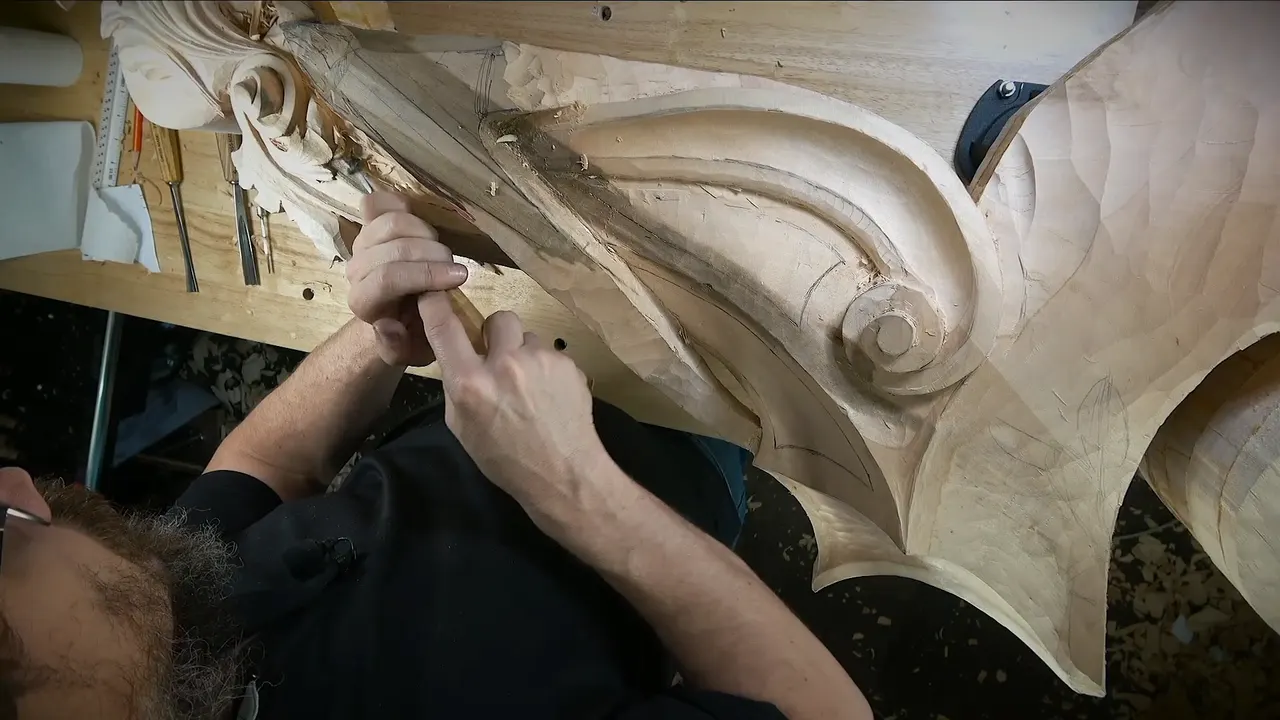

"Complicated" is my word for a shape that looks hard, and in part 8 of workshop 90 I use it both ways: "not complicated piece in all, except what I could do, I could actually make it little more complicated." The same word shows up in my Hashemi, Furniture Panel, Greek and other Venice Room lessons. Each one below has its link.
Ever looked at a carved leaf and thought it was out of reach? Then Venice Room 90 is a good place to start. My words from this part come first. Lines from my other courses on wood carving follow, and there are a lot of them.
How does the video start?
A fix of a size comes first, then a hand tool. "Half a millimeter. I'm sorry, one millimeter, not half." Then "One-millimeter veiner," which is 0.04 inches. The plan with it, in a short line: "I'll create the undercut." And the verdict, "That's going to look good."
Next, what I want to see: "Really need to see that sharp ridge." One limit goes with it, and it runs long: the slope "still has to kind of continue the same slope all the way," so no "overdo my sloping." Then a check on you, "I hope that makes sense."

How simple is the first movement?
Plain, in my words: "So that is a kind of simple movement." Then an idea. "But what I could do, I could actually do something interesting." One part of it can "flip right on top of this movement." The reason is to "continue the idea."
A rule goes with the flip: "I need to make sure everything is going to go to the same direction." The summary of the whole side comes next, and you have it already, in bold, at the top.
Flipping shows in Venice Room 79, part 4, where I am "using my plastic" and find it "not that complicated to flip it both directions."

What makes it more complicated?
Two eyes do, and both are pipes. "Maybe I can just add an eye right here, and maybe I can add an eye right there, which means that is going to be a pipe." The small movement ties in, with "go right underneath of that movement." The payoff in my words is "really beautiful look."
Depth gets a brake. "And this pipe should not be that far because I don't want to excavate that deep." Four millimeters is the size, "I would say," which is 0.16 inches. A short phrase gives the reason for the brake, right after "Get my tools back": "too messy."
Later: "I'm going to use four millimeters, number 11," and the job is to "indicate that eye a little better."

Which area of this part is the plain one?
A different area gets the other verdict. The tool is "previous number 11 and 10 millimeters" (0.39 inches), and the verdict reads "This area is not complicated at all. So it's simple, straightforward, pretty much."
A hollow is the job, a concave, and the pipe is "like a big one." A second hollow is planned for "this side."
One tool turns out too big: "And maybe this tool is little too big." A mallet is the fix, with "I do have a mallet" as the proof and "much better control" as the reason.

How does the video end?
With more hollows and a count. "So pretty much I can actually get that concave from all the way here." Soon the light moves: "Let me move my light out. Reposition it little differently."
The count, in order: "So convex, convex," and then "also convex on the side of those, but little later." A blend is planned. Last comes a tool: "I could probably use just upside down my number seven for this."

What do the two next videos add?
One has a depth: "I've got about 3/16 of an inch deep, five millimeters, and that's plenty for me." Five millimeters is 0.2 inches. Its tool is "my macaroni tool."
The other has a doubt: "I'm not sure if I'm going to do or not this little thing. Maybe, yes." It also has "I know it looks messy right now," and a note on the back: "I've got too much going on underneath, so I need to remove lots of material from the backside."
Does a design look complicated before it is?
In my Hashemi course, a design can. Lesson 1, part 2, says "I know this type of design looks really complicated and can scare you off, but believe me, I can prove to you, you are able to do that."
Part 4 of that lesson explains it: "if you know the techniques, and this type of carving is all about the techniques, it's not that complicated as it looks."

In Furniture Panel 11, part 3, the same thing happens with a furniture design. "And I know this panel looks already a little complicated for some of you, but believe me." Then a comparison: "So I know it's not the same if you would just carve some simple flower or a simple leaf. It's a more complicated design."
The aim of that video is to show that "you are actually able to do something nice, something more complicated."

What made the peony complicated?
Undercuts. In Hashemi 43, part 4, the line is "it's the most complicated flower, actually. A lot more complicated than rose." The rose sits next to it in that line. Then: "I know it doesn't look complicated now, but once we're going to get all the undercuts, all the movements on this flower, it's going to be complicated. You'll see it, I promise you."
A correction follows. "Well, I shouldn't say complicated." Then comes a better word, "Complicated in a good way, okay?"

A wavy edge is the same choice, in Hashemi 30, part 2: "the edge of the flower also has to be kind of wavy, in my case, okay, because I want to do a complicated flower." Tiny details add to it, in Hashemi 39, part 3, with the berries: "every little, small, tiny detail helps, actually." And that can "make it look more complicated, if I can say that."
Part 6 of Hashemi 45 names the cause: "the reason why it's most complicated, that's amount of undercutting you have to do, and you have to train to do the right way undercutting." A limit comes next. "So, of course, not every flower is complicated." Then: "You can do easy way without too much undercutting. But I'm talking about more realistic-looking one."

Does going deeper make a carving more complicated to clean?
Depth does, in Hashemi 49, part 1. "I don't want to go too extreme because the deeper you go, the more complicated" is how the line starts, and the cost it names is the cleaning. The pipe in this video gets the same brake.
Hashemi 49, part 2, turns it round: "by now, you should see there is nothing complicated about carving somewhat complicated flowers. So it's pretty much just repeating the same cuts over and over."

Why would I make a design more complicated on purpose?
A curl asks for a second move, in Furniture Panel 10, part 4. "But I also understand if I added that curl, I have to add this movement somewhere else. So I just make my design more complicated for just myself." My answer to the cost is "I'm okay with that."
The same lesson, part 1, says why I show it: "I'm just trying to show the way I develop my complicated designs, and this will be somewhat complicated later on." Then "I really wanted to show the process, how I think."

Part 2 of Furniture Panel 7 names the size of the job: "I do know this panel is kind of, the dimension of it and so on, it will be somewhat complicated panel." My point for you is "it should not stop you from creating your own in different dimensions."
A complicated panel can take longer, though the design is not the cause. Part 7 of Furniture Panel 23 says "it takes little longer for me, and not because of the design and so on." The cause is a schedule: "It takes longer because my schedule."
Then Furniture Panel 20, part 10: "I know it just kind of looks complicated. Once you're going to work on it, you'll know exactly what I mean when I'm saying complicated." And "On this scale, it's a little more challenging, okay? And it's easy to mess up."

Who finds it complicated?
Sloping is one answer, in Venice Room 62, part 12. "It was confusing for me also when I started to carve those. I'm talking about complicated movements, like when it's sloping and it still has to be visible from all of the points." Then "It's not that easy, even if it looks simple."

A movement I did many times shows in Venice Room 45, part 9: "I know sometimes it's just kind of complicated. It's not really complicated, but when you're doing it first time, it could be complicated." The aim there is "to see in three dimensions" (three dimensions).

One more line, from Venice Room 70, part 9, about a shape "wrapping from underneath and growing this way": "It looks a little complicated, but it will make sense." This video has the matching words, "I hope that makes sense."

When do I say a part is not complicated?
A hidden piece is one case, in Venice Room 68, part 4. the piece is "probably the most simple one." Most of it is "hidden."
Moldings are another, in Venice Room 159, part 1: "nothing complicated about creating moldings whatsoever." The job there is "just to be accurate."

A rosette is a third. In Venetian Flowers Rosette 4, part 1, the line is "Nothing complicated. It's a simple couple leaves."

Do I ever call a choice too complicated?
A brake like the others. In Venice Room 82, part 3, the words are "I can overcomplicate myself. I can make too complicated."
Venice Room 74, part 4, is about a leaf: "really complicated one. I really don't need to." Then Venice Room 163, part 3, on subdivisions: "Sometimes it's just overkill also. I really don't need to."
A form can look complicated for a reason. In Venice Room 83, part 12: "I know it's a little complicated looking one because we are working in not just a simple form, but it's in two dimensions."
What is the easy way and the complicated way to check a depth?
In Furniture Panel 18, part 9, there are "lots of different ways to measure" the depth of a background. "There's some complicated ways, there's some easy ways." The easy one is a machine: "a pointing machine in your workshop. That's probably the easiest way."
The hard one is by hand: "And I can readjust my needle if I need to, and I can always check other areas, and that way, even by hand, I can do that. That's the complicated way, I guess."

Part 10 of Venice Room 85 splits it the same way. "Well, there's an easy way, of course, and there's a complicated way." The easy way is to measure, and the check ends on "That's the final depth."

Why do I like complicated acanthus?
The Greek course says it, in Greek Acroterion 5, part 3: "Not just a simple acanthus leaf. Simple acanthus leaf is easy, but complicated ones, that's what my really big interest is in, complicated acanthus leaf design."

Part 1 of Hashemi 22 gives a use for hard pieces: "If you want to do really complicated pieces later on," there are "a lot of fragile parts." Then "that's good practice, like I said."

Where does the word sit in the lessons?
| Where | My word |
|---|---|
| The first simple movement, Venice Room 90.8 | Something interesting, a flip |
| A movement with two eyes and two pipes | Little more complicated |
| A broad area in the same video, part 8 | Simple and straightforward |
| A design that scares people, Hashemi 1.4 | Scare you off |
| A peony and all its undercuts in Hashemi lesson 43.4 | Complicated in a good way |
| Digging deeper into the wood, as in Hashemi 49.1 | The more complicated |
| An entire Furniture Panel in lesson 11.3 | A more complicated design |
| One added curl, lesson 10.4 of that panel | Complicated for just myself |
| Sloping movements seen from every point, 62.12 | Complicated movements |
| A mostly hidden piece in Venice Room 68.4 | Not a complicated one |
| Creating moldings in lesson 159.1 of Venice Room | Nothing complicated whatsoever |
| Measuring a background depth, Furniture Panel 18.9 | Some complicated ways |
| The final depth, Venice Room 85.10 | A complicated way |
| The leaf in Greek Acroterion 5.3 | Complicated acanthus leaf design |
Is there a spot on your own carving that looks complicated, and might not be? Workshop 90 sits inside one tuition plan with the other Part 8 workshops. This page ends where the video ends, on a plan for "upside down my number seven."
How it's done
- Start with the ridge. The video opens on a one-millimeter veiner (0.04 in) and the words "Really need to see that sharp ridge."
- Keep the slope going. Do not overdo the sloping, since the same slope has to continue across the whole side.
- Flip one part of the movement. A part can "flip right on top of this movement," so the idea continues.
- Put in an eye, then a pipe. Each eye is a pipe, and that is the extra work in this video.
- Indicate the eye. A number 11 is the tool to "indicate that eye a little better."
- Make the concave. A number 11 is the plan again, and a mallet gives "much better control."
Frequently asked questions
Where does workshop 90, part 8, use the word complicated?
Three spots. The first side holds "a kind of simple movement." The extra eyes add work to it, and the whole line sits in the bold paragraph at the top. A bigger area is "not complicated at all." For that area the tool is a number 11 at 10 millimeters (0.39 in).
Why add eyes and pipes to a simple movement?
A plan was behind them, and each eye is a pipe. Under the other one goes the small movement. The line about the result is "really beautiful look."
How deep did I want that pipe to go in this part of workshop 90?
A short way, since the pipe "should not be that far." Part 7 gives a number for a different spot, "about 3/16 of an inch deep, five millimeters" (0.2 in), and calls it "plenty for me."
What to carve next
- Venice Room 90
- Venice Room Part 8
- Hashemi Flowers 1
- Hashemi Flowers 22
- Hashemi Flowers 43
- Hashemi Flowers 30
- Hashemi Flowers 39
- Hashemi Flowers 45
- Hashemi Flowers 49
- Furniture Panel 7
- Furniture Panel 10
- Furniture Panel 23
- Furniture Panel 11
- Furniture Panel 18
- Furniture Panel 20
- Venice Room 45
- Venice Room 62
- Venice Room 159