

Alexander Grabovetskiy, woodcarver, School of Woodcarving · Published 2020
What does a wood carver mean by a "deeper cut"?
Quick answer: In workshop 90, part 10, I ask whether I really want a "deeper cut" and then say "I don't think so" and plan a concave hollow shallower than the first plan. Other lessons of mine set the words beside depth limits, tool sizes, a question to the viewers and the thickness of the wood, and each has its link below.
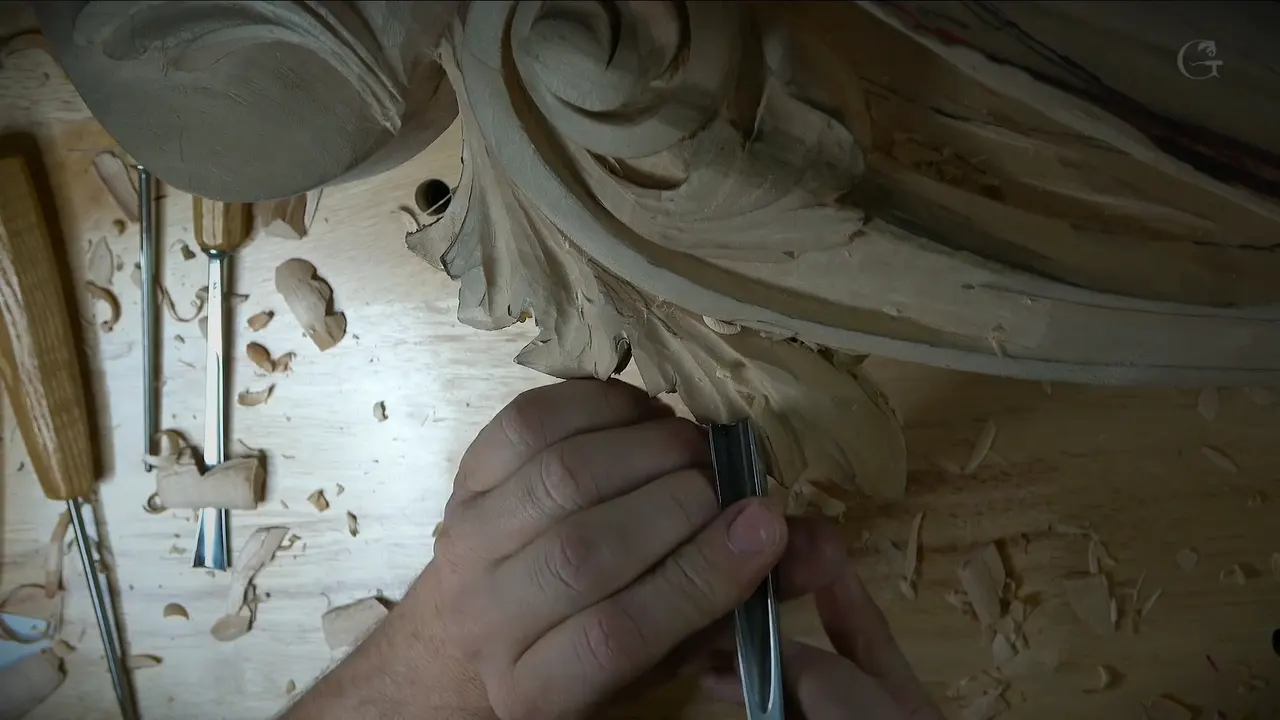

In part 10 of workshop 90, I weigh a "deeper cut" at one spot and say no to it, and the same two words sit in lessons from many of my courses. Each lesson below has its link, and my own words from part 10 come first.
Ever stood over a hollow you just carved and wondered if it should go deeper? Then Venice Room 90 is a fair place to start. After this video, I go through wood carving lessons from my other courses where I say those two words. Sizes come in both systems, inches and millimeters, with my own figure first.
What comes before a "deeper cut"?
The video opens with "not really deep," and a note about "too stripey." Next comes "All I need is just pretty much an indication of the movement." One small plan sits at the end of that stretch: "And let me round this a little better."

How do I weigh the "deeper cut" in that spot?
Here I say "now I have to make the decision." Then come the question and the answer: "I wanted to do a deeper cut right there, but do I really want to do it or not? I don't think so."
My plan for the spot is "I'm going to just do a concave cut, but not as deep as I wanted to before." Right away comes "And let me blend a little bit."

More hollows go on my list in the same breath: "And I'm also going to do another concave cut on this section and another concave cut of this section." The reason follows, "Because it's also going to be convex." Next comes "And let me blend it."

Once the hollows are in, what do I say about how the carving looks to me?
"Okay. That is approximately what I want to see." Soon after, "Of course, all of that needs to be cleaned." On the look, "Right now, it just looks all bulky," and a beat later, "Not good. No bueno."
A need and a tool: "I need bigger tools. I use a number seven." A plan to blend follows soon after: "I'll try to blend it nicer."

A little later, "That's the wrong position. I need to attack from this side." Next, "Okay. That is good." And "Yeah, I know it doesn't look too appealing yet." A line follows: "It will."

Where does part 10 end?
On a check of the whole movement: "So now what I have to do, I need to make sure I'm happy with the overall movement." And right after it, "Which I can't say that I am."
Then the edge: "Okay, let me get a little closer to the edge, and that way I'll know exactly if it's going to look good or not." And "It is simple."

About my own work, "Maybe I just overcomplicate it. Which sometimes happens." The last idea is the rasp: "Okay. Well, actually, you know what I can do? I can try my new addition and get those ridges out." The tool itself is named next, and the final words are "rasp will help me a little bit."

What does part 9 say before the hollows?
In part 9, the words are "Let me also make this one nicer." Another idea: "Maybe I can just roll this one out like this and make it look even nicer." Later, "I've got too much going on underneath, so I need to remove lots of material from the backside." Next, "I want to make sure I'm not removing too much." And "I have to just follow the main body." Next, "Let me use number nine," followed by "Do not want to overdo it."
Near its end I say "So that's going to be a concave." Then the tool, "number 11, 10 millimeters" (0.39 in), and "exactly the same what I've done previously."

How does part 11 treat the drop?
Over in part 11, I open with "Let me check how it looks in overall." Next, "And in overall, it doesn't look too bad at all." After it, "What I have to do, I have to just flip it and clean it from the backside." The drop comes later: "This is actually one of the most important part."
The tool I name is "a really big gouge, number seven." The shape I want is "a little more bulkier on the bottom of that drop and a lot less at the top." And "I need to make it tighter." The figure I give is "approximately half an inch from the surface to this line" (12.7 mm). A moment later, "But I think I can go a little less than half an inch, maybe about 10 millimeters" (0.39 in), and "Then it's going to look like a real material."

More lines from that video: "So this section needs to be also blended really nicely." "I still have to be careful how I do it." Another line: "I have to create the concaves and the convexes," and then "But my goal is just to create the overall shape really nicely."

Do I reach for a "deeper cut" or leave the spot higher?
In Venice Room 30, part 5, I ask "Should I create a deep cut or I should leave it somewhat higher like that?" Next, "But I think I probably should go with the much deeper cut on inside."
For that excavation, my plan names a big gouge and a heavier mallet: "just to create the big opening with the big gouge, okay, like number nine." And "hit, rotate, hit, rotate, hit, rotate." Last, "Okay, much heavier mallet."

Venice Room 66, part 12, turns the question to you: "My question is, should I create a deeper cut, a deeper shadow in this area, or should I bring this separation all the way?" A direct ask follows: "I would like to know what would you do."
The lines after it: "So I think there's no reason." Then "There is no reason," and then "But I'll do it anyway." The pass itself gets "Create a little deeper shadow." A mess shows too: "I've got lots of mess on the side, but it's okay."

How deep is too deep?
A limit sits in Venice Room 22, part 5: "I could use maybe 7 millimeters" (0.28 in), "right here because I have plenty of material on this side." Next, "deeper cut, but not too deep." The number is "No more than 3 millimeters" (about 0.12 in), and "No more than one-eighth of an inch" (3.2 mm).

In Lily Box 3, part 10, the words are "16th of an inch, maybe less even" (1.6 mm). My next line is "And I don't want to create deeper cuts." And the tool, "of course, one millimeter" (0.04 in).

Near an edge, Venice Room 16, part 1, has "create a little deeper cut at the side." A limit follows, "But not too close to the edge," with a reason that ends in "that mushy thing." Also "Number five, that is what I'm using." The size is "About 13, 14 millimeters, something like that" (about 0.5 in).
Which tool do I name near a volute?
Beside a volute in Venice Room 151, part 1, I say "closer to the volute I get, a little deeper I have to be." About the tool, "But to create a deeper cut," then "a smaller tool, and I'll use five millimeters." After that, "Five millimeters, and of course, it is number 11 veiner" (0.2 in). The plan is "across the grain cut."
Two lines follow: "Careful around the volute itself." And about the grain, "I am working against the grain in some of the parts, but I'm okay." And "My tool is really sharp, and if my tool is sharp, I should be okay."

What tells me the pass is not deep enough?
A wrong tool shows in Venice Room 20, where I reach for a deeper pass and then say "Well, actually, I used the wrong tool." Second, "I need to use 3 millimeters" (0.118 in), and also "I want to see really good shadow underneath." Another need: "I need to undercut underneath right there." And "But let me use 3 millimeters and excavate even deeper."
Roman Acanthus 16, part 1, has "if it's not flying out, that means my cut, this cut, is not as deep as supposed to be." And "And what I'll do, I'll just recreate or just to make a deeper cut." Earlier in that video, "this cut is only about 16th of an inch deep" (1.6 mm), and "that means we have to really, really hold our gouge really stably."
What makes me say "much deeper"?
In Venice Room 44, part 5, the words are "roll it also." Right after, "Which means I have to create much deeper cut"; that one goes on the side. Also "reduce the thickness of this chunk, because right now it's just too thick."
Venice Room 32, part 2, goes the other way: "I'm not excavating deeper. I'm just trying to hit the sides, okay?"
And Venice Room 62, part 5, adds a pass to a pipe: "I also need to create a concave in this section." After that, "And for this, I need to use a smaller tool."
When do I hold the pass back?
A stop shows in Venice Room 57, part 8: "for me, I would stop, and I can't do anything right here." Next, "Well, I could probably, but I don't want to damage." And "Maybe I should actually go a little deeper cut on this side also."
Right away comes the tool: "two millimeters, number 11" (0.08 in), and "clean whatever the mess I created." Also "attacking from two sides." A hair dryer gets a place in the plan too.

A deeper pass is in view in Venice Room 58, part 5, and I say "It is up to me."
Held for later, Hashemi Flowers 43, part 4, has "You can always fix it later, all the movements and so on." And "So we're going to establish deep cuts later on, or deeper cuts."
In Hashemi Flowers 6, part 2, I say "just doing an illusion of the veins." Next, "some spots I want to exaggerate and make even deeper cuts."
A knife outline shows in Furniture Panel 19, part 2: "because I made my preliminary cut with the knife, I may detect imperfections, just like that." And "Make a couple deeper cuts right here."
What if the thickness is the limit?
In Lily Box 11, a lily flower lesson, part 2, I say "I have enough thickness on the other side." Next, "I can actually exaggerate this concave on this side and get an even deeper cut."
And "when I took this material, it's 5/8 of an inch" (16 mm), "and it looks like it's plenty of thickness." Next, "But you're running out of the material, of the thickness, pretty quick."
When I say "deeper," do I mean deeper?
A triangle sits in Furniture Panel 23, part 11, a furniture lesson: "This triangle, I'm going to create even a deeper cut." Next, "Not deeper, but kind of shave it like this." After it, "We want to make it feel like it's growing from underneath of that part." And "It is better now, but it's still not there, so I really need to take care of this moment."

Beside a skew chisel, Venice Room 51, part 10, has "a deeper shadow right here." Next, "Deeper cut, so feel like it goes in." Right after, a chisel gets named: "exactly the same we can create right here with the small skew chisel."
Which lesson holds which line?
| Where | What I say |
|---|---|
| Venice 90.10, beside the plan for a concave | A shallower hollow, in place of the deeper one I first wanted. |
| Lily Box 3.10, beside a hollow | No deeper ones. |
| Furniture Panel 23.11, at a triangle | A shave instead. |
| Hashemi Flowers 43, part 4, beside "preliminary cuts" | "Deeper cuts" planned for later. |
| Roman Acanthus 16.1, beside a pass that is not deep enough | A pass made deeper until it is clean. |
| Venice 22.5 | Seven millimeters (0.28 in) named, and a limit well below that. |
| Lily Box 11.2 | Running out of the material, with 5/8 of an inch (16 mm). |
| Furniture Panel 19.2, beside imperfections | A couple of "deeper cuts," after a "preliminary cut" with the knife. |
| Hashemi 6.2 | An illusion of veins, and some spots to make deeper. |
Is there a hollow on your own carving that you may not want deeper? Workshop 90 sits inside one tuition plan. The Part 8 course page holds the other workshops, and this page ends where part 10 ends, on "rasp will help me a little bit."
How it's done
- Start with less depth. The video opens with "not really deep" and a note about anything too stripey.
- Weigh the deeper pass. I ask whether I really want it, answer no, and plan a concave hollow that is shallower than the first plan.
- Add the other hollows. The plan adds a concave hollow on two more sections, and the reason I give is "convex."
- Check the overall movement. The check is whether I am happy with the overall movement.
- Look at the edge. I plan to move nearer the edge so I will know whether the look works.
- Try the rasp. The last idea is my new addition, the rasp, to get the ridges out.
Frequently asked questions
Where in workshop 90 do I weigh a "deeper cut"?
Part 10 of the workshop. I decide against the deeper pass I first wanted and plan a shallower hollow instead, with two more hollows on other sections.
How deep is too deep in my other lessons?
The limit in Venice Room 22 comes as two figures, 3 millimeters (0.12 in) and one-eighth of an inch (3.2 mm). The other lessons above give their own figures for their own hollows.
Which tool do I name beside a volute?
A number 11 veiner at five millimeters (0.2 in), in part 1 of Venice Room 151. I name it for a deeper pass, and I plan to work across the grain beside the volute.
What to carve next