

Alexander Grabovetskiy, woodcarver, School of Woodcarving · Published 2020
What does a wood carver mean by "dancing"?
Quick answer: I said "just dancing between two millimeters and a flatter tool" in workshop 90, part 5. Other lessons put the same word beside a client's drawing changes, a gouge's sound, shadow and light, a body motion and a change of hands.
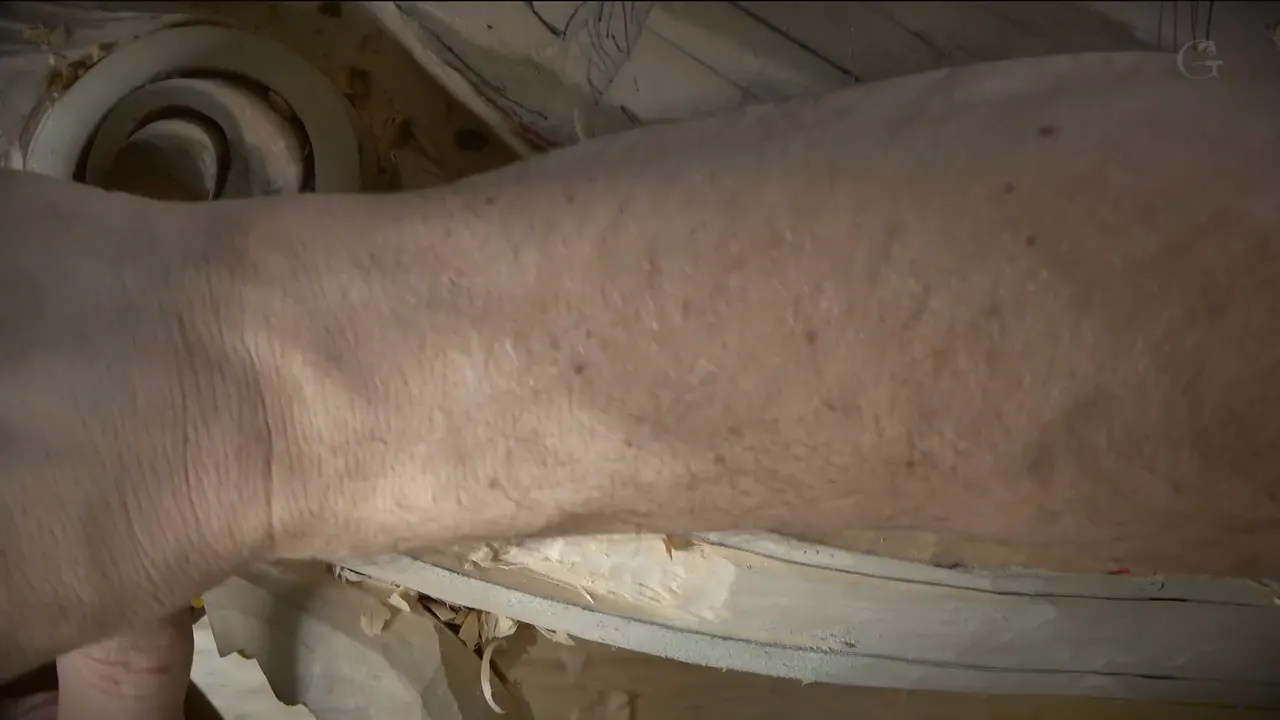

In Venice Room 90, video 5, I said "it's actually just dancing between two millimeters and a flatter tool." Other lessons of mine use the same word for a drawing a client keeps changing, a body motion, a change of hands, the sound of a gouge and light and shadow. Each lesson below has its link.
Ever held a tool over a wall and wondered whether the next one should be bigger or smaller? Then you know where part 5 of workshop 90 starts. First come the words I said there, and after that the same word in lessons from my other courses on wood carving.
What happens in 90.5?
- A wall near 90 degrees, and the tool named for it.
- About five millimeters (0.2 in) deep.
- A smaller veiner, maybe about two millimeters (0.08 in), around the acanthus.
- About a quarter inch (6 mm) down, as a plan.
- Then 1 mm (0.04 in) and smaller.
- One line where I cannot undercut, and a plan for punches.

Before the dancing, what came first?
The first cue speaks of texture. "There's going to be really interesting texture on inside also." A tool comes next, said as a plan: "what I could do, I could actually use a furniture maker's tool."
Next, the wall. "What I can do with that, I can create a really nice 90 degrees almost. It's not 90 degrees, but almost 90 degrees wall." About the tool itself: "That's a really nice tool to have for architectural carving." And what it is not: "Again, that is just an indication. It's not a final cut."

A depth follows: "About 3/16 of an inch deep. So around my acanthus with the smaller number 11 veiner, maybe about two millimeters, I would say." Three sixteenths of an inch is 4.8 mm.
Next, a plan for the line, and a depth for it. "And let me go like this. And I'm going to go right inside of my line." Then the depth: "about a quarter inch down."

A word about the corbel. "So this corbel is unique to the Venetian style. But it's beautiful. You could just use the design anywhere on mantels or pretty much anywhere, even in the kitchen below the hood. If you do have a kitchen with a hood."
How did the dancing line go?
The line itself is at the top of this page. After it: "And actually right here, I need to use a one millimeter to create the better cut."

Then a comparison for the tool: "It's still like a knife. Going to create a really nice wall right here." From there, the sizes move down one more step: "Okay, let me use one millimeter. And clean that a little bit. You know what? I need to use a half a millimeter."
Soon a question gets its answer: "And does it really matter? Yes, it is. It's actually going to give me a beautiful shadow." A plan follows, to create "even sharper, nicer transition."

More of the same: "and I can start taking even deeper undercut. Even deeper undercut." The limit comes in plain words. "All right. I can undercut underneath of my acanthus, but I cannot undercut underneath this line." And a warning for it: "So have to be really careful how I do that."
A check on the wall comes later: "I'm actually looking at the wall, and I want to make sure it's really the same measurements overall."

The numbers end the part. "Right now, it is approximately five millimeters, like I said, about 3/16 of an inch." A quarter inch is the plan, 6.35 mm. Then the way to get there: "with punches, okay, because it's going to be textured."
How do videos 4 and 6 carry the sizes?
Video 4 of that workshop had the numbers earlier: "maybe about five millimeters in" and "one millimeter for later."
Part 6 of that workshop carries the sizes on. "one millimeter is not a big deal to take out, but I want to make sure before I create my final cleanup cut." Past that: "I stayed away approximately one millimeter." And a little mess: "You can see I created a little bit of mess right here, but it's okay because I've got an extra millimeter, and I can totally take care of it."

Farther in, the sizes change again: "One millimeter to get inside right here." Then I correct a size: "I'm sorry, one millimeter." Later in that part: "And I'll use half a millimeter number 11 veiner. And remove all that." Soon after: "Now it looks really nice."
Does dancing mean a client's changes?
In the Techniques lesson on the iPad for wood carving patterns, the word comes with a drawing on paper. A client wanted that acanthus leaf higher, and my answer was "Yes, I can." Then: "I had to take a razor and erase everything and get rid of whatever I just drew and spent hours and hours of drawing, and then redraw and submitted that."

The client called me back. "Well, I like it, but I would like to move it toward right." My answer was a plan: "Okay, I can probably do that. I have absolutely no problem. I'll just redraw that." And: "And again, just redrew and submitted." The word comes next: "It was like dancing. Okay?"
"And that is normal. Okay? I'm working with the high-end architects, and sometimes those high-end architects, they just like to do changes." Next comes a name for it: "And I call that stage dancing stage." And: "That's just dancing. So we have to just draw, redraw, and so on."
The iPad enters here. "And on a piece of paper, it just takes so much time. It's just a waste of time." Soon after: "personally, lately, I really like iPad because it's so easy. Okay? So easy, and I can change in a second." The same lines sit in Venice Room 104, video 1, word for word.
What was the big process between a client and me?
In a livestream of April 2020, the word sits beside a client's drawing. "I'm still working on this piece, and I need to speed up. But yesterday, I didn't do too much because I had to spend some time drawing for a client, okay? And it's a big dancing process between a client and me." Right after: "So it always starts with the drawing."

The same passage goes on: "when you estimate your wood carving, you really have to consider how much time you spend drawing and designing, okay? And yes, I do charge for time I spent on the drawing. And I didn't do that at the beginning."
About an architect, farther on: "And I asked him back, like I said, it's dancing. It's dancing between a wood carver and architects and designers and just the clients." Later: "dancing back and forth, approval, disapproval, red marking". Here is the livestream page.
What about teaching?
In Let me introduce myself, video 9, the word sits next to teaching. "I ignored the idea of teaching because there is a barrier. For example, English is not my first language, and I'm also really super busy with my projects, ongoing projects."
Next: "I didn't consider myself as a teacher." And: "Will people listen to me, and will they like it or not? For a couple of years, it was just like dancing". That lesson has the rest.
Can a gouge in wood sound like dancing?
Another livestream of that month speaks of a video without music or talk. "Yes, I posted yesterday night video when I was carving without any music, without any talking. It's just the sound of a gouge and the wood. I call it like a dancing or waltz, if you wish."
Farther on: "I can't talk all day long even if I'm filming for hours every day for my school. But there's some gaps, actually, when I'm really quiet. Okay? Really quiet, and all I can hear is just the sound of my gouge."
Where does the light come in?
In Lily Box 8, video 7, the sizes come down too. "Let me try 2 millimeters first, okay?" Next: "And if I started with 3 millimeters far this way, so with 2 millimeters, I'm going to jump closer." Two millimeters are about 5/64 in, and 3 mm is about 1/8 in.

Then: "Looks like 2 millimeters is a little too big for now. Okay, let me use 1.5 millimeters. And I get even closer." One and a half millimeters make 0.06 in. Farther on: "And let me go with 1 millimeter" and later "But even 1 millimeter is already too big. I think probably right away, 0.5 mill."

And the word itself: "I know it sounds like a broken sound sometimes, but for me, wood carving is more about light and the shadows and how it's going to dance together. Okay. It's like a dancing. Light and the shadow dancing."
How does the body move in a long stroke?
In Floral and Molding 4, video 3, the long strokes go with the body. "With the long cuts, I am trying to use my body very much, and I'm pushing not with the hands, but with my whole body. So you can see my hands actually staying almost at the same position toward the body, but I'm just pushing with the whole body."

Then: "Just the same idea if you would use a plane. Okay? So just watch what I'm doing. Okay? You don't see the cut, but you can see that I'm holding my hands really tight to my body, and I'm using that body motion, almost like dancing." A size follows: "I left, I don't know, maybe about one-eighth of an inch, three millimeters. Something like that. Maybe a little less, maybe two and a half millimeters." Two and a half millimeters is 0.1 in.
The Cabernet Sauvignon tray, lesson 6, video 1, speaks of the same movement on a smaller scale. "So that's a beginning stage." Then, as plans: "I'm gonna start on the right hand side of the tool. And I'm gonna do really slowly for you, and I'm gonna finish almost upside down like that."

Then: "Okay? Again, the same thing, but slowly, slowly. Like almost dancing with the, with your body, how you move it." And: "it's just like indication of the same movement, but on a lot less, you know, smaller scale."
Is the word also for swapping hands?
The Swapping Hands lesson is short and shows two ways. "Different one, I'm not changing hands. Well, when I'm changing hands, it goes like this. Okay? It goes like that. Just like a dance."

The other way: "But when I'm carving and I don't want to change the hand, what I do, I just still keep the same hand. I just rotate the tool." Later: "That is a really fun trick." On the second hand: "the closer to the blade you hold your second hand" and "more control."
When did I say it is not like dancing?
In the Sharpening V tool lesson, the word sits in a line about a wiggle. "See, closer to the edge you get, it thinner becomes." Then: "So that's why you wiggle it to make sure it's a consistent bevel all the way to the edge. But it's not like rocking back and forth like you're dancing."

And right after it: "No, it's just the really, really tiny movements, but without pressing too hard."
Who is the best dancer?
In Modern Acanthus 1, video 1, the word goes with the Big Tool. Before it: "I have some of the tools like three inches or even bigger." That is 76 mm. And: "So we're gonna get just the number 9 20 millimeters." Twenty millimeters make 0.8 in. Last: "and this is the best dancer the Big Tool."
Where did the word show up, lesson by lesson?
| Spot | Beside the word |
|---|---|
| A veiner and a flatter tool, workshop 90, part 5 | Sizes of tools |
| Changes asked by a client, Techniques, iPad lesson, video 1 | Draw, redraw |
| The drawing before the carving, livestream, April 2020 | Drawing for a client |
| Architects, designers and clients, same livestream, later on | Wood carver and clients |
| Doubts about teaching, Let me introduce myself, video 9 | A couple of years |
| The sound of my gouge, another livestream that month | Metal and the wood |
| Light and shadow, Lily Box 8, video 7 | Sizes coming down |
| Long strokes with the whole body, Floral and Molding 4, video 3 | Body motion |
| A slow movement from the right side, Cabernet Tray 6, video 1 | Number nine |
| Changing hands, Swapping Hands lesson | Rotate the tool |
| A wiggle at the stone, Sharpening V tool | Tiny movements |
| The biggest tool, Modern Acanthus 1, video 1 | The best dancer |
Is there a wall in your own carving, with two tools in reach and no sure answer on which one goes next? Could you say the sizes out loud before the mallet comes down? Workshop 90 waits inside one tuition plan with the other Part 8 workshops, and this page ends where the part ends, on the word "textured."
How it's done
- Look at the wall. The first tool of the part is for a wall of 90 degrees, or almost.
- Name the depth. Approximately 5 mm, near 0.2 in, around the acanthus, with the smaller veiner.
- Follow the line. The plan: right inside of my line, 6 mm down, about 1/4 in.
- Try the sizes. Two millimeters (0.08 in), one millimeter (0.04 in), then 0.5 mm (0.02 in), as the cues go.
- Mind the other line. Underneath the acanthus, an undercut is possible, and underneath this line it cannot be done.
- Plan the quarter inch for later. A quarter inch (6 mm) comes later on, with punches, and a texture.
Frequently asked questions
How deep does 90.5 plan to go?
Approximately 5 mm (3/16 in) right now, with a plan to go all the way to 6 mm (1/4 in) later on.
Which sizes came up in part 5?
A veiner near 2 mm (5/64 in), then 1 mm (about 1/25 in), then 0.5 mm (about 1/50 in).
Was the wall 90 degrees?
The words are "It's not 90 degrees, but almost 90 degrees wall," said of a wall made with a furniture maker's tool.
Where could the carving be undercut?
What to carve next