

Alexander Grabovetskiy, woodcarver, School of Woodcarving · Published 2020
What does "preliminary movement" mean in wood carving?
Quick answer: Workshop 90, part 9, sets the words beside a point and "another separation." Other lessons of mine set them beside a depth, a detail on the side, a stem and a tray, and each of those lessons has its link below.
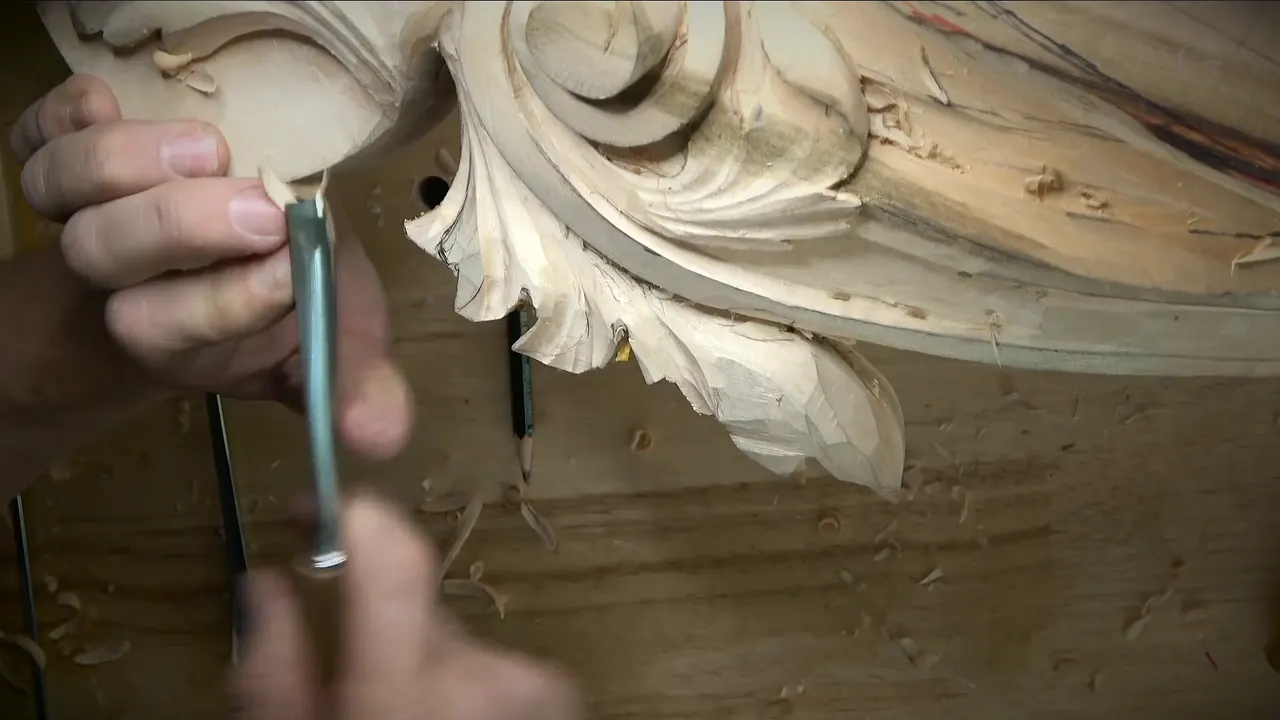

I say "that's the preliminary movement, but I still don't like how it looks" in part 9 of workshop 90, and the same two words, "preliminary movement," sit in lessons from several of my courses. Each one below has its link. My own words from part 9 come first.
Ever stood in front of a rough shape and not liked it yet? Then Venice Room 90 is a fair place to start, and its lesson page names the piece as a corbel. Part 9 comes first. Past part 9, I walk through my other courses on wood carving. Sizes come in both systems, inches and millimeters, with my own figure first.
Where does workshop 90 use the words?
"That's good," I say, and then I name an option, "just blend everything in nicely." A short "There you go" follows. The words come next: "So that's the preliminary movement, but I still don't like how it looks because the point is going to be right here of this one."

Why is the point a problem?
In my own words, "this section is going to be below because I need to get another separation, otherwise it's not going to look nice." My need comes first in that line. The worry about the look comes second.
An idea for the chunk follows: "I can just create another cut right underneath like this and make it illusion, like another section growing from underneath." You hear "I can just" before it, so I treat it as an option, not a finished pass.

What comes after the idea for the chunk?
Next: "Also excavate this way." Then "Something like that." Then "another separation right here," with more of them named in the next lines.
What do I say about the look right now?
"Let me also make this one nicer." Then "I know it looks messy right now," and after it, "it's going to look really good."
Two ideas come next. One is "Maybe I can just roll this one out like this and make it look even nicer." The other is "the same idea right here. I can actually roll it." Both stay ideas, and I do not count either one as a finished pass.

Which material comes off the backside?
Material from underneath. "You know what? I've got too much going on underneath, so I need to remove lots of material from the backside." A limit sits next to the need: "I want to make sure I'm not removing too much."
The reason for the limit: "I have to just follow the main body, so I don't want to chop too much out." Tool plan: "Let me use number nine." Another line in that stretch: "Do not want to overdo it."

Some of the work is planned for off camera: "And some of it, I'm going to take care of off camera because you don't really see what is going on underneath, so no reason for me to show that to you."
How far does the hollow run?
"So now, I've got this movement, and I've got that separation, so which means the concave I have to run from all the way right here." My plan for the tool is "same number 11, 10 millimeters" (0.39 in), and the other plan is "exactly the same what I've done previously."

A doubt ends the video. "I'm not sure if I'm going to do or not this little thing. Maybe, yes." Then the last words in it: "Maybe I'm not going to worry about it."
What do the videos on each side add?
Near the end of part 8: "Blend little bit this movement." And "I could probably use just upside down my number seven for this."
Part 10 opens with "not really deep. I don't want to make it too stripey." Then "All I need is just pretty much an indication of the movement." A choice follows: "I wanted to do a deeper cut right there, but do I really want to do it or not? I don't think so." Plan after it: "a concave cut, but not as deep as I wanted to before."

Later in part 10 a verdict lands: "That is approximately what I want to see." A need follows: "Of course, all of that needs to be cleaned." Next comes a flaw: in my words, it "just looks all bulky," and the tools are "I need bigger tools. I use a number seven." About the overall movement: "Which I can't say that I am."
A check from close up comes first, "a little closer to the edge." After that: "Maybe I just overcomplicate it. Which sometimes happens."
Last comes a rasp. I say "try my new addition and get those ridges out," and my reason is "I want to see it a little more smoother."

Does preliminary mean the shape is final?
In Venice Room 132, part 3, I say "It's not final, but preliminary movement, I should say." Before it comes a need: "And now I need to create a somewhat final shape of this side." After it: "downhill like that."
In that same video: "We've got the main shape. Now I have to redraw everything, and we're going to establish the details." After that, "now I can make it look really light and nice."

Beside a detail, the same two words show in the third video of Venice Room 86. "And yes, I am creating only preliminary movement," and "not final movement yet because I do have a detail which is going to go right on the side." Close by sits "I have to be really careful."
How deep does a preliminary movement go?
In part 4 of workshop 86 I stay "approximately eighth of an inch, about three millimeters or so, from my red line, because it's not the final depth yet." Then "Okay, so I have to measure it first. That is a preliminary movement." Speed is in there too: "Pretty much couple moves and I'm already there."
In Venice Room 48, part 5, I plan "18 millimeters number 11" (0.71 in). Then: "It's not undercutting, but preliminary movement."

A reason for it: "I also need to roll this side downhill like that, too." Another line there: "So it has to have that nice shape." And one more: "But it also has to be really nice, not just a straight line, because right now it looks like a straight line. It has to go with all the design together." Later: "I know it looks kind of extreme, but it is not." And about the whole move, "one of the ways to finish up the bottom."

Does the movement come before a separation or after?
Both show together in Venice Room 27, part 5. "So you can see my separation cut, and I can see the preliminary movement. So that is an eye." Next: "And I could create pretty much actually another eye."
A look from every position follows. "I think I need to roll little bit downhill this one, otherwise, it doesn't look round enough for me." And "Not much, but little bit."
Then Venice Room 70, part 3: I say "just chop a little bit this side, because otherwise, it's just too much curvature." Then "And hopefully, you can see preliminary movement. Of course, it needs to be cleaned and everything, but the idea is still the same right there."

The next line is an idea: "I can actually exaggerate convex right here." Next, "exactly the same idea what I've done before, exaggerate this side."

Do my furniture lessons use it too?
Over in Furniture Panel 32, part 2, I say "I got my preliminary movement. All it's gonna take from me, it's just to clean this up." A suggestion goes with them: "I highly encourage you to just watch" how I did "those small movements."
I give this reason: "that's gonna give you an idea how it's supposed to be." Then "So I don't wanna repeat myself." And "the idea is gonna be the same, like right here, right there, right there in all of those ones."
Another plan follows for the same furniture panel: "I'll just use flatter tool and clean the background." And "I'll bring that exactly to the same level, like what I have right here."

Is it in a grape project too?
In Grape Onlay 4, a grape piece, part 1, it sits in a look back: "as you see, we established preliminary movements at the class." For that day, I would love to "concentrate just on my right hand side section."
For the day I name a plan: "I gonna create a complex movement," then "going right on top." And "This part gonna go right underneath."
One more wish: "I don't wanna see any straight lines," so "I'll make sure there's some kinda motion going on."
For the tool: "I'll use number 11 and that would be four millimeters" (0.16 in). Then "Doesn't have to be four millimeters, it could be five, it could be six, it could be seven," which is 0.2 in, 0.24 in and 0.28 in.

What about a shape that runs downhill to a stem?
In Hazelnuts 2, part 1, my line is "All I need is just a preliminary movement." Right after it: "just going downhill." The reason I give is "everything goes to the stem," and "higher than the nuts itself."
Next comes a plan: "So let me finish shaping this side." Here the tool is "three-quarters of an inch skew" (19 mm), a kind of chisel. Then "I have to protect those guys. Those two future nuts." And a plan: "excavate down."
One more line: "I still have to go low enough."

Do I use it on a plate with butterflies?
In Butterflies 12, part 1, on a plate with butterflies, the words are "All right, that would be preliminary movement. And let me think what we can do." On volutes: "I could just create whatever the volutes I have if I wanted to. But I'm not sure if I wanted to or not."
A distance sits in that video too: "about 7mm, something like this little over quarter inch" (0.28 in). And on variation: "I still want to do some kind of variations."

In Butterflies 4, part 1, I put it this way: "So let me get this preliminary movement. This way that way it's just continuous from here." A size sits ahead of it: "as long as I gonna be pretty close to 3 millimeters. I should be okay" (0.12 in).
Further on in that video: "I'm gonna preliminarily just establish some other movements and it's gonna wrap around."

Does my Gibbons class in Maine use it?
In the Maine class, lesson 16, part 1, my words are "So that's gonna be preliminary movement." Right after, "maybe you can see there's the movement right underneath." The next words are "Maybe you don't see it, but there is one."
On dark spots: "Those openings those tiny small dark spots." Then "That's what gives a complex look." One need goes with it, in these words: "And obviously I need to undercut."

What does the grain have to do with it?
In Tray of Blessing 7, part 1, the line is "I'm gonna pre establish my preliminary movement with the flute slightly to the right." Its tool is "three millimeters" (0.12 in). The depth I plan is "about 16th of an inch deep" (about 1.6 mm).
A spacing note: "Even if I drew wider, I can always make it narrow later, but now I'm keeping about one eighth of an inch, the spacing" (about 3.2 mm).
On the wood itself, the grain: "be careful what the grain does. You feel, what the grain does because you could catch it." And "So approach from different positions."
On speed: "See how slowly," and then "like almost like a slow motion."

Which lesson holds which line?
| Where | What I say |
|---|---|
| Right here, in the video above | The preliminary movement |
| Workshop 132, the third video, beside the main shape | I should say |
| The third video of workshop 86, beside a detail | Creating only preliminary movement |
| Venice 86.4 | I have to measure it first |
| Lesson 70.3 | You can see preliminary movement |
| The fifth video of workshop 48, with a number 11 | Not undercutting |
| Venice 27.5 | So you can see my separation cut |
| Furniture 32.2 | Those small movements |
| Grape Onlay 4, part 1, beside my right hand side section | We established preliminary movements |
| Hazelnuts 2, part 1, beside the stem | Just a preliminary movement |
| Butterflies plate 12, part 1, on a plate | Preliminary movement |
| Butterflies 4.1 | Let me get this preliminary movement |
| Maine 16.1 | The movement right underneath |
| The Tray of Blessing, lesson 7, part 1 | Movement with the flute slightly to the right |
Is there a spot on your own carving that you do not like yet? Workshop 90 sits inside one tuition plan. Part 8 holds the other workshops, and this page ends where part 9 ends, on "worry about it."
How it's done
- Blend the pass in. The video opens with the idea to "just blend everything in nicely," and then comes "There you go."
- Look at the point. The words are "the point of this one," with a section "below."
- Add the separation. The need is "another separation," and the reason is the look.
- Check the backside. The plan is to "remove lots of material from the backside," with "I'm not removing too much" as the limit.
- Keep to the body. The guide is "I have to just follow the main body," and the tool plan is "number nine."
- Run the concave. The hollow is "the concave I have to run from all the way right here."
Frequently asked questions
Where in workshop 90 do I say "preliminary movement"?
In part 9, after a short "That's good," and a pass of blending. The point and the next separation are named in the lines after it.
What did I need before the part looked right?
A separation. Part 9 has me saying "I need to get another separation." Next on the list was a hollow was the next job, with a tool of 10 millimeters (0.39 in).
What is my plan for the backside in part 9?
A removal with a limit, and "number nine" is the tool in that plan. Part of the work is planned for off camera, and I say why in part 9.
What to carve next