

Alexander Grabovetskiy, woodcarver, School of Woodcarving · Published 2020
What does an extra millimeter mean to a wood carver?
Quick answer: Mess and one extra millimeter sit side by side in workshop 90, part 6. Other lessons of mine speak of extra material near grain that changes direction, shell work, an eye, volutes and moldings, each linked below with its own words.
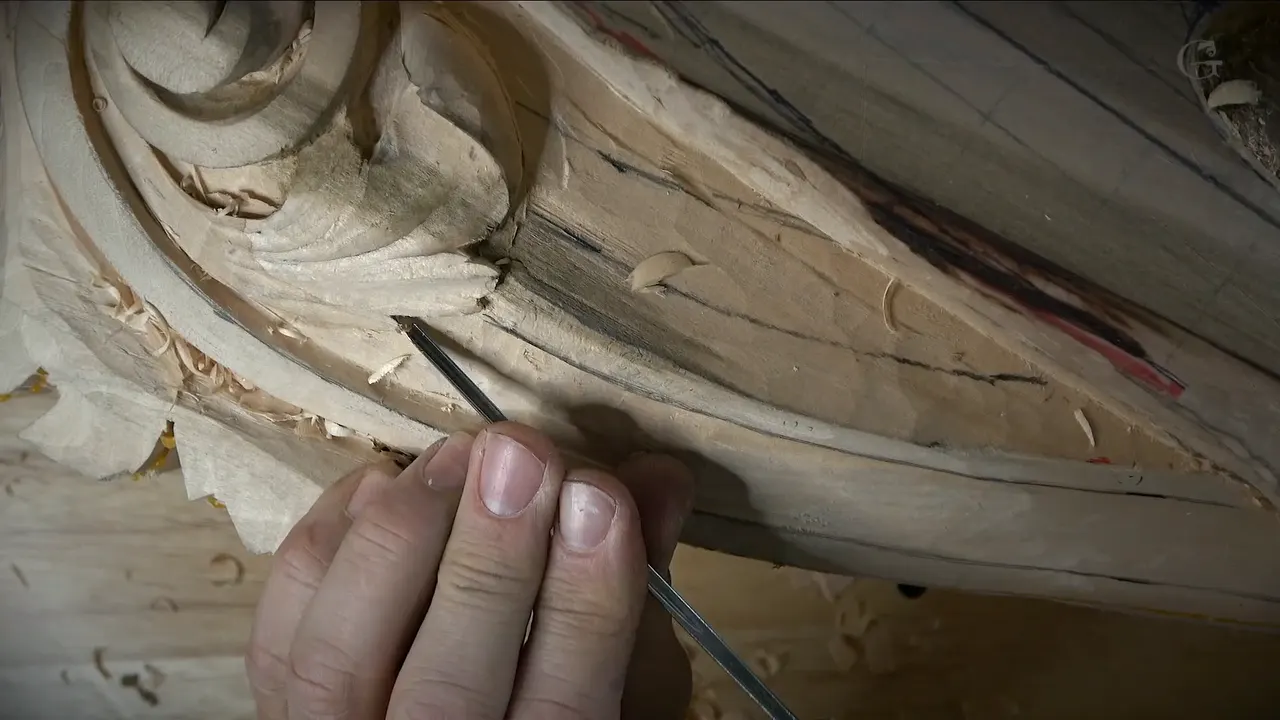

In Venice Room 90, part 6, I said "it's okay because I've got an extra millimeter." My other lessons have lines with extra material in them too, beside grain that changes direction, shell work, eyes, volutes and moldings. Each lesson below has its link.
Ever held a tool over a line and wondered how close to go? Then you know where part 6 of workshop 90 stands. The words I said there come first, and after them the lines from my other courses on wood carving.
What happens in 90.6?
- One millimeter (1/25 in) to take out first.
- A plan for a beautiful shadow, one millimeter next, and a really deep excavation after it.
- A tool turned upside down, also a plan.
- Sizes from two millimeters down to 0.5 mm, in turn.
- At the end, a number 23 tool at four millimeters (about 5/32 in), said as what I can do.

What came before the cleanup?
Part 6 says: "One millimeter is not a big deal to take out, but I want to make sure before I create my final cleanup cut." A plan comes next, "But let me excavate even deeper."
The shadow comes with a plan, to "create a beautiful shadow, one millimeter next." Then: "And we're going to get a really deep excavation."

The grain gets a word: "So it's really going to feel like I glued that on. But it's not glued because you can see the grain."
Where did the little mess happen?
A tool is turned upside down, as a plan, so that it can "take it right to the edge." About a corner: "I don't worry about this corner yet, though I can actually take care of it right away."
One question about the tool: "See how handy that tool is?" Later, "Here you go. Just to clean that."

Then, the mess: "You can see I created a little bit of mess right here, but it's okay because I've got an extra millimeter, and I can totally take care of it."
How close did I stay to my line?
"And I can probably ride right at the edge of my line." Later comes "I stayed away approximately one millimeter."

Which sizes did I reach for after that?
The sizes come in turns: "And let me use two millimeters again." Then "One millimeter to get inside right here," which is 0.04 in, after 0.08 in for the two.
A size gets corrected on the spot: "And half a millimeter. I'm sorry, one millimeter." The smaller one is 0.02 in, or 1/50 inch. The plan goes on with "excavate even deeper a little bit."

A line gets a word: "Because right there, this line is not straight and nice. Well, it shouldn't be straight, but it should be nice." After that comes a cleaning pass, said as "And get a cleaning cut like this." The veiner follows: "And I'll use half a millimeter number 11 veiner." Next comes the removal, said as "And remove all that." Then comes: "Here you go. Now it looks really nice."
Which tool closes the part, and what is its name?
"Also, what I can do, I can take again number 23 Macaroni tool and four millimeters. That's the name, by the way, of it. Okay, it's Macaroni. Same way like what you eat." The last cues are about another tool: "There is another tool called Fluteroni, pretty close neighbor. It's to make flutes."
How does part 5 describe the wall?
Over in part 5 of workshop 90: "Again, that is just an indication. It's not a final cut." About the depth: "About 3/16 of an inch deep. So around my acanthus with the smaller number 11 veiner, maybe about two millimeters, I would say." That depth is 4.8 mm.

On the piece itself, "So this corbel is unique to the Venetian style." Then a use for the design: "You could just use the design anywhere on mantels or pretty much anywhere, even in the kitchen below the hood."
A limit on a line, in my words: "I can undercut underneath of my acanthus, but I cannot undercut underneath this line." Next, a look at the wall: "And I'm actually looking at the wall, and I want to make sure it's really the same measurements overall." Near the end, a number: "right now, it is approximately five millimeters." That makes 0.2 in.

Does part 7 add anything?
Another tool comes in a question: "And if you would ask me, why don't I use a 90 degrees V-tool?" A short answer follows, "Oh, absolutely you could," and then: "You could do that. I just like that tool, okay?"

About sharpening: "I need to strop it again." Also: "I need to also not forget about wiping it after stropping."
The surface gets a comparison with sandpaper: "But now, once I strop that, I can actually get my finish almost like I sanded that with a 4,000 grit."

A depth, too: "I've got about 3/16 of an inch deep, five millimeters, and that's plenty for me. So don't want to overdo what I don't have to overdo." A doubt about a spot follows: "But I'm not sure yet if I'm accurate right here. Okay, so I can only do one side first. On this side, I am accurate."
About one more line, a few words show doubt: "This one, I'm not sure yet." And: "Maybe it's not the right position yet of this line."

Do my other lessons say extra the same way, or differently?
This part has its own line about it. The word sits, in the lessons below, beside grain that turns, shells, eyes, layers, moldings and regions that could break, each in its own words.
Does the grain turn in the Greek course?
Greek Acanthus 7, video 3, has it: "Although my grain changes direction, and I have to be really careful in this area." And: "it's a good thing that I have extra material."

How much extra was planned in Venice Room 24?
The Venice Room 24 lesson has a line in video 10 (that lesson): "It does look like I don't have too much material right here, but it's okay." And: "Originally, I want to leave like a half an inch extra material. It looks like I have about 3/8 of an inch, the max, 10 millimeters." That makes 12.7 mm and about 9.5 mm.

Why stop short of deeper in Venice Room 25?
Lesson 25, video 12 (Venice Room 25): "Well, first of all, why I didn't cut that deeper, because I still have to bring it all the way down, and I need that extra material."
What about the shell in Venice Room 35?
On the shell, Venice Room 35, video 6, has: "Otherwise, it just doesn't look too organic. Kind of round this up a little bit." And: "and that is a good thing that I have extra material." Then: "So I think it's much better." And about the shell: "And that shell can go a little under."

Where is the outer shape not final in Venice Room 6?
From Venice Room 6, video 9: "And by the way, the outer shape is not the final shape yet. So I left extra material."
What does Hazelnuts 2 say to keep?
The carving itself, in Carving Hazelnuts 2, video 3, is "kind of challenging, especially for those of you who never carved." And: "if you follow the right directions or right rules."
Then the advice comes in plain words: "Don't take too much material at once." And: "Keep some extra material, and you should be okay." For the center points, the words are "Also important not to lose them."

Which line did the lily box leave a gap from?
A number sits between the final line and the wall, in Lily Box 2, video 3: "between my final line and the wall, approximately maybe 1/64 of an inch. Just in case, okay?" Right after: "Just extra material I going to need." That gap is about 0.4 mm.

How is an eye treated in Venice Room 66?
The depth in Venice Room 66, video 7: "I did not undercut that right away really too much because I really need that depth. I can always undercut, but it would be a big mistake." Soon after, a doubt: "Although, I'm not too happy about this eye. Maybe I can just move it slightly this way. Not too late yet."

Which layer kept extra thickness in Venice Room 62?
Video 4 of Venice Room 62 says: "luckily, or on purpose I should say, I kept the extra thickness of this upper layer." The next cues: "I did not hit the glue yet. Maybe I will, I don't know." Then: "But I tried to be wise."
About this case: "But in this case, it doesn't really matter because it's going to be paint grade. So it's okay."

Which count did workshop 86 give?
In workshop 86, part 3: "But this spot is exact spot, so I cannot go farther than that." Then: "extra material left, maybe about half an inch or so." That is about 13 mm.

Which regions get a little thickness in workshop 95?
The regions come from workshop 95, part 3: "So it has to be really careful not to create too much damage. So I have to leave a little extra thickness, you know, in those regions, otherwise it's going to be broken."
Part 4 of that workshop adds: "Let me get rid of this triangle." And later: "And I do have some of that extra material I can remove easily with no problem."

When is extra a smart thing, in workshop 150?
In workshop 150, part 2, the line is: "Like I said, I'm happy that I left extra material. So that is sometimes smart thing to do, just to leave some extra if you're not 100% sure what you want to do." The next cues: "And later on, you look at it, at the design, and you see exactly what you want to change."
The volute gets a plan: "But I'm not going to finish it right away, this volute, because I still have to establish the final look from above."

How do the panel lessons treat details?
In Furniture Panel 16, video 2: "And like I said, I'm going to leave extra material. Once we're going to get ready to work on the details, we can always remove whatever we left extra."
Furniture Panel 17, video 5, says: "It's really important detail." Next comes a plan: "Let me keep little extra material right here. I'll make the decision later."
And Furniture Panel 18, video 8, has a millimeter of its own: "stay away approximately, I would say, a millimeter on both sides. Maybe less." Then: "Maybe a little less." Soon after: "But I'm going to need the extra material for now."
Which section is saved in Hashemi 13?
In Hashemi Flowers 13, video 4: "I don't want to waste this section. I could actually chop this out, but I think it's actually good idea to have some extra material, and we can actually create beautiful acanthus there."
What room does a molding get in Floral and Molding 8?
Floral and Molding 8, video 1, has: "The reason why I left some of the extra material, because I have to carve other moldings. I have to make those moldings." A miter sits in the same lesson, as "a miter going this direction." In the same lesson, too: "I have some room to play around and make it look really nice."
Where did each extra show up?
| Spot | Beside the extra |
|---|---|
| Some mess, part 6 of workshop 90 | That extra millimeter |
| The grain changes direction, Greek course | Careful in this area |
| Rounding up a section of the carving, Venice 35 | A good thing |
| Center points to protect, Hazelnuts 2 | Keep some |
| The wall beside the final line, Lily Box 2 | Just in case |
| The size wanted, Venice 24 | Ten millimeters |
| Going deeper later, Venice 25 | All the way down |
| An eye I may move, Venice 66 | I really need that depth |
| The upper layer that stayed thick, Venice 62 | Extra thickness kept |
| A spot I cannot go beyond, workshop 86 | A half inch or so |
| Regions that could break, from part 3 of 95 | Extra thickness left |
| A triangle to remove, in part 4 of the same workshop | Can remove easily |
| The volute still waiting for its final look, workshop 150 | Happy I left it |
| A detail I really do not want to lose, Furniture 17 | Let me keep little extra |
| A curly detail with a millimeter beside it, Furniture 18 | Needed for now |
| The outer shape in lesson 6 of that first Venice course | Not final yet |
| Moldings with miters, the Floral course | Room to play |
Is there a spot on your own carving where a tool left a little mess? Could you say, in millimeters or in inches, how much wood still waits under it? Workshop 90 sits inside one tuition plan with the other Part 8 workshops, and this page ends where part 6 ends, on a tool "to make flutes."
How it's done
- Check first. One millimeter (1/25 in) is not a big deal to take out, said before the cleanup.
- Hear the mess. Mess shows, and the extra millimeter sits beside it in part 6.
- Stay away, approximately one millimeter. The distance is just under 1/25 of an inch.
- Try the sizes. Two millimeters, one millimeter, then the smallest with the veiner, close to 1/12, 1/25 and 1/50 inch.
- Read the wall, part 5. Approximately five millimeters, with a quarter inch (6 mm) planned for later.
- Look at extra material elsewhere. The Greek course and the Venice Room lessons each have a line with extra material in it.
Frequently asked questions
Which sizes did part 6 name?
Two millimeters, one millimeter and 0.5 mm (0.08, 0.04 and 0.02 in), with the veiner at the smallest. A number 23 Macaroni tool at four millimeters (0.16 in) is what I say I can take at the end.
How much did I want to leave in lesson 24?
Originally, about 13 mm (1/2 in) of extra material. About 3/8 of an inch (9.5 mm) was the max I had, and my plan was to leave 10 millimeters (0.4 in), in video 10 of that Venice Room lesson.
Which plan did I state for the volute in workshop 150?
My plan was not to finish the volute right away, since the final look from above is still to be established. In that lesson I also said that leaving some extra is sometimes a smart thing to do if you are not 100% sure.
What to carve next