

Alexander Grabovetskiy, woodcarver, School of Woodcarving · Published 2020
Why does a carver spend days cleaning at the end and still call the work never perfect?
Quick answer: Days of cleaning are the finishing stage I save for the end of a carving. In workshop 21, part 11, I said the final form waits for the last moment, then I clean and refine for a few days, and I called the result "never perfect."
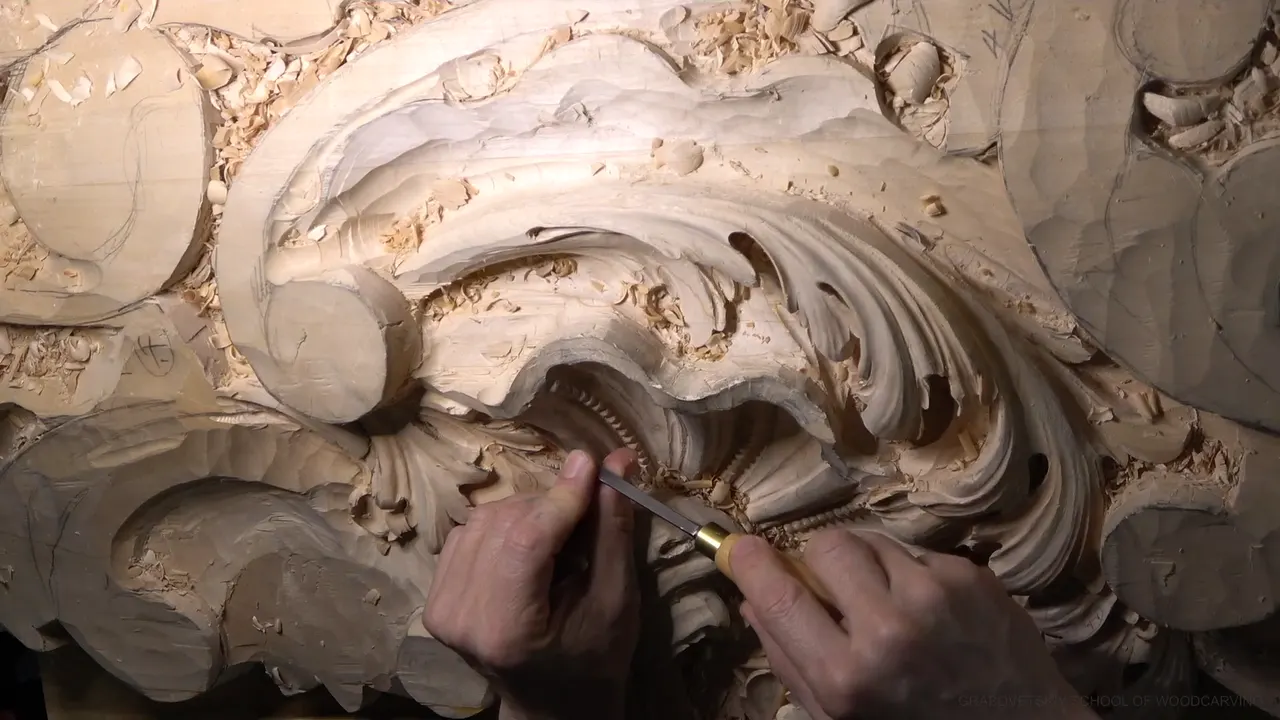
Spending days cleaning a carving is the last stage of the work, after the forms are set and the rest is nearly done. Near 06:46 in part 11 of Venice Room workshop 21, I said I spend a few days just cleaning and refining everything. Then came a second line, at 07:26: "it's never perfect."
Does your own carving look rough halfway through? Do you spot a flaw and want to fix it right now? Part 11 and my other lessons give my answer to both, and the rest of this page is my own words from other lessons, each one linked to its lesson.

The short version of my finishing stage
- Keeping the final form for the last moment makes the work look rough along the way (06:29).
- A stretch of cleaning and refining comes near the end.
- Cleaning is one move done again and again.
- My work is "never perfect," and nobody else's work looked perfect to me.
- A small flaw that bugs me gets fixed at once.
- A hand carving should show that a person made it.
What was I carving in part 11?
A movement that needed fixing. A number 5 was my first thought (00:12), and by 00:18 I had decided: yes, number five is okay. Next I said I could remove some excess material I did not need, since it blocked my movement. A bigger number 5 was probably the better choice for one nice pass right there.
I thought the piece fit almost perfectly inside, though I had no wish to force it (01:05). Around 01:29 I was cleaning again. The tool was a number 5 at 1/4 inch (about 6 mm).

Then a number 11 at 3 millimeters (about 1/8 in) went under an eye, near 03:31, to excavate. A number 7 at 4 millimeters (close to 5/32 in) followed, and then a number 5 at 8 millimeters (roughly 5/16 in) carved the letter S shape, like a wave. By 06:01 a number 11 of 2 millimeters (about 5/64 in) was digging a little more underneath. I told you I had used 3 before and had switched to 2.

At 01:41 I said I would undercut later with a number 11, I would probably say.
What makes a carving look rough until the end?
Final form is last. At 06:27 I said it plainly: I am not doing the final form until the last moment. So the carving sometimes looks a little rough. I wanted you to know why. Once the rest is finished, the work turns to cleaning, and I take everything to the edge.

Workshop 37 says the same thing. I said, now you see why I am leaving undeveloped parts (05:58). One area had no work on it, and I left that part really rough "until the last point." The last moment, I called it at 06:15, though not quite yet in that area.
A section of Furniture Panel lesson 19 could wait too. I could leave it alone for a little while (00:07). Look really close and you will see some imperfections yet, I said, since more cleaning is still ahead. I usually leave that to the last point (00:33). At 01:25 I said a quick clean with a small knife is not the final form, which is why I do not worry about it.
Rough also has a second use. Lesson 15 of the same course shows me keeping a high spot beside a line, because the router plane needed it for support (06:47 to 07:00). We were not going to shape those moldings to the last moment, I said at 07:04. The router plane was the reason for the high edge.

Why not get one area perfect before moving on?
The big movement comes first. In workshop 38, near 03:32, I said that of course I could go and clean everything and get that to perfection. My main goal first, I said at 03:44, was to establish the main movement. Next, I said, I needed to make sure I was doing the right thing (03:52).
Off camera is another place the cleaning goes. Workshop 76, part 8, has me saying I can work a little more on details, maybe off camera, since for details I need to get closer to my work and clean everything (03:10).

What does cleaning mean with a gouge in my hand?
There is nothing special to it, I said at 07:04 in part 11. All you do is just clean, clean, clean, clean, clean, and clean again. That's it.
Byzantine Acanthus lesson 10 has the same line. I called it the last operation (05:57): clean up everything, bring everything to the edge and refine all the movements. No sharp corners, and all movements flowing. If you have a number 12 knife, it makes the job a lot easier (05:36). The closing words came at 06:09, "clean, clean, clean, and clean."

Cleaning makes no new form. Modern Acanthus lesson 7 puts it this way: the same operation that does not create any form (07:12). Sometimes it takes much longer, I said, to clean all of those facets than to carve the whole thing.
Lesson 21 of the furniture course gives a small case. I was making just a small tool mark, because I had not gone all the way yet to one-eighth of an inch (about 3 mm). I can always make it look perfect, I said at 14:49, and clean everything to that tool mark.
How many days does the cleaning take?
Workshop 51 has the longer version. Its lesson page holds the line near 05:27: of course I can refine everything and create a nicer finished look, and I am going to do it no matter what. At the end I planned to work on an overall design after everything was done.
Then came 05:49. I still am going to spend a few days cleaning everything and refining everything until I'm happy with the look. Both lessons call it a few days. My own eye decides the last one.

Do I clean as I go, or wait for the end?
Both, and I said both. The bouquet lesson has the first way. Sometimes it is a good idea to just attack right away and clean everything, I said at 04:31. My reason was that toward the end you still have to clean, and some areas I do not have to revisit.
The panel course, lesson 19, left a section for the last point. Both lines hold. A place that is final gets cleaned once, and a place that will still change can wait.

The Venetian Flowers Rosette course adds a third case. In its first lesson I said I don't want to spend too much time on cleaning that stuff (21:28), since it would go even more down. For me there was absolutely no reason to do it. The result was approximately, I said at 22:02, "not to the perfection."
Another case sits in Venice workshop 72, where I wanted a really smooth transition (01:02). I can always make it to the perfection and take out those facets completely, I said at 01:19, and then I added that I did not worry too much yet about the inside.

Can a carving ever be perfect?
Mine cannot. Around 07:19 in part 11 I began to say make it perfect, then corrected myself: almost perfect. "Because it's never perfect." At least my work is never perfect, I added at 07:30.
Hashemi Flowers lesson 49 goes deeper. The hardest part for me (08:07) is how nice I want to see my final look. You can go as extreme as you wish, and there is not going to be even the end of it. Something to fix or to do differently is always there to find (08:24).

Then I passed on what my teacher would tell me. If a day comes when you look at your work and say it is beautiful and you could not make it better, he said, that is the last day of your artistry, and you are not an artist anymore. The true artist always sees imperfections in the work, I told you at 09:05. He can work on one piece all his life and still see it is not done.
Why would I want some imperfection left in?
A person carved it. In Roman Acanthus lesson 2, at 04:40, I told you that if the two sides are not exactly the same, do not worry about it. I said it is a human being doing this carving, and you have to have some imperfections. Otherwise it looks too plasticky (05:01).

The flowers say it too. I know those petals are not perfect, I said in the panel course at 00:35, which is what I'm after. Make them too perfect and they look artificial instead of natural.
Hashemi Flowers lesson 42 has a drawing version. Do not use a compass to make a perfect round, I encouraged you at 02:40. Hand-draw it, and it is actually better when it is not perfect, because it has to have some kind of waviness.

Chamomile and Bow Rosette lesson 4 puts it in one breath. I removed what needed removing, and I really didn't want it perfect (00:13). It's not about the perfection, I said. The next job was a nice downhill transition.
Back in workshop 72 I said it again at 07:10: I am not after perfection. I would not check with a ruler, I said, whether I was on a golden ratio or not. That would be too much.
What did I say about Grinling Gibbons?
At the close of this video I widened the point beyond myself. Honestly, I did not see anybody else's work that I would say is perfect (07:36). Even Grinling Gibbons did stuff that is not too clean (07:45).
That was my opinion, of course, and I said it does not make him less famous. He was one of the best wood carvers ever (08:01), and at 08:10 "not the best, but one of the best." Other wood carvers lived back then too, I said, and they created beautiful stuff, but we do not know the names of those people.

Why fix a small flaw if most people will not see it?
It bugs me. In Furniture Panel 22, at 02:27, I said that you may ask why I spend so much time on details that look insignificant to some people. My answer was that it is going to bug me. Better to fix it right now, I said, than to have it bug me for many years.
The viewers mattered to me as well. People looking at that panel would be furniture makers (03:11), and some furniture makers are perfectionists. I meant makers who can spend a lot of months on one piece of furniture, not production makers. People are not stupid, I said, and they see all imperfections, especially when we try to be authentic to the techniques.

A clean flat line can please those same people. A later panel course has me saying, in lesson 39, that I could place my big 90 millimeter (about 3.5 in) chisel right on the line and create the line with a mallet (06:11 to 06:22). That is going to give me a perfect line, I said at 06:34, and at 06:39: that's what furniture makers love, the perfection.

Does a painted piece need the same finish?
Workshop 61 gives a case with paint. I liked the line work and the finish I was getting from the tool marks (06:56 to 07:06). Maybe I should leave it like that, I said (07:08), because it is anyway going to be paint grade, so there is no need to worry too much about perfection.
In the same part I still said I needed to knock down the ridges of those pipes, because it is too sharp a ridge and not good (07:28 to 07:42).
Where did each line come from?
Here is a short record. The right column says what each line shows.
| Where I said it | What the line says about finishing | What it shows |
|---|---|---|
| Venice, workshop 21 | The last moment holds the final form | Rough meanwhile |
| Venice, workshop 51 | Cleaning for a few days until happy | Happy look |
| Hashemi lesson 49 | A true artist sees imperfections in work | No end |
| Roman lesson 2 | A human being needs some imperfections here | Plasticky otherwise |
| Furniture lesson 24 | Petals too perfect look artificial, not natural | Natural look |
| Chamomile lesson 4 | I really did not want it perfect | Stop here |
This video sits inside workshop 21, and the whole course sits on its own page, Advanced Carving: Venice Room, Part 2. The craft is wood carving, a branch of woodworking. Most of the tools named above are gouges, and the room is named for Venice.
Which part of your own carving can wait for the last few days?
How it's done
- Hold back the final form. The work looks rough on the way, I said, because the last moment is when the final form comes.
- Set the main movement first. Workshop 38 has my main goal: to establish the main movement before I go and clean everything.
- Give the end a few days. With the rest nearly finished, I clean everything and refine it.
- Keep the cleaning plain. Nothing special here, I said: one plain move, repeated, out to the edge.
- Expect almost perfect. Perfect never arrives, I said. Another lesson adds that a human being has to have some imperfections.
Frequently asked questions
Why leave the final form for later?
Part 11 (06:27) has me saving the final form to the last moment, so a carving sometimes looks rough on the way. Once nearly all the carving is in, I go over the whole piece and refine it.
How long do you spend cleaning a carving?
A few days, I said in workshop 21, and I said it again in workshop 51. There I planned to go over everything and refine everything until I was happy.
Is cleaning the same job as carving?
Cleaning makes no new form, I said in Modern Acanthus lesson 7. The operation is the same, and sometimes it takes much longer to clean all the facets than to carve the whole piece.
What to carve next