

Alexander Grabovetskiy, woodcarver, School of Woodcarving · Published 2021
What does a wood carver mean by "I wouldn't"?
Quick answer: In video 2 of Byzantine Acanthus lesson 6, I answer a question about a deeper second bowl with "I wouldn't," then say "We're still just after a shadow." Other lessons put the same words beside a depth, a mallet, big tools, sandpaper, super glue and a messy cut.
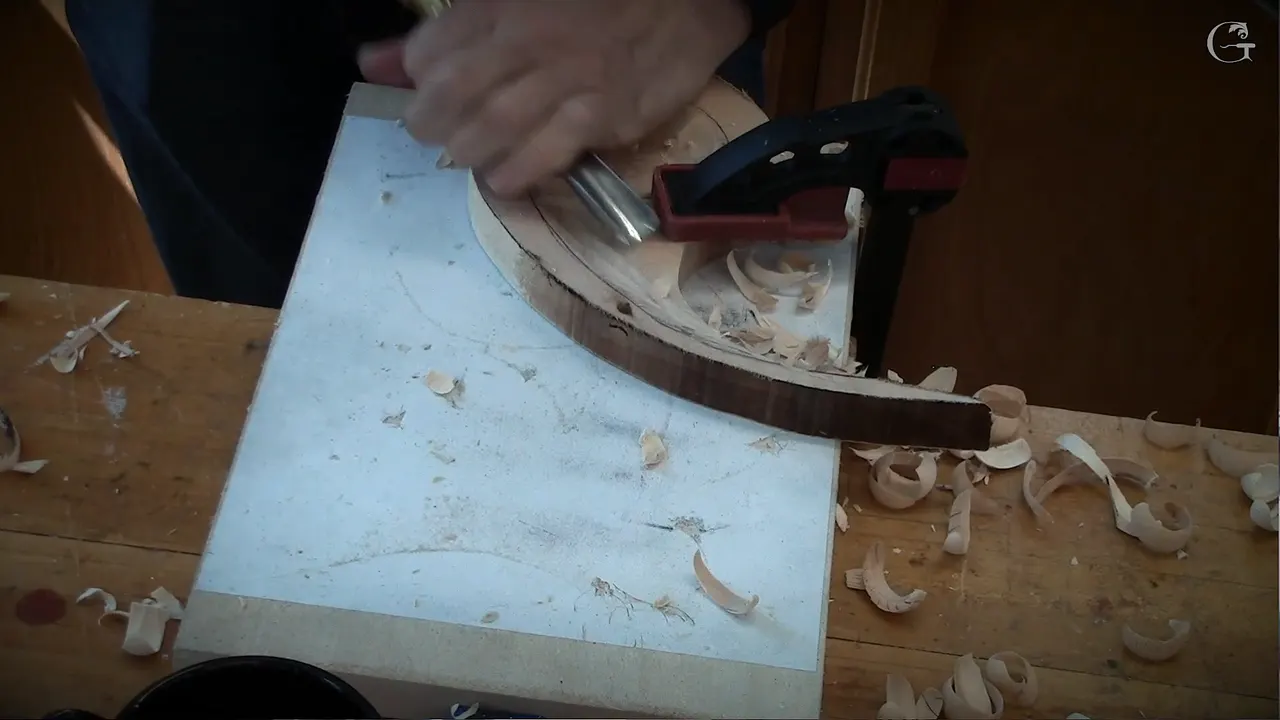

In Byzantine Acanthus lesson 6, video 2, the question comes up whether the bowl should go deeper on the second layer, and I answer "I wouldn't." Other lessons put the same two words beside a depth, a tool or a glue.
Ever dug a bowl and not known when to stop? Ever stood over a tool or a glue and felt it was the wrong one? This page starts with the sixth lesson of the Byzantine course. Then it follows my words through Hashemi, Furniture Panel, Lily Box, Roman, Greek and Corinthian acanthus, a livestream and a few more courses.
What got a no on the second layer?
The video opens with "the operation is easy." We do it "the same way" and "If you do have a clamp, you can clamp it." The question follows: "should the bowl go deeper on the second layer?"
My answer: "I wouldn't. We're still just after a shadow." Behind those words sits "there's a chance you're going to get through." A "really good blending" is still ahead. A door stays open, though: "But we'll see. We can probably deepen it later on if we need to."

Tools stay the same: "we're going to use just the same tools." One reminder about the wood follows. "We're just carving across the grain when we're just dishing out, okay? When we're just doing that bowl." And again, a little slower: "Not with the grain, but across the grain."

Next comes the pattern. "We don't need to trace anymore through the plastic. We can just actually trace the existing piece." The new piece gets extra length: "I cut another piece, and I left little longer just in case. I want to make sure it blends really nicely."

Glue is next: "And now I'm going to just glue it on top, okay? And clamp it. We might going to need more clamps." A yellow wood glue does the job, and the original or the second kind will do. The third kind I don't like for this project: "For the outside is good, but it just takes too long to dry." With the first two, "half an hour and you already can carve."

My plan for the pieces: "So all three pieces together. And then I'm going to start carving." A re-glue comes later: "we have to re-glue later on, on a piece of paper." The video ends with a word for anyone who wants a mark inside: "if you want to put something inside, like a signature or something, it's time to do before you glue it."

How deep was too deep elsewhere?
An outline gets its depth first in Hashemi Flowers 5, video 1: "Approximately maybe eighth of an inch, I would say" (3.2 mm). I try more: "maybe even 3/16 is going to give even more three-dimensional look. Let's do that." The tool is a "bigger V tool" and "this one is a number 16 and 6 millimeters, or quarter inch, if you are in USA."
A little later comes the limit: "I wouldn't do deeper than 3/16" (4.8 mm). I give the reason right away: "if you will do little more than 3/16, then it's going to be bumpy" and there is "too much bump in this area."

A groove shows up in Furniture Panel part 3, lesson 32, video 3. I plan to use "half a millimeter number 11" (0.02 in). On depth, I say "Doesn't have to be too deep of a cut" and "That's about one millimeter or so, maybe little more than one millimeter" (0.04 in). Past that, "I wouldn't go like millimeter and a half" (0.06 in), and "That would be little too much."

Crunchy wood is the topic in Lily Box 2, video 9, and the depth is the viewer's call, "up to you how deep you want to go." About the wood I use: "I wouldn't go too deep if you're using the same wood like I use because it's kind of crunchy, and you can actually break the edge." Right after, "Just blend" and "please spend your time with this work."

How far should a pass or a detail go?
Close to a line is the topic of Roman acanthus 2, video 2, where I work with "number three and half an inch" (13 mm). "I'm getting kind of really close, but I would not suggest you to do that," I say. The gap I name is "about one millimeter" (0.04 in). My own mood is "I feel confident" and "I don't think I will mess up."
Scale changes the answer in Lily Box 5, video 9. "And the scale is small. We're talking about just a small box for the Bible, and those small details, they're going to make big difference." After that comes "On a bigger carving, I wouldn't do so many subdivisions" and then "on this one, I think it's a good idea."
How often is the topic in Hashemi 47, video 9: "those are small details" and "They have to be random, not as often, because it's going to be too much."
Which mallets and tools did I leave alone?
Tiny tools are the topic in video 2 of Roman acanthus lesson 3. I say I could use "probably the same eighth of an inch" (3.2 mm), "number eight." Then I turn to the mallet: "I would not recommend to use any mallet, but if you're careful, you could probably." The verdict is "it is better not to use a mallet on really tiny, small tools."

A really long bevel is the topic of Venice Room 41, video 4: "With the really long bevel like this, I wouldn't use it on a hardwood because you can break the tool." My fix is "a different number seven with a little smaller bevel" and right after, "See, that's much better."
Size is the topic of Roman acanthus 9, video 1. "The bigger tools here, they're just going to create damage," I say, and "I would not use any big tools in areas like that."
Two mallet clips point two ways. In the Dotted Background Texture video, a mallet "if it has a plastic and a rubber" works, or "just a regular mallet also." The one made of wood I leave alone, "because you're going to damage it, because you're using the wood against the metal right here." In Rosette Workshop 6 the tool is a punch about half an inch (13 mm) round, and I use "a normal carpenter's mallet with the plastic at the end." You can use "any type of mallet," I add, and "I wouldn't use any metal one."
Divisions come in Furniture Panel part 3, lesson 33, video 2. I plan "Number 11" and I add "I would not use V two in this case."
The Dining Table Apron course has a direction rule. In workshop 7 I talk about "when you're removing that background." The line is "I would not put my tool with the grain, although I could, but it's more dangerous" and then "You can hit this side, and you can just kind of snap it. And I've done it, so I'm telling you from my experience."
Which wood did I not recommend?
Someone asks in the livestream of April 13, 2020, "What other wood do you best with?" Basswood comes first: "The best is, of course, basswood, especially if you want to start carving." I name two woods: "I would not recommend to use poplar." maple gets the same answer. They are "both carvable," I add, and "You can use almost any wood pretty much," but it will be "difficult."
What about sandpaper, glue and tape?
Finding ridges "before you make the final cut" is the job in Lily Box 4, video 10, and I want "nice movement." My line on paper: "I wouldn't use sandpaper because sandpaper leaves abrasive inside of the wood fibers, and your tool is going to become dull really quickly." A way out stays open: "as an option, if you like to do that, you could do that."

Dutch reed stands in for paper in Greek acanthus 15, video 1. I do not recommend sandpaper there either: "You still would use probably Dutch reed and kind of make it little more smooth if you wish." Later, in Lily Box 12, video 7, I say "I could hit that with the sandpaper, by the way" and then "Not much. I wouldn't do too much."
The Grape Onlay final assessment puts a floor under it. Any sandpaper will work, I say, but "I would not go lower than 100 grit because it's gonna be hard to take care of" later. A finer pick: "I would take probably 240 in this case."
Glue is the subject in Lily Box 3, video 9. Any type of glue could do, I guess, yet "I wouldn't use super glue, okay?" My reason is longevity: "Longevity or longevity, however you pronounce the right way, it's not there."
Thin glue is the subject in Rosette Workshop 5. Some glues are "really thin" and are "penetrating inside of the wood fibers." I add "I wouldn't use it if you are planning to finish it with some type of stain or lacquer," because it is "noticeable." The other kind is "just yellow glue, normal yellow glue."
Holding the work is the subject in Grape Onlay 10, video 1, along with double-sided tape. Not just any tape, I say, and "carpet double-sided tape" is "too, you know, heavy duty."
What waited until later?
A V tool and a 90 degree side are in Greek acanthus 3, video 3. "If you're not really accurate, even if you kind of slightly undercut, it's not a big deal, although I wouldn't do that yet." I say it again, "Okay? I would not do that yet" and give my next order: "start outlining your piece."
Extreme undercutting gets a split answer in Corinthian acanthus 5, video 1. "Some people saying you should not do that, and that is probably true if you're doing that for furniture." For something "heavily used," or touched "all the time," I would not suggest it.
The other side: "But if it's a piece of art, I go to the extreme." And: "Sometimes you can see on some of my work, it's so much undercut it can easily break."

Separations get advice in Grape Onlay 9, video 3, with a number three at "three millimeters" (1/8 in). The advice: "You could fix your separations" and "I wouldn't do all of them right now if I would be you because it becomes fragile."
What could stay messy?
Greek acanthus 3, video 2, is about chopping away "a lot of stuff." "It is important," I say, and "I wouldn't worry about if it's not too clean right now." Then: "A little too messy. It's absolutely fine with me."

Chamomile and Bow Rosette 1, video 2, has it too: "If it's not really clean, I wouldn't worry about it right now." The next line ends with "go back and take care of it."
A brand-new tool can give trouble with the metal on the sides, I say in the V tool sharpening lessons, video 3. It can be "thicker on one side and thinner on another side." Even so, "I wouldn't tear my hair." It is "still workable. You sharp it, and you use it. You don't throw away."
Byzantine Acanthus 7, video 3, brings "clean up cut somewhat." And: "I wouldn't call it clean, but it's still, just to get that out." Then: "I don't see a 3D movement yet. So I need to blend that better than what I have, okay?"

Small flowers come in Lily Box 12, video 4. For scrolling, "just try to find the best grain for the flower, okay?" My line on direction: "I wouldn't really worry about the direction overall." There is one more: "Of course, there's one main direction, but it's not as critical with the small flowers."

Venice Room 121, video 1, has a cut that "must be 90 degrees down." On one piece alone it would not worry me, "but I have to do opposite side." The second side is "equal, just flipped."


Which lessons said it, and about what?
| Lesson | Action | Reason |
|---|---|---|
| Byzantine Acanthus 6 | Take the bowl deeper on layer two | It's only for the shadow's sake |
| Hashemi Flowers 5 | Carve the outline past 3/16 inch | Too much bump in this area |
| Furniture Panel 32 | Go to a millimeter and a half | That would be little too much |
| Lily Box 2 | Go too deep in the crunchy wood | You can actually break the edge |
| Roman Acanthus 3 | Use any mallet on tiny small tools | If you're careful, you could probably |
| Roman Acanthus 9 | Use any big tool in those areas | Bigger tools just create damage here |
| Livestream April 2020 | Recommend poplar or maple to start carving | They're both carvable, but it's difficult |
| Corinthian Acanthus 5 | Suggest extreme undercutting on a furniture piece | Heavy use, and hands on it |
| Greek Leaf 3 | Start the undercut just yet, even slightly | Slightly undercut, it's not a big deal |
| Grape Onlay 9 | Fix every separation right now with small tools | Because it becomes fragile |
Which depth, tool or glue in your own work might get a quiet no from you this week? A number after a course name is the lesson, and "video" is the part. The courses behind these lessons sit inside one tuition plan. The Byzantine Acanthus course page holds all ten lessons, and lesson 6 is where the second bowl stays shallow. Wood carving and relief wait there, with acanthus running through the course in Byzantine style. Sizes follow my own figure first, then the other unit in parentheses, such as an inch figure beside millimeters, or a gouge number beside its width.
How it's done
- Keep the second bowl shallow. Asked about a deeper bowl on layer two, my answer was no, since the job was a shadow.
- Dish the bowl across the wood. Dish it crosswise to the grain, not along it.
- Name your depth. In the Hashemi lesson the outline stopped at 3/16 of an inch (about 5 mm).
- Match the tool to the spot. Roman lesson 9 says bigger tools create damage there.
- Let a messy cut wait. Greek lesson 3 and the Chamomile lesson both call a cut that is not clean fine for now.
- Hold the extreme back. In Greek lesson 3, the undercut waits, even a slight one.
Frequently asked questions
Should the bowl on the second layer go deeper?
I answered no. I called the job a shadow job, and a deeper bowl risks getting through the wood. I left one door open for later, in case the bowl needs it.
How deep did I stop in the Hashemi flower lesson?
The outline stopped at 3/16 of an inch (4.8 mm), cut with a V tool. A bit past that makes the area "bumpy," I said, so the limit was firm.
Why would I skip a mallet made of wood?
Damage was my word for it. I said the wood goes against the metal right here. A mallet with plastic and rubber works, I added, and so does a regular one.
What to carve next