

Alexander Grabovetskiy, woodcarver, School of Woodcarving · Published 2022
What is a #1 gouge used for?
Quick answer: A #1 gouge is a flat chisel with no sweep, so strictly it is not a gouge. On my panel I named a small double bevel one for a triangle, for the facets and for a tight corner by a molding, and a tiny one needed a finger to hold it.
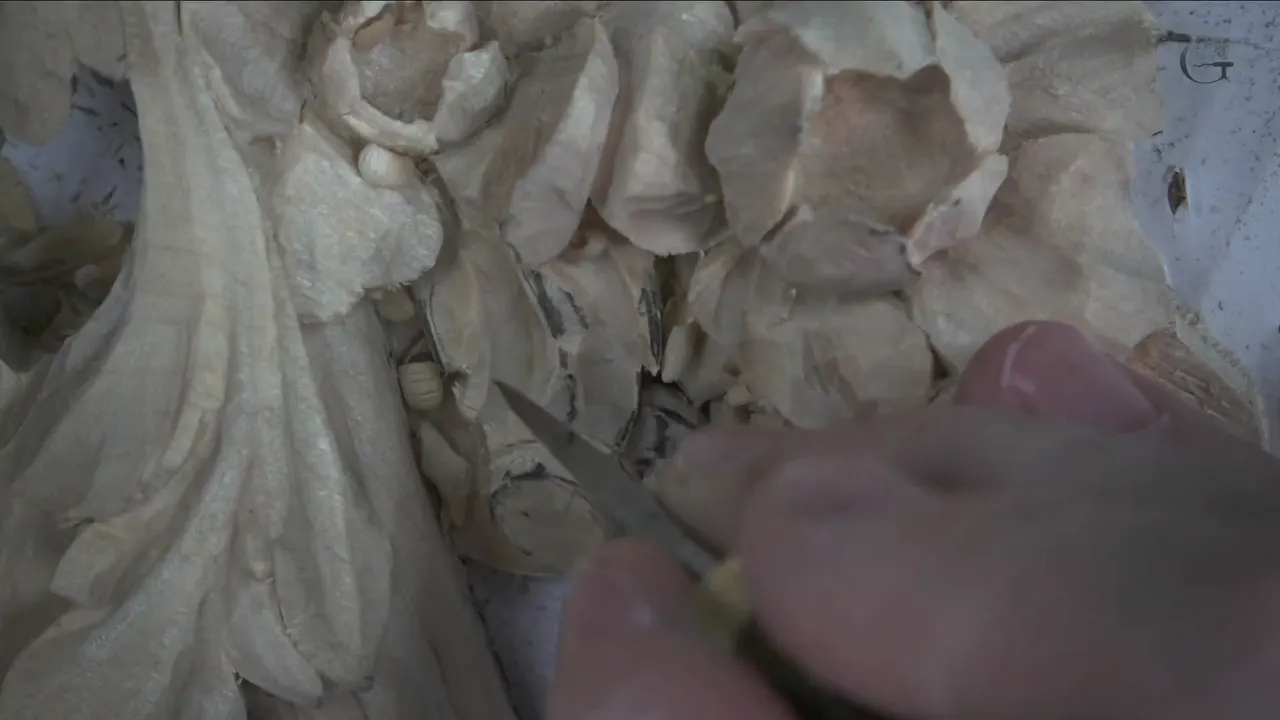
A #1 gouge is a flat chisel, because its edge has no curve across it. In lesson 9 of my floral and molding panel I picked a small one, beveled on both sides, to take a triangle out, and I named it again for the facets and for a corner next to a molding.

Look at the flat tool in a set of carving tools. Does it look too plain next to the curved ones, and can you picture it doing real work on a leaf? Mine did, in small spots, over and over. Here is where, starting with lesson 9, and after that my words from other lessons and courses, each one named and linked.
Six lines on the flat chisel
- A number one has no sweep, so it counts as a chisel.
- The one in lesson 9 was small and had a bevel on both sides, the kind I call a double bevel.
- I called for it to remove a triangle and to clean facets.
- A tight corner by a molding came next, in part 2.
- Other lessons show single bevels, big sizes, and a job much like the work of a knife, done with that flat chisel.
- My sizes ran tiny and big.
Is a number one a gouge or a chisel?
A chisel. Back in lesson 2 of this course I held a small, tiny antique number one that I still called a spoon, and I named it on the spot. "It's a spoon chisel because it's number one." After that came the rule. "As you know, a chisel is always flat." It's the absence of radius, I said, the absence of sweep, and if it has a sweep, then it's a gouge.

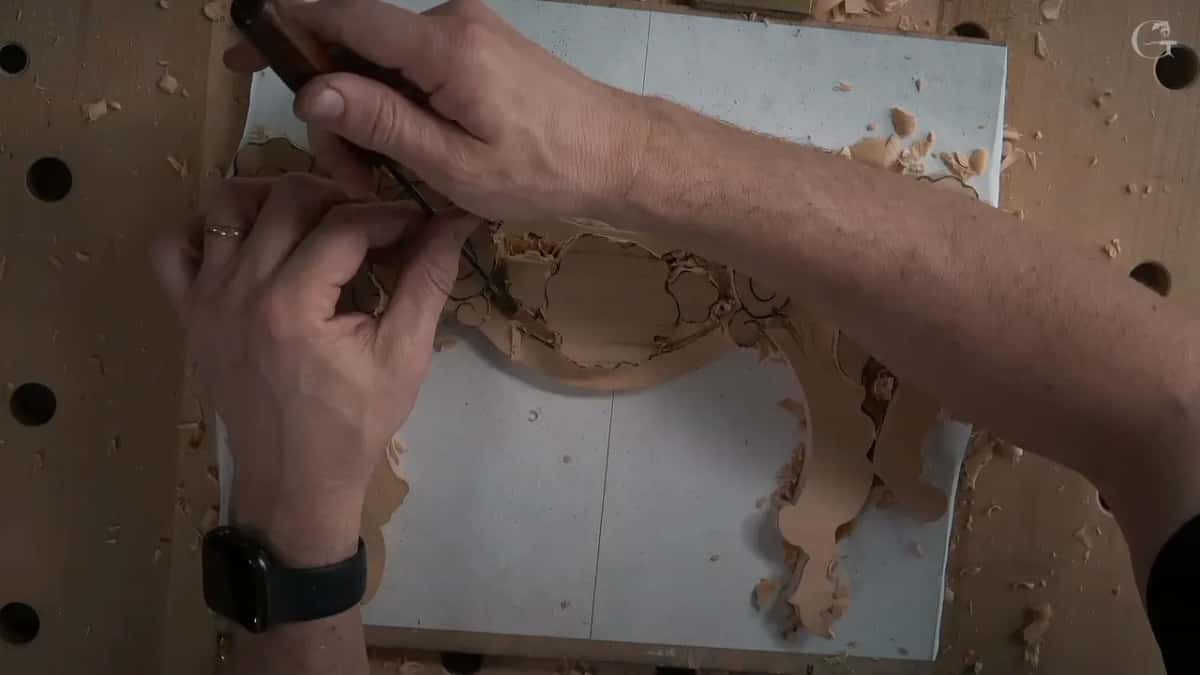
The Lily Box course says the same in lesson 10, and I was blunt about it. "Number one is always chisel." Greek acanthus adds a size. There, lesson 7 had me take an eight millimeter (5/16 in) one with a double bevel, a straight chisel that is neither a gouge nor a veiner.
A molding course of mine repeats it. On the third part of lesson 10 I reached for a first gouge and said, "It doesn't have to be a gouge," and "it could be just a chisel like number one."
"Chisel is a number one. It's absolutely straight." I put it that way to a beginner class, showing one to the camera in cutting board workshop 16. It is marked as number one, with a single bevel or a double side bevel. Where you live changes it a little, since a number two in the UK would be a skewed chisel. Wikipedia covers the chisel and gouge.


Where did the number one go in part 3 of lesson 9?
I was shaping the outside of a section, and I said what I wanted. "An outside shape I can just use number one. Double beveled, and get the triangle removed." Then I said again that I did not want too many details in that section. "There is no reason for me." All I had to do, I said, was blend it and make it look nice.
Some facets stayed on that section on purpose. I like a clean surface, but I said I was not going to take too many of them out, because they were working for me. They would make an interesting shadow. I still had to clean the spot, though "not as much," and I said that twice.

A little later I named the flat tool again. "I'll use a spoon, but in this case, it is a number one. Spoon chisel, I could call it." Same name as in lesson 2. I looked at how the whole section read together, and then I moved on to the next part of the piece.

What did it do in parts 1 and 2?
Part 1 ended with a flat tool, named before I used it. For the last cleaning I would take a small tool like a spoon, "but flat, really flat, pretty much like number one, just almost like a knife." It would go after all those facets and blend them. I told you I would do that off camera, so you did not have to watch the whole process.
Part 2 handed it a corner. I was working near a volute and had to be careful in one corner, because the miters for the moldings were still to come. My plan was a small one, "like a double bevel both sides, number one, and attack that." Damage to that point was the worry, since I had to get the miters to it and attach the moldings.

Later, one more spot was hard to see, and it had to go. "I'll take, again, just the number one, but the small, tiny one, like a one-eighth of an inch" (about 3 mm), I said, "and work my way in." And yes, I said, "in this case, I have to hold it with a finger." Then came "I think it's enough," and a promise to stay there only briefly.

Other straight tools came up in lesson 9 as well. For a slope in part 2, I said any straight tool will work, and my pick was "number two, that's what I'm going to use, or number three and number two will work." During lesson 4 I caught myself in the middle of a sentence. "You could use just number one. Not number one, but number two or number three," placed 90 degrees down with a mallet. "That also going to work."
Why pick a number one when a knife would do?
At times I named the chisel on purpose. For lesson 12 I wanted everything brought to the edge of an undercut, and I said it out loud. "It could be done with the knife, but I'll use a number one chisel, a double bevel. Really, really small one." Lesson 5 had me going back and forth. "I could use probably even knife. Maybe I should. But it's okay."
The Roman acanthus course is plain about it. Its lesson 10 has me saying, "I really love to use a double bevel number one in some of my carvings." It works just like a knife, but it's a chisel, and the small one was in my hand. Some people call a small tool like that a lazy hand carving tool. I don't completely agree, I said, because it's just handy to have small tools you can use to reach areas when the big tool is not as convenient.

Its lesson 16 comes at it from the other side. "You don't have to use a knife. If you have a number one, just a chisel or a single bevel, or if you have a double bevel." Mine was a double bevel from Ashley Iles, the Peter Benson collection, and I said it's more for the details. A knife stays an option beside it.

Over in Maine, lesson 15 of the Grinling Gibbons class adds a reason I like. Because it's so thin, I said, "I can just dig inside of the fibers without creating a lot of stress."
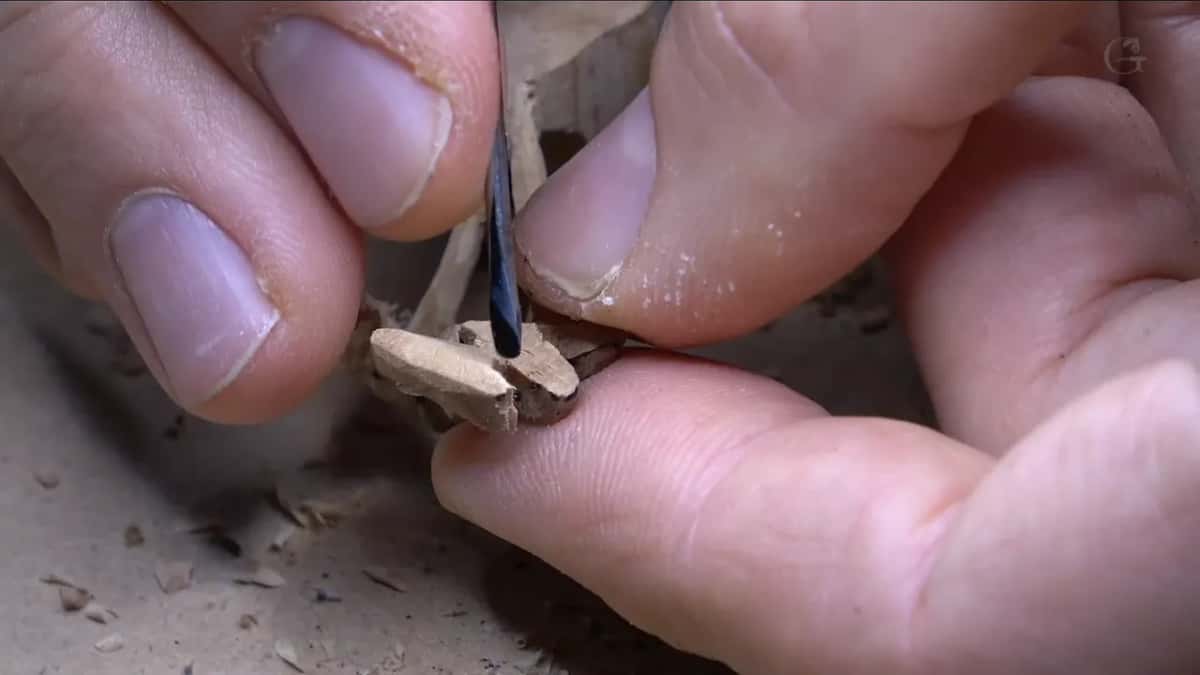
The Hashemi flowers course makes the same offer in lesson 20. "Be really careful." Next came the offer. "You could use an actual number one in this case also, or even knife will work."
The Furniture Panel course gave the corner job to a knife or a chisel. In lesson 15 I said a small knife or small chisel will do, though I really like a tiny small knife by Ashley Iles, Peter Benson collection. Getting inside that corner, I said, I could achieve with the number one, only a chisel, in either bevel. And maybe a smaller number one on the inside, just like that.
Does a number one have one bevel or two?
A single bevel is the plain one. In Venice Room lesson 149 I said I would take it for a straight down line along a molding. "It's also called just a carpenter's chisel." The plan was to place it on the line and go straight down, and I told you not to undercut if you're working with moldings, because that would be a big mistake.

In this course the one I named, lesson after lesson, was the double bevel. I took the tool with these words in lesson 5. "So bevel on both sides, pretty much." Roman acanthus lesson 2 says either kind will do, since "even a single, just the carpenter's chisels will do." A short page on the bevel itself sits on Wikipedia.
The Venice Room, lesson 30, shows a swap. I reached for a double bevel, stopped, and changed my mind out loud: "I need to use different one, different number one." The new one had "a much longer bevel. So much longer bevel." With it, I said, I could take the work all the way to the edge.
How big is a number one?
Big or tiny. Over in lesson 5 of the Roman acanthus course my goal was "a straight gouge, not a gouge, straight chisel," to remove the sides going downhill, a straight cut down. "If you do have a big chisel like this, number one, that's three inches, it would help a lot." Three inches (76 mm) was my figure, and the card on the screen read Straight Gouge #1, 3 1/8 in (80 mm). A smaller chisel, I said, gets the same results.
Then lesson 8 sent me back to the big one, to protect one section from an undercut I did not want. At the other end are the tiny ones. The Chamomile and Bow Rosette course names one at 1/16 of an inch (1.6 mm), and I said the chisel means number one.
| Where | What it did | Size | Note |
|---|---|---|---|
| Roman acanthus 5 | Goal was removing the sides, straight down | 3 inches (76 mm) | Smaller chisels reach the same result |
| Greek acanthus 7 | Straight chisel, two bevels, not a veiner | Eight mm (5/16 in) | Single bevel comes too, I said |
| Lily Box 2 | Blended the ridge until it almost disappeared | 14 mm (9/16 in) | I called it half an inch |
| Floral molding 6 | Planned to shape it little by little | Five mm (3/16 in) | Five millimeters or so, I said |
| This course 12 | Tiny chisel, double bevel, named for cleaning | Three mm (1/8 in) | Looked like 4 mm (5/32 in) |
| The corner job | Tiny one to work my way in | One-eighth inch (3 mm) | I held it with a finger |
| Chamomile rosette 1 | Small chisel to refine toward the center | 1.6 mm (1/16 in) | Chisel means number one, I said |
One tiny chisel, double bevel, in lesson 12 of this course was "supposed to be like one-eighth of an inch, three millimeters, but it looks more like four millimeters, I'd say." That works out to about 5/32 in. My plan in lesson 6 was one of about 5 mm (3/16 in) after a preliminary undercut, then shaping the part little by little.
Lily Box used it two ways in lesson 6. My choice was a double bevel of about six millimeters (1/4 in), "Straight down." Later came the plan to take a double bevel again. "And I'll go downhill."
Lesson 8 of that molding course shows what a small one leaves behind. Mine would be one-eighth inch (3 mm) in my case, I said, attacking from the side. Later I had a wall of maybe a couple of millimeters (about 5/64 in), and I said it was going to give me "really beautiful shadow."
Can a number one blend a surface?
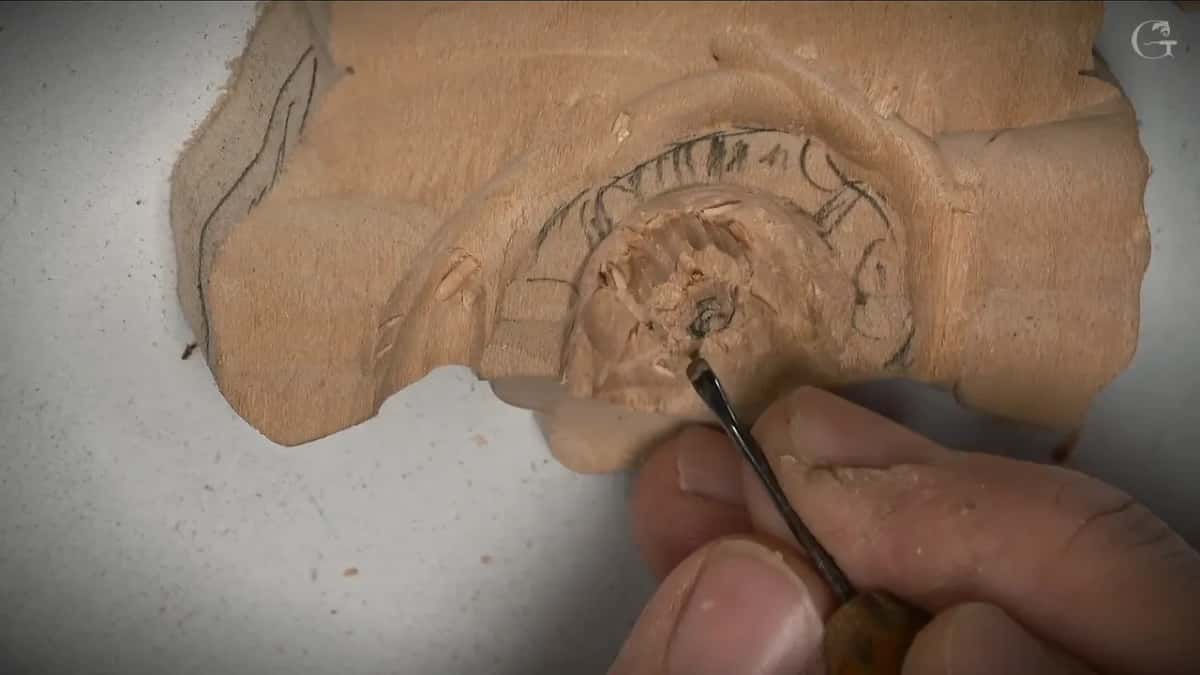
It did in Lily Box lesson 2. I took one to deal with a ridge, the connecting line between a blending cut and a straight surface. "And blend that even more until that line almost disappears." That chisel had a double bevel and measured 14 millimeters (about 9/16 in), which I called half an inch.

Here on the panel, lesson 11 had me reach for a small chisel at an intersection. "I'm going to kind of blend it much better." It was not that bad, I said, but "it doesn't look too nice in my opinion." The intersection line has to be higher than anything else, so it cannot go right underneath. I came back with the chisel afterward, and I said so. "I'll attack that."

A short list for blending one side came in Venice Room 28. "Maybe with number three or number two, or even I could use just a double bevel number one." And the 159th lesson says any flat tool will do it, "even with the number one, so you can blend both directions."
Where does this part sit in the course?
This video is part 3 of lesson 9 in Carving Floral and Molding for the Panel. The panel is relief work, one kind of wood carving, and its leaves follow the old acanthus shape beside a molding. The Acanthus over Moldings course takes the same kind of leaf on a molding further.
Which flat tool sits unused in your rack? Access to the school puts every lesson of this panel in front of you on video, the small flat chisel included.
How it's done
- Read the edge. Look across the edge of the tool. If I see no curve at all, it is a chisel, and a number one is just that.
- Choose the bevel. One bevel means the plain carpenter's chisel. Two bevels, one on each side, is what I picked up in lesson 9.
- Take the triangle out. For the outside shape my pick was a small flat chisel with a double bevel to get the triangle removed, and I said there was no reason for many details in that section.
- Go small at a corner. Near the molding I wanted a small one, since that point could not be damaged before the miters went on.
- Clean the facets lightly. I named a flat tool for the cleanup, a spoon chisel in my words, and I left some facets because they were working for me.
- Blend the ridge. In another course a number one blended a ridge until that line almost disappeared.
Frequently asked questions
Is a #1 gouge really a gouge?
Its edge is flat across, so I call it a chisel. Lesson two showed it, with a small antique one in my hand, and I said a sweep is what makes a tool a gouge. In the UK, a skewed chisel carries the number two, I told a beginner class.
What separates a single bevel chisel from one with two bevels?
One bevel means the plain carpenter's chisel, and I wanted it for a straight down line along a molding in lesson 149 of the Venice Room. A double bevel has a slope on each side, and that is what I named for the triangle and the facets on my floral panel.
How small is a number one at its smallest?
Small, in my lessons. One on the floral panel was meant to be about 3 mm (0.12 in), though it looked closer to four millimeters (0.16 in). In my Lily Box course I wanted one of about six millimeters (1/4 in), straight down.
What to carve next