
August 28, 2024 · Updated October 7, 2026
By Alexander Grabovetskiy — Master Woodcarver · Founder, School of Wood Carving · 18 min read
What does rot resistant wood mean?
Rot resistant wood is heartwood whose own chemistry fights the fungus that eats wood. The Forest Products Laboratory sorts that heartwood into four classes, and only the top class is expected to survive contact with the ground. I carve basswood almost every day, and basswood sits at the bottom of the same list. Black locust sits at the top.

Most boards on this bench end up in a room somewhere. When I carved for outside, I used cedar and cypress.
You want to carve something that goes outside and is still there in twenty years.
Let me be honest before we start. Most of what I carve lives inside. Furniture panels, corbels, ornament for rooms people live in, that is where over forty years of that work mostly went. I have done some carving for outside too, and for that I used cedar and cypress, because they are not going to rot as much.
So the species list here is not mine. It comes from the USDA wood laboratory in Madison, and I name my source every time.
The other half of this answer is mine. I can teach you to read a board before you trust it with a hundred hours of work. Plus why the old carvers made outside work bolder than parlor work.
- Rot is a fungus feeding, and it needs water in the wood to start.
- Only heartwood carries the defense. Sapwood off a durable tree gets the worst rating Europe hands out, every time, no exceptions.
- Basswood, maple and beech sit in the bottom group.
- Ten percent of the weight gone, half the strength gone.
- Dry wood does not rot at all, and the Laboratory draws that line at 20 percent, so a wet spot matters more than the species does.
What actually makes one wood rot and another one last?
Fungus eats wood, and fungus can only eat wood that carries water. Take the water away and the whole business stops.
The 2021 Wood Handbook runs to 543 pages, and its chapter on wood deterioration splits decay into kinds. Brown rot fungi eat the cellulose and leave the lignin, and they usually go for softwoods. White rot fungi eat both. A third kind, soft rot, comes from a fungal family nearer the molds, and stays shallow.

Sound wood under a sharp gouge gives you an edge you can see across the shop.
The prevention line in that chapter is one number. Keep wood to 20 percent moisture or less and the fungus never gets going. Species is the second argument here, not the first.
In my design class I call it a war between fungus and fungus. On a spalted board you can see the border where two of them met, a dark line, and one has always taken the most territory. A live fungus keeps moving. Spalted wood has to be dried well before it rots to death.
I know what damp does to a building, too. They held me for a while in a pitch black cell under a 300 year old building, damp the whole way through, moldy.

Weather would take this undercut off a piece first, so work like it stays indoors.
Which woods does the Forest Products Laboratory call resistant?
Heartwood goes into four groups, and just the first group is expected to work in the ground. Table 14-1 of the handbook names them: very resistant, resistant, moderately resistant, and slightly or nonresistant.
Among American woods the top group is short, and it holds black locust, red mulberry, Osage-orange and Pacific yew. Most woods you have heard about live in the resistant group below it: the white oaks, black walnut, old growth redwood, the whole run of cedars.
Basswood is in the bottom group with the maples, birches, beech, hickories and yellow-poplar. My everyday carving wood, and I will not pretend otherwise.

Look along the rounded top edge and you can count the open pores, which is oak telling you what it is.
Here is the part most pages get wrong. The rule printed beside that table says resistant heartwood generally serves above ground, while the very resistant class is the one expected to perform in soil contact. The other two groups need treatment.
The phrase rot resistant wood on a lumber yard sign means nothing until somebody tells you which of those two jobs it was rated for.
| The species by name | Decay class in Table 14-1 of the handbook | Crushing strength, dry | What the pairing means for a carver |
|---|---|---|---|
| Robinia pseudoacacia, black locust | Top of the four groups, very resistant | 10,180 pounds per square inch | Punishing on steel, and the tables call that the price of soil contact |
| White oak, the stave oak | Resistant, and that is one step down from locust | 7,440, dents at 1,360 pounds | Open pores fight against fine detail work |
| Teak, old growth | Very resistant when the tree was old growth, and only moderately resistant when it grew on a plantation | 8,410, from the handbook's imported-woods table | Silica inside it, so your edge pays |
| Western redcedar, Thuja plicata | Resistant, and the shingle wood of the west | 4,560 dry, under basswood | Light in the hand, durable outdoors, and that pairing is rare |
| Northern white cedar | Resistant class as well, one step down | 3,960, below even basswood | A weak wood that lasts anyway |
| American basswood, Tilia | Slightly or nonresistant, the bottom group of them all | 4,730 at 12 percent moisture | It belongs indoors, with me |
Those crushing numbers come from Table 5-3b of the same handbook, set beside the decay class on purpose. Read the cedar row twice. Northern white cedar crushes at a lower load than basswood, and the Wood Database calls it one of the very lightest and softest domestic woods, rated durable to very durable anyway. Strength and durability are separate questions.

Those dark streaks in the flat ground are pores, and outside they hold whatever lands in them.
Two corrections before you quote me. The Wood Database rates white oak very durable, pointing at boatbuilding and cooperage. The government table puts the white oaks a class lower. Both are published, they do not agree, so name whichever you use.
Teak is the other correction. Old trees make the very resistant teak. Plantation teak is only moderately resistant, and that is most of what sells now. Teak also carries up to 1.4 percent silica, and silica does to a gouge what a sidewalk would do to a pencil.

This one is a dining table and will outlast me. Which tells you nothing about oak in the rain.
For that ranking with a calendar attached, Swedish Wood publishes service life for heartwood buried in soil, measured by RISE on sticks 20 x 50 x 500 mm. Spruce, birch and alder: under five years. Pine and larch get five to ten, oak five to fifteen, locust past fifteen, teak past twenty five.

One dining table takes four of these, so a species decision is never about a single board.
Why does durability stop at the heartwood?
Extractives are the reason, and a tree only puts them where its living cells have died. Its own chemistry, deposited in the heartwood as the heartwood forms.
In the handbook's chapter on the structure of wood, teak is the example: stability and water resistance come from waxes and oils formed in its heartwood. Then the text says the quiet part out loud, since for species like that sapwood has little or no value.
Chemists have named the families doing the work. A 2024 review in the journal Insects lists terpenes, stilbenes, resin acids, tropolones and antioxidants. Western redcedar brings thujaplicin and water soluble phenols to that fight.

The dark piece underneath is the original I had to match, species and part of the log.
Europe writes the rule harder still. The five durability classes of EN 350 start at very durable, end at not durable, and a note restricts every class to heartwood, with sapwood in the bottom class. A teak log's sapwood is not durable teak. It is just wood. The 2016 edition of that standard covers beetles, termites and marine borers too.
Now the part that should worry you at the lumber yard. The handbook warns that marketable sizes of some species are second growth carrying plenty of sapwood, and says plainly to use heartwood. Nobody volunteers which half of the log you hold.

Blue and red lines survive where I have not reached yet, and get redrawn many times.
My own experience of the middle of a log is about movement, not decay, and I keep those apart. Nearer the outside, wood puffs and expands much more. Near the heart it hardly moves. Heart pine held up big American factories in the 19th century for that reason, out of the middle of huge trees.
I had a project in heart pine once. Hard as a rock. I broke a lot of gouges carving it by hand, you can barely drive a nail into it, and the same center-of-the-log rule runs through basswood too.
One more thing about extractives that carvers never hear. They get used up. A 2022 study in Frontiers in Plant Science watched a brown rot fungus work on Scots pine heartwood, and the stilbene content fell below a quarter of the original before even 1 percent of its mass had gone. Defense gets stripped first, while the board still looks perfect.

One clamp, one panel, and the bottom of that drawing has a long way to go.
Standing trees lose the same defense. The Forest Service says western redcedar's protective extractives are eventually detoxified by invading fungi, which is why living redcedars carry more accumulated decay than any other major conifer in British Columbia. The most durable conifer in the west rots from inside.
Locust does it differently. Locust borer larvae tunnel through the wood, those holes let heart rot fungi in, and damage can be bad enough that the trees are not fit for fence posts. Very resistant heartwood, unusable log. A pity, since fence posts are what locust is famous for.
How do I spot rot in a board before I carve it?
Color tells you first, and then the fiber under your edge tells you the rest. Both signs arrive long before anything looks rotten.
Whenever I see a dark spot on lime wood, that is a water mark. Damaged wood. It already started to rot, and it is already much softer, so be careful which tools go in there.
Green is the other color. In a Venice Room workshop I stopped on a section and said out loud that you can see the color there, it is green, which means water damage, and water damage means rot has started. Sharp tools are a must there or every cut comes out dirty.

A shaving like this is my best rot test.
Here is the part I care about, and no chart carries it. The trouble goes past the wood simply being softer. The structure of the fibers is different. Mushy, and I do not even know if there is a word for it. Maybe I made that word up myself, but it is exactly what the stuff feels like.
That is what you are doing when you test a suspect board. Listening through the steel.

My left fingers stay flat on the blade because they feel a change before my eyes do.
Laboratory numbers say I am not being fussy. In their tests, toughness fell anywhere from 6 percent to more than half by the time wood had lost 1 percent of its weight. At 10 percent weight loss, most strength losses run over 50 percent, and decay is still only detectable under a microscope.
Put that beside a carving. A board that quietly lost a tenth of its weight to fungus has lost more than half its strength, and it still looks fine. Their own text adds that wood with visible decay has been greatly reduced in all strength values, and that brown rot does more early damage than white rot.

I redraw as I go, and any soft grey patch under the pencil is where I stop and think.
Old news at the lab. The 2010 edition printed both findings in the same words.

That pattern stays on the bench all day because I keep going back to it.
Does a finish make wood rot resistant?
A finish buys time, and it changes nothing about what the wood is. Film over a nonresistant species is a delay.
Go back to the one number. Below 20 percent the fungus does not grow, so every honest thing a finish does is keep water out and let whatever gets in dry back out. Chemical treatment is the reference answer when natural durability runs short, says the handbook chapter on preservatives, which tests treated wood against fungi, marine borers, termites and bacteria.

Same pattern, same shop, and the dark one survived by living indoors.
For carvings that already went soft, there is a product conversation. Penetrating epoxy beats CA glue on a punky area, because CA glue has only about a five year span. Stores also sell a rot protection solution for rotten outside wood, and soft wood soaks it up and comes back solid without darkening.
All of which consolidates wood that already went bad. No product makes a nonresistant species behave, and I have never used one that way.
What a finish does do is worth its own reading. We have pages on finishes and sealants, on sealing wood after carving, on how a lacquer finish works and on how many coats a durable finish needs. Oil is a different animal, covered under oiling wood before you carve it.
Here I call basswood a poor outdoor choice because it is soft and it rots, then work through preserving a carving outdoors.

Rosettes and leaves the whole length of it, and every punched ground would trap water.
Moisture is the whole game, which is why drying a board before you carve it is not fussiness, and why how long wood takes to dry sits under all of this. Cut your own and you want drying green wood at home first. Told to soak it? See whether wood should be wet and what boiling water does to wood.

Punching that ground is a decision I make for light, and outdoors it would be a decision about water.
Why did the old carvers make outside work bolder?
They knew the weather was coming and never put their best detail where it would be lost. Furniture sits close to your eyes, which is a different job.
On a boat the carving is not that close to your face, so they could make mistakes and carve rougher. Same with vehicles. They knew there was going to be mud, there was going to be chipping because the thing gets used daily outside, and weather damage on top. House carvers were more careful, but plenty of their work sits above you, crown molding and the rest, so they could leave spots rough and nobody would know.

Raking light does the work here, and outside the sun would do it differently every hour.
White oak proves the point, and the Forest Service calls it the most important lumber tree of its group. Its signature use is staves for barrels, which is where the name stave oak comes from. A barrel holds liquid for years. Nobody carves a rosette on one.

Several inches of undercut, and daylight through the pierced parts.
The old rule had nothing to do with magic species. Design for what the piece will live through, choose your wood, then carve to the design. A Greek acroterion was roof ornament, broad for a reason. We keep a page on weatherproof carving practices if that is where you are headed.
How do I set up a carving that has to live outside?
Start with the water. Then the class, then the drawing. Five steps, and not one of them begins at the lumber yard.
Step 1, decide what the piece will touch
Above ground, or in the ground. That one question moves you between two classes in the American table, because resistant heartwood is expected to serve above ground while soil asks for the very resistant class. A bracket under a soffit and a post in a flower bed are different jobs entirely.
Step 2, order heartwood and say the word on the order
Sapwood is not durable in any standard I have read, and much of what sells today is second growth carrying plenty of it. Ask for heartwood. Look at the board. Pale outer wood on it lives on borrowed time, whatever species is stamped on the invoice.
Step 3, read the board for color before you draw on it
Green and dark grey patches mean water got there first. Press a fingernail in. Take one test cut where nobody will see it, and if the shaving crumbles instead of curling, that board is for practice.

Three strips of green tape, and the design is settled before the wood loses a gram.
Step 4, draw it bolder than you would for a hallway
Deep, wide forms with room between them. Fewer thin tips, shallower pockets that would hold rain, and no delicate pierced work standing out where weather can find an edge. Here you can copy the old carvers exactly.
Step 5, plan how the piece stays under 20 percent moisture for life
Where it hangs, what sheds water off it, how air gets behind it, who looks after the finish in ten years. That is what the number really asks. Wood kept dry will not rot, and the rest of this page is insurance for the days it is not.

Paper comes off, design stays, and the wood only gets smaller.
One more thing, and it is the strangest fact in my whole source pile. Untreated piles pulled from the Milwaukee River after 85 years came back different. Red pine had lost real strength and stiffness while white pine and tamarack were barely touched. On the Potomac, bacteria had cut the crushing strength of sapwood after 62 years. Water was never a preservative.

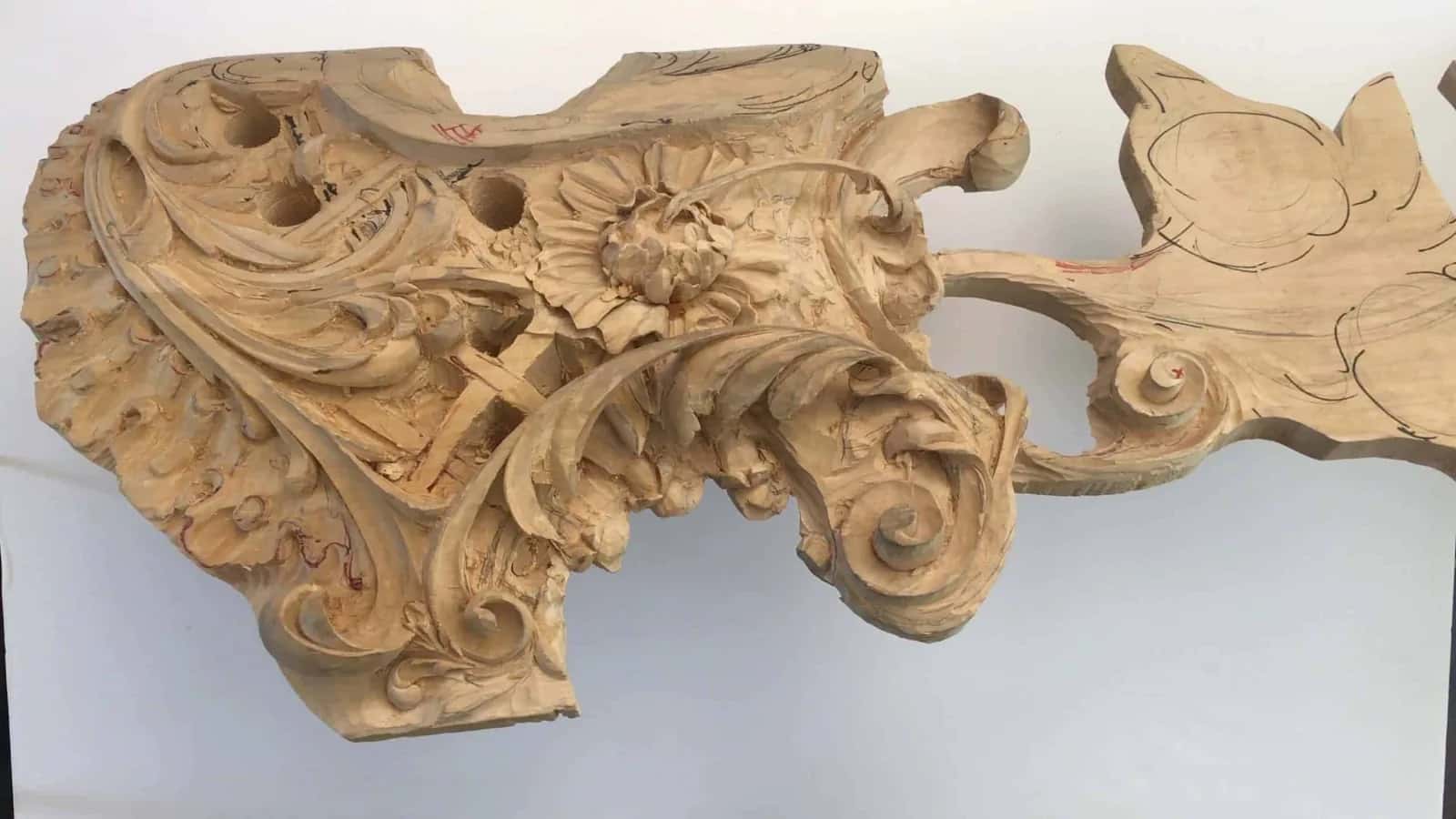
Left end carved, right end a flat blank with lines on it.
Do you want to see the water damage in a board before your gouge finds it? Would you like to know which half of the log you are paying for? Do you want somebody to show you where a thin part is allowed to go and where it is not?
The whole path is inside the course library, first blank through finished panel, and the oak apron in these photographs is a course of its own. Or start with the material. Species come one at a time in the wood guide, red oak and willow oak among them, with the white oak and aromatic red cedar work gathered on the blog.
Read the board first. Everything else on that list is second.

Two hands across, and a long gouge to reach the middle.

Marking a curve with a little yellow tool, and I have never counted those gouges.
Frequently asked questions
Which wood should I use for a carving that sits on the ground?
The American table has one answer, black locust, the only group it expects to hold up in soil, and Swedish Wood gives a buried locust board more than fifteen years. Expect it to dull a gouge fast, which the Wood Database notes too. I have never carved it.
Is white oak a very durable wood or not?
Two published answers exist. The Wood Database rates white oak very durable and names boatbuilding and cooperage. The government grouping puts the white oaks a step lower, at resistant, which means good service above ground and treatment in soil. Name your source.
Does teak deserve its reputation for lasting?
Old growth teak earns it and plantation teak does not. The American grouping splits the species by the age of the tree, calling one very resistant and the other moderately so. Teak also runs up to 1.4 percent silica, which blunts an edge fast.
How can I tell a soft spot is rot and not just soft wood?
Look at the color first. A dark or green patch on lime wood is a water mark, and water damage is the beginning of decay. Then carve it. Rotted fiber does not simply feel softer, it behaves differently, mushy under the edge, and a clean shaving will not come off.
Can I carve basswood for a piece that goes outside?
Basswood sits in the bottom decay group with the maples and birches, so it belongs indoors. My own weatherproofing video marks that chapter plainly, that basswood is a poor outdoor choice because it is soft and it rots.
Does keeping wood dry really stop rot on its own?
At or below the 20 percent mark it does, and that is the laboratory's own prevention line. Wet does not automatically mean rotted either. Untreated piles pulled from the Milwaukee River after 85 years showed red pine badly weakened while white pine and tamarack came out nearly untouched.
Filed under
- applications of rot resistant wood
- basswood for carving projects
- benefits of rot resistant wood
- best wood for carvings outdoors
- best wood for outdoor carving
- characteristics of rot resistant wood
- differences between rot resistant and non-resistant wood
- how to choose wood for carving
- how to maintain rot resistant wood
- natural rot resistant wood species
- rot resistance in treated wood
- rot resistant hardwood options
- rot resistant wood care tips
- selecting when carving wood
- types of wood for carving
- Understanding Wood for Carving
- what does rot resistant wood mean
- why choose rot resistant wood
- wood carving blanks for projects
- wood carving blocks explained
- wood types that resist decay