

Alexander Grabovetskiy, woodcarver, School of Woodcarving · Published 2020
What does a wood carver mean by "wonder"?
Quick answer: In workshop 6, part 2 of the Venice Room, some of you probably wonder what in the world I do, I said, and I answered that I was creating original to the 15th century design. In other lessons I said wonder before a depth, a drill I did not use, a back bend, a rough spot and a sound.
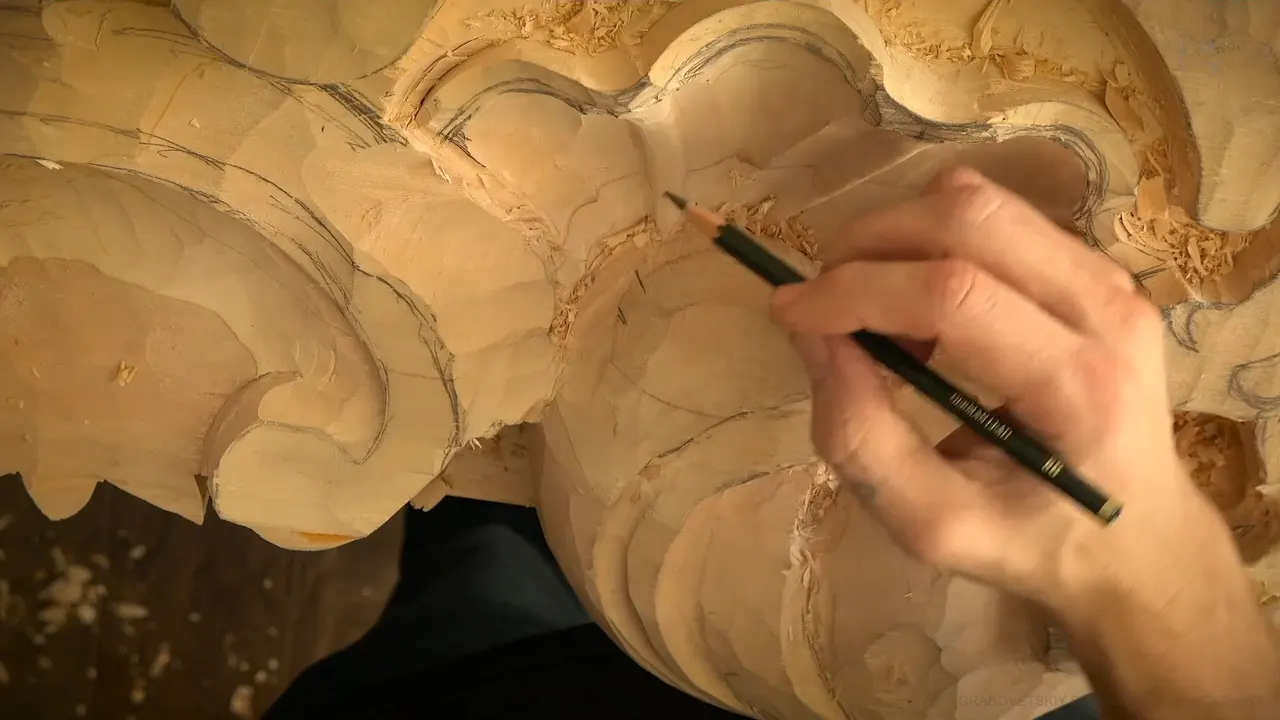

In part 2 of Venice Room workshop 6 I said "some of you probably wonder" and I answered with "I'm actually creating original to the 15th century design." In other lessons I put the same word beside depths, tools, a sound and rough spots.
Ever watched a carver reach in and asked yourself why that tool? Video 6-2 comes first, and the other lessons follow.
What this page holds
- The 6-2 video, with the eyeballed marks and the spoon gouge cuts.
- My words about Venice and the 15th century.
- Places where I wondered aloud about a depth.
- Lessons where I named a tool, or a tool I did not use.
- Rough spots, a squeak and a bead molding that looks like a machine made it.
- A table, one note per video.
What was I doing at the start of the video, before I said it?
I opened with "Again, I'm just eyeballing it. I really don't want to measure." After it came "I also want to make sure I measure from the inner part." The numbers came next. I gave 3/16 and one-eighth, and then "So 5 millimeters and 3 millimeters." In metric terms that is 5 mm (3/16 in) and 3 mm (1/8 in).
The line "I can always double-check later" came next. Not long after, I said "Sorry. That is the sound of a woodcarving shop. So you're supposed to blow."

Carefully, I said, I would "just create my line." I went on: "And double-check that line. That's supposed to be a really nice curvature line following actually the main form." One more line came before the question: "I need to use the right position also."
What came after it about the 15th century?
The question was "What in the world does he do?" The answer came in the same breath. Right after it I said "It was a really, really common thing." I added "And I love that actually. And that was going from 15th all the way to 17th century."
I named the shell: "That style of the shell. There's different styles, like I said, of the shell, but I'm talking about a particular style." The wider history has its own page, the Italian Renaissance. Here I stay with my own words from that video.

About the room, I said "when I designed this room, I had to stay in the original." Then, "It's supposed to be original to Venice." The carvers there, I said, developed their own approach even to the design. A place and a date, both in my own words.
How deep did the first cut down go?
I checked my marks first. "Yeah, it looks like I am touching a little bit the edge, which is okay." The distances should be pretty close, I said, "which they are." Then "So now I have to create another cut down."
I named two tools: "So I could do that with the number 11 and 3 millimeters, or I could use actually a quarter-inch number nine." The two tools were a number 11 at 3 millimeters (about 0.12 in), or a number nine at a quarter inch (about 6 mm). My words: "And I think it's going to be a good idea, just a quarter-inch number nine."

"Okay, let me start from this side." After it I said I would work right on the side, little by little. My reason came with it: "Because it is challenging because it's becoming deeper, and sometimes it's almost impossible to use a straight tool. At some point, I probably will just switch."
And the depth? The plan was "maybe about 3 millimeters deep. About one-eighth of an inch deep." Two more lines follow: "That's still going to cast a shadow and gives me an extra line. But that's still going to leave me plenty of the material for the next detail."
When did the spoon gouge come in?
Partway along I said "some of the areas I will have to attack multiple times during the carving and clean a little bit more." Soon after: "See, it's almost impossible for me because right now it's in my way, and I need to probably just use a spoon gouge, number nine."

I corrected the size as I spoke: "And let me use 3 millimeters in this case is what I'm going to use. 5 millimeters, sorry. 3/16th of an inch." Five millimeters is near enough to 3/16 of an inch, so the numbers agree. Then the plan: "And I'll continue my cut with the spoon gouge."
A little later I said "got to change the direction" and "Almost messed up" and then "I'll fix it a little later." Next came "that is good. Let me go to the next one." The video ends on concave cuts "on the side of the line" in my words.

Which lessons had wonder beside a depth?
Hashemi Flowers 23, part 2, has it. This volute, I said, would be kind of higher, and then "if you just wonder how much down I went" with the answer "about one-eighth of an inch, three millimeters." Next line: "I easily could go even lower than that."

In Furniture Panel 33, part 1, the same question came up about how deep I was going to go. The answer was "about maybe three millimeters, one eighth of an inch" and then "some parts, maybe four millimeters or so." Four millimeters is about 5/32 in, a little past the eighth.

A different shape of the question sits in Greek Acanthus 14. "I know most of you probably wonder why do I do that so deep if it's not going to be visible." The reply was "when you're going to put it in light, it makes big difference how it looks." Since I broke that piece, I said, I can use it as an advantage and undercut that section with, again, the same five millimeters (about 3/16 in).

Where did I name a tool after wonder?
A tool and a hole come up in part 3 of Venice Room 51. I had about 3 millimeters down (about 1/8 in), and I said I could go lower. Here is the line: "And for those of you who is wondering why I don't use a drill, there's no way you can place a drill that low. There is barely my hand fitting. But with the gouge, if I wish, I can go all the way through." A drill and a gouge are the two tools in that answer.

Roman Acanthus 7 has "just in case if you wonder, just easier to reach" about my back bend. The rest: "sometimes I have a limitation with the straight gouge. This one raises my handle higher, and I have a gooseneck, so I can actually control much better." Then a plain line: "It's not what you really have to have. You can get by without it." The Roman Acanthus 7 lesson is where it sits.

Over in Venice Room 18, part 7, people are wondering how it is even possible to get in "just like that." The reply was "It's possible, okay" and "I can get with the back bend." With a shorter back bend, "I could go even more extreme." One more line: "Except I still have to clean inside, which again, you don't see."

For anyone who wonders in Grape Onlay 10, I named a tool and a size: "I'm using two millimeters. Number 11." Two millimeters is about 5/64 in. Next I said to see how deep a shadow I was getting.

What about the spots I leave rough?
For a spot I left, part 9 of Lily Box 7 has my line: "I know sometimes, you will see some spot on the camera and it bugs you, and you probably wonder why I'm not taking care right away." "I'm waiting until I create the final movement before I jump and clean," I said. I added "It's easy to overdo it, and one of the overdo it things, it's when you clean before you finish."

The rough spots come in Venice Room 100, part 10. "Don't pay attention if you see some rough spots and you just wonder yourself," I said. Then "Sometimes I do, but not all the time, okay? So this is one of the cases." After I am "happy with the overall movement, I'll clean everything." Then came a plan: a number 11 at 2 millimeters (about 5/64 in) to excavate around my volute. The workshop 100 lesson holds the rest.

A broken edge is the worry in Venice Room 29: "And no, I don't worry about, just in case if you wonder, if I break that edge. Really don't."
Does anyone wonder how a bead molding gets so accurate?
Furniture Panel 22, part 8, is where I said it about a bead molding. I was using "a quarter-inch number seven" (about 6 mm) and planned to attack from both sides. My caution: "you can't just push it. The grain goes like that. If you're going to push it, you can break that grain."

The line itself: "And that technique actually applied if you're doing a bead molding with the multiple parts like that." People will look at it and not know you did it by hand, I said, "And they just wonder how in the world is it possible to do this so accurate. It looks like it's done on machine, but it's not." In 6-1 I said I wanted a step down "before I do my bead mouldings," so a molding is where that workshop was headed. The old bead and reel has a page of its own.
Furniture Panel 15, part 11, took the question to speed. Watching other people carve, you wonder how they do it quick, I said, "but they don't. They just show you the results." Editing mine to one minute was an option, "but that way you're not going to feel how long it takes, I should say."
A squeak is the question in Greek Acroterion 2. I told anyone wondering about the sound what it was: going through the glue layer under my paper. The 6-2 video has a sound too.

In Venice Room 108, the question was what some shapes were: "I've got multiple on this side, and I do have on another side also." I spelled it out, "those are just like a ray, okay? R-A-Y." Then "An idea of those rays also comes from original Venetian style designs." Same word, "original" as in 6-2.
When do I wonder out loud about myself?
Part 10 of Venice Room 83 has a computer in front of me: "my 3D model, and I'm looking what I modeled. And sometimes I just wonder myself, how in the world did I do that? Or why I have done it, what I've done."
Over in Venice Room 24, my plan was to take my time not to force it. And "I just wonder sometimes why I didn't sand before." Then "I shouldn't say I didn't sand. I did little bit on some of the works, depends on the customer."
Rasp talk is in Venice Room 14: "again, I'm going to use a rasp" and then "Just wonder myself, sometimes asking myself why I didn't use that before?"
Old tools come up in part 5 of Lily Box 2. "I just wonder sometimes what type of tools those people in ancient times used." Then "Did they have gouges or just they used a knife? Well, most likely, probably, they used just a knife, I would say." I closed that thought with "But I don't know. Of course, I don't know."

Which lesson held which wonder, and what sat beside it?
| Course and video number | What sat beside the word wonder |
|---|---|
| Workshop 6-2, Venice | A question about what I do, and a 15th century style |
| Hashemi 23-2 | How much down I went, and an eighth of an inch |
| Panel 33-1 | Depth I go to, and about three millimeters |
| Greek Acanthus 14-1 | Why so deep, if it is not visible |
| Workshop 51-3, Venice | A drill I do not use, and a hand barely fitting |
| Roman 7-3 | A back bend, and easier to reach |
| Room 18-7, Venice | How to get in just like that, and a back bend |
| Grape Onlay 10-2 | Two millimeters, and a number 11 |
| Lily Box 7-9 | A spot I leave, and a clean after the final movement |
| Venice 100-10 | Rough spots, then a cove around the volute |
| Venice 29-1 | A broken edge, and no worry |
| Furniture 22-8 | A bead molding, and a hand that looks like a machine |
| Panel 15-11 | How other people carve so quick, and real life speed |
| Greek Acroterion 2-1 | A sound, and a glue layer under the paper |
| Video 108-1, Venice | What those are, and a ray from Venetian designs |
| Lesson 14-10, Venice | A rasp, and not using it before |
| Room 83-10, Venice | How I did it, and a 3D model |
| Lesson 24-8, Venice | Sanding, and what the customer requires |
| Lily Box 2-5 | Tools of ancient times, and a knife |
Where does the rest of Venice Room workshop 6 sit?
Everything on this page sits inside the tuition, and the rest of the workshop is in Venice Room 6. The course page lists all twelve workshops.
What would you ask the carver in front of you? Pick up a gouge, look at the grain, and give it one pass of wood carving.
How it's done
- Mark by eye. "I'm just eyeballing it," I said, and I wanted to measure from the inner part. The numbers I gave were 5 millimeters (0.2 in) and 3 mm (0.118 in).
- Pick a tool. Number 11 with 3 mm (about 0.118 in), or a quarter-inch (6 mm) number nine: I named both, and said the number nine would be a good idea.
- Start on the side. Let me start from this side, I said, and do it little by little.
- Reach for the spoon gouge. When the straight tool was almost impossible, I said I needed, probably, a spoon gouge, number nine, and I gave 5 millimeters (0.2 in) as the size.
- Fix it a little later. "Got to change the direction. Almost messed up," I said, and then that I would fix it later on.
Frequently asked questions
What was my answer to the wonder in Venice Room 6-2?
I answered in the same breath, about a 15th century style of the shell. I called it a really, really common thing, and I said I love it. The style ran, I said, into the 17th century.
What depth was planned for the first cut down in Venice Room 6-2?
About 3 mm (0.12 in) was the plan. It would still cast a shadow and give me an extra line, I said, and leave plenty of the material for the next detail. The tool was a quarter-inch (6 mm) number nine.
Why did I say I do not use a drill in Venice Room 51-3?
There is no way to place a drill that low, I said. My hand was barely fitting. With the gouge, I said, I can go through if I wish. I could go lower than that, I said.
What to carve next
- Venice Room Part 1 course page
- Venice Room 6
- Venice Room 83
- Hashemi Flowers 23
- Carving Furniture Panel 33
- Carving Greek Acanthus 14
- Venice Room 51
- Carving Roman Acanthus 7
- Venice Room 18
- Carving Grape Onlay 10
- Lily Box 7
- Venice Room 100
- Venice Room 29
- Carving Furniture Panel 22
- Carving Furniture Panel 15
- Carving Greek Acroterion 2
- Venice Room 108