

Alexander Grabovetskiy, woodcarver, School of Woodcarving · Published 2020
What does a wood carver mean by "don't judge me"?
Quick answer: In Venice Room workshop 6, part 6, I said "Please do not judge me by the unfinished product." Right before it, I said that a good look does not mean a finished one. Other lessons carry the same plea beside a camera position, a camera I was covering and a piece I called not finished.
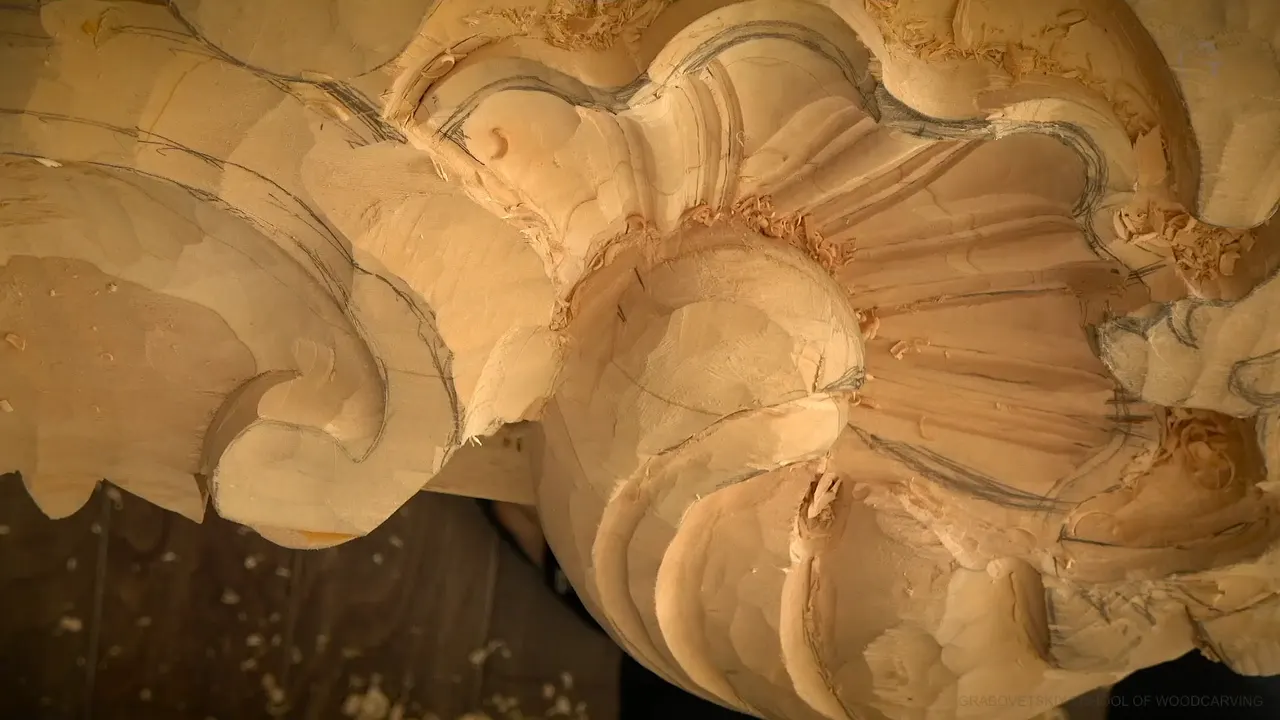

In part 6 of Venice Room workshop 6 I asked the viewer not to judge me while the piece was unfinished. The same plea sits in other lessons. One has a camera angle, one has me covering the camera, and one has work against the grain. In another I called a piece not finished.
Ever turned on a carving video and wondered if the rough spots are the finished work? Below is what I said in part 6, what I did around those words, and the lessons where the same plea came back.
What this page holds
- This video, from its first cue to "And the next one."
- Both parts beside it, and part 9 of the same workshop.
- Lessons in the Venice Room course and in my other courses where I asked it again, each with the cue words around it.
- Other times I used the word judge about my own carving.
- A table with one note for each video.
How did part 6 start?
The video opens with "Okay, that is enough, I think." Next comes "Now I am ready to create my mid-moulding," followed by "A couple of ways I could do." Doubt followed: "I should say this is a quick way. Okay, I'm not sure if it's going to work or not."

For the first cut I planned "I'm going to use a number eight backbend." Then "But you know what? This is in my way, this chunk, so I've got to take care of it first." So "I need to actually take number seven and remove some of it," I said.
The chunk and the grain
Next, about the grain: "But I have to be careful because grain changes direction, and I got to be really careful how I attack that." Then "I'll clean it later. That is no problem. All I need is just create space for myself, okay?" And "And let me dig in."

Then "And maybe I have to dig in really deep." I also said "And I have to go back and create even deeper cuts with number 11 to clean everything." After that, "Okay. That's probably the case."
Which spot gave me a hard time?
Then "I see. Well, this is not going to fit right there." Then "Well, kind of gives me a hard time in this area, but it's better to get it done right now than later."

Number seven again was my plan: "I need to probably take number seven again" Then "You know what? I think I should use a skew number seven."
Here is what I said about the tool: "So that is a skew number seven and approximately 10 millimeters, 3/8 of an inch." I gave a reason: "But that's much easier to control in this case because of the grain of the wood in this area." And "Okay. It just gives me really, really nice slice."

For the other side I planned "Now let me use another skew, opposite side, opposite direction skew." After it came "And I can just attack just like that." One caution: "But I don't want to mess up my curvature on inside, so I still have to be careful how I do that."
What came right before I asked not to be judged?
Then "Here's a number 11, three millimeters, and kind of clean all that mess" (about 1/8 in). My reason: "Because I know it doesn't look too appealing when it's too messy."
About another one: "This one needs to be taken care a little more." A check followed, and I said "Let me double-check." Then "It looks good."

And here is the plea itself, word for word: "When I'm saying it looks good, it doesn't mean it looks finished. Okay? It looks good to that stage." Then "Please do not judge me by the unfinished product."

How part 6 wound down
The last stretch opens with "I would probably leave it like that. Let me clean a little bit on inside." Then "See, I should do a little deeper cuts, but it's okay. I'm pretty close anyway." The video closes on "And the next one."

What parts 5 and 7 add
Part 5 has "Sorry that I'm covering that with my hands, but I have to." It also holds "What I'm doing, actually, I'm just preparing canvas."
The seventh part carries "Again, I apologize if you can't see." In the same part, my offer was "another angle, and maybe you're going to be able to see better." About myself: "I do have a tendency of overdoing stuff which I shouldn't." And about a look I did not like: "That just doesn't look too nice, okay? For my taste, at least."
Does the same plea sit in other Venice Room lessons?
Part nine of the same workshop has the camera: "I looked myself yesterday in one of the segments, when I was editing, and it's almost impossible to see the real shape right now because my camera position." The explanation: "And you have to understand that just the swoops like that, and I'm looking at that to the front like this, and you're just looking from the angle a little bit. That's why you don't see the real shapes."

Next, "But later on, I'll make a overall picture, and I'll show to you how it looks." Then "But please forgive me, and again, don't judge too hard."
Venice Room 8, part 5, has "I don't want to go too deep on inside." A plan there was "maybe just fix the overall movement." Then "Don't worry about the background yet." And "Don't judge." A spoon gouge was the tool I planned, and I said "Let me use four millimeters first" (about 5/32 in).

Over in Venice Room 65, part 8, the cue is "Number five and smaller this time. Like a quarter inch" (A quarter inch is about 6 mm.) Then "And yes, I know I am carving." Next, "Please don't judge" and "I still have to do my work."
A wish came next: "I wish there is such a thing as airbrush, when you can stay away with your tool and still paint something." Then "Airbrush carving."

Where did I ask it in the Furniture Panel course?
Furniture Panel 19, part 7, has "And for me, it looks much better, but that is still not the final look yet." The form came next: "This is just the initial form." Then come the words "judge me too harsh."
Next I planned to undercut: "I'm going to undercut underneath of this one with this leaf." My favorite for it, I said, "would be half a millimeter, number 11" (about 0.02 in).

The camera comes up again in Furniture Panel 21, part 5: "Sometimes it's hard to figure out what's the right position for the camera to show, but I am trying my best, okay?" Then "judge me too hard."
The cut itself: "And now this cut is pretty much finished. Maybe just a slight cleaning, and that's good." After it I had a flatter gouge in mind: "I'll use a flatter gouge, maybe about 10 millimeters, number 3" (about 0.4 in).

The day wraps up in Furniture Panel 32, part 3, with "And that's it for today, I guess." About the panel: "I do like it." A plea to hold the verdict followed: "It is not done."
I added "Let me move this out. Here you go." Last, "That is, uh, what we worked on today, this section."

The whole panel is in view in Furniture Panel 14, part 3: "I kinda like it. You can judge, but I love how it looks."
Tools I got for free are the subject in Furniture Panel 15, part 5. The key line: "Just because I've got those tools for free, it doesn't mean I have to give a really good or bad or whatever review." My aim: "I want to honestly judge it if I'll be using it or not a lot." Later in that part: "It's too early to judge, like I said, but we will see the process."
What do the Lily Box lessons have to say about it?
Paper against wood is the subject in Lily Box 3, part 10. There I said "And now it looks much better." Of the carving I said "when you're just carving in real wood, sometimes you have to just judge it, as you go along what is going to look better." And "And just change whatever needs to be changed."
Further along, Lily Box 11, part 7, has "If you want to judge me, I'm okay." I also said "Anyway, I don't hear you." And "Don't say anything bad." Then "If you just don't like my technique, don't judge."
A fragile spot sat in that part too: "right now it's really fragile." And "But placing that finger underneath, I'm creating some kind of support."

The eleventh part of that lesson has "Of course, not on purpose, but sometimes I am covering my camera." On being judged: "Or you can judge me, whatever as much as you wish. I'm okay."
I went on with "There's just no way sometimes to get it." And "Sometimes you really have to think what angle you're going to hit that with." My tool: "I'm using a one millimeter number eight to clean little bit underneath, just slightly right here" (about 0.04 in).
What do the vase, onlay and Maine lessons say?
Carving Vase with Grape Leaves 1, part 12, has "Right now, like I said, it's just preliminary setting in, so it's not detailed or anything." I asked for the verdict to wait, and said "And I missed a couple cuts right here."
About the vase background I said "I think it's going to be ebonized. I don't know yet."

Carving Grape Onlay 2, part 2: "if I am covering with my hand some of that stuff" and the plea was for a gentle verdict. Then "Actually, I thought I'll be able to do the triangle, but it's not."

In the Maine class, Grinling Gibbons 12, part 3, has "So that is how it's supposed to look. Yes. Obviously, I will clean that." Right after: "Don't judge."

Grinling Gibbons 13, part 3: "I am working against the grain. Please don't judge me." I followed with "I know what I'm doing." And "Sometimes it's just no other way."
The stem was in the way: "There's a stem on the way, but see how big excavation I've got underneath of the stem." The figure was "I've got about 10 millimeters. Or so about 3/8 of an inch."

Where else did I use the word judge about my own work?
Acanthus Moldings 4, part 3, is about tool numbers. Some of the manufacturers "still do like two three four, five six, seven eight nine." Of the modern guys I said "which is okay." And "I don't judge."
Over in Acanthus Moldings 10, part 3: "you could spend a lot longer than just the carving." Then "that is why I'm not filming." The words "Don't judge" follow, and then "I know I've got the overall shape."
My All about tools for Wood Carving course shows a piece and the line "That is not finished. Don't judge." Of that piece: "it's a Byzantine acanthus leaf, and I tried to use those tools on that piece."
Hashemi Flowers 22, part 3, shows me asking for a lighter verdict "if I forget to name the tool what I'm using, okay?" The next line: "I hope you will understand me."
In my April 2020 livestream I read out a comment on one of my videos: "great carving, horrible music." My answer: "Don't judge, right?"
Which video holds which words?
Every video below holds my words, with a note on what sat beside them.
| Course and video | What sat beside the words |
|---|---|
| Venice 6-6 | A chunk in my way, plus a skew and a number 11 |
| Workshop 6-9, Venice | The picture I promised, and a plan for a step down |
| Workshop 8-5, Venice | A background to leave for now, and a spoon gouge I planned |
| Venice 65-8 | A number five at a quarter inch, and a wish for airbrush carving |
| 14-3 in the design course | A look at how the whole panel looks all together |
| Panel course 15-5 | Tools I got for free, and a review not given yet |
| Panel 19-7 | The initial form, and a plan to undercut |
| 21-5 in the furniture lessons | The right place for the camera, and a cut I called pretty much finished |
| Panel 32-3, the furniture course | A section done for today, and a panel not done |
| 3-10, Lily Box | Drawing on paper against carving in real wood |
| Lily Box 11-7 | A technique someone might not like, and a finger for support |
| 11-11, Lily Box | A camera I was covering, and a one millimeter number eight |
| Grape vase 1-12 | A background, and an ebonized finish I was not sure of |
| Grape Onlay 2-2 | My hand covering some of the work, and a triangle that did not fit |
| Maine 12-3, Gibbons | A shape that is supposed to look like that, and a cleaning to come |
| Maine 13-3, Gibbons | A stem in the way, and a big excavation under it |
| Moldings 4-3, acanthus course | Tool numbers, and a remark about the modern guys |
| Moldings 10-3, acanthus course | A long cleaning |
| My course, All about tools for Wood Carving | Not finished, a Byzantine acanthus leaf |
| Hashemi 22-3 | A tool I might forget to name |
| Livestream April 2020 | A comment about the music in a video |
Where can you watch part 6?
You can watch part 6 inside workshop 6 of the Venice Room course. Parts 5 and 7 sit beside it on the lesson page, and everything on the site sits inside the tuition.
Which rough spot on your own board could use one more pass? Pick up a gouge, turn the board to the light, and give it a pass of wood carving.
How it's done
- State your plan. My plan for the first cut in part 6 was "a number eight backbend."
- Name what is in your way. I called a chunk "in my way" and said I needed number seven to remove some of it.
- Let cleanup wait. The line was "I'll clean it later. That is no problem."
- Name the stage. I said the work looked good, and that did not mean finished.
- Ask for patience. Near the end of part 6 I asked for patience with an unfinished piece.
Frequently asked questions
Which words did I use in Venice Room 6-6?
It followed "It looks good to that stage." I asked not to be judged by what was still unfinished.
Which work waited for later in part 6?
The need was "just create space for myself," and the cleaning could wait. I called that no problem.
Which skew was named in part 6?
A skew, "approximately 10 millimeters," which I put at 3/8 in. It was "much easier to control in this case because of the grain of the wood in this area."
What about the camera in part 9 of this workshop?
What to carve next
- Venice Room Part 1 course page
- Venice Room 6
- Venice Room 8
- Venice Room 65
- Carving Furniture Panel 19
- Carving Furniture Panel 21
- Carving Furniture Panel 32
- Carving Furniture Panel 14
- Carving Furniture Panel 15
- Lily Box 3
- Lily Box 11
- Carving Vase with Grape Leaves 1
- Carving Grape Onlay 2
- Grinling Gibbons Maine 12
- Grinling Gibbons Maine 13
- Acanthus over Moldings 4