

Alexander Grabovetskiy, woodcarver, School of Woodcarving · Published 2020
What does a wood carver mean by a "beautiful detail"?
Quick answer: The words came in part 8 of Venice Room workshop 6, while I cleaned an edge with a number eight. In other lessons the same words sit beside flowers and a roll, and beside a shadow and a plug cut, and each lesson is set below beside what I said.
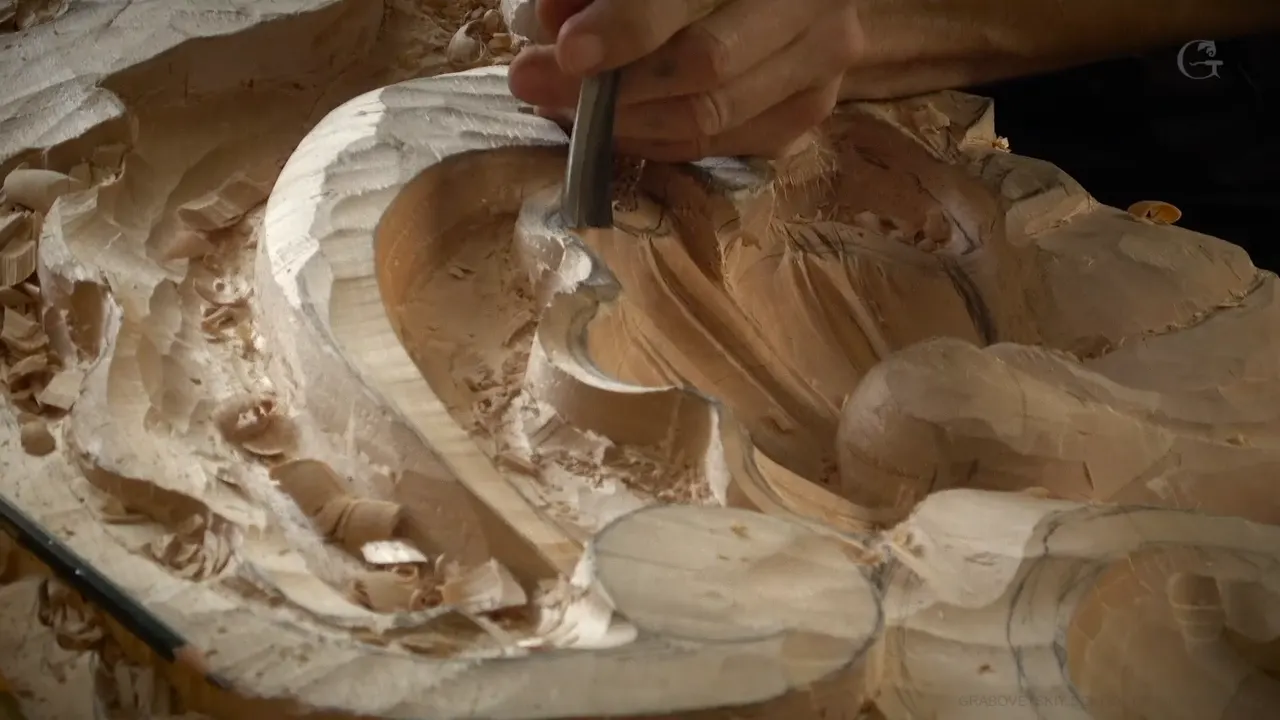

In part 8 of Venice Room workshop 6 I said "See, that creates beautiful, sharp lining, and a nice, beautiful detail." Those were my words while I worked with the number eight. Other lessons carry the same two words beside a flower or a roll, and beside a shadow or a mistake I could still save.
Ever stopped at one small spot on a board and wondered if it earns its place? Below is what I said in part 8, what sat around it, and the lessons where I said those words again.
What this page holds
- Part 8, from my first words about an edge to my words about a different tool.
- The two videos beside it in workshop 6.
- Lessons where I called a small shape beautiful, with the cue words around it.
- The spots where I called a detail only my opinion.
- A table with one note for each video, so you can find the words fast.
What did I say about the edge?
My first words in the video were about an edge. With the number eight, I wanted "a really clean transition." Not everywhere would that work with the same big tool, I told you, but I wanted to see if it would here. It looked like yes, but I needed to clean this side too.
The words came next: "See, that creates beautiful, sharp lining, and a nice, beautiful detail." High spots were my next check, and I found some. Those were spots I did not wish to see, and I said so plainly. "A really gradual movement" was what I wanted to see.

"That is actually excellent," I said next. What I had just done gave me the look I was after. Even a number nine was possible, I said, but the number eight was okay. It was "deep enough."
What got in my way in part 8?
"Can you see what I see?" I asked. The spot was getting a little too dark outside, so really soon I would have to turn to different lights. Later I noted that I had to change my position, because I could not do that work from the other side.

Facets were waiting too. A spoon was my plan for attacking them, but "No, I can't probably." Even with the spoon, it was "already becoming a little challenge."

One part sat on my way, another sat on my way too, and I had to figure out the best way to approach it. My plan was a different tool, maybe attacking a little bit sideway. Then came "Okay, that is wonderful."
Which words sat in the videos beside it?
The bead shows up in part 7 of Venice Room 6. I called it one of the details I really like, a really good detail to use pretty much anywhere. Then I stopped with "That is enough because sometimes I do have a tendency of overdoing stuff which I shouldn't." My plan for the cleaning was a number 11 of 3 millimeters (about 1/8 in), followed by a 1 millimeter (about 1/25 in). One side bugged me a little bit.

A taste line sits in the same part: I said I should use a deeper concave, and "That just doesn't look too nice, okay? For my taste, at least." After I tried the number eight, my verdict was much better, I think.
Part 9 shows the other side of it. A smaller tool is not ideal in an area like that, I explained, but it was okay there because the look was not final yet, even on the inside. At the top I wanted a smooth transition before my beads. There are so many details, I said, so many different elements you can use on different types of wood carving.

Sizes come up in that video: six millimeters (about 1/4 in) at the top and five (about 3/16 in) at the bottom, with my beads meant to get smaller and smaller. For the marks, I said plainly, "I am just eyeballing."
Which beautiful details were small?
In Venice Room 66, part 9, my words were "Maybe even a little deeper because shadow." Then "It's not a big detail, but I think it's beautiful detail." Another line was "Just something different."

Furniture Panel 23, part 6, has a smaller gouge, a number eight of one millimeter (about 0.04 in). The spot was small. Its detail was "really nice," giving me extra movement, I would say.
Over in Carving Plate with Butterflies 13, part 3, my cut would be about a sixteenth of an inch only, a millimeter and a half or so. It was going to be so tiny, I said, and it would "create really beautiful detail."

Venice Room 93, part 5: I called one shape a really nice detail. Inside the columns I still had to carve, I said, it would be the same detail, and "that detail is small."

Part 6 of Venice Room 11 has "Maybe I'm not doing the right thing. Well, actually, I do." Maybe I could make that part a big separation going downhill, I added, and I think it would give me nice detail. Part 3 of that lesson has me planning to keep a ridge: I kind of like it, for now at least.
How deep did those details go?
Depth is the point in Venice Room 46, part 6. Going "really deep" was the plan, I said, at least one-eighth of an inch (about 3 mm). That was going to give me beautiful detail that I can repeat everywhere.
A plug cut from the opposite direction is the plan in Venice Room 118, part 3. That plug cut would add an extra shadow. My name for it was a "really unnecessary step," though I thought it would give extra beautiful detail. "It's my opinion, okay?" I called the result "Beautiful" and a small veiner of one millimeter (about 0.04 in) could clean it out.

A concave on the inside and then a convex was the shape in Venice Room 88, part 6. "Concave, concave, convex, convex," I said, and it would give me really beautiful detail. I planned a skew back bent for it.

Which detail did I say I did not want to lose, and where?
Workshop 47, part 2, lives in Venice Room 47. Probably a number six or so was the tool, and I had to be careful not to lose that detail. Right after, "And I do not want to lose it. That's a beautiful twist."

Venice Room 38, part 11, is about backbends. I was using a lot of them. There was absolutely no other way, I said, to clean underneath and create beautiful detail. Nothing else could fit in that spot, since this was in my way and that was in my way.

A division comes in part 2 of Venice Room 41, and I thought it would be beautiful detail, though the other side needed cleaning too, "otherwise, it just doesn't look right."
Where did I call a detail only my opinion?
Look at Venice Room 82, part 6. The roll is not seen from above, but it will be really visible from below. Rolling back like that, it really creates "beautiful detail," I said. And "Of course, that's my opinion."

Workshop 82, part 1, has me saying "Beautiful detail" then that I think it is one. Unfortunately you don't see as good how it looks, I said, but I would show you a little later, maybe from a different angle.
In Furniture Panel 18, part 3, I called it "detail inside of detail." My view was that it looks awesome. "You don't have to agree with me, but I think it looks awesome."
Did a beautiful detail cost time?
Time matters in Venice Room 77, part 10: I could spend a lot longer creating beautiful detail. But I also had to be mindful that it was a real project, and that I needed to deliver it by a certain date.

Furniture Panel 21, part 5, has a mistake. "It's not like I completely destroyed that detail." Saving it was still possible, and so was creating beautiful detail. "Nobody's going to know, beside me, that that was a mistake." Then "Oh, and you, of course."
Which flowers and leaves got the words?
Part 9 of Venice Room 67 says there would be a flower, and another flower on the other side. "But for me, I think it's just a beautiful detail." Attacking that first and then jumping on the acanthus was my plan, and I expected the acanthus to be really easy.
I planned 18 millimeters (about 0.7 in), a number 11, and I needed a bigger mallet.

Over at Venice Room 64, part 10, one movement got the words "beautiful detail" plus "I really love those details," I added. I needed maybe a number eight.
The piece in Carving Floral and Molding for the Panel 13, part 2, would be painted. Carving a flower like this, I said, gives "a beautiful, beautiful, beautiful detail right in the middle." Its lines need not look perfect. "Much better if it's not perfect."

With no glue on the edges in Lily Box 5, part 4, the wood gave me a really clean surface, plus nice detail, and I could dig as deep as I wished. One detail needed lowering a little, because it did not look too good, and I have to look from different points of view many times.

Which other courses used the words?
Carving Greek Acanthus Leaf 9, part 2, carves deeper than the Corinthian leaf, and of a deep undercut I said "that's going to create the beautiful details." A knife could bring that undercut almost to the edge, just like that.
"It gives a really nice detail, that long grain," I said in part 2 of Carving Corinthian Acanthus Leaf 4. I added "I do like what I see."
The beginner course on the Kitchen Cutting Board has two. In workshop 7, part 2, I said not to press too much near the second line, and not to force it, "otherwise you can just break." Without a break, you get a beautiful detail.
In workshop 10, part 1, a volute would just sound like a curl in some countries, I said, because it is like a curl. "But doesn't matter how you call it. It's beautiful detail, and that's really common."
Ribs and corbels sit in Venice Room 102, part 8. I could probably do without the ribs, I said, yet I think it's a good detail, and "Why not use it?" It gives extra dimension.
Last is Furniture Panel 20, part 10, with "beautiful detail. Really gorgeous detail." A smaller number eight was needed, about a sixteenth of an inch (1.6 mm), and later "It gives me beautiful, gorgeous, I should say, shadow."
Which video holds which words?
Every video below holds my words, with a note on what sat beside them.
| Where I said it | What sat beside my words there |
|---|---|
| Workshop 6-8, Venice | An edge, a number eight, and high spots |
| Workshop 6-7, Venice | The bead, and a deeper concave |
| Workshop 6-9, Venice | A smooth top, and beads of different sizes |
| Workshop 82-6, Venice | A roll that shows from below |
| Workshop 82-1, Venice | One number three, and a new angle |
| Workshop 77-10, Venice | A real project, and a date to meet |
| Workshop 67-9, Venice | A flower, and an 18 mm (0.7 in) number 11 |
| Workshop 66-9, Venice | A little deeper, because of a shadow |
| Workshop 64-10, Venice | A movement going in, and a number eight to try |
| Workshop 47-2, Venice | A twist I wanted to keep |
| Workshop 46-6, Venice | A depth of at least 1/8 in (3 mm) |
| Workshop 118-3, Venice | A plug cut, and an extra shadow |
| Workshop 88-6, Venice | Concaves, convexes, and a planned skew back bent |
| Workshop 93-5, Venice | A small detail, and a number three I planned |
| Workshop 38-11, Venice | Backbends beneath, where nothing else fits |
| Workshop 41-2, Venice | A division, and a side to clean |
| Workshop 11-3, Venice | A ridge I planned to keep |
| Workshop 18-3, Furniture Panel | Detail inside of a detail, then a clean up |
| Workshop 23-6, Furniture Panel | Number eight of 1 mm (1/25 in) |
| Workshop 21-5, Furniture Panel | A mistake that I could still save |
| Workshop 13-2, Floral and Molding | A flower, and lines that need not be perfect |
| Workshop 5-4, Lily Box | A clean surface, and digging as deep as I wish |
| Workshop 13-3, Butterflies | A tiny cut, about 1/16 in (1.6 mm) |
| Workshop 9-2, Greek Acanthus | A deep undercut, and a knife that could help |
| Workshop 7-2, Cutting Board | A line close to a second line |
Where can you watch part 8?
Part 8 sits inside workshop 6 of the Venice Room course. The other two videos sit beside it on the lesson page, and everything on the site sits inside the tuition.
Which small spot on your board still looks plain? Pick up a gouge and give it one more pass of wood carving.
How it's done
- Reach the edge. I started on an edge with the eight and wanted a really clean transition.
- Check the high spots. I checked high spots, found some, and did not wish to see them.
- Look for a gradual movement. The aim I named was a gradual movement.
- Say when the depth is enough. I weighed a nine against the eight and called the eight okay, and deep enough.
- Change the position or the tool. Parts were on my way, so I planned a different tool and maybe a sideways attack.
Frequently asked questions
What were my words in Venice Room 6-8?
They came while I worked an edge with a number eight. High spots were my next check. A gradual movement was my aim, and a nine was possible, I said, yet the eight was okay.
Does a beautiful detail have to be big?
Workshop 66-9 has me calling a detail not big, and still beautiful. In 93-5 I said the detail is small, and Furniture Panel 23-6 has a small one that gave me extra movement.
How did I word it when the detail was only my view?
My line in Venice Room 82-6 was "Of course, that's my opinion." Workshop 118-3 has "It's my opinion, okay?" and Furniture Panel 18-3 has "You don't have to agree with me."
What to carve next