

Alexander Grabovetskiy, woodcarver, School of Woodcarving · Published 2020
What does a wood carver mean by "different light"?
Quick answer: In the part 4 video of Venice Room workshop 6 I said I go back and check a spot under another light, turning one side, then another. Other lessons show a moved lamp, a switched-off light and a rotated piece. Each is set below beside what I said.
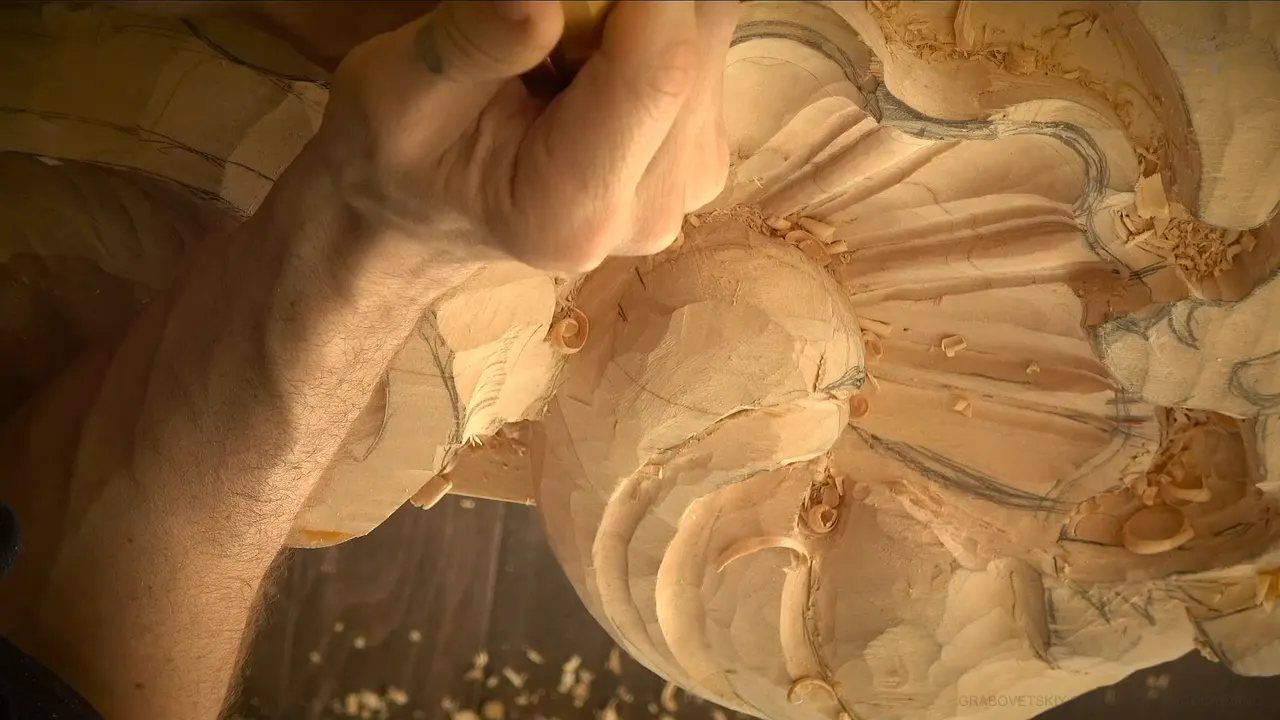

Workshop 6 of the Venice Room, part 4, has me saying "I have to check under different lights." Other lessons carry the same idea beside a lamp I moved, a light I turned off and a piece I rotated, and I put it there in my own words.
Ever looked at a cut, felt sure of it, then walked around the board and felt less sure? Below are my words from Venice, what came next, and the lessons where I turned the light again.
What this page holds
- This video, from "Just create my beautiful curvature" to my last words about one side being deeper.
- Both parts beside it.
- Other courses, where I changed the light.
- Lessons where the light showed me how thick a spot had become instead of how it was shaped.
- A table at the end, with one short note for each course, so you can scan it.
What came before the words about light?
The video opens with "Just create my beautiful curvature." A little later: "Okay. And now when I look at it, now it looks good." Next: "Okay, now I'm happy with that curvature."
The sides were not the point yet. I said "Don't look at the sides" and "those sides, they don't really matter right now." What I wanted was "just one ridge," the "main focal point."

A plan came next: "I need to actually cut away a little bit" and I would "get closer" because "my grain changed right here, direction of the grain." I added "And I have to be really careful how I approach the final line." A flaw followed: "And I don't like how it bumps out right here."
What did I say about the light?
My words were "Again, sometimes I have to check under different lights because shadow can also create the problem how you see when the light hits, creates the shadow."
And the method: "So very often I just go back and just check that under a different light condition, like at night, and I just turn one side, and I turn another side, and I can see exactly what is going on."

What came next in part 4?
A plan opens the next stretch: "So let me cut one more time." Then I saw trouble: "one of the spots just gives me trouble a little bit, which is this one right here." Of that spot: "It just doesn't want to go."
Soon I could say "And now it is gone, that's good, that is much better." Another spot got its turn with "Okay. Let me do this one" and its verdict was "And this one is good."
Next came the decision: "Okay. So now it's probably time to make the decision." Of the sides I said "I'm not going to touch that side yet and this side yet, but I can actually start working on the beads on inside."

My plan for the tool: "I'm going to create an extra cut on inside right now with the 3 millimeters" (about 1/8 in). Of the first one: "that's going to determine my side of the bead."
For another spot I put it this way: "I may use actually 2 millimeters number 11 right here" (about 5/64 in). Of that cut: "a double challenge because I am carving against the grain." My last words are "One side is going to be deeper, okay? One side."

Which shadow words sit in the parts beside it?
Part 3 of workshop 6 has "What I'm doing, actually, I'm creating extra shadow point." The ridge matters because it will "cast a shadow." Later a shadow worked against me: "That extra shadow throws me off, and I really can't see what is going on in real world."

Part 5 holds the decision on size: "I need to make the decision how big my beads going to be." Its limit was "I shouldn't go more than a quarter-inch, six millimeters bead from this side to that side." Of one place: "this area is a focal point." Near the end came "What I'm doing, actually, I'm just preparing canvas."

Where else did I move the light?
Part 6 of workshop 12 gives "And I think at least this side looks fine" then "Let me try to do different lights. Move around" and "Move on that side. And yes, it looks good."

Workshop 22 comes from the second Venice Room course. In Venice Room 22, part 6, I said "I know it's still not the final look yet, but at least it gives an idea, so how it's supposed to look." My next move: "And let me move the light. Here you go." The view: "how it looks from a different lighting position."
What the new position showed: "the movement of a shadow," followed by "How deep those shadows are." And "that's what I'm after. It should look really good in real life."

Over in Venice Room 61, part 9, I started with "I'm not sure if it's too dark." A moment later: "Different light." Then comes "But I guess you can see it's a beautiful and deep shadow."
The lamp matters again in Venice Room 30, part 12: "So it depends how the light hits." Of a line that is almost no cut: "your eyes can detect a really nice line work" and I tied it to a light I was going to turn off. The payoff: "You'll see that right away how nice it casts the shadow."
In Venice Room 48, part 2, I named "really extreme shadows" and said "you don't see that shadow right now." Furniture Panel 24, part 3, has two lamps: "I've got the lights from two sides" and I said a shadow comes with one turned off.
The sun did the job in Venice Room 44, part 11: "sunshine helps me a lot, actually. I can see how the light hits, and I can see clearly what I have to do." Close behind: "It's almost sunset."
The Carving Hazelnuts course, workshop 6, part 3, puts the lamp on top: "the light going to hit from above. I want to cast the shadow away from the light." I wanted "an overlapping effect" there.
How did I change the light in the acanthus lessons?
Carving Roman Acanthus 16, part 3, starts with a plan: "Well, let me turn one of the lights off, and we'll see how it's going to cast a shadow in more natural lighting." Another light was planned off too, and I said "that's a different look."

The goal came with the left light: "you see how it catches the light" then "So that is the goal." I also named an option: "exactly the same idea" on "those fingernails."
A vise did the turning in Carving Roman Acanthus 7, part 3: "you constantly just rotate. That's why I like that vise. I could just rotate and see in a different lighting situation" and I said it helps me "to determine should I carve deeper? Should I go not as deep?"
The acanthus leaf in Carving Greek Acanthus Leaf 8, part 1, was turned too: "just because I turned that, my light hits from different position, I can see much better where I have to clean it a little more."

That video holds a plan to "reposition my lights and see from different directions." The marks and ridges I left would show, and I said I would clean them. I closed it with "And I encourage you to do the same."
My caution is "not always possible to see right away, especially when you're used to the lights." On habit: "you actually get used to the certain angles of the light, and you can see one side of the cut, but you don't see other."
Which light words sit in the beginner lessons?
The beginner course has a curly kitchen cutting board over many workshops. Workshop 10, part 4, gives "I'll probably later on, want to place in the different lights, all my carving." A look from different angles shows "much better if there's any ridges left."
Workshop 11, part 3, repeats the plan to turn it and look from different perspectives, "just to see if there's any ridges which is not visible from this side." On cleaning: "I can see I need to clean some areas."
Workshop 18, part 2, comes after "And now it's time to apply some oil." My words were "Maybe different lighting" and "And I do like it."

The first beginner lesson, workshop 1, part 5, ends with "you can see the result, what we have right now in different lighting." I added "how it's nicely playing with the shadow and light."

Which lessons put the light on a finished piece?
In Carving Flower Rosette 7, a rosette is done, and I put it in a different light. My verdict was "I think it looks just beautiful."

A different rosette came in Venetian Flowers Rosette 3, part 4. I offered different lights, so that "you can see how it looks in the shadows." The switch: "And let me turn off the main lights."

The piece gave "I've got different light. And let me rotate just to show you from different points of view." The look was "just like a diamond. Different looks from different sides."
In Lily Box 3, part 11, there is a plan and a doubt. I thought of switching the lights off, so that "you can see in different light." Next: "Although it's almost impossible." Then: "Let me hold it, and you can see. I'll try to get a different view."

Lily Box 6, part 9, goes the other way: "Let me try different lights" then later "dim little bit this light. And I think it looks good."

Where did I put the lamp?
Part 13 of Lily Box 2 gives "when the light hits from certain point, it casts the shadow." My own lamp: "I placed my lamp at the front of me."

Small ridges mattered there: "they make big difference when the shadow just hits from certain point." The limit I named: "if I'm going to put light right above... Well, can't do that because of my camera, so you almost can't see that."
The livestream from April 2020 was about the lamp itself: "those lights, I can position from any point on my workbench, and I can cast any type of shadow and just check whatever I wanted to."

Overhead light fails here: "if you're just using natural light, and especially the worst light, if you're using just above light" and you cannot see all the cuts and all the facets on your work. The fix I named: "get at least one light."
More lamps are a step up, I said: "But I encourage you, if you can afford to get two lights." A lamp that changes color came up too: "So I can make it yellow and get rid of completely of white, and I can work at night without getting tired."
When did the light show thickness instead of shape?
Carving Hashemi Flowers 9, part 1, uses the light another way. On thickness I said the only way is "just to look at the light, and if the light already penetrating, or if the light is already you can see through, I should say, then that's probably too much."
Which course holds which words?
Every row below holds my words, with a note on what sat beside them.
| Lesson | What sat beside the words |
|---|---|
| Workshop 6, part 4 | A bump, a spot that would not go, and a check at night |
| Its two neighbors | A shadow that threw me off |
| Workshops 12 and 22 | Move around, and a light moved to a new position |
| Workshops 30, 44 and 48 | A line work, sunshine, and a shadow you cannot see at first |
| Roman Acanthus 16 and 7 | One light off, and a vise to rotate |
| Greek Acanthus 8 | A light from a different position |
| Curly Cutting Board, workshops 10, 11 and 18 | Different angles and perspectives |
| Beginner workshop 1 | The shadow and the light, nicely playing |
| Lily Box 2, 3 and 6 | My lamp, lights off, one light dimmed, and an almost impossible check |
| Flower Rosette 7, Venetian Rosette 3 | A finished piece, in a different light |
| Hashemi 9 | Light passing through, and a thickness check |
| Livestream, April 2020 | A lamp I can position from any point |
| Furniture Panel 24, Hazelnuts 6 | Lights from two sides, and a lamp on top |
Where can you watch part 4?
Part 4 sits inside workshop 6 of the Venice Room course. Parts 3 and 5 sit beside it on the lesson page, and everything on the site sits inside the tuition.
Which spot on your own board feels settled until you walk around it? Pick up a gouge, move the daylight or the lamp, and give it one more pass of wood carving.
How it's done
- Name what looks wrong. My line in part 4 was "I don't like how it bumps out right here."
- Check under another light. Part 4 has me going back to check a spot in a different light condition.
- Switch a light off. Roman Acanthus 16-3 opens with my plan to switch a light off and watch how a shadow falls in more natural lighting.
- Look from another angle. On the cutting board my plan was to view the carving from different angles.
- Say what is better. The words "Much better" come later in part 4.
Frequently asked questions
Why did I go back to the light in Venice Room 6-4?
A shadow can also create the problem, I said, because where the light hits it makes a shadow and I cannot read the shape. So I turn one side, then another.
What did I find after the check in workshop 6?
A spot gave me trouble a little bit and did not want to go. Then I said "now it is gone" and "much better."
Which tool did I plan for the bead's side?
My plan was an extra cut on the inside with 3 millimeters (about 1/8 in), and I said it would set the bead's side. Another plan named a 2 millimeters number 11 (about 5/64 in).
What to carve next
- Venice Room Part 1 course page
- Venice Room 6
- Venice Room 12
- Venice Room 22
- Venice Room 61
- Venice Room 30
- Venice Room 44
- Carving Roman Acanthus 16
- Carving Roman Acanthus 7
- Carving Greek Acanthus Leaf 8
- Curly Kitchen Cutting Board workshop 10
- Curly Kitchen Cutting Board workshop 11
- Curly Kitchen Cutting Board workshop 18
- Beginner in Woodcarving workshop 1
- Carving Flower Rosette 7
- Venetian Flowers Rosette 3
- Lily Box workshop 3