

Alexander Grabovetskiy, woodcarver, School of Woodcarving · Published 2020
What does a wood carver mean by "coming alive"?
Quick answer: Part 12 of Venice Room 6 has me hoping the beads already looked alive to you. Part 11 shows the work before it, with a quarter inch (6 mm) tool and a warning about pressing. Alive came back for an acanthus, leaves, a flower, a convex and the wood itself.
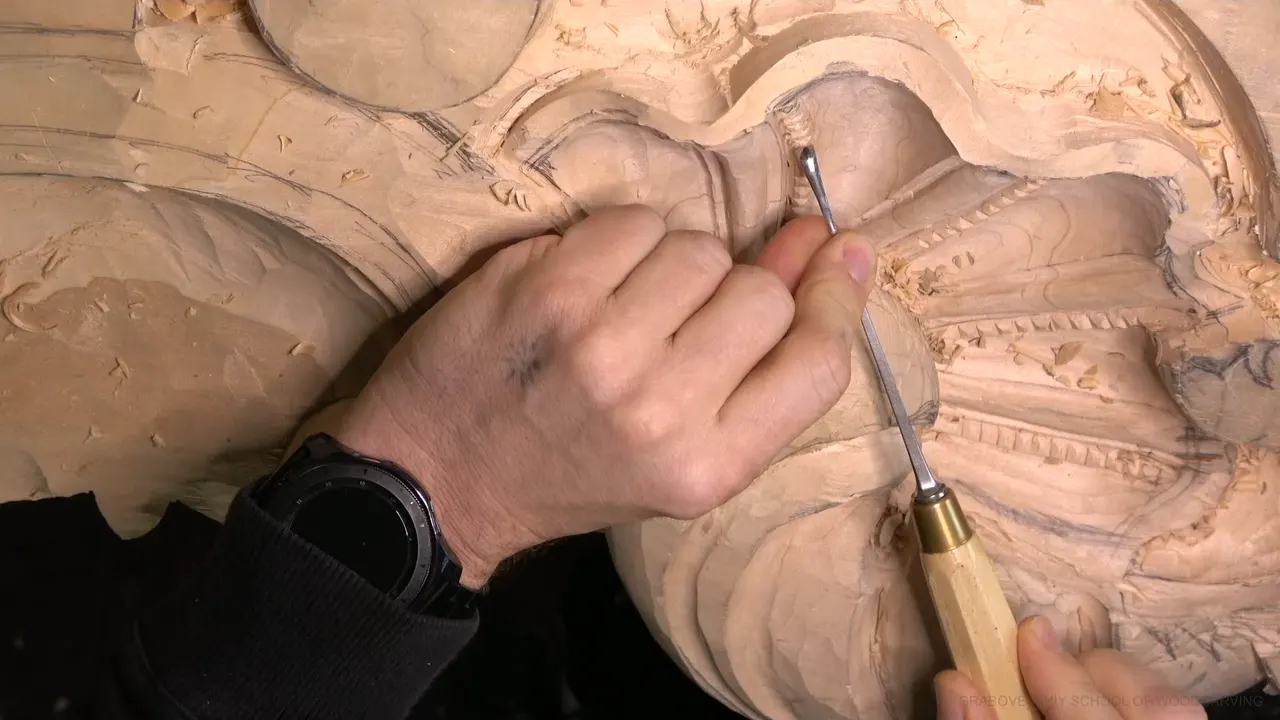

In Venice Room workshop 6, part 12, I said "hopefully, you already see those beads coming alive." That word came back for an acanthus, leaves, a flower and a convex. The video right before it is part 11, and it shows the careful work that came first.
Has a tool ever gone a little too deep beside a bead? In part 11 I said I have made that mistake more than once. Below are my words from parts 10, 11 and 12, then the lessons where I said alive.
What this page holds
- Part 11, from the first warning to the last line about grain.
- Parts 10 and 12 beside it.
- Places where a leaf, a flower or a convex was alive.
- The wood itself, in lessons where I called it alive.
- A table with one short note for each of the videos named above.
What did I say in part 11 about pressing too hard?
The warning that opens part 11 is mine: "That would be a big mistake for me to press too hard." Next came "I can't do that." And "It's better to take time." The end of that thought was "just approach to the final result."
This came next: "And I love that element myself." The plan: "let me do it everywhere." And "hopefully, you're going to be able to see it."

Something was in my way, and I said I might need a back bent gouge: "maybe I have to use a backbend again because I do have this in my way, and I'm not always able to get to the area."
About the mess: "I do have a lot of mess right here, just kind of in my way." The stage, I called it, was "the beginning stage." Then "I need to pull my backbend." And "Because just almost impossible for me to do the next."

My plan for a tool: "I'm going to use, in this case, number eight." And "Number eight and a quarter inch" (a quarter inch is about 6 mm). Soon after, about that tool: "See, and a backbend just lets me to get really, really close to almost everywhere." And "Probably I could use it from the beginning."

Further on: "And now I'm going to flip to that side and do exactly the same, just opposite direction." Then "Okay, that is good." Later: "Well, looks like I need to create little better cut right here." And "maybe I need to sharpen."
Why did I call a bead row an easy operation?
The words were "it looks like it's an easy operation, and it is a kind of easy operation." The catch came next: "but if I'm not careful, I can make a too deep of a cut, and then one of those beads can pop out."
Next: "And yeah, you can glue that back, but if you can eliminate that pop out, just eliminate that from the beginning." After that: "And yes, I've done that mistake multiple times. When you just press too hard on your tool."

A little later, "hopefully you can see it's already starting to look like beads." Of one bead: "Let me do this one. But again, I got to be really careful here."
The outline: "Let me fix this. Not fix, but my first bead outline has to be really, really nice." The part closes on "got to be careful, careful, careful because of the grain direction."

Which words sit beside part 11 in its own lesson?
In workshop 6, part 10, one way I named was "just take a straight gouge, like a number one, and create the preliminary notches." The other way: "just take a V tool and create preliminary cuts like that with the V tool attacking from the sides."
Fibers got a line of their own: "I don't want to really overstress my fibers." Then "Because when you're pushing fibers, next day, they're going to go back." I planned to "take a skew number one, which is in England would be number two." I also said "I forgot to place my marks on this section." And "Can't forget it because that is also supposed to have the same idea." I called one stage "just a relieving cut" and the next was "Step number two would be take either number seven or number eight." The tool: "Maybe number seven and a quarter-inch." And "Going to create some roundness."

Part 12 starts with "My tool has to be really sharp." Then "Really, really, really sharp." Next: "now, what I need to take care of, I need to take care of those sides." Then "That looks like number seven works just fine." And "Again, I can't rush it because it would be a big mistake."
For the sides: "I could use just the number seven, the previous number seven." The second way: "Or I could use a smaller tool and just without going too deep to the side." Later: "And now I need to clean those sides. Okay, let me use the same number seven, what I used right now." Corners: "Let me get inside of those corners and kind of remove."
Then came the line behind this page: "But hopefully, you already see those beads coming alive." After it: "Maybe there is other ways to do them, and maybe some of you can do them much quicker, but I've always done that operation that way, and it works every time for me."

Beading came up too: "And I've done a lot of beading." The bead: "It's a really, really, really nice element to add to the picture frames, to any pretty much architectural designs." On bead moldings: "there is a skip one, like you've got one bead, then you skip a couple of them." Inside the corners: "Be careful. I'm using only edge of my tool." And when my hands covered the cut: "Sorry if I'm covering that with my hands. Sometimes you just have to."
The result with the number seven was this: "But see? It just becomes really, really clean and nice." Then, with a different tool: "I can get in the corners." Next: "See? I can make even cleaner cut if I need to." On the chips: "And of course, it would help if those chips would fly out right away. But not always the case."
Where else did I say something was coming alive?
Alive turns up beside an acanthus, a flower, a convex and some leaves. Each line below is mine, with the lesson it comes from.

Venice Room 20, part 5, has a question: "Can you really see this acanthus is coming alive?" After it: "I know it's not the final form, but at least it's already showing some life." The eye: "And this eye could be much bigger." And "I can use number nine and a quarter inch," which is about 6 mm.

A short one is in Venice Room 37, part 11: "And I can see my convex coming alive."
Over in the Furniture Panel 23 lesson, part 5: "And yes, I need to go much deeper right here. Otherwise, it doesn't look too good." Next: "And I hope you're already starting to see the flower coming alive." And "I'm using number three, three millimeters, one-eighth of an inch."

Carving Hashemi Flowers 6, part 4, has "I know those cuts were deep, but like I said, they're making those leaves alive." Right after it: "And again, I'm not doing it everywhere. Some spots, but they create beautiful things."
In The Tray of Blessing 5, part 2, the line is "So don't do it everywhere. Just some spots." Then "It's just more decoration than anything else." And "but what it does, it just brings even more life."
Chamomile and Bow Rosette 2, part 2, is a plan for an edge, in this lesson: "I also want to create some kind of movements, some waviness." Then "It's going to give me more lifelike look."

Carving Grape Onlay 8, part 1, has "in this case, I'm using seven millimeters and I create little wave." Seven millimeters is about 0.28 in. Next: "Again, it doesn't have to go all the way." And "that's what makes, uh, those leaves alive."
Acanthus over Moldings 7, part 3, has "Make a paper thin look and you can see it's already establishing beautiful shape." Next: "But I created the movements inside" and "it looks more alive."

Part 8 of Lily Box 5 is in this lesson: "I want to go deep, but I also have to keep an eye on the thickness of this slope because I don't want to make it too fragile." Then "I'm not sure about you, but I can clearly see my flip is actually becoming alive."

Lily Box 11, part 2: "that's really important for me to have that convex." Then "It just makes the whole world of a difference, if it's really looking alive or not, okay?"
Design Principles for Wood Carving 3, part 1, was about movement in a design of flowers: "the main movement goes uphill. It's growing. It's alive." The second one came with "Look at the second movement" and "It falls."
A nearby word turns up in Venice Room 61, part 4: "I kind of like that it leaves some tool marks. It just gives some life even on inside." Then, a little later: "It just gives even more life."
Is wood alive too, in my words?
The word also fits the wood itself. Carving Roman Acanthus 16, part 1, has "Some of you wrote me email and said that wood is not really good." And "my teacher said there is no such a thing as not good wood." Then "Sometimes the same piece of wood, one day, it carves normally, and the second day, it just becomes like mushy, and the third day, it could feel absolutely different, like it's not even basswood anymore." Next: "So please do understand, it's not because wood is bad, but wood is alive, and it's a living thing."

The reason, in my words: "So it actually sucks the water in and swallows and then shrinks." Then "It could be more water inside of the fibers, less water inside of the fibers."
In Lily Box 8, part 3: "I really want to keep the connection underneath of this piece because I really want to prevent too much movement of the wood." Then "And wood is alive. Even if it's cut, it still has lots of movements." And "Sometimes it moves like crazy, really badly."

The talk continues: "And especially if you're carving, some of the points are going to be weaker." Next: "I can feel this wood especially." And "I feel like this is a little too fresh. So it did not have a long period of drying."
The April 2020 livestream on wood movement has "those fibers when you cut the tree, they're still alive." Next: "Longer that tree was harvested, what happens, the fiber's drying out and they don't take that water anymore." Of kiln-dry boards and air-dry boards, I said air drying "was always my preferred method" and "some of my boards I keep in my shop for over 10 years."
Which video holds which words?
Every video below holds my words, with a note on what sat beside them.
| Course and video | What sat beside the words |
|---|---|
| Venice 6-11 | A bead row, and a warning about pressing too hard |
| Workshop 6-12 | Beads, a sharp tool, and the sides of the beads |
| Room 6-10 (Venice) | Pushed fibers that go back by the next day |
| Workshop 20-5 | An acanthus, and an eye that could be much bigger |
| Workshop 37-11 | A convex that I could see coming alive |
| Room 61-4 (Venice) | Tool marks left on the inside, and some life |
| Furniture Panel 23-5 | A flower, and a place to go much deeper |
| Hashemi 6-4 | Leaves, and deep cuts in only some spots |
| Tray of Blessing 5-2 | Only some spots, with more life added |
| Chamomile Rosette 2-2 | A wavy edge planned with a small tool |
| Grape Onlay 8-1 | A little wave made with a seven millimeter tool |
| Acanthus over Moldings 7-3 | A paper thin look, and movements created inside |
| Lily Box 5-8 | A slope, with an eye on its thickness |
| The Lily Box 11-2 | A convex, and a maybe even nicer deeper cut |
| Design Principles 3-1 | A flower design, with one movement going uphill |
| Roman Acanthus 16-1 | Wood, water, fibers and a change from day to day |
| Course Lily Box 8-3 | A connection I want to keep underneath, and wood that feels fresh |
| Livestream April 2020 | Fibers of a cut tree that still suck water |
Where can you watch part 11?
Workshop 6 holds part 11, inside the Venice Room course. Parts 10 and 12 sit beside it on the lesson page, and everything on the site sits inside the tuition.
Would your own beads look alive after one gentle pass? Pick up a gouge, take your time, and look at the row.
How it's done
- Take your time. Part 11 has the line "It's better to take time."
- Reach for a back bent gouge. I said I might need one, with something in my way.
- Watch the depth beside each bead. A too deep cut is the danger beside a bead, I said, and I have made that mistake before.
- Watch the grain. I said I have to be careful, careful, careful because of the grain direction.
- Check how the row looks. Part 12 has me hoping that you see the beads alive.
Frequently asked questions
Which tool did I name for the beads in Venice Room 6-11?
My tool plan in part 11 was a quarter-inch (6.35 mm) number eight. A back bent one was named in the same part, and I said it lets me get really close to almost everywhere.
What could happen to a bead if the tool goes too deep?
Part 11 has the line "if I'm not careful, I can make a too deep of a cut, and then one of those beads can pop out." I added that I had made the same mistake more than once, from pressing.
Which part had me hoping the beads looked alive?
Venice Room 6-12, soon after I said I can't rush it. In 20-5 I asked about an acanthus, and in 37-11 I spoke of a convex.
What to carve next