

Alexander Grabovetskiy, woodcarver, School of Woodcarving · Published 2020
What does a wood carver mean by "something off"?
Quick answer: The part 3 video of Venice Room workshop 6 has me saying "Something off." Other lessons carry the same words beside a mark against a wall and a level. A pencil mark and a red marker line were a trouble too. Each is set below beside what I said.
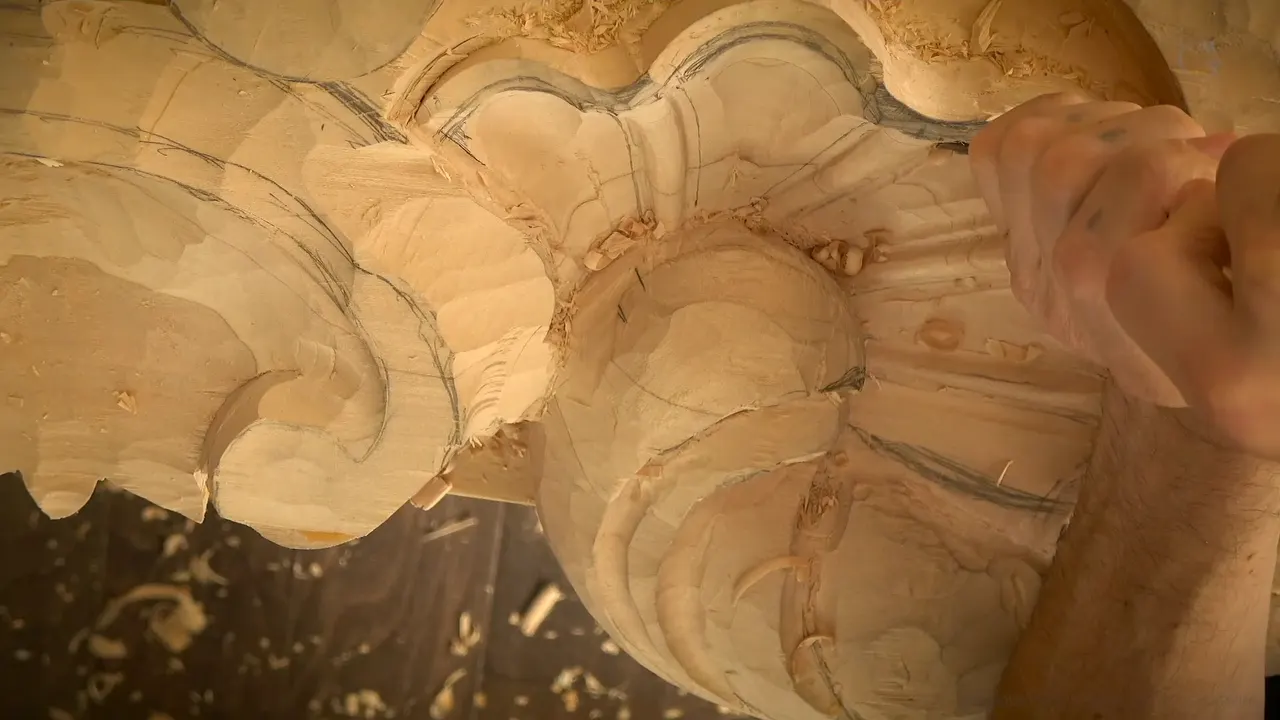

In part 3 of Venice Room workshop 6 I said "Something off." A little later I said "Just something off. Something bugs me." Other lessons carry the same words beside a mark against a wall and a level, and a pencil mark and a red marker line gave me the same trouble.
Ever looked at a cut that felt wrong and could not say why? Below is what I said in part 3, what I did next, and the lessons where those words came back.
What this page holds
- This video, from "I'll clean a little better later on inside" to my last words about a number nine.
- Both parts beside it.
- Lessons where "something off" came up again, each with the cue words around it.
- Marks and lines with the same trouble.
- A few lessons where I was a little off and called that okay.
- A table with one note for each video.
What came before the words "something off"?
The video opens with "I'll clean a little better later on inside." Then "Get a little deeper cut." A shadow comes up early: "What I'm doing, actually, I'm creating extra shadow point."
I went on with "So that ridge also going to cast a shadow." Then "That is all about the shadows." Next came "right here, the same idea" and "little deeper cut."

On the next side I said "I need to check, keep an eye on my line I created." The depth I wanted: "And I need much deeper cut." Another line: "And I want deeper."
About a spot I wanted gone I said "All I'm going to do is just to take same number seven, what I used before, and get rid of that thing."

Which side did I say was off?
My words were "But most important for me to create really nice cut right here, and for some reason, I'm not too happy about this side." Then, on its own line, "Something off."

Next: "I think I know what is off." The cause I named was "That extra shadow throws me off, and I really can't see what is going on in real world." The plan: "I need to clean little bit upper part right here."
On it: "And you know what? It still doesn't look like what I want to see." My plan was "Let me use a rasp" to figure out what was going on with the edge. Then "Just something off. Something bugs me."

Then came "Now it's just a shadow. It's got little inconsistent look right there" and I followed it with "Yeah. I'm too aggressive."
How did part 3 come to an end?
The next lines are "Oh, no, I just going to use my old way. Just gouge and touch out this side." A verdict: "It's still not what I want to see, but much better."

A plan followed: "Let me give a slight cut right here." After it, "Okay, now it's much better. Much better." The last lines of the video are "I shouldn't do that. I should just use the same number nine."
What did the other parts add?
Venice Room 6, part 2, begins with "Again, I'm just eyeballing it. I really don't want to measure." I also said "And double-check that line." My tools were a choice: "I could do that with the number 11 and 3 millimeters, or I could use actually a quarter-inch number nine." A quarter inch is about 6 mm.

Part 2 also holds the depth: "I'm going to go maybe about 3 millimeters deep. About one-eighth of an inch deep." Then "That's still going to cast a shadow and gives me an extra line." A slip shows in part 2 too: "Okay, got to change the direction. Almost messed up."

Part 4 has "Now I'm happy with that curvature." On the light I said "sometimes I have to check under different lights because shadow can also create the problem how you see when the light hits, creates the shadow, and you really can't see what is going on."

On checking: "So very often I just go back and just check that under a different light condition, like at night, and I just turn one side, and I turn another side." Of one spot I said "And I don't like how it bumps out right here."
In the same part: "And now it is gone. That's good. That is much better." The grain mattered too: "because my grain changed right here, direction of the grain."

Part 5 of the same workshop has "Okay, I don't like what I see right here. I am a little off. Maybe not even little, I'm a lot off." A tool followed: "Spoon gouge, that's what I'm trying to say."
Where else did "something off" come up?
In workshop 160 of the Venice Room, part 2, I said "Of course, how the camera pointing, for you, it's just not the right distance. But for me, it also doesn't look like that." Then "So I don't know. Let me check."

The check I named: "let me place this tool against the wall, make a mark, and I can place it right here on the... Yes, I am off." Then "But I need to make sure what is off."
Next, "Maybe I could just use a caliper." Then "Which side I'm off." And "I hope I didn't mess up." I also said "I know it's not too late yet to fix it, but I still don't like to make mistakes."
A later check: "this side is good." Of the line itself: "I am right on the line. There is actually a mark." Of the other one: "This side, opposite side, is way off."
Part 3 of Venice Room 12 has "I kind of like that small detail we created, or I should say I created." Next: "But something off right here yet."

Next: "kind of not too happy about how it looks right here. So I think I should give a better defined piping." About the movement: "the movement is okay." I said "It's just not too defined, I should say." My plan: "Probably have to go with the deeper concave cut on the side like that."
Part 4 of Venice Room 36 has a line about practice: "it's a good practice to train your eye to just eyeball those lines." Then "More you do, more you'll able to see and catch if there's something off."
Further on, in part 2 of Venice Room 134, I said "I'm approximately the same level with this, so I cannot go deeper than that." Then "It's not that critical, but you will be able to catch that." And "Not the problem, but if something off with the level."

Then: "I can get actually this side a little lower, and let's chop down." For the edge I said "couple ways I could attack this edge" and the first was "I can clean it with the number 11."
Which marks and lines brought the same trouble?
Part 9 of Venice Room 75 has "that red marker." The next line says "It still leaves some marking inside, which is okay." An option: "I can always cut deeper right here."

I added "But if I would have a thinner material, that would be a big problem, because even now it's actually deep penetrated, really deep, especially red marker for some reason, just penetrates really deeply."
Over in Venice Room 38, part 12, my words were "And let me get rid of those marker lines. Just kind of throws me off." Next came "And I don't see the edge. But I really need to see the edge" and later, "Okay, now I can see it."

An aside: "That was just a pencil sharpener, by the way."
Lesson 43 of the Venice Room, part 1, has a pencil mark too, with the line "It doesn't look right." Then "Fix that eye." Carving Furniture Panel 32, part 2, had the same trouble with a pencil mark. My tool: "So let me get flatter tool. I'll use number three and one eight of an inch," which is about 3 mm.

Lily Box 8, part 5, has a worry about "overall movement." I wanted "maybe number five and one inch" (about 25 mm) "and try to fix overall movement."

The grain was the cause: "just because it has a lot of curls in the grain." About the look: "When you look at it, it looks like it's wavy."
I said "Also try to hit the surface to find if there is any high spots." Then "And indeed there is." Next: "And now it's all gone."
The grape vase lesson, part 10, has "So I got that leaf, but something wrong right here, because I still have to move that direction and that direction. So that cut is wrong cut."

Then: "Okay, now one of the lines threw me off. So that is unnecessary line." Later, "There's going to be a middle line for this moment."
When is a little off okay?
In Hashemi Flowers 29, part 3, I said "And I'm not measuring anything right now with the flowers." My goal: "My goal is to make it look as close as possible to nature and still be more or less accurate to my design." After that, "But if I'm off a little bit, I'm okay."

Venice Room 1, part 13, has "But let me do straight cuts. And if I'm off slightly, that is okay." Over in Venice Room 2, part 9, I said "Oh, I'm off that slightly, so it has to go this way." Then "That has to be excavated."
In Carving Furniture Panel 15, part 1, I said "And make my initial marking." Next: "And I'm not sure why I am a little off."
Another from Venice Room 36, part 9: "And if it is just slightly off, it's not a big deal at all." The reason I gave: "It's just going to show that it's a human being did it, not CNC machine." Then "Of course, to a certain degree."
Carving Roman Acanthus 7, part 5, has "I can always rotate and look straight down." It is "much easier for me to fix" when I am off somewhere, I said, and I can check if the piece is "completely symmetrical."
The same part: "I can see that this side, it's not really symmetrical yet." Then, further on, "I can see that is much better now."
In Venice Room 85, part 6, I said "that is not exactly 90 degrees, but a little off because I really want to be careful how I do that." Then "But that's pretty close, but not exactly, okay?"
Last, in Venice Room 96, part 11, I said "if you like the idea of Fibonacci sequence, if you take this side and if you take this side." Next: "this line's supposed to be at the 60/40 rule or 38 versus 62 rule, if you wish to do that." After it, "looks like I'm slightly off."
Which video holds which words?
Every video below holds my words, with a note on what sat beside them.
| Course and video | What sat beside the words |
|---|---|
| Venice 6-3 | An extra shadow, a rasp, and a slight cut |
| Venice 6-2 | Eyeballed lines, and a quarter inch number nine |
| Venice 6-4 | A different light, and a ridge |
| Venice 6-5 | A spot where I was a lot off, then a spoon gouge |
| Workshop 160-2, Venice | A tool against the wall, and an opposite side |
| Workshop 12-3, Venice | The detail I liked, and a piping to define |
| Workshop 36-4, Venice | Lines to eyeball, to train my eye |
| Workshop 134-2, Venice | A level, a table to rotate, and a number eleven |
| Workshop 75-9, Venice | Red marker, and the risk with thinner material |
| Workshop 38-12, Venice | Marker lines, and an edge I could not see |
| Workshop 43-1, Venice | Pencil mark first, then an eye to fix |
| Furniture Panel 32-2 | A number three, and a pencil mark to remove |
| Lily Box 8-5 | Curls in the grain, and high spots |
| Grape vase 1-10 | A wrong cut, and an unnecessary line |
| Furniture Panel 15-1 | My initial marking, and a small cut |
| Hashemi 29-3 | Flowers close to nature, and my design |
| Venice 1-13 | Straight cuts, and a bigger gouge to try |
| Venice 2-9 | One line that had to go another way |
| Workshop 36-9, Venice | A finger a little too thick, and a human being |
| Roman Acanthus 7-5 | A symmetry check, looking straight down |
| Workshop 85-6, Venice | An angle that is not exactly 90 degrees |
| Workshop 96-11, Venice | The 60/40 rule, and a line slightly off |
Where can you watch part 3?
You can watch part 3 inside workshop 6 of the Venice Room course. Parts 2 and 4 sit beside it on the lesson page, and everything on the site sits inside the tuition.
Which spot on your own board still looks off? Pick up a gouge, turn the board under another light, and give it one more pass of wood carving.
How it's done
- Say it plainly. My plain line in part 3 was "Something off."
- Name the cause. Later in part 3 I named an extra shadow as the cause, and said I could not see what was going on.
- Look under another light. Part 4 has me checking under different lights, turning one side and then another side.
- Keep the old way ready. I planned my old way in part 3, a gouge to touch out one side.
- Say what is better. After my plan for a slight cut, I said it was much better.
Frequently asked questions
Which words did I use for the problem in Venice Room 6-3?
My plain words were "Something off." Later I named a cause, planned to clean the upper part, and named more than one way at the edge. Near the end I said "much better."
What cause did I name in workshop 6, part 3?
An extra shadow. In the same part I had said "I'm creating extra shadow point," and my cause came after that "Something off" line.
Which tools came up in the part 3 video?
A number seven, "what I used before," and a rasp I planned to use. A gouge for touching out one side came up too. My last words named a number nine.
What to carve next
- Venice Room Part 1 course page
- Venice Room 6
- Venice Room 160
- Venice Room 12
- Venice Room 36
- Venice Room 134
- Venice Room 75
- Venice Room 38
- Venice Room 43
- Carving Furniture Panel 32
- Lily Box 8
- Carving Vase with Grape Leaves 1
- Hashemi Flowers 29
- Venice Room 1
- Venice Room 2
- Carving Furniture Panel 15
- Carving Roman Acanthus 7