

Alexander Grabovetskiy, woodcarver, School of Woodcarving · Published 2020
What does a wood carver mean by "anyway"?
Quick answer: In Venice Room workshop 6, part 1, I put anyway on a mess that was too early to clear. In other lessons the same word sits beside a part that ends up hidden, gone, lower or painted, and beside a spot that is too late.
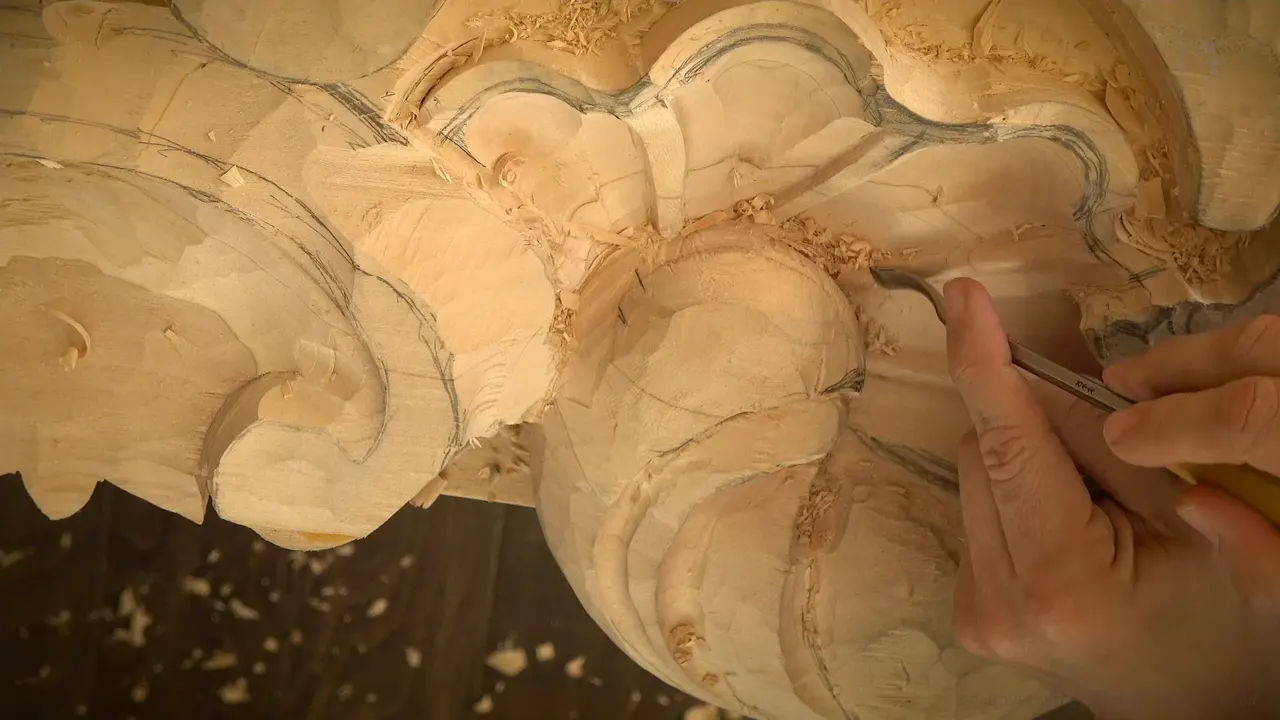

In workshop 6 of the Venice Room, part 1, I said "But it's a little too early anyway" and in other lessons I put the same word on a spot that ends up hidden, gone, lower, painted or carved away. Each lesson is linked below, and a table near the end lists the videos.
Here you get the lines around it in workshop 6, the two parts beside it, then my words from other videos, each one named.
What this page holds
- The lines around "anyway" in workshop 6, part 1.
- Its tool sizes and its step down, the two parts beside it, and their shadow cuts.
- Spots I said stay hidden.
- Spots under paint, and spots that go lower, wrap or get undercut.
- The "too late" lines.
- A table of the videos, with a note on each one.
Which lines come before anyway in part 1?
The part opens in the middle of a thought: "That is also really important for me not to create the waviness." Next come "Maybe a little cleaning of facets" and "I'm happy with this one, too."
The mess comes next. "All that mess kind of bugs me, but I really should take care of it," I said, and then the word itself: "But it's a little too early anyway, but let me just get rid of some of it."

A limit followed, "I don't want to create marks in my background." A note on touching came after it, "This needs to be just slightly touched, and let's move to another one." Last in that stretch was "So now it gives me a really beautiful curvature."
How did I move around the piece in part 1?
"Okay, let me get another side now," I said. A little later came "And again, my apology if you really can't see what I'm doing" and then "Let me try to show you from a different angle."

My next stop was the upper part, with "So let me touch up the upper part" and a pencil mark to remove. My worry there was the shape, "lose my curvature." I added "Again, I'm talking about curvature in three-dimensional flow, okay?"
For the work I gave myself a rule: "If I need to do multiple cuts, I'll do multiple cuts, okay?" Soon after, "Whatever it takes" and "But I also have to keep an eye on this corner."
Which lines about the light and the facets sit just after that?
"Now I'm going to hit the upper part, but almost no pressure at all, just shaving," I said. Then came "also depends how the light hits."

Small cuts were my reason to take care: "Even small facet, even small cut creates the shadow" and "So that is why I have to be really careful." The look I wanted: "I want to see those facets, but not as much." Right after, "I don't want to look rustic. I want to look authentic, but not rustic."
Which tool sizes came next?
The next words were "I need to get little bigger" and "clean those upper parts." Sizes followed: "Okay, so that was 10 millimeters and 25" (0.39 in for the 10). Then "Let me use 25 and maybe half an inch" (12.7 mm).

A doubt came with the half inch, "little too small." Then "Maybe three-quarter of an inch, 20 millimeters" (0.79 in), and "Be carefully touch it, just like that."
The movement got a plan: "It's going to start from almost nothing and gradually create that movement and the pipe movement." A line later: "At least for now. I'll see how it looks, and if I have to change it, I'll change it."
What came last in part 1?
Near the end of part 1 comes a plan: "Let me create little cleaning right here." Then the next step: "So what I want to see before I do my bead mouldings, I want to create a step down."

It came with a line: "I'm going to draw approximately 3 millimeters away from this detail, a line" (0.12 in). Its figures were "3/16th and 3/16th on both sides" (4.8 mm each).
What do parts 2 and 3 add?
The second video opens with "Again, I'm just eyeballing it." I also want to "measure from the inner part." Its figures: "one-eighth right here, so 3/16 from here to there, and about one-eighth right here. So 5 millimeters and 3 millimeters" (an eighth of an inch is 3.2 mm, 3/16 in is 4.8 mm, and 5 mm is 0.20 in).

Soon came "I can always double-check later" and "That is the sound of a woodcarving shop." Of the line itself: "That's supposed to be a really nice curvature line following actually the main form." Next to it, "I'm actually creating original to the 15th century design."
For that step I named "the number 11 and 3 millimeters" (about 1/8 in), "or I could use actually a quarter-inch number nine" (about 6 mm). I thought "a good idea, just a quarter-inch number nine."
I planned the depth, "maybe about 3 millimeters deep" (0.12 in), and "About one-eighth of an inch deep" (3.2 mm). Of the shadow: "That's still going to cast a shadow and gives me an extra line" and "still going to leave me plenty of the material for the next detail."
The third opens with "I'll clean a little better later on inside." Further on, "What I'm doing, actually, I'm creating extra shadow point" then "that ridge also going to cast a shadow." Straight after that ridge line comes "That is all about the shadows."

Where else was a part hidden or gone anyway?
Hashemi Flowers 32, part 2, carries "Let me refine my cut." Of most of it I said "hidden anyway" and then "but still, I'm all about the shadows."

A big eye is planned in workshop 29, part 11: "go all around until I remove that plug completely." "And I can go as deep as I wish," I said. My reason: "It doesn't really matter how deep" because it is "not going to be visible anyway."

The line went on with "All I need is just a shadow line" and "number 11 and 4 millimeters" (0.16 in), to "get to that hole I just created."
Against the grain: in workshop 13, part 11, I said "Yes, I am cutting against the grain. Not supposed to, but it's okay." I added that most of it is "gone anyway." A line after: "So now I've got a really good idea where that stuff is going to end up."
I was eyeballing in Roman Acanthus 1, part 3: "I'm not that accurate" because most of that material would be "gone anyway, and I have to redraw and refigure out all my movements and so on."

Next: "So that's why I'm not really just trying to be dead on, on those lines, just approximately, visually really close."
Hazelnuts 2, part 1, tells you the same thing: "So please don't try to be exact, okay? Absolutely no reason." You "cut out anyway" the greater part, I said, and "there's no reason to spend too much time protecting it."
A marking knife is in workshop 154, part 3: "Of course, if you have a marking knife," a line is "a lot more accurate, but that's okay." I said you will not be able to "see those lines anyway" once they come out.

Down in workshop 12, part 9, I said "I could continue that movement like that and get this one below, which would also be good." Then "Anyway, we have to look from down," because you cannot "see that overlap anyway." The plan: "Just take this one down."
A small detail sits in workshop 21, part 9, and I said "Let me double-check if I should or not." Then "Maybe I shouldn't spend my time" on what I will not be "able to see anyway." The next line: "But let me create the preliminary S."

In Lily Box 12, part 7, I said "put a small amount of super glue on the inside. Do it right away." Its spot was "hidden anyway." Next: "See what happens when you are trying to get really thin?" And "But there is a way to reinforce it."

Plate with Butterflies 2, part 2: "I hit some of the spots with number two, which I have absolutely no problem with it, but right there's kind of deep spot." After that, "That's okay majority of it's gonna be gone anyway."
In Furniture Panel 15, part 6, I said "I still was planning to lower that anyway." The reason I gave: "it still has to be a little lower than the leaf anyway." Going deeper there "would be a big problem."
Lily Box 10 has more. A crack in part 6 was "okay as long if I can keep this side of the paddle," because the other side is "removed anyway." Later, in part 7, "covered anyway, and I should not be afraid" and "covered with the inner part of a bunch of details."
Where does paint cover a spot anyway?
Inside workshop 14, part 3, I said "It doesn't give me a crisp cut like I would like to see." Then "But on the other hand, for me, to cut from this side, I have to switch to a spoon gouge or so." The turn: "I don't need to" because of "paint grade anyway."

Pencil comes up in workshop 47, part 11: "But it's better not to because first of all, it creates a lot of mess." Then "hard to clean." The turn: "But in this case, it's okay because it's going to be paint grade anyway."

Which spots go lower or underneath anyway?
About a part going lower, workshop 128, part 3, has "acanthus head going right on top, which means later," a part will be "lower anyway." Then "So I can go ahead and remove a lots of material right here."

Sizes came next: "go almost as low as this side, about 30 millimeters almost" (1.18 in). Then "I think I'll be safe. Well, maybe about 25 millimeters, let's say" (0.98 in).
A wall appears in workshop 51, part 5. I planned "the same number nine, quarter inch" (about 6 mm), and "carefully" to "start excavation." Next: "And I'm not afraid to get really close to this wall because it has to wrap anyway on inside."

A second point: "For me, it's more important to keep away from this ridge because it's fragile."
Greek Acanthus 2, part 3, says the surface will look less clean, and then "we're going to undercut anyway later on."
Where do I say too late?
A plan sits in workshop 68, part 9, with "And if I'm not going to like it, it's too late anyway." Part 1 of workshop 6 had "too early" with the same word.

In workshop 70, part 3, I was checking a depth, "before it's too deep." Next, "It looks like I'm okay with this moment, and if I'm not okay with this moment, it's too late anyway." My last words there: "It's already too deep."
A third spot, in part 2 of workshop 12, has "Extra detail" then "Extra something" and "Still not sure if I like it or not." Anyway closes that line, and "Just a small flip" follows.
What comes right after But anyway?
Two lines are worth a look. Workshop 130, part 3, has "But anyway, I don't see enough concave yet, so I need to take maybe number seven and create that concave."
Over in workshop 76, part 10, I said "I think it's a good setup" and then "But anyway, so let me start working on that."
Which videos hold the word, and with what?
Each video below holds the word, with a note on what sat beside it.
| Video | What sat beside it |
|---|---|
| Venice Room 6-1 | A mess I called too early, and a limit about marks in my background |
| Hashemi Flowers 32-2 | Most of a part hidden, and shadows I still wanted |
| Workshop 29-11, Venice | An eye with a free depth, and only a shadow line needed |
| Roman Acanthus 1-3 | Eyeballed lines on material I redraw later |
| Hazelnuts 2-1 | No reason to be exact, and none to protect the part that goes |
| Lesson 154-3, Venice | Drawn lines that nobody sees once they come out |
| Lily Box 12-7 | A drop of super glue inside, in a spot that stays hidden |
| Plate with Butterflies 2-2 | A deep spot, with most of that wood going away |
| Greek Acanthus 2-3 | A surface that looks less clean, with undercutting still to come |
| Room 47-11, Venice | Pencil mess, hard to clean, and a piece for paint |
| Part 128-3, Venice | A part that goes lower, with 30 millimeters (1.18 in) in mind |
| Clip 70-3, Venice | A depth I checked, and a spot already too deep |
Where can you watch part 1?
You can watch part 1 inside workshop 6 of the Venice Room course. The other two videos sit beside it on the lesson page. Everything on the site sits inside the tuition.
Which spot on your own piece will be gone, hidden or painted anyway? Pick up a gouge, look at what will stay, and give it one more pass of wood carving.
How it's done
- Name the mess. The mess "kind of bugs me," I said, and I planned to clear a part of it.
- Set a limit. My limit was the background, with no new marks in it.
- Watch the light. It "depends how the light hits," I said, and even a small facet or a small cut creates the shadow.
- Pick a tool size. Half an inch (12.7 mm) was "little too small," so I said "Maybe three-quarter of an inch, 20 millimeters" (0.79 in).
- Draw the step down. My plan was a line approximately 3 millimeters (about 1/8 in) from the detail, before the bead mouldings.
Frequently asked questions
Which line holds "anyway" in part 1 of Venice Room workshop 6?
The word sits in the mess talk near the start of the video, with a line on the mess just before it and a limit about the background just after it. I called clearing early and said I would take away part of it.
What did I say about a hidden part in Hashemi Flowers 32, part 2?
Right after "Let me refine my cut," I said "hidden anyway," and a line on shadows followed. A small turn, "but still," came before the shadows. The video is lesson 32 of the Hashemi Flowers course, and it has its own lesson page.
Which lessons say that paint covers a spot?
A spoon gouge I did not need comes with workshop 14, part 3, because paint goes on that wood. Pencil mess and the same word sit in workshop 47, part 11, after I said it is better not to use those pencils. "It's okay," I said there.
What to carve next