
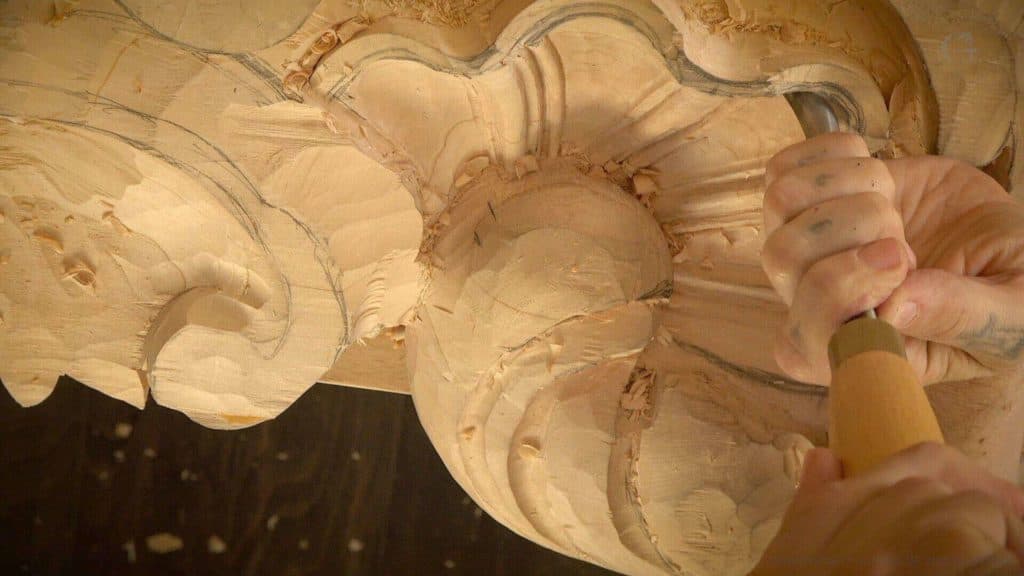
Alexander Grabovetskiy, woodcarver, School of Woodcarving · Published 2020
What does a wood carver mean by "anywhere"?
Quick answer: In workshop 6, part 7, I called the bead a detail I really like, and a detail to use "anywhere." The same word returned for shells, an acanthus and a corbel design, and with a clamp and a spray adhesive in "go anywhere."
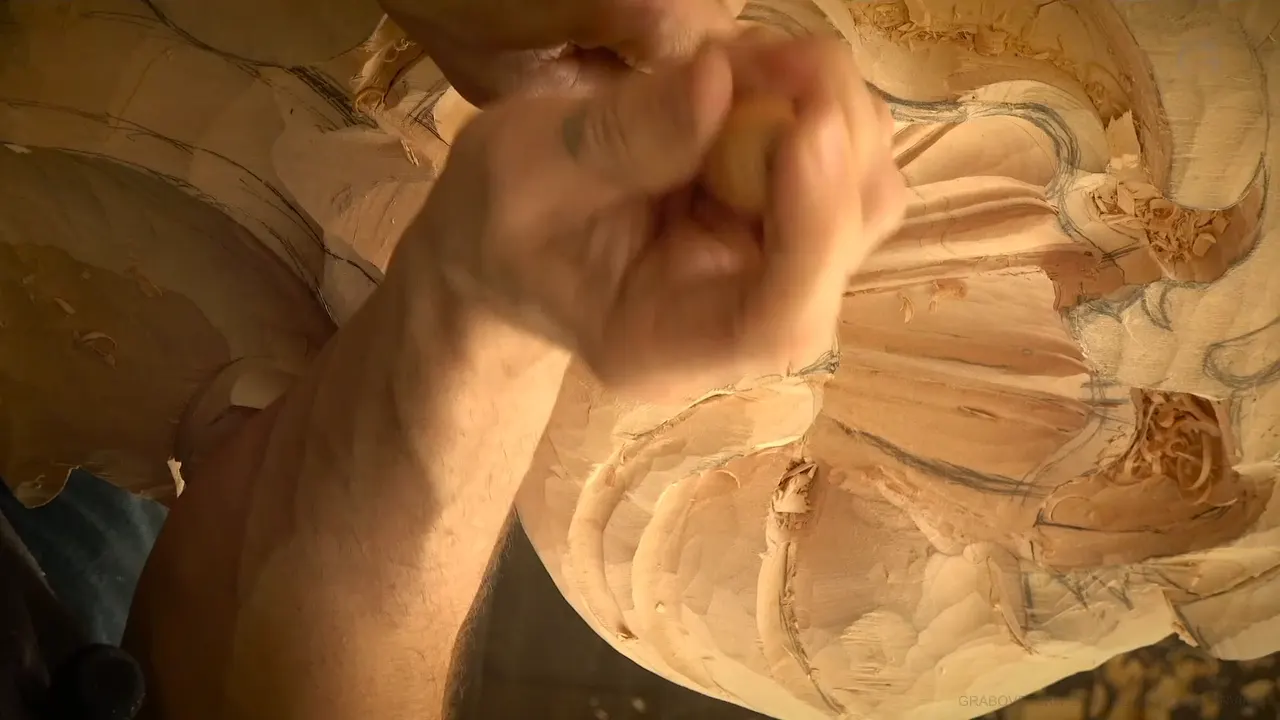

In part 7 of Venice Room workshop 6 I called the bead a detail I really like, and a detail to use "anywhere." The same word came back for shells, for an acanthus and for a corbel design. It came back beside glue and a clamp too.
Ever wondered how far one carved detail can travel? Below are my words from part 7 and from parts 6 and 8, followed by the lessons where I used the word again.
What this page holds
- This video, from "Clean" to the closing line about another angle.
- The two parts beside it.
- Lessons where a shell or a leaf could go "anywhere."
- Lines with "go anywhere" in them.
- Places where I said "not everywhere" or "anywhere else."
- A table with one note for each video.
What came right before and after the word in part 7?
Here is part 7: "Clean." Next came "Get really nice and round here." Right after it: "Really good detail actually to use that anywhere pretty much you can use it." And "So that is one of the details I really like, the bead."

My next move: "Okay, let me get a little deeper right here." After that, "That is enough because sometimes I do have a tendency of overdoing stuff which I shouldn't."
My tools: "let me clean with number three, and then I'll just follow, I'm sorry, with number 11 and 3 millimeters, and then I'll just follow with the 1 millimeter." That 3 mm is close to 1/8 in, and 1 mm is close to 0.04 in. Then came "Number 11," followed by "Both sides."
About the middle: "And the middle part will be gone anyway, so I don't really worry about that middle part." About a side: "that bugs me a little bit, this side." Also "Okay, double-check."

I had a plan: "Maybe it's a good idea to take care of the middle part first and then move on." I added "Okay, I think that's what I should do."
For a bigger tool: "let me get the big number seven, one inch, and start just removing more of the material." One inch is roughly 25 mm. I wondered about its size: "Maybe number seven and one inch is a little too big as of now." Then "We'll see."

On the concave: "I could use probably a little deeper concave. I think I should use deeper concave." My taste came in: "That just doesn't look too nice, okay?" And "For my taste, at least."
My plan: "let me take care of it with number seven" with "I'll just switch to probably number eight. We'll see." Its cause: "right now, just not enough movement on that side." Then "And this side also. But for some reason, I'm having some resistance."
Next: "Yes, I definitely need deeper cut" with a plan to "probably turn to number eight." And "Okay, let me try number eight." Afterward, "that is much better, I think."
My last words in the video: "Again, I apologize if you can't see. Let me turn to another angle, and maybe you're going to be able to see better."
What did the parts beside it add?
In workshop 6, part 6, I said "Okay, that is enough, I think." Then "Now I am ready to create my mid-moulding." A plan: "A couple of ways I could do." And "Let me try first." Then a doubt: "I'm not sure if it's going to work or not."
Part of the plan: "I'm going to use a number eight backbend." And on grain: "I have to be careful because grain changes direction, and I got to be really careful how I attack that."

Further on came a skew: "I think I should use a skew number seven." It was "a skew number seven and approximately 10 millimeters, 3/8 of an inch." On why: "that's much easier to control in this case because of the grain of the wood in this area." Also "It just gives me really, really nice slice."
Of a finished look: "When I'm saying it looks good, it doesn't mean it looks finished. Okay? It looks good to that stage." And "Please do not judge me by the unfinished product." Near the end: "I am pretty close." And "I can always go deeper."
Over in part 8: "What I'm trying to do, I'm trying to get to this edge, okay, with the number eight, and create a really clean transition." Then the limit: "Not everywhere I'm going to be able to with the same big tool, but let me see if I'll be able here."

After it: "that creates beautiful, sharp lining, and a nice, beautiful detail." On high spots: "And I will check high spots." And "I want to see a really gradual movement."
My tool choice: "I could actually do even number nine," but "I think number eight is okay." It is "deep enough." On the light: "that becomes a little too dark outside. So really soon, I have to turn to different lights."

Facets come next, and I said "now I've got some facets to clean." Then "Let me use a spoon just to try to attack." And "No, I can't probably." The spoon too: "Even with the spoon, it's already becoming a little challenge." And last: "Okay, that is wonderful," followed by "That is absolutely what I want to see."
Which lessons said a detail could go anywhere?
A line from part 1 of Venice Room 82: I told viewers "I know most of you" would not carve a project that big, and then "sections of this project could be used anywhere" with "pretty much" after it. Next: "You can just use the details of it and just design your own application for that."

Venice Room 70, part 8, has "So now I need to undercut it." Of that section I said it could go "on the top of the mirrors, on the frames." And "It's actually a really beautiful ending, the upper part."

In Venice Room 54, part 5, I said "It's not the final cleaning." Then "that shell also going to give me extra level of shadow, by the way." Next: "So that's why I love 15th-century design. I can put shells anywhere."

Shells come up again in Venice Room 5, part 7: "those shells, they look beautiful, and there is just so many variations." I added "You can do that on the furniture" and "in architectural carving." One word stood alone: "Anywhere." Then "I've done some shells on bed headboards." Also, about keeping an eye on the grain: "see this is a weak side, and it just breaks away."

In part 3 of Venice Room 32 I said "It works like a cover-up" and "You can use them pretty much anywhere you wish." Then "to connect two elements. So you could use acanthus."

Venice Room 90, part 5, has "this corbel is unique to the Venetian style." Then "You could just use the design anywhere on mantels or pretty much anywhere, even in the kitchen below the hood." And "this corbel is actually excellent corbel."

Carving Furniture Panel 23, part 1, has "if you don't have big tools like that, with the small tools, it would give you exactly the same result." And "Don't panic. You don't have to buy it, really." Then "It gave me really quick excavation." The big ones, I said, could be used anywhere, and I gave this: "bigger tools are always better. Because bigger tool you can use as a small tool."

The Roman course, workshop 2, part 4, mentions "furniture makers who are still using symmetrical acanthus leaf just to decorate furniture." Next: "It just looks beautiful when you put this on the sides of a table leg or anywhere," I said, and then "pretty much."

For grapes, see Carving Grape Onlay 3, part 3: "That is pretty much the technique I'm using all the time just to block in." Next: "anywhere on the mantels, the kitchen hood" and "just on the wall." And "It's still gonna look nice."

In my beginner course, First Cuts for Beginners 1, part 5, I said "we're going to do a simple ancient style molding." Before it: "The goal is to establish the feel." Next: "around the frames" and "you can use it anywhere."
In the livestream on using plastic as a wood carving tool I said "you just redraw opposite direction and all of your movements." Then "you can use that trick anywhere, just on any design, like for the mantels, for hoods, and so on." Next: "Just to draw one side if it's supposed to repeat another side." And "That actually saves you a half of the time."
What did "go anywhere" mean with a clamp or a lowered part?
Back to Venice Room 82, part 11: "I can lay it right on a surface and create a rotating cut." Of a single bevel: "you can lay it on a flat part and do exactly the same what I've just done" and it would not "move anywhere from the surface." Next: "So it's actually a really good trick of a trade."

A lowered part is in Venice Room 107, part 3: I said that "lower that down about four millimeters" would still let me "grab the material." Four millimeters is close to 5/32 in. Next: "I can't make it too tight because this becomes also kind of fragile." And "Okay, I lowered that, and it looks like it's solid." The part would not "go anywhere" and I could "remove majority of the material."

A clamp shows up in Venice Room 125, part 2: "use my clamp again." Next: "And now it's solid." Then "I can take out this clamp. Don't need that anymore." And "It is not going to go anywhere. It's solid."

Acanthus over Moldings 1, part 1: "let me glue that piece to the board" and the glue was "just a spray adhesive." Then "And it's not going to go anywhere. I am ready to carve it." The downside I named: "using spray adhesive, it just collects dust." I also said "it doesn't bother me that those details are quick to do."

Lily Box 8, part 3: "Let me use number 11 and spoon gouge, two millimeters, and clean a little better right here." That is close to 5/64 in. Next: "You can probably hear that the wood doesn't want to go anywhere." Then "this is really crunchy wood. So you can see it's just not really chips, just really, really crunches."

Where did "not everywhere" and "anywhere else" come up?
Where a camera was the limit, Venice Room 5, part 8, has "there's just no way I can position anywhere else my camera." Before it: "I apologize that I am covering with my hands."
Preliminary concaves come up in Venice Room 7, part 3: "I am able actually to do preliminary concaves anywhere else. Okay? At least right here, I could preliminary do that." And in Venice Room 30, part 7, I said "I do have a deep excavation right there, and I've got deep excavation anywhere else." Then "really good for the shadow."
Which video holds which words?
Every video below holds my words, with a note on what sat beside them.
| Course and video | What sat beside the words |
|---|---|
| Venice 6-7 | A bead, and tools numbered 11 and eight |
| Venice 6-6 | A mid-moulding, a skew and the grain of the wood |
| Venice 6-8 | A clean transition, and a limit on one big tool |
| Venice 82-1 | Sections of a big project, and my own application |
| Venice 70-8 | The top of mirrors and frames, and an ending |
| Venice 54-5 | A shell, and a design from the 15th century |
| Venice 5-7 | Shell variations, furniture and bed headboards |
| Venice 32-3 | An acanthus used to connect two elements |
| Venice 90-5 | A corbel for mantels and below a kitchen hood |
| Furniture Panel 23-1 | Big tools, and small tools for the same result |
| Roman Acanthus 2-4 | The sides of a table leg, and furniture makers |
| Grape Onlay 3-3 | Blocking in a grape, then mantels and a wall |
| First Cuts for Beginners 1-5 | A simple ancient style molding, used around frames and anywhere |
| Livestream April 2020 | A trick for drawing one side only |
| Venice 82-11 | A single bevel laid on a flat part |
| Venice 107-3 | A part lowered about four millimeters, and a fragile spot |
| Venice 125-2 | A clamp I could take out, and the word solid |
| Acanthus over Moldings 1-1 | A spray adhesive, and the dust it collects |
| Lily Box 8-3 | Crunchy wood, and a spoon gouge of two millimeters |
| Venice 5-8 | My hands over the cut, and a camera angle |
| Venice 30-7 | Deep excavation, and the shadow it gives |
| Venice 7-3 | Preliminary concaves, and the spot I named right here |
Where can you watch part 7?
Workshop 6 holds part 7, inside the Venice Room course. Parts 6 and 8 sit beside it on the lesson page, and everything on the site sits inside the tuition.
Where would your own detail go? Pick up a gouge, carve a short row, and see how far it travels.
How it's done
- Name the detail you like. Part 7 has "Get really nice and round here," and then the bead.
- Say where it could go. The detail was good for "anywhere," I said.
- Check the size of your tool. The size was "a little too big as of now," and then "We'll see."
- Go deeper when the concave looks off. I said "I definitely need deeper cut," and my plan was a number eight.
- Look from another angle. The closing line of part 7 is about another angle, so that you can see better.
Frequently asked questions
Which words did I use for the bead in Venice Room 6-7?
My words were "So that is one of the details I really like, the bead." Just before it: "Really good detail actually to use that anywhere."
Where do shells go in Venice Room 54-5?
In 54-5 I said "So that's why I love 15th-century design. I can put shells anywhere."
How did I describe the clamp in Venice Room 125-2?
My words were "I can take out this clamp," and "Don't need that anymore." Before those words: "And now it's solid."
What was my point about small tools in Furniture Panel 23-1?
What to carve next
- Venice Room Part 1 course page
- Venice Room 6
- Venice Room 5
- Venice Room 7
- Venice Room 30
- Venice Room 32
- Venice Room 54
- Venice Room 70
- Venice Room 82
- Venice Room 90
- Venice Room 107
- Venice Room 125
- Carving Furniture Panel 23
- Carving Roman Acanthus 2
- Carving Grape Onlay 3
- First Cuts for Beginners 1
- Livestream April 2020