
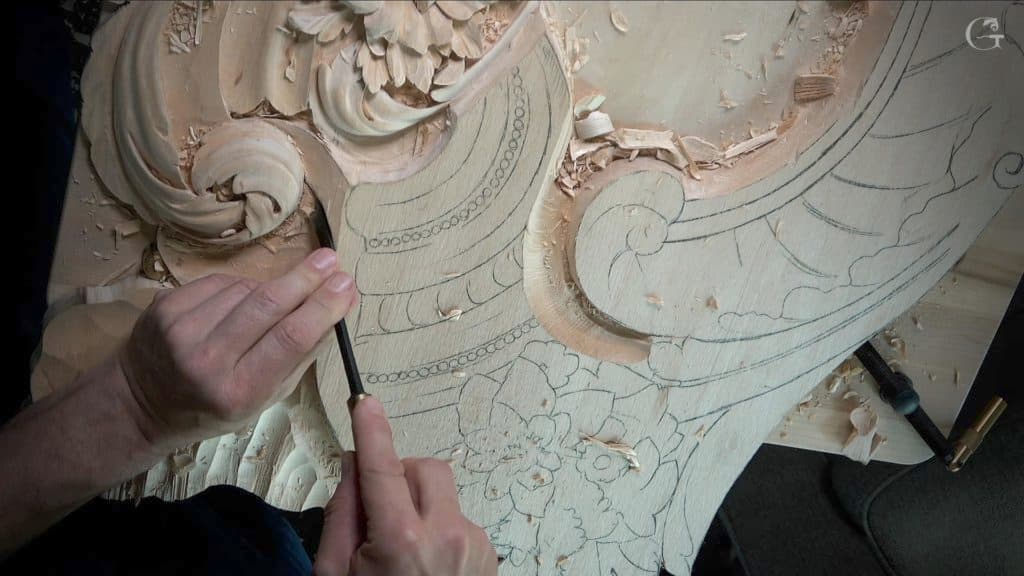
Alexander Grabovetskiy, woodcarver, School of Woodcarving · Published 2021
What does a wood carver mean by "unfixable"?
Quick answer: In Venice Room 123, first video, I called an undercut underneath a big mistake, and I said nothing could fix it. In other lessons I said unfixable or can't fix about a fragile piece, a high area to keep and a tiny part I might lose.
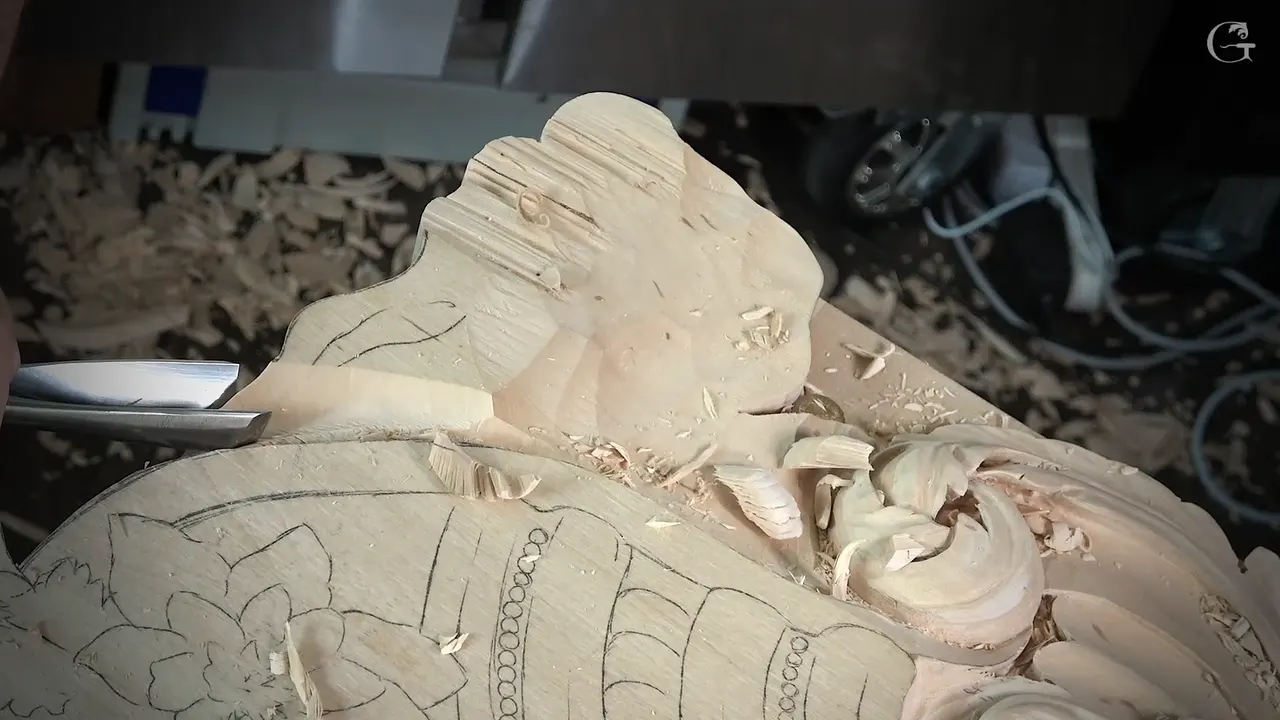

In Venice Room 123, part 1, I said it about an undercut: "there's no way to fix it." This page starts with that number five. After it come lessons from other courses where I said "unfixable" or "can't fix" and each one tells you where it comes from.
Have you ever set a gouge on a line and wondered whether one more tap could be a slip you could live with? Did you stop to think about how the edge would sit before you hit it? Then you know the weight behind my words in this part.
What did I say about an undercut?
"Especially, I don't want to undercut underneath this way. That would be a big mistake." Those were my words.
Next I told you what I could fix: "If I would do it this way, it's okay, I can fix it." The next sentence was short. "But undercut, there's no way to fix it."

What led up to that? A number five. I said I would use "probably number five, let's say" and I added "I think number five will work really good." The angle came next: "Again, I want to make sure it's 90 degrees down, otherwise I'm in big trouble." Then: "I'm not measuring it. I'm eyeballing it." My next words were "But still, I have to be careful, I should say."
Which tools came before the number five?
My first cue named a big number 11, "30 millimeters" (about 1 3/16 inch). My reason was "I really don't need that chunk of material on this side. So I have to remove it." On the waste: "All that also going to be removed." And "I'm pretty much able to chop some of it off right away."
A smaller tool came next in my plan, a number 11, "15 millimeters," about five-eighths of an inch, to "get closer to that edge." Then a possible change: "Probably have to change the position and attack it from this side."

For the number three I said I could start "about here and clean it. Again, just straight down cut." About the side I said "Unfortunately, you don't see the side of it. But there's not much to see anyway."

A tool can be too small. "I need to get a little bigger tool," I said. I named a number two "and see if it's going to fit better." Then: "Yes, it is." And then: "And even bigger, 40 millimeters, number two." That is a number two of 40 mm (about 1 9/16 in).
I held back on cleaning. "I really don't want to make it too clean yet," I said. I did not want to spend time I did not have to spend. Just a little bit. For the other side: "I need to attack this side, make it look really nice." I would use "whatever fits right there" and I would start "little by little chopping with the number seven first at 14 millimeters, about half an inch."

Which tool did I call handy for the corners?
A skewed number three. "I need to take care of this area," I said, and that was where I would use it. "That's a really unique tool. It's actually excellent." I like it "because it's slightly bent." My feeling about the bend came next, "So that's what I love about it." "Sometimes it's really handy to have." And yes, it is skewed. A cue after that says "Really handy to have to get in the corners like this."
One plan came before it. "And let me also outline this baby, our head of Acanthus."

Did the worry come back in lesson 123?
In part 2 I said "That's not a big deal." My other words there were "I messed up little bit, just a slight area" and I added "There is a mallet in the way."
In part 3 the words were "little deeper cut right here. Otherwise, it would be a big mistake." Another line in that part is about losing something. "I'm not afraid of losing the details because I do have an iPad drawing, so I can always recreate that."

Where else did I say I could not fix a slip?
See Venice Room 5, part 1. I had just said "Airy is light like air." Then: "when you do an extreme undercutting like I'm doing most of the time, you really have to control your tools and feel what you do." Right behind it came "Because those mistakes, when the piece becomes really fragile, most of the time you can't fix." The same words are in Roman Acanthus lesson 10, part 2.

A line I wanted to keep high is in Furniture Panel lesson 15, part 1. "Try to stay right on the line. Really important because you really have to keep that area high." You cannot fix it later, I said. The angle comes up there too, and I said "your cut's supposed to be straight down, like 90 degrees. Do not do undercut or opposite cut."
About pace I said "And don't rush it" and "Take your time."

A line about a volute is in lesson 16 of the Furniture Panel, part 7. "Get a little closer to the volute. Again, be really careful when you approach the side of this detail." I warned you not to dig in it. I went on, "It's not that you can't fix it, but it's better not to make that mistake."

Lily Box lesson 4, part 9, has a weak area. "I am using small tool just because, like I said, this area is really weak." A slower pace was my choice. "I know with the smaller tools it's a much slower process, but I rather spend a little more time and make it a little slower than to make a mistake that I can't fix."
More followed. "Because some of the mistakes you really can't fix. Most of it you can, but if I'm going to lose a really tiny, small part so it's impossible to recreate sometimes."

Over in Lily Box lesson 5, part 7, I said I was going to "take a look at the reference." The one I wanted to avoid was "a mistake that later on I can't fix." The reason I gave was "Because wood carving is an art of deduction, as you know."
Size was the topic in Flower Rosette lesson 4, part 3. A small carving needs more care, I said: "every cut, every ridge makes a big difference on a small one." Then: "Just one small mistake on a smaller scale work, and that's it." You cannot fix that, I said. Next: "So that's why sometimes, actually, to do the smaller carving is a lot more harder than to do the big scale carving."

In Vase with Grape Leaves lesson 1, part 8, I talked about "my first initial cut" and "my middle stem or vine itself, if you wish." About the cut I said "I'm doing about 16th of an inch deep" (about 1.6 mm). "If you remember, I said there's only 6 millimeters" (about 0.24 in). The problem to avoid was "a problem that I can't fix later" and I left a door open with "Unless if I would do a pierced one later on."

Rushing came up in Greek Acanthus Leaf lesson 11, part 1. "When you rush something in wood carving, you can make a lot more mistakes, and it's going to take you a lot longer to fix it." Then: "And sometimes some mistakes you do, they actually can become unfixable."
The rule behind it was "Remember, wood carving is an art of deduction. So once you deduct, you can't add that back." Next, a question that people ask me about a break came up. "So what happens if you break something? Well, it's better not to break. Some stuff you can fix, some stuff you can glue back, but many times you really can't." I added "So you can't glue it back."

It comes up again in Greek Acroterion lesson 2, part 4. "So which means if you made a mistake, in some cases, it's fixable, but sometimes you can't fix it. Once you deduct, once you minus it, then it becomes a problem."

Which slips were not unfixable?
An idea I loved sits in Venice Room 11, part 2. "I love that idea. Although I've got two separations too close, and that's not too appealing, but it's not unfixable. I can actually create an extra separation right here."
Depth is the topic in the Furniture Panel course, lesson 18, part 2. "So if you push too deep with the tool, then you have to lower everywhere. Okay. It's possible to fix it. It doesn't mean it's unfixable." The only fix was to "lower everywhere to the same depth," if I wanted to be consistent with the background. And then: "I guess it's okay when you're doing one panel, but it's not okay when you're working on a multiple panels."

A slip of my own turns up in Hashemi Flowers lesson 11, part 7. "Okay. I made a mistake. I attacked it from a wrong position. And now I have to be really careful how I fix that." Of the slip I said "That's not a good mistake, but it's still fixable." Next I asked "What do you do in cases like that?" One way I gave was "I do have enough meat, and I can just start removing everything and make it deeper."
Overdoing one area is the worry in Venice Room 101, part 4. "When you concentrate too long on one area, you have a tendency to overdo it." A smaller number seven, once more, would do that, I said. "I would overdo this section, and then I had to fix it somehow." Then: "It's not unfixable, but it's really nice and smooth, and I don't really want to kill that feel."

A pencil mark was my concern in Venice Room 84, part 8. The pencil mark had to go: "I need to get rid of this pencil mark for the eye." Then: "It's not like a mistake can't be fixed like that."
Why fix a slip you can avoid?
A class story comes from Venice Room 3, part 10. The words were "I go deep" and "I just remove the plugs." Some people ask, "Why would you do that?" The story was about a class "in person" in Tampa. One of the guys said, "I'm carving for a long time already, so I never done it. I never had any problem." My next words were "And guess what happened?"
"He just messed up. He decided not to do that way, and he messed up his carving." Then: "Well, it's not like it's unfixable. It is fixable. But still, why would you fix something if you can avoid that in the beginning?"

A flip I was weighing is in Venice Room 10, part 11. "I kind of like the idea of flipping this part." Then: "Let me think before I do anything which is going to be unfixable."
A direction I did not have to take is in Venice Room 65, part 2. My words were "I don't think I have to, but maybe." And: "Let me try." Then: "And if I don't like it, then there is a problem because I cannot fix it." Then my plan was "the number nine and half an inch" (about 13 mm).

Every lesson that told me what to fix, or not
The table names each lesson and what I said about fixing in it.
| Lesson | What I said about fixing |
|---|---|
| Venice 123 | An undercut underneath, which I called a big mistake |
| Venice 5 | A piece that has become really fragile, mistakes mostly not fixable |
| Furniture 15 | A high area to keep, with no fixing it later |
| Furniture Panel 16 | A slip next to a detail that I called better avoided |
| Lily Box 4 | Some mistakes you really can't fix, and most you can |
| Flower Rosette 4 | One small mistake on a small carving, and that's it |
| Greek Acanthus 11 | Rushing can make mistakes that become unfixable |
| Venice Room 11 | Two separations too close, and still not unfixable |
| Furniture Panel 18 | Pushing too deep, so you lower everywhere to match |
| Hashemi Flowers 11 | A wrong position, not a good mistake but still fixable |
| Venice Room 101 | One more cut that would overdo a smooth section |
| Venice lesson 3 | A class story that ends with avoiding it in the beginning |
| Venice lesson 10 | A flip I liked, and a pause before something unfixable |
What is the one cut on your bench that you could not take back? The full set of workshops for this panel sits inside full access to every workshop. The Part 11 course page holds workshops 122 to 131, and the lesson 123 page has all three videos. More wood carving waits there, along with a chisel or two and a mallet, and relief work too.
How it's done
- Pick the tool for the spot. My pick was probably number five, and I thought it would work well.
- Check the angle by eye. I wanted it 90 degrees down, otherwise I was in big trouble, I said, and I was eyeballing it, not measuring it.
- Watch the underside. Undercutting underneath this way was what I did not want, and I said I needed to be careful.
- Save the clean up for later. I held back on cleaning and said "Just a little bit."
- Reach corners with a bent tool. A skewed number three gets in the corners, I said, and I like it because it's slightly bent.
Frequently asked questions
What could I fix in part 1 of lesson 123?
Doing it "this way" was okay, I said, because I can fix it. For an undercut I said nothing could fix it, and I called it a big mistake.
Which tools did I name in lesson 123, part 1?
A number 11 of 30 millimeters (about 1 3/16 in) and one of 15 mm (about 0.6 in), a number three, a number two of 40 mm (about 1.6 in) and a number seven of 14 mm (about 0.55 in). I also said number five would work really good, and I called a skewed tool handy for corners.
Why did I pick a small tool in the Lily Box course, lesson 4?
The area was really weak, I said. Smaller tools are a much slower process, and I would rather spend a little more time than make a mistake I can't fix. Most mistakes you can fix, I added, but some you really can't.
What to carve next