
Alexander Grabovetskiy, woodcarver, School of Woodcarving · Published 2021
What does a wood carver mean by "anyway"?
Quick answer: During the second video of Venice Room 123, I said a line had to go down anyway and that I saw no reason to be shy, so I planned a 30 mm (1 3/16 in) number 11 for it. In other lessons the same word came with waste, a lower spot and a later undercut.
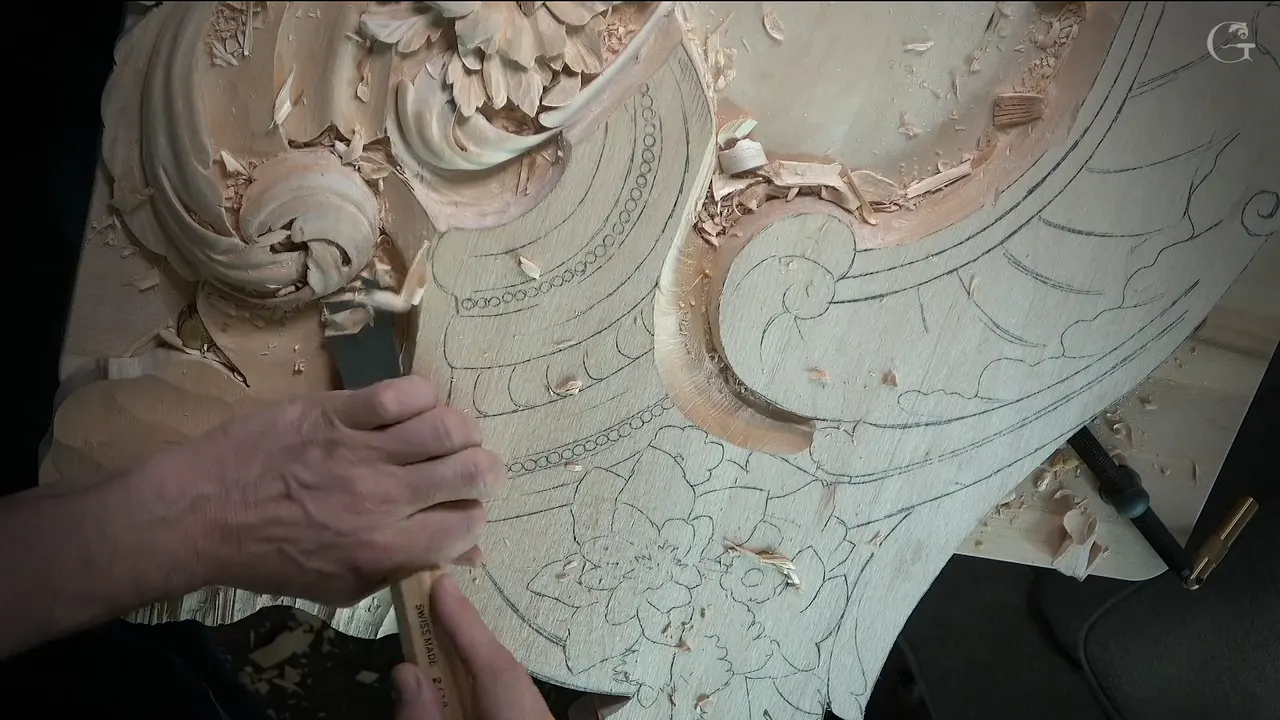

In Venice Room 123, part 2, I said a line had to come down anyway, so there was no reason for me to be shy with it. The tool I named was a big number 11 gouge of 30 millimeters (about 1 3/16 inch). After this part come my words from other lessons, where a spot was going away, going lower or getting an undercut anyway.
Have you ever stood over a spot on your board that you already knew was coming off? Did you pick a small tool because the spot beside it needed one? Then you know the pull between the two, and this page is about how I handled it.
Why did I not clean one area in part 2?
The first words of part 2 are about one area. "Okay, and I don't need to clean too much this area because I still have to develop that later." I named a tool for a little of it: "But little bit I can hit with number two."
A second choice came next. "Number two or number three will work." Then: "That is enough."

Which tool did I plan for that line?
Here is what came next, and it was only a plan. "So next would be outlining that line." And the tool: "I think in this case, I could use a number 11 and big one, 30 millimeters."
My reason came right behind it. "Okay? Because really it has to go down anyway, so there's no reason for me to be shy."

Care came with that plan, in these lines: "That's it, I have to be careful" and "All done."
Somewhere right there it was okay, I said. "That's not a big deal, but I really have to be careful."
Why was I okay taking a spot down?
A flower explained the next spot. "And that is going to be lower anyway, because I have a flower going on, so I'm okay to take it down."

A plan followed. "Let me take this out." Then a question for myself: "And let me think how low I want to go."
How low did I say I could go?
My first number was small. "Maybe about five, six millimeters from a high spot down. Maybe even lower." That is 5 or 6 millimeters (about 0.2 inch). A look from above was on my mind, too.

Next I weighed both sides. "I don't want to lose it on the other hand, but I also need some depth in this area so I could go actually lower."
The new figure was bigger. "Think I could go all the way, 10 millimeters from the highest spot." Then: "Yeah. 10 millimeters from high spot down." My last words on it were "So about three-eighths of an inch." That is 10 millimeters (0.39 inch).
Later in the part I said "Okay, so I am about three-eighths of an inch down." Then came a need and a plan: "And I need to switch to a smaller tool. Let me use 12 millimeters" (about 0.47 inch).

What happened with the other side and the mallet?
Another side was waiting. "But I need to outline this side also right away. Why don't I do it?" Then: "And perhaps I can use 30 millimeters pretty much right here." It would be quicker, I said.
A slip came after that. "Okay. And that is good, except I messed up little bit, just a slight area." My words were "I apologize" and "I didn't see." The reason was in the next line: "There is a mallet in the way."

My next tool was a plan, too, and I changed it midway, from "So let me take number three" to "Actually, you know what, I can take number seven." The number seven was 14 mm (about 0.55 inch), and I said "Some of the spots looks like I'm able to."
The last lines of part 2 are about going inside. Hitting inside was probably possible, I said. I wondered whether the tool was too big and said it looked like it was, but I wanted to see if it might work. Part 3 opens with "No, it's not going to work."
What do parts 1 and 3 of lesson 123 add?
In part 1 the word sits beside a side I could not show you. "Unfortunately, you don't see the side of it, but there's not much to see anyway."
Cleaning came up there, too. "I really don't want to make it too clean yet." Then: "Just a little bit."

Part 3 ends with a plan to move gradually in one direction, and I said I could safely blend toward it because all of that was leaving. Earlier in that part, close up, I was not sure you could catch what my corner was doing. "But anyway, so you can see from above." There the word comes before a new plan, the view from above.
Where else was a spot waste anyway?
In Hashemi Flowers lesson 9, part 6, I was wiggling the tool. "I am working against the grain now, that's why I'm wiggling." My words about the wood were "And I did not break anything because this part goes like this, and that was waste anyway."

Next came a line for you: "So that is going to get removed later on." Then: "So don't be scared, I did not make mistake."
Roman Acanthus lesson 1 has a volute drawing in its third video. "You could probably notice I'm just eyeballing everything." Then: "I'm not that accurate because most of that material is going to be gone anyway, and I have to redraw and refigure out all my movements and so on."

The rest of that thought was "just approximately, visually really close."
The Venetian Flowers Rosette, lesson 1, third video, shows the side of a carving, where I said "I can just go around with a straight down cut." After that: "You can see how rough the side, just looking, it's not really nice."

The choice was yours. "So now it's up to you if you want to do a nicer look." Most of that side was leaving anyway, I said. "But inside, I'll just clean it a little bit." Maybe I would use flatter tools like number three or number two.
In Venice Room lesson 1, part 9, I talked about a second approach, a hatchet. "I have a beautiful handmade hatchet." About the hatchet I said "you can use that one to do some roughing out" and "just be really careful how you work with that."
It was "a kind of really quick way to remove a lot of material." My own view: "But for me, it's about the same if I would just use a gouge." I told you again that the spot was leaving anyway.
On the Plate with Butterflies, lesson 2, part 2, my words were "let me get the number seven again." I had hit some of the spots with a number two, "which I have absolutely no problem with it, but right there's kind of deep spot." My next words were "That's okay majority of it's gonna be gone anyway." After that I wanted the center.

The Lily Box, lesson 10, part 6, had a paddle with a crack inside the wood. The crack was okay, in my words, "as long if I can keep this side of the paddle." The other side would be removed anyway, I said.
Later I said "I hope I'm not going to lose this flower." And my plan: "Let me use the smallest tools I could use."
Carving Hazelnuts lesson 1, part 3, is about glue. "Like I said, don't save on glue. Put lots of it, don't worry about squeeze outs, we're going to carve it away anyway." The spreader got a line, too: "The true woodworker's spreader is your finger."

When was a spot lower anyway?
Over in Venice Room 62, part 9, I said "Although I didn't have to use a spoon for this cut. I could use just a normal." My plan was to lean: "I'm going to lean little bit to the right. Because that barrel needs to be lower down anyway" and then "I can take advantage of that future development and lean it little bit."

Furniture Panel lesson 17, part 4, has these words: "A little too far. It's okay." Then: "It's got to be anyway a little lower because I've got this leaf flipping above this detail, so I'm okay." About a hand push technique I said "if you're using just a hand push technique. It's a little less control."

Another stop is lesson 18 of the Furniture Panel, part 9. My first words there were "Okay, let me make it even lower." I was unsure about it: "I'm not sure if it's too aggressive or not, but I have a lot of material to remove anyway." Later in the part I said "It's a 3/32 of an inch blade" (about 2.4 mm).

In the Flower Rosette, lesson 4, part 3, a slip came up. "Oops, I should not do that." Then: "But it is fine since it's just going all the way down anyway." My wish was a change: "I want to make this side a little more rounded."

Floral and Molding lesson 5, third video, has a mold. "We've got movement going downhill." Then: "Some part of that mold is going to go anyway much lower." The work left was blending: "Just blending, blending, and blending. Which I don't have to do on a camera."
When was an undercut coming anyway?
Number five comes up in Venice Room 34, part 3: "I'll use number five." Then I said "it's just the edge, okay? Because it still has to be undercut anyway." The need, in my words: "But what I need it's just that edge." I called that edge "absolutely perfect."

Then comes Venice lesson 41, part 7, with an outline. "I guess I need to probably just outline it much better." My reason for not being afraid was this: "Later on, I'm going to undercut anyway, so that's why I'm not afraid of doing it." A problem followed: "I developed that detail later, so I lost my line." Then: "So I have to fix that first."
A ridge shows in Venice workshop 51, part 5. "For me, it's more important to keep away from this ridge because it's fragile." About a number nine I said "Let me see if it's enough with this number nine, I could use a smaller number nine, but this needs to be undercut anyway."
Greek Acanthus lesson 2, part 3, is about an edge. "I just took out the edge." That was fine with me, I said, because it would still go down. I warned you to be careful, "because you can take too much out." The edge would not look as clean, and my reason was "we're going to undercut anyway later on."

Last is Venice lesson 48, part 4. "I think I should go deeper right here because I really want to see a full motion." Then: "And no, I don't worry about that." The spot still had to leave, I said. The worry was elsewhere: "What I worry about, where I want to see the movement ending."
Every lesson and its spot
The table names each lesson and the spot that went anyway.
| Lesson | What was going anyway |
|---|---|
| Venice 123, part 2 | An outlined line, so no reason to be shy |
| Venice 123, part 3 | Everything to blend toward, which had to disappear |
| Venice Room 1, part 9 | Wood that a small handmade hatchet could rough out |
| Venice Room 34, part 3 | An edge that still had an undercut ahead |
| Venice lesson 41, part 7 | An outline I was not afraid of, with an undercut to come |
| Venice lesson 48, part 4 | A spot I did not worry about, unlike the end of the movement |
| Venice workshop 51 | A number nine against a smaller one, with an undercut to come |
| Venice workshop 62 | A barrel that needed to be lower down, so I planned to lean |
| Hashemi 9, part 6 | Waste that I said was no mistake |
| Furniture 17, part 4 | A spot a little lower beneath a leaf flipping above it |
| Furniture Panel 18 | Material to remove, with a 3/32 in (2.4 mm) blade |
| Flower Rosette 4 | A part going down, even after an oops |
| Floral and Molding 5 | A part of a mold that would go much lower |
| Venetian Rosette 1 | A rough side where most of it was leaving |
| Hazelnuts 1, part 3 | Squeezed out glue that I would carve away |
| Lily Box 10, part 6 | The other side of a paddle with a crack inside |
| Roman Acanthus 1 | A drawing I eyeballed because most of the material would be gone |
| Butterflies 2, part 2 | A deep spot, where the majority was gonna be gone |
| Greek Acanthus 2 | An edge taken out first, to be undercut later |
What is the one spot on your bench that you already know is coming off? The full set of workshops for this panel sits inside full access to every workshop. The Part 11 course page holds workshops 122 to 131, and the lesson 123 page has all three videos. More wood carving waits there, with a chisel or two and a mallet, and relief work too.
How it's done
- Name what waits for later. I did not need to clean one area too much, I said, because I still had to develop it later.
- Pick a big tool for the line. My plan was a big number 11 of 30 millimeters to outline that line.
- Stay careful. Right there I said I really had to be careful, even with a big tool in my hand.
- Think about the depth. I gave two depths, a small one first and a deeper one after it.
- Change the tool when you need to. A smaller tool was my next need, and I named 12 millimeters.
Frequently asked questions
Which tool did I name for the outline in part 2 of lesson 123?
A number 11, a big one, at 30 millimeters, which is about 1.2 inches. Outlining that line was where I said I could use it.
What depth figures did I give in part 2?
5 to 6 mm (about 0.2 in) to start, maybe even lower. Then I said ten millimeters from the highest spot, and I put that near 3/8 inch.
How careful was I in part 2 of lesson 123?
Where I stood it was okay and not a big deal, I said, but I really had to be careful. I also messed up a slight area and said there was a mallet in the way.
How did I describe the hatchet in Venice Room 1?
What to carve next