
Alexander Grabovetskiy, woodcarver, School of Woodcarving · Published 2021
What does a wood carver mean by "different type"?
Quick answer: In part 3 of workshop 123 I said the flowers I was outlining beside the acanthus were "just a different type." My other lessons use the words for flowers in other courses, for acanthus leaves, for a movement, for a kind of complication and for a wood.
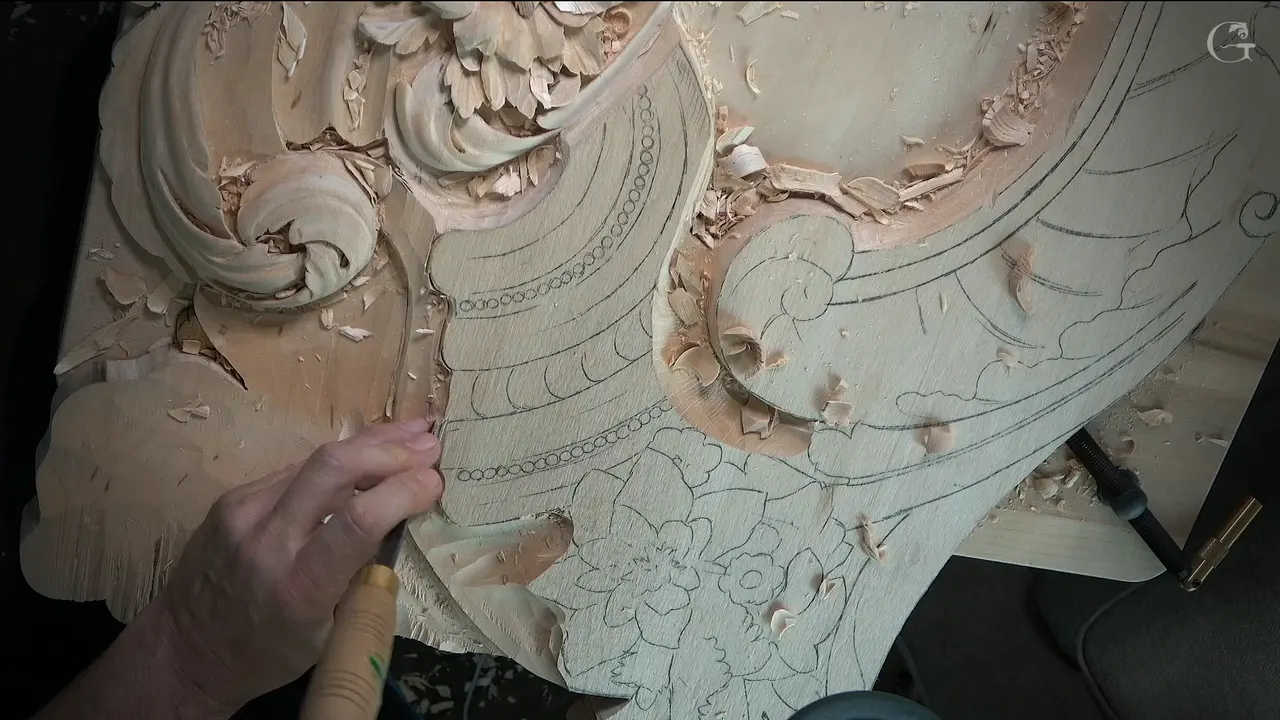

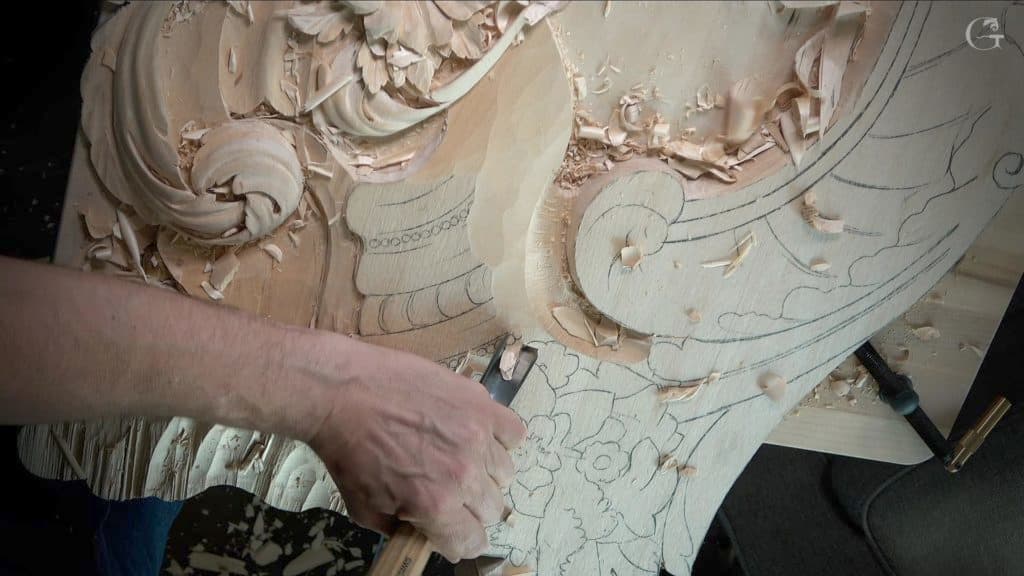
In part 3 of workshop 123 I told you that the flowers I was outlining were not leaves. "That's actually not the leaf, it's the flower, actually." Other lessons of mine use "different type" about flowers, about acanthus leaves and about a few more things, and this page follows each one.
Ever looked at a carving and seen two flowers side by side that are not the same flower? Did you stop and wonder how to carve the second one? You can follow my words about that from the gouge work of the Venice Room back through the Furniture Panel, Hashemi, lily box and Maine class lessons. Each one is linked.
Where do I say "different type" in these lessons?
- Workshop 123 has a flower beside the acanthus.
- Flower lessons from the Venice Room, Hashemi, the Furniture Panel drawings, the lily box and the Maine class name a second flower before I draw it or while I carve it.
- Acanthus lessons in the Venice Room, the Furniture Panel and the Greek acanthus course say there are many kinds of leaf.
- Complication in Hashemi Flowers 45 and symmetry in Venice Room 93 get the same words.
- A carving built of two woods turns up in Lily Box 4.
What was I doing in part 3 when I said it?
The job was outlining flowers using a number 11, after working with a big number two. Part 3 opens with "No, it's not going to work." A straight tool, like a number three, was my plan after that, and then came a maybe about the design: "change a little bit design." The plan was a curved part: "I think I'm going to do also curved part right here." And "just repeat those movements." The new look, I thought, would be "much better."

Cleaning could happen "off camera," I said, and "You really don't have to watch." What I could do with you watching was lower down a side and "make it going all the way underneath of that canvas." And: "So I think we can do beautiful movement right here."
I named a big number seven first, then had a second thought: "a seven or maybe two." Then, "No, maybe number two," I said, "like 50 millimeters" (about 2 in), "or even let me do 60 millimeters" (about 2 3/8 in). One word followed. "Huge." After it: "That way I can just scoop it and make it gradual."

A corner needed attention: "So I have to keep an eye my corner." I was "not sure" you could catch it "close up" and I told you "you can see from above."
Next came a need to go deeper. "Now I need to create deeper, little deeper cut right here. Otherwise, it would be a big mistake." A number 11 of 2 millimeters (about 5/64 in) was the tool I named for a "preliminary cut."

The look I wanted: "I want to make it feel like it's going right underneath." The number two would "follow after number 11" and I said I was going to lean it, "undercut a little bit underneath." And: "which means this corner needs to be lower."
The lean came next. With the same number two, "I can lean a little bit on inside and create undercut." Then: "Use that just like knife, just like that." And again: "attack that from this position."

"But now I have to control a lot more," I said. "I don't want to overdo it." Two short lines came after that: "Here you go. That is what I'm after."
A look from above came next: "it looks very good, in my opinion, but I need to also blend this side." Losing details did not scare me, I said: "I'm not afraid of losing the details because I do have an iPad drawing" and "I can always recreate that." And about the shadow line: "But I really like the shadow line. Beautiful. I think it's beautiful shadow line, what you see."

Back to the big number two: "the same number two, big one" and "gradually move this way." Flowers were next. "I guess I need to outline at first those flowers." My tool for it, I said, would be a number 11, "maybe about 20 millimeters" (about 0.79 in).
Next I sorted out what the flowers were. I called them leaves, and then said, "That's actually not the leaf, it's the flower, actually. It's just a different type of flower. They going to grow right on top of it, okay? I can safely outline it."

A plan for blending followed: "I want to gradually move that direction. So which means all that has to be gone anyway, so I can safely blend toward this direction."
What came before it in parts 1 and 2?
Part 2 had the flower in it: "that is going to be lower anyway, because I have a flower going on, so I'm okay to take it down." Then: "Let me think how low I want to go." My numbers were "Maybe about five, six millimeters from a high spot down" (0.2 to 0.24 in). After that came "10 millimeters from the highest spot," which I called "about three-eighths of an inch."
Part 1 starts with tool sizes in plan form: a big 30 millimeter number 11 (about 1.18 in) for a chunk of material I did not need on one side. A smaller eleven of 15 millimeters (about 0.59 in, and about five-eighths of an inch in my words) would get closer to an edge. And a number two of 40 millimeters (about 1 9/16 in) was my answer to needing a bigger tool.
Where else does a flower turn out to be another type?
In five courses I say so before I draw, before I carve, or while the carving is already in the wood. Lesson 74, part 3, comes first, in Venice Room 74. I called it "actually the same process how I create the flowers like I did in Hashemi flowers." The only difference would be "what type of inserts." I pointed back: "on Hashemi flowers, you saw" that the flowers came in more than one type.
A shape that is "too perfect" would not look good, I said. On the main divisions I said: "it could be five, it could be eight, if you just follow the Fibonacci sequence and so on. But I'll make it just five." Then: "Five divisions, but they don't have to be exactly the same."

Lesson 33 of Hashemi Flowers, part 1, says the idea would be the same. I would like it "as wavy as possible," even though that flower would be another type, and the first ring would be "semi-similar in my case." I said there are "many different types in nature," but on that carving I wanted "just maybe a few varieties, not too many varieties of the flowers."

Leafage came up next, in part 1 of Hashemi Flowers 34. A few spots needed "some kind of leafage" similar to the peony leafage. Then a doubt: "should I do that one? Or maybe this can be a different type going from inside." "Maybe I'll just clean it with number four," I said, at 10 millimeters, "three-eighths of an inch."
The Furniture Panel design course puts it on paper. In lesson 12, part 1, I wanted more flowers: "maybe I can place absolutely different flower right here." By different I meant an "absolutely different" one. I also wanted "to repeat the same type, but I want to do a small one, smaller than this one, fill this space."

Part 2 names leafage. I could make absolutely different leafage, "like triple leaves." Changing it was possible, too: "I can always change it." But I wanted to "keep my center line," because "it's going to repeat my center movement."
Part 4 of Lily Box 10 says "there's different types of lily flowers, of course." "I am doing more with the curls." In the Song of Songs, I said, the man talks about the girl he loves, and "actually mentions that she has some curly hair." Next: "I made the decision to do a curly flower."

Part 8 of that lesson has a rule for a lily. "Let me create right away this separation cut also, because it has to go underneath this one." Another kind of flower would not matter: "I really wouldn't care. It can actually be above this one. But in a lily, it's a no-no." "In a lily, it's supposed to be divided in triples."

The Maine class changed a flower while it sat in the wood. Over in lesson 12, part 1, I said I was probably going to change the style of that flower: "you can change stuff and nobody's gonna know it's still gonna look nice." Then: "So let me change it. So what I'll do, I'll create the different type." It would be "just a slightly different looking one." And: "Gotta be careful, but still I think this flower gonna look much better."

What does a different type mean for an acanthus leaf?
In my lessons it points to a leaf from another place or a named style. Lesson 52, part 7, in Venice Room 52, says it plainly: "Acanthus is not just acanthus." The types are "regionally developed." Morocco has "absolutely different acanthus movement" from Germany, and I split Germany in two: "Northern German acanthus. There is a Southern German acanthus."
More places followed. "If you go to France, there is absolutely different acanthus." "Belgium, it's a different acanthus. England, English acanthus." "You can go as far as Mongolia."

Then came "this particular case," which was "acanthus Venetian style, Italian style, authentic to 15th, 16th century" and "different how the movement develops, the overall movement." On "this small chunk," the divisions were "really, really short divisions." But if you go to France, the same part is "really long." "So that's the big difference."
Lesson 65, part 3, in Venice Room 65, puts the idea beside a concave: "I'm bringing my concave in this case, not always, but in this case, all the way there." Then: "Not every acanthus is the same." I checked my wood, and "I do have plenty" of material. More shadow was possible: "I can actually give it more shadow."

Lesson 8 of the Furniture Panel design course, part 3, is a drawing lesson. In one area I said I could develop "what's called the Louis XVI acanthus leaf," which is "a more French-looking one." Next in my plan: "the main subdivisions." The lesson is Furniture Panel 8.

Venice Room 12, part 11, has me repeating it: "I know I mentioned before." "A lot of people even don't know what acanthus leaf is." Even "professional furniture makers" had "no idea." I said you can "probably combine" many of them, and "you're going to be okay because most of the people anyway don't get it."

Greek Acanthus Leaf 8, part 2, has it too. We are "just trying to be authentic and gradually work on the different types." "This is just one of the types of acanthus leaf," which I called "also beautiful." "Even in the Byzantine style, there was some more development, but still the main idea was based actually on the same, what you see right here."

Part 12 of Venice Room 60 has the words for a movement that is "not acanthus." Then: "Really interesting movement, actually."

Where else did I use the words?
Four more things carry the words: complication, a symmetry, a wood and a flip. Part 5 of Hashemi Flowers 45 is the first. "flowers actually, for most of the people, the most complicated type of wood carving." Wildlife may look harder, and I had done wildlife. On flowers, though: "not because of the form, it's a different type of complication."

With wildlife, "you have to be accurate how the animal's looking." With flowers: "how deep you excavate with the flowers, that's what's the hardest part of it, okay?" Then: "So it's not as easy as it looks."
Part 6 of Lily Box 4 has a carving of two woods. The technique from the first layer would return, with one millimeter at the undercut, so that "it's going to look like it's from a same piece of material." "Although it's two different types of wood, by the way."

Lesson 93, part 9, in Venice Room 93, has a symmetry I called another type. That side would "repeat this side" with no "lot of lines like I've done on one side." Symmetry like that, I said, is "somewhat the same, but little different."

In Grape Onlay 8, part 3, the words went to a motion. Several kinds of flips are possible, I said, and one leaf was "asking me to do separation and I couldn't resist."

Where does each of these passages sit?
| Kind | Where | Words |
|---|---|---|
| Flowers outlined near my acanthus | Venice 123.3 | Safe to outline with a number 11 |
| The inserts inside a flower | Venice 74.3 | The only difference is the inserts, I said |
| A few varieties of flowers | Hashemi 33.1 | Not too many varieties of the flowers |
| Another flower drawn on paper | Panel 12.1 | Repeat the same one, smaller |
| A curly lily with curls | Lily 10.4 | Almost no curl on one side |
| A lily has its own rule | Lily 10.8 | Triples for a lily, I said |
| A flower changed in the wood | Maine 12.1 | Careful, but much better, I thought |
| Acanthus that varies by region | Venice 52.7 | Really, really short divisions here |
| More shadow in a deeper concave | Venice 65.3 | Plenty of material and more shadow |
| A French looking acanthus leaf | Panel 8.3 | The main subdivisions come next |
| Many acanthus kinds mixed together | Venice 12.11 | Combining them is okay, I said |
| Complication of its own in flowers | Hashemi 45.5 | How deep you excavate with flowers |
| Two woods made to look like one | Lily 4.6 | One millimeter at the undercut |
| Another type of symmetry, I said | Venice 93.9 | Somewhat the same, little different |
The full run sits in Part 11 of the Venice Room, where lesson 123 is followed by lesson 124.
Full access to the school opens every lesson named on this page, so you can watch each of these moments for yourself.
How it's done
- Plan the outline. I needed to outline those flowers at first, with a number 11.
- Name the flower. Flower, I said, not a leaf.
- Plan the blend. A gradual move in that direction was my wish, with all of that wood gone anyway, and a safe blend toward it.
- Lean the number two. Leaning the number two a little on the inside would create the undercut, I said.
- Check from above. From above, I said it looked very good, and that I needed to blend the side next.
Frequently asked questions
What did I say about those flowers in lesson 123?
I had called them leaves and then corrected myself: flowers. I named a number 11 for outlining them, and I said they would "grow right on top of it."
What is the rule for a lily?
In Lily Box 10, part 8, I said a flower of another sort could sit above the piece next to it, and I would not care. "In a lily, it's supposed to be divided in triples."
Are there types of acanthus leaf?
In Venice Room 52, part 7, I said "Acanthus is not just acanthus," and named Morocco, Germany and France. In Furniture Panel 8, part 3, I said I could develop the Louis XVI leaf, a more French-looking one.
What to carve next