

Alexander Grabovetskiy, woodcarver, School of Woodcarving · Published 2020
What does a wood carver mean by "legit"?
Quick answer: Legit is my word for a way of working that is fine to use when a job has more than one good way. In Venice Room 64.11 I said it of carvers who stop at a relief cut on big church carvings. Other lessons use it for knife grips, overlaps and even a name.
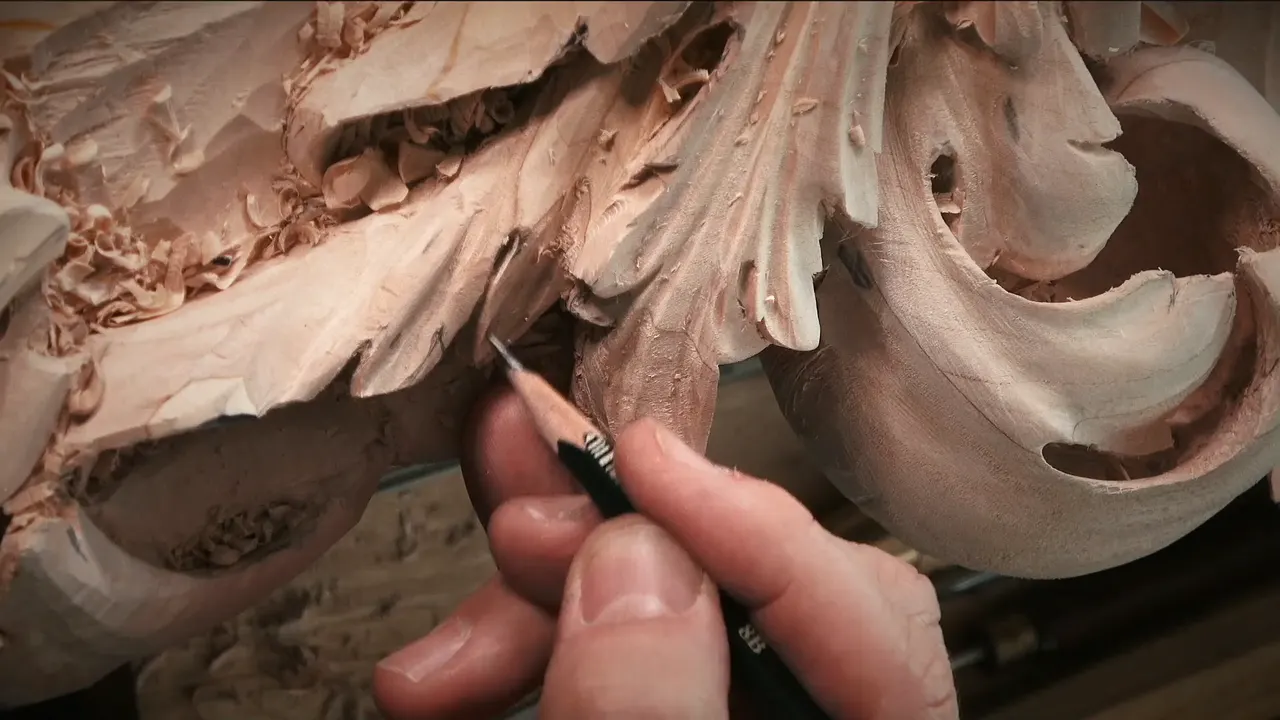

"Legit" is the word I use when a job has more than one good way and I am not calling one of them wrong. In part 11 of workshop 64, it came out for carvers who leave a relief cut as it is on huge church pieces. Other lessons use it for knife grips, overlaps, questions and names.
It goes by fast in my lessons, and it is easy to miss. So this page follows it. The first stop is part 11 of the Venice Room. After that come the lessons where the same word turns up, each with what my hands were doing at the time. Wikipedia has a page on wood carving too.
What did I say about carvers who stop at the relief cut?
I was bringing everything to its final shape, "how I want to see it." A remark about other people followed. "I know some of the carvers actually leave without creating final cuts like I'm doing right now." Their method is short. "All they do just create a relief cut, with a tool and leave it like that."
Right after that comes the word. "Which is also legit if you're doing a big carving for churches and stuff." I added "So huge pieces. Yeah, it makes sense," and that was the whole thought, so a short Wikipedia page on cathedrals can stand in for the scale.

My own piece was a different job. I was making the final cuts, and a little later my hands were dirty from pencil sharpening. "That's no bueno. No good." The pencil is the other half of this part, and it has a small story of its own.
What happened with the pencil in part 11?
It broke. "Oops, my pencil broke," I said, and a few attempts at sharpening later, "I've got my beautiful and not cheap pencil, 8B, really short." Then a line about supply, "But I'm glad I have a lot of them, okay?" With the point back, my plan was a division, and then another.
The plan came in pieces. "I'm going to create that division right there, and I'm going to get another division right here." Another division was planned going downhill. One more was only a maybe: "I could actually go to extreme and divide even right here. But I'll see if it's necessary or not."

Before any of that, I asked the people watching for something. "I really would appreciate if you would comment a little more on-site, not just on YouTube." The line "I need your feedback" went out twice.
What did I do about a shape I was not happy with?
A gouge was the answer. "I'm not too happy about this shape right here, so I'll just use a gouge," I said, and then "create that shape a little better." An idea followed: "Maybe I'll just do micro division to give extra curliness." And then "I really like the idea of giving extra curliness."
My tool for it was a number 11 at half a millimeter (about 0.02 in). It was "a tool of choice now," in my words. Small cuts were the plan, and the words were "I can just kind of get small notch cuts. Not big, just the small ones." Then "Beautiful. I love it," was my verdict on the result. The unit has a Wikipedia page too, if you want to read about millimeters.

How did I undercut in part 11?
Only a little. "Now I need to probably undercut a little bit underneath," I said, and "which I really don't have to create too much mess. But a little bit." The reason was short, "Just to expose this piece." My head, I hoped, was not in the way of the camera.
The tool size changed to "now a millimeter and a half" (about 0.06 in), "and carefully escape because I do have that movement, and I don't want to lose it. Uphill movement." Hands covered the work for a while, and I said you most likely could not see what I was doing. By then the shape of that uphill movement was made, and the wall was next.

For the wall I picked "a number two back bent, six millimeters, quarter inch." The word "Carefully" came first. Then "It's against the grain, but that's okay. This tool is super sharp, and I should be okay." Wikipedia has a page on grain.
Why so small an undercut? In my words, "I don't need to create a really extreme undercut for the reason I said too many times, the light source and shadow, and point of view." The last lines were about strength, "I don't want to make it too weak. Or I should make it a little stronger in this area." A shadow page is on Wikipedia too.

Where else did a second way get the word?
Many lessons have a moment where two ways would both work, and the word comes out. Furniture Panel lesson 24, part 2, has one. A part of the carving could be "a part of a big flower." Or it could be "a continuation of my molding, like this piece, straight piece."
Then my verdict. "Both would be legit, but I think I would probably just stick with the original idea." So the part became a piece of the flower, and a leaf nearby would "go kind of underneath."

The Venetian Rosette course has a choice of its own in lesson 1, part 1. One option was an applied ring. Or the whole thing could be solid, "just from single piece." My call, said plainly, was "So both ways are legit. Both ways going to look good."
A decision still had to come. I still had to decide what would be best. My lean was toward a solid. The oval, by the way, was a freehand sketch made on an iPad, and I needed a little better version.
The Venice Room has plenty of these moments. Workshop 66, part 7, was about to start my eyes and pipes. One overlap question came up. "This part going to overlap that part, or this going to overlap that part? Because both of those ways actually legit."

Twice in a row, and then a pick. "Maybe more logical for me going to be, in this case, go this one little bit below that." For a movement uphill I wanted a bigger number 11, 12 millimeters, about half an inch.
In workshop 70, part 9, an offer to myself came up. I could make the part "a concave" and "give an even nicer movement to it. So that would also be legit in this case." It would be "a lot nicer transition from the main part to the ceiling," and then "Maybe I should do that."

Part 4 of workshop 69 wondered about a middle line. It could end about an inch below and wrap, to establish a head movement. Or it could "go down and then return this way." The second one was legit too, and then "Also good," and a check on where people would look from.
That check is worth a line. "I have to consider the position," I said, and in my case that meant "visible from the bottom." Seen from far away, you would still detect that movement.

A roll came up in workshop 132, part 3. "If it's going to roll this way or roll that way, and both legit." Visibility settled it. "Makes sense for me to roll it a little bit this way." Over in workshop 151, part 2, I wanted "some kind of bigger movement" right on top of a molding, and that was "also legit." My idea was a separate acanthus laying on top.

Next, workshop 156, part 1. The middle looked "just too stripey," so a single concave on the inside of a separation was the fix. "But that's also legit, so also should work." Not much later, "it's creating a beautiful shadow, and I am happy with that."

In workshop 53, part 6, it covered a name. "Relief triangle of the division, or if you wish to call it subdivision, that's also legit." And "For me, it's a division, and subdivision is going to be smaller sections of divisions."

Which cuts and tools got the word?
In Chamomile and Bow Rosette lesson 4, part 3, an edge got an arching move, "like if I would work on a dome." Material came off slowly, and I called the move "a slicing pretty much," then "It's what I do."
Then the verdict. "But it's also really legit way to remove a lot of material at once." So the slow slice is what I do, and it can also take off a lot of wood at once.

In Floral and Molding lesson 13, part 2, a number 11 shows up. "You could attack first with the number 11 and attack with the side of the tool, pretty much the left side in my case, like a left wing, and carefully just go with the grain until you hit the line." Then "And that is also a legit way to do that."
There was a reason, and it is small. "It's actually safer somewhat. Safer because you don't push anything." With a straight-down cut, in my words, "you still have to create some kind of stress," but the number 11 way was "just taking little by little that material." And "That is only one of the methods," I added, because "There's multiple methods."

A V tool gets the word in Furniture Panel lesson 27, part 3, where the tiny number 11 is missing. You could use "a v tool" and lay the flute "almost flat right on this left wing." Then "Carefully, carefully you can do that undercut, which is also legit." Notice the size. It is the same number 11 as in part 11, and for my own work "I still love" it, with "the flute to the right."

Digging the inside came up in workshop 145, part 1, "otherwise, it's not going to look as nice." One way was "number 11 spoon, maybe five millimeters or so," worked from both sides. Five millimeters is about 0.2 in. Then "And that's legit."
Was a way to hold or measure called legit?
Yes, in two lessons. In Butterflies lesson 5, part 1, my first knife cut was coming, and "the way I'm holding my knife, it's also really important." There were "a couple of ways." One was the grip I had just shown, and the second was "just like a pencil." That grip was "also a legit way" of holding the knife, in my words.
I said to try both and see which one is better. For deeper excavation, probably a full hand, and for smaller areas, "like pencil or pen."

Measuring is the topic in workshop 154, part 3. "Other way how you can do it, use small calipers." Pretty much any calipers would do, to "establish whatever the distance you need to establish and transfer it." Next came "also legit." Right after came a limit: "sometimes my eyes working much better than any of those calipers." That is "just eyeballing it."

Vase with grape leaves, lesson 1, part 3, gives a direction. One way was to "grow from a bottom of the vase up." Another was to "grow from up, down," and that, I said, was legit too, so both worked. And "So it's still going to work out really good." A mix was possible too.

Did I use legit for a question or a name?
Yes, and it means something close to fair. Greek Acroterion lesson 4, part 1, brought some of you asking "why I don't dilute my glue" under a paper design. "And that's a legit question," because "some of the wood carvers, they actually add some water to glue."
No scolding followed. "I don't think it's anything wrong with that. You can probably add water." Next, "That's my thinking. Okay? It's how I think," and then the reason. Diluted glue "has a tendency to penetrate inside of the fibers of the wood." For a clear coat, "I don't think it's a problem."

The tools course has another. The question was "Do I shorten my bevel when I'm carving harder wood?" The answer started with "Yes. That is an actually excellent question," and then "That is a legit question." A really long bevel, I went on, leaves "this metal part" weak at the point on the harder wood.
A name got the word in Hashemi lesson 19, part 1. "I do have interesting details, which is, I don't know, could you call them berries? But I think it's probably legit name for those." So those are berries. A V tool could then separate the future berries around the details.

A tray lesson has two uses. In Tray of Blessing lesson 7, part 1, put a curly one or a wavy one on the table. "So that is gonna be also legit." The catch was "When you doing a waviness, also try to just to make sure you understand how you're gonna excavate it, what tools you have."
Tools mattered there. "If you don't have really micro tools like I do, it is gonna be kind of hard." One option was a tendril, going right on top of the leaf. Tray lesson 5 faced a stem choice, and the call was "I think both ways legit. But what's gonna give me more shadow?"

Which lessons use the word, and for what?
The table lists eight of them, with the lesson and the moment.
| Where | The moment | Said |
|---|---|---|
| Venice Room 64.11 | Carvers who leave a relief cut on huge church pieces | Also legit |
| Furniture Panel 24.2 | A part that joins a big flower or a molding | Both would be legit |
| Venetian Rosette 1.1 | An oval ring applied or carved from solid wood | Both ways are legit |
| Floral and Molding 13.2 | The number 11 along the grain to a line | A legit way |
| Venice Room 66.7 | Which of two parts overlaps the other one | Two ways, both legit |
| Butterflies 5.1 | Another way to hold a knife | Legit, I said of that grip |
| Greek Acroterion 4.1 | A question about water in the paper glue | Legit question |
| Hashemi 19.1 | Small round details I called berries | Legit name |
Where can you watch these lessons?
Every lesson named above sits inside one of my courses. This lesson holds all of workshop 64, and workshops 62 to 73 are in Venice Room Part 6. The chisel, gouge and relief pages linked here are for reading. To watch the full videos, start here.
How it's done
- Make the divisions. Once the 8B pencil was sharp, one division was the plan, then another.
- Shape with a gouge. A shape I was not happy with got a gouge, and I planned micro division for extra curliness.
- Add small notch cuts. A number 11 at half a millimeter (about 0.02 in) was the plan for notch cuts.
- Keep the undercut small. The undercut underneath stayed small, with a number two back bent, six millimeters, quarter inch.
Frequently asked questions
Which carvers did I say stop at the relief cut?
Some carvers, I said in workshop 64, part 11, leave the relief cut made with a tool and do no final cuts. Also legit, I said, for a big carving for churches and stuff, and for huge pieces it makes sense.
What tool did I plan for notch cuts in part 11?
Number 11 was the tool of choice now, as I called it. With it, the plan was notch cuts that are not big, just the small ones.
How else can you hold a carving knife?
The second way I showed in Butterflies lesson 5 was just like a pencil. I called it legit too, and I said to try both and see which one is better.
What to carve next