

Alexander Grabovetskiy, woodcarver, School of Woodcarving · Published 2020
What does a wood carver mean by "crazy"?
Quick answer: Workshop 64, part 3, has me saying I could go crazy, then asking how I would finish. Elsewhere in my lessons the word marks a limit I set on depth, a move I want to try, or grain that changes direction.
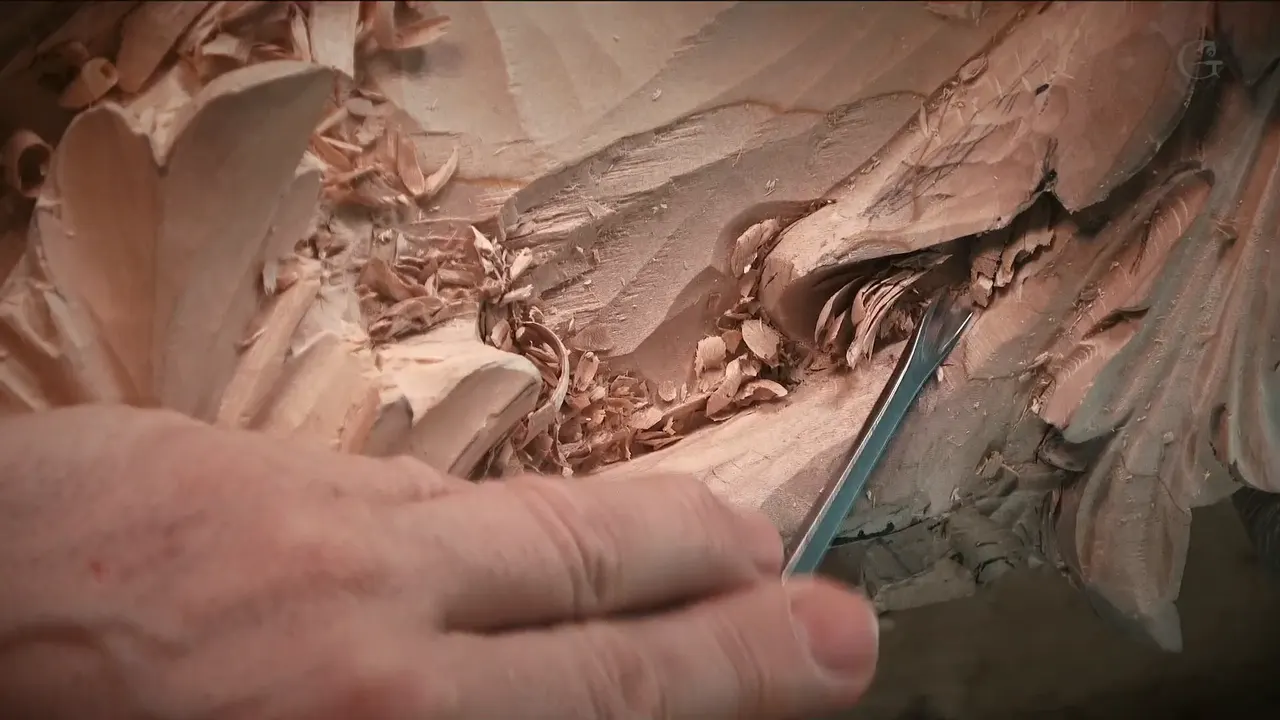

In part 3 of Venice Room 64, I said, "I could go as crazy as I wish," and then asked, "How am I going to be able to finish it?" My own answer was a certain degree. My other lessons use the word for a limit, for a movement I like, and for grain that runs all over.
This part comes first, in order. After it come the places in my other courses where the word returns, sorted by what I was holding back or letting loose.
What did I say about crazy in workshop 64?
The part opens on a result: "beautiful shadow casting." I had the camera "a little closer to you," hoping you could see how deep a shadow it casts. With the same tool, I could bring all of my cuts to the same hole, "little by little, without forcing too much."
A warning for myself came next. I had to be "mindful not to dig too deep that direction on the side." Otherwise, it would not make much sense. Still, "it's okay," as long as I get my proper shadow.
Then the word itself. "Another thing I have to consider, how deep I want to go." Going crazy would "create another problem," and I asked how I would finish it. My answer: "So only to a certain degree. That's what I want to do."

Tool sizes followed. A spoon gouge was next ("I will switch to spoon number 11"), and I weighed "maybe seven millimeters" (0.28 in). "Let me try." The reason for seven: a smaller tool would leave "extra marks," and a seven could "lay on a previous cut pretty much and match my cut." A small one was still ahead of me: "Two millimeters, four millimeters, maybe." Then "maybe four millimeters." Next I said to "get all that junk dug out like a shovel, almost."
Shadow had a job. My plan was to undercut a section "because that is going to cast shadow." And "that shadow is important for me," so I had to excavate inside, and a bigger tool was next, I said: "maybe seven millimeters, number 11." Two short lines: "I need that shadow." Then: "I need it, and I'll get it."

The size gave out there. Seven millimeters was "a little too big now because I can't get underneath of here." The four millimeters, "little bigger than eighth of an inch," could do it, though even that one would be slightly large for getting inside. Then a turn: "I don't need to do anything inside anymore." Inside, it was already deep shadow, deep and everything clean.
I hoped you could see how it looked, said I could take it to extreme, said of course it is possible, and then asked: "do I need to?" After that I weighed "maybe 10 millimeters" (0.39 in), and said what they call a 10 millimeter tool really measures: "almost 12 millimeters or so, closer into the half an inch" (0.47 in).

Part 4 of this workshop has a similar line. "I don't have to go too deep, again, for the reason I just said multiple times." Next came a fact about light: on that side there would be no casting shadow "because of the light." So I did not really need to work on my shadow there.
Part 2 gives two reasons. A deep undercut would be "visible only from the bottom." And at another moment I could not dig deep, because "I've got a lots of material I need to remove."
Can you go as far as you want with a gouge?
In workshop 78, I said it can be broken if I make it too fragile. It was "already through all the way," and I had my separation. I could get crazy with it, "as I want to," and then I asked, "do I want it to or not? And I think I don't want it to." Soon after: "I really need to keep it somewhat strong yet."

My April 2020 livestream had a good transition "already there," so I did not need to push it. I guessed I could go crazy with it, "but I don't need to." Later I was rotating "just like a drill" for a "really deep, deep, deep cut." Then: "I can go as deep as I wish. But I think it's enough."
Sanding gave me the same choice in the Grape Onlay final assessment. A 240 grit "knocks down, you know, those facets really good," and then: "I'm not gonna go too crazy with this." Go as far as you like, but in my case I wanted to "knock little bit the upper parts." I would probably take 120 next. Obviously a tool does it better, I said, yet even the sandpaper would do the job in this case.

The same freedom shows up in Grape Onlay 9. You can get crazy "as you want," I told you, and gave the next move: "take a small, like a one millimeter number 11" (about 0.04 in), "clean all that mess on inside."

Over in Acanthus over Moldings 10, I said of an undercut, "Why I do that you don't really have to." But "I think it's gonna give me more pronounced shadow and I believe wood carving all about the light and the shadows." Then: "you can do as crazy as you wish you can go as deep as you wish." The warning came next: "But you really have to be careful. And remember what type of finish you're gonna put if there's no finish you can go all the way." Soon after I said, "I've got about maybe two millimeters deep" (0.08 in).

Style can set the limit too, in workshop 72: "if it would be different style of a canvas, I could do crazy stuff with this canvas. You can just do a lot of different twists and moves, but I have to be, again, really true to the Venetian period."

Grape Onlay 13 leaves the choice to you. "It's up to you if you wanna take it to the extreme or not." For my own piece, I thought it was "a really good area for me just to get some crazy idea." My plan: "excavate deeper and on both sides." Then a doubt: "I don't know if I'm gonna do it or not." A back bend was a good idea to get, I said: a number three, a quarter of an inch, about six millimeters.
Can the wood I have left decide how crazy I go?
Thickness set the limit in Hashemi Flowers 29. My V tool would "kind of undercut," I said, and I wanted to "just keep an eye." The thickness was the worry: "I don't have too much thickness in this area," so I just wanted to make sure I was not overdoing that side. Moments later: "looks like this side is really, really thick."
After a three millimeter number 11 (0.12 in) in Floral and Molding 4, I held back, because "there is not much material left." I was "already at the level of that cut," I said.

Furniture Panel 18 has a line about depth. "It's much safer when it's deeper." On the other hand, I asked you to hold back: "just because it's easier, you can always overdo it and get a little too deep." If you do, "then you have to redo everywhere else."
Does the next movement decide it?
A shell decided it in workshop 60. "I really can't forget there is going to be a shell sticking from underneath. At least that was my original idea." I held back on the excavating. My reason: a deeper dig would be "a problem for me to create the shell movement."

Venice Room 11 has a shell too, and I said, "I also can't forget that this element going to flip above my shell." Then: "although I still have plenty of space with my shell, I can lower it down, but still, I don't want to be too crazy about it. I think it's enough shadow." Its part 12 adds: "I still have to develop the shell."

Workshop 51 adds a spot I could use. I did not want to lower it, "because I could utilize this spot and create some movement from this element and go underneath." So, as of now, "Just how deep I'm going to go, but somewhat deep."
The question in workshop 59 was how deep to go. Another movement would run in that direction from underneath, and removing too much material meant "I could be in trouble." Then, in the same part: "the reason why I really need that depth to get that flip movement the right way."
Does a break or a hard cleanup decide it?
A break did in Furniture Panel 32. I planned to turn my flute upside down and make some kind of undercut, and I had to be careful: if I overdo it, "I'm gonna break what we just carved." A deeper shadow closer to the dome was another wish of mine.
I said in Grape Onlay 1 not to overdo it, and then I described what overdoing would look like. "You wanna make sure it's still lace on top of this leaf." And not to "excavate too much 'cause it's gonna look like it's just floating in the air," which is "still possible to do." Then: "you can see how deep I can excavate."

A hard cleanup was the reason in Plate with Butterflies 8. I planned to undercut a wing slightly, to "cast some shadow," and I said not to push it, since it is "kind of hard area to clean." A similar line sits in workshop 48, about a spot that would be "much harder to work in" if you want a lot of concaves and convexes on the inside.
Byzantine Acanthus 4 has a softer version. "I'm creating deeper concave without going too crazy on the bottom." And Modern Acanthus 3 has a careful one: "We're gonna go right underneath of here. Okay? Keep about six millimeters quarter inch." I added not to push it there, and to be careful.

Is crazy a matter of looks too?
In Vase with Grape Leaves 3, I talked about a kind of movement I thought would look nice, then said to hold back. "Don't do it everywhere. Otherwise, it's just going to look too much." Chamomile and Bow Rosette 2 puts it on the line of a leaf. I did not keep it "like a straight arc," I said, and "Of course, don't be crazy just like that. It's not going to look nice. Just a slight waviness. A slight waviness is going to help."
Hashemi Flowers 46 puts the question out loud, right after I said I would get my gouge. "I'm going to start undercutting first." Then: "Should I do something crazy with this one or not? Okay. Let me think. What I could do, I could create a slight curl. Not big." Much later: "Maybe just leave it like that. I think it looks good already like this. Because not every one's supposed to be-- Not every petal is supposed to be curling that crazy."

When is crazy a good word?
Crazy shows up beside movements I like. In Hashemi Flowers 45: "all those crazy movements on the petals, they just create beautiful thing." In Plate with Butterflies 2, I said of a butterfly, "It has all types of crazy movements." In Acanthus over Moldings 7: "That's why I like to carve flowers because you can be really crazy with those flowers be creative."
Grape Onlay 8 asks for it. I wanted to see what lifts you come up with, "just send me a picture," and I said, "Be crazy about it. Create something." A back bend in Grape Onlay 11 "lets me actually go above and I can excavate like that," I said, and "you can be really crazy with that." And in Grinling Gibbons, Maine class 9, with a number 11 of four millimeters (about 5/32 in): "I can create really crazy excavation right in this section going up going down back."

What does it mean when the wood goes crazy?
The word can describe grain too. About knots in Furniture Panel 18: "Those knots, they're not as friendly, okay? Grain sometimes just changes direction and does crazy stuff." The grains turn up again in Grape Onlay 14, where I said it is better "to take a time" when "you're working with the crazy grains, and I'm talking about the grain here runs all over."
Lily Box 8 uses it for the wood itself. "Wood is alive. Even if it's cut, it still has lots of movements." The word comes in this line: "Sometimes it moves like crazy, really badly." I felt "this is a little too fresh," and "it did not have a long period of drying."

Which lessons give a figure or a tool?
Twelve places sit in one table, this part first, and some rows carry no figure, because the lines I quote give none.
| Lesson | What crazy was about, in my words | Figure or tool |
|---|---|---|
| This part | How deep to dig for good shadow | Seven and four millimeters (0.28 and 0.16 in) |
| Venice 78 | A separation that could turn too fragile | no figure |
| April livestream | A deep cut rotated like a drill | none stated |
| Grape final | Sanding the facets on the upper parts | 240 grit |
| Grape 9 | Cleaning the mess inside with a small tool | One millimeter (0.04 in) |
| Hashemi 29 | The thickness I had left in one area | V tool |
| Floral Molding 4 | There was not much material left there | Three millimeters (0.12 in) |
| Workshop 60 | A shell that would stick from underneath | no size given |
| Venice 51 | A spot I could use for movement | nothing measured |
| Panel 18 | Going too deep and redoing the rest | no tool named |
| Modern Acanthus 3 | Going right underneath, with real care about it | Six millimeters, a quarter inch |
| Gibbons Maine 9 | An excavation going up, down and back | Four millimeters (0.16 in) |
Where can you watch the full video of each lesson?
Every lesson named above can be found on my site. This lesson holds all of workshop 64, and workshops 62 to 73 are in Venice Room Part 6. The wood carving lessons I quoted are linked where I named them, and each one shows the work in real lumber. To watch the full videos, start here.
How it's done
- Ask how you will finish. Before going deeper in workshop 64, I asked about the finish.
- Match your last pass. Why seven millimeters: it can lay on a previous cut and match my cut.
- Drop to a smaller tool. The seven millimeter tool would not get underneath, and the four millimeter tool could.
- Ask whether you need to. Extreme was possible, I said, and the question was, "do I need to?"
- Keep the next movement in mind. In workshop 60 I held back on excavating, since a shell would stick out from underneath.
Frequently asked questions
How deep can you carve?
Going crazy was on the table in workshop 64, I said, then I asked about the finish, and my own answer was a certain degree. A separation in workshop 78 could get crazy too, but I needed to keep it somewhat strong.
Was a seven millimeter tool too big in part 3?
A little too big, I said, since I could not get underneath there. The four millimeter tool, a little bigger than an eighth of an inch, got in, though even that one would be slightly large for the inside.
Can grain go crazy in wood carving?
In the Panel 18 lesson I said knots are not as friendly and the grain sometimes changes direction and does crazy stuff. In Grape Onlay 14 I said to take a time with the crazy grains.
What to carve next
- Workshop 64 lesson
- Workshop 62 to 73 course
- Workshop 78 lesson
- April 2020 livestream
- Grape Onlay final assessment
- Grape Onlay lesson 9
- Acanthus over Moldings lesson 10
- Workshop 72 lesson
- Grape Onlay lesson 13
- Hashemi lesson 29
- Floral and Molding lesson 4
- Furniture Panel lesson 18
- Workshop 60 lesson
- Workshop 11 lesson
- Workshop 51 lesson
- Workshop 59 lesson
- Furniture Panel lesson 32