

Alexander Grabovetskiy, woodcarver, School of Woodcarving · Published 2020
What does a wood carver mean by "I wish I didn't"?
Quick answer: In Venice Room workshop 64, part 5, I made the move I had warned about, and the words after it were about the beautiful shadow of the eye and the mess to fix. Other lessons carry the same wish after a pencil mark, a broken edge and a hole made bigger.
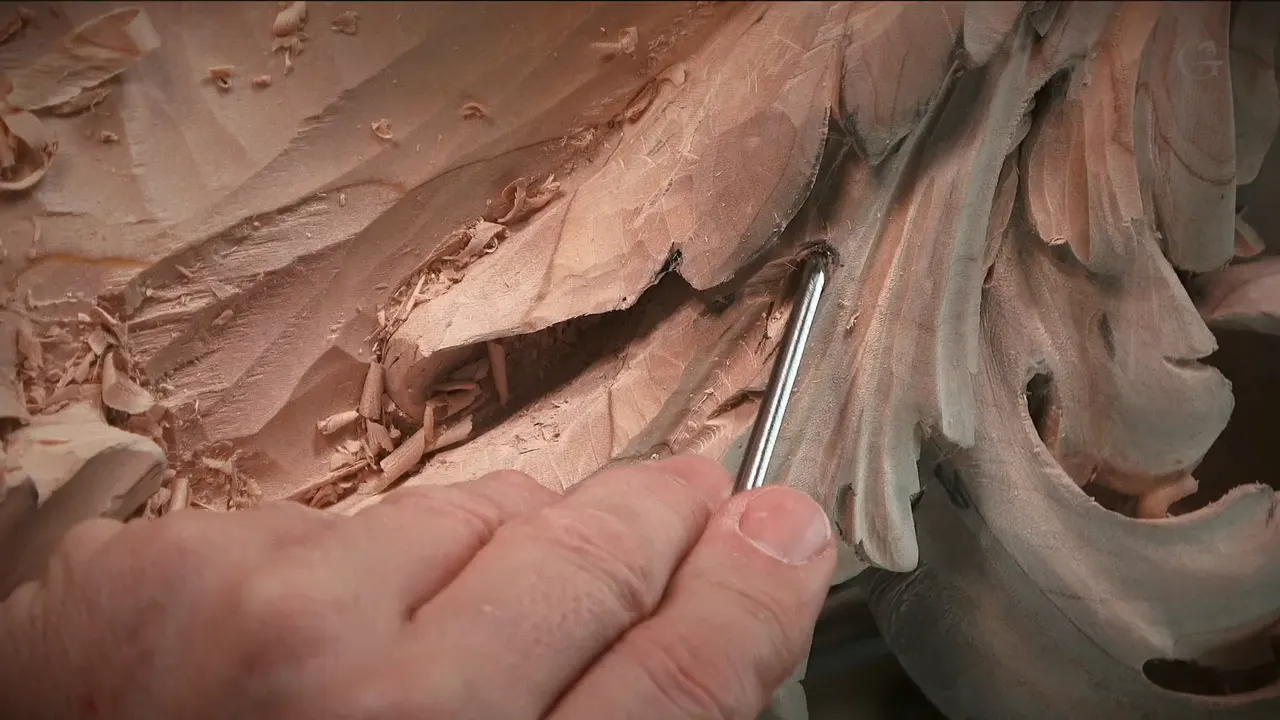

In Venice Room workshop 64, part 5, I did what I had explained not to do, and I said I wished I had not. That same wish turns up in other wood carving lessons, after pencil marks, a broken edge, a harsh knife pass and a hole that got bigger.
You know the moment. You make the move you just warned about. Here is what I said in this video, what came next, and where else you can hear it.
What did I say as part 5 began?
The part opens with a warning. "It's a dangerous operation sometimes because you are cranking against or leveraging against that shape of the eye. So you've got to be careful. Watch not to smoosh it too much, okay?"
"See what I just did." That is what I said next, and then "I get a little on inside" and "I'll take care of it." Then came the line itself. "It's not a big deal, but I wish I didn't do it. So I just did what I explained not to do."
Soon after, "But I'm okay, like I said, in this area," and then, "But see, that eye gives me beautiful shadow." Also "All it took is just the one tool."
How did I plan to fix the mess?
The plan came in order. "Yes, now I have to take care of the mess that I just did. Maybe just with the back bend, I'm going to be able to attack it and blend that. Maybe yes, maybe no."
A short bend was next: "it's not going to work because of the position, so I have to use a short bend." Another try was "number five, eight millimeters" (about 5/16 inch), and I added "A little bigger than a quarter inch."

"But it feels like it needs to be sharpened first." Next I named "Number 11, one and a half millimeters" (about 1/16 in), plus "carefully go in and excavate underneath."
My reason for not doing a lot: "I don't have to do a lot again because the light is going to hit from this point from above like this, so it's not going to cast too much shadow."
What about the pipe?
"But what I have to worry about, I need to create beautiful movement. And I don't like so far how that pipe or should I say pipe formation. I'm not too happy about it, okay?"
The eye still needed work: "I still need to excavate a little deeper an eye, a little deeper." A small tool was my plan, and I gave its size: "Small back bend, which is number two and six millimeters, a quarter inch, and clean it with one and a half millimeters. Dig out whatever mess I just created."

"I could spend much longer and clean it even better," I said. Later, "See? There is a nonstop process. So I really have to stop at some point. Okay, good. That is good."
Did I clean everything at first?
The pipe came up again: "I don't really like the formation of this pipe. If you would ask me why, it just doesn't look nice for me." Around the eye, "I will have to excavate a concave. And yes, it's kind of tricky for me." A small detail, I said: "I know it's a small detail which is not that visible, but I think it's still going to give me satisfaction that I'm happy."

Next is a line about clean work. "Again, that is why sometimes when I'm working, I'm not 100% doing clean at first" is how it starts, and the reason comes next: I know I will change some stuff, "especially if I'm not too happy with the outcome." Then "And I know I could do much better and I didn't. So I'll just leave it, walk away, and return to that area later."
Next, a new plan: "And now I need to lower down a little bit that side." My aim was "to create that type of movement upward. Create uphill movement." "I'm going to use maybe about number three," I said, and after that "maybe I should use a different sweep, maybe number six or so." Then "Or even seven."

Near the end of the part came "And that way, it's going to give me the right formation of the pipe. So the pipe is going logically." Last was "maybe even create some shadow underneath of the pipe." The workshop 64 page holds all twelve parts.

Is a mark on the wood enough to make me say it?
Workshop 67, part 2, has a black marker in it. "I don't need that mark," I said, and "I also don't need this black marker also," with a plan to "just get rid of it." Then my wish, about the marks: "those marks because it's kind of hard area to clean. Really not convenient to clean."

"All right, and let me refine the edge," I said next. A bit further on, "a little bit touch-up underneath," in what I called a "tricky area." Of the inside, "on inside I can clean off camera with no problem."
Part 3 of that workshop has the same wish, about pencil marks. Before it, "going to need the one millimeter, number 11," about 0.04 in, "and make little longer cuts in the areas of micro-separations." Its words named "pencil marks."

Cleaning came up too, with "extra facets I don't need." And "cleaning and refining everything could be done just off camera," with "cleaning sometimes takes actually the longest."
Workshop 50, part 5, has a check on distance. "I need to make sure the distance before it hits the middle line, it's somewhere on a golden ratio, so which means six parts out of 10." "this way, it has to be also logical," I added. In that part the wish was for "that mark with the pencil, but it's okay. I did it just for you."

"Again, the same idea." My plan was a first channel cut, and "exactly the same on this side, a little deeper." Ridge options came as "the same tool," "a bigger number 11," and "Or just a flatter gouge, like maybe number three." The pick was "just use a flatter gouge."
Carving Hashemi Flowers 9, part 4, tells you why the mark was there. "Okay, now I have to clean it. Let me take half an inch number eight" (about 13 mm). Its words: "that pencil mark. I really don't like to use a pencil."

My reason was "just to show you what I am doing, okay? But it's better not to use it because it leaves dirty marks."
What do I say when I break an edge?
In workshop 40, part 3, I named "number seven now. Spoon gouge." Then "See, I just broke this edge, which is not too good." The wish came next.

After it, "I use a smaller tool right now, and go underneath, give that roundness. Later on, I could use a bigger tool and excavate. Not excavate, but clean a little better. But as of now, just use the small one."
Workshop 45, part 6, has a mistake I said was not big. "But what I did, I just made a mistake. It's not a big mistake, but still," and then the wish. Following it came "Using number seven. Number seven and four millimeters" (about 0.16 in).

"Yes, carefully. Going to create that concave." Later in the same part: "That was unfortunate, but it's okay." Then "That is not what I was planning, okay?" "I was just probably too fast." "See, I just used number seven." My next words were "and that's not always the best idea to get really close to detail like that."
What about a knife pass that came out too harsh in one lesson?
Workshop 93, part 11, is the knife one. "It looks like my previous cut was too harsh. The knife cut. See that line?" Pushing the fibers together a little bit was something I said I can kind of do. Here the wish was for "that harsh cut, but I did because I didn't think I going to do that detail. So because of the change. That's all right."

Next: "Okay, let me use again, one millimeter and excavate much deeper" (about 0.04 in). With it came "And maybe even half a millimeter" (about 0.02 in) and "excavate all the way to the background."
Does a cut that goes too deep get the same line?
For the blending spot in Furniture Panel 38, part 2, the tool I named was "a spoon gouge, which is number three, but it's a small one that's about quarter inch or so" (about 6 millimeters). "You kind of have to feel how deep you have to go with the cut," I said.

A cut too deep in one section got the wish too. "It's kinda interesting area. Interesting because it's just, I don't know what I was thinking, so I should admit that is the mistake, mistake of the design."
Afterward came "But please, you're the only one who knows that. Nobody's gonna catch it." And "Maybe it was on purpose. It's a really good transition, a really good transition. Kind of like it actually."
Which words came when my hole got bigger?
Part 4 of Lily Box 11 was in what I called "this olive wood." "Oop, I made my hole even bigger." Then "Got too close. Too close. Although I tried to check, but still..."
Fixable, I said: "And that is fixable, by the way. I have no problem with fixing that." The wish followed: "do that, but it is what it is. Okay, let me remove my clamp. It's in my way."
Earlier, "I have to deal with that." Next, "I need to be more careful, I guess." After that I said I would switch tools: "And I'll switch to number seven. Number seven, and also about 10 millimeters, 3/8 of an inch."
Do I say it about mistakes from before?
Yes. In Carving Hashemi Flowers 23, part 2, "I could make it, this volute, this part, this section, the round part of the volute, like a high point and just make it this side a little lower. I think it's going to look nicer."

"So again, number five. Again, I have to be really careful not to press too much. It's better to make a couple passes than to make the mistake. I don't want to make any mistakes anymore." Soon the wish: "make mistakes before, too."
My words after it were "And I can actually make it even lower. I have plenty of the material." Also "I feel comfortable doing it." My figure for the drop was "about one-eighth of an inch, three millimeters." "I easily could go even lower than that," I said.
Is it only about the wood?
No. In Lily Box 11, part 2, the line came out about video footage. First, "when I took this material, it's 5/8 of an inch" (about 16 mm), "and it looks like it's plenty of thickness. But you're running out of the material, of the thickness, pretty quick."

Next, "I'm a little frustrated that I lost some of the video footage, although I didn't do too much, but still, I just wish I did not lose it. Let me check." Then "Don't want to overdo it" and also "Check, check, and check again."
Which lessons did I list?
Each row below is a lesson, what the line was about, and the minute and second where I said it, in the last column.
| Lesson | What the line was about | When |
|---|---|---|
| Part 5 of workshop 64 | The move I had warned about, near the shape of the eye | 0:31 |
| Workshop 67, part 2 | Marks I put on the work, in an area that was hard to clean | 6:08 |
| Part 3 of workshop 67 | Pencil marks, followed by a little cleaning of extra facets | 4:01 |
| Workshop 50, part 5 | A mark made in pencil, which was just for you | 5:40 |
| Hashemi Flowers, lesson 9 | A pencil mark on the piece, which I said leaves dirty marks | 5:47 |
| Workshop 40, part 3 | An edge I said I broke, which was not too good | 4:54 |
| Workshop 45, part 6 | A mistake that I called not big | 0:43 |
| Workshop 93, part 11 | A knife cut that looked too harsh, made when I did not think I would do that detail | 2:47 |
| Furniture Panel, lesson 38 | A cut that went too deep in one section of the carving | 19:38 |
| Lily Box lesson 11, part 4 | A hole that I made even bigger | 9:14 |
| Hashemi Flowers, lesson 23 | Mistakes I made before, on a volute I said I could make a little lower | 3:41 |
| Lily Box lesson 11, part 2 | Some of the video footage, which I said I lost | 2:07 |
Where can you watch the full videos?
The lines above come from my furniture panel, Hashemi and Lily Box courses, and from several Venice Room workshops. Workshops 62 to 73 are in Venice Room Part 6. To watch the full videos, start here.
How it's done
- Name what you just did. In this lesson my words were "See what I just did."
- Plan the clean-up. The mess had to be fixed, and my plan was to try the back bend.
- Pick the tool to try. A short bend was a need, I said, and number five was something I would see about.
- Look at what the work gave you. My words were "But see, that eye gives me beautiful shadow."
- Say when it is good. Stopping at some point was a need, and then "Okay, good." Last came "That is good."
Frequently asked questions
What did I say after the line in part 5?
The eye gave me a beautiful shadow, I said, and one tool was all it took. On the mess, my plan had a maybe in it: try the back bend and blend it.
Which tools did I plan to use for the mess?
I named the back bend, a short bend, and number five at eight millimeters (about 5/16 in), and I said "it feels like it needs to be sharpened first." Number 11 and a small back bend, number two, were on my list too.
Do pencil marks get the same line?
Yes, in workshop 50 and in Hashemi lesson 9. In the Hashemi lesson my reason was "just to show you what I am doing," and I added that it is better not to use it.
What to carve next