

Alexander Grabovetskiy, woodcarver, School of Woodcarving · Published 2020
What does a wood carver mean by "my favorite"?
Quick answer: In Venice Room workshop 64, part 4, I said a long bend with thick walls was not my favorite, and a slightly bent one of 1/8 in (3 mm) worked much better for me. In other lessons I say favorite about a nine, a number 11, a way to clean, a knife, a mallet and a wood.
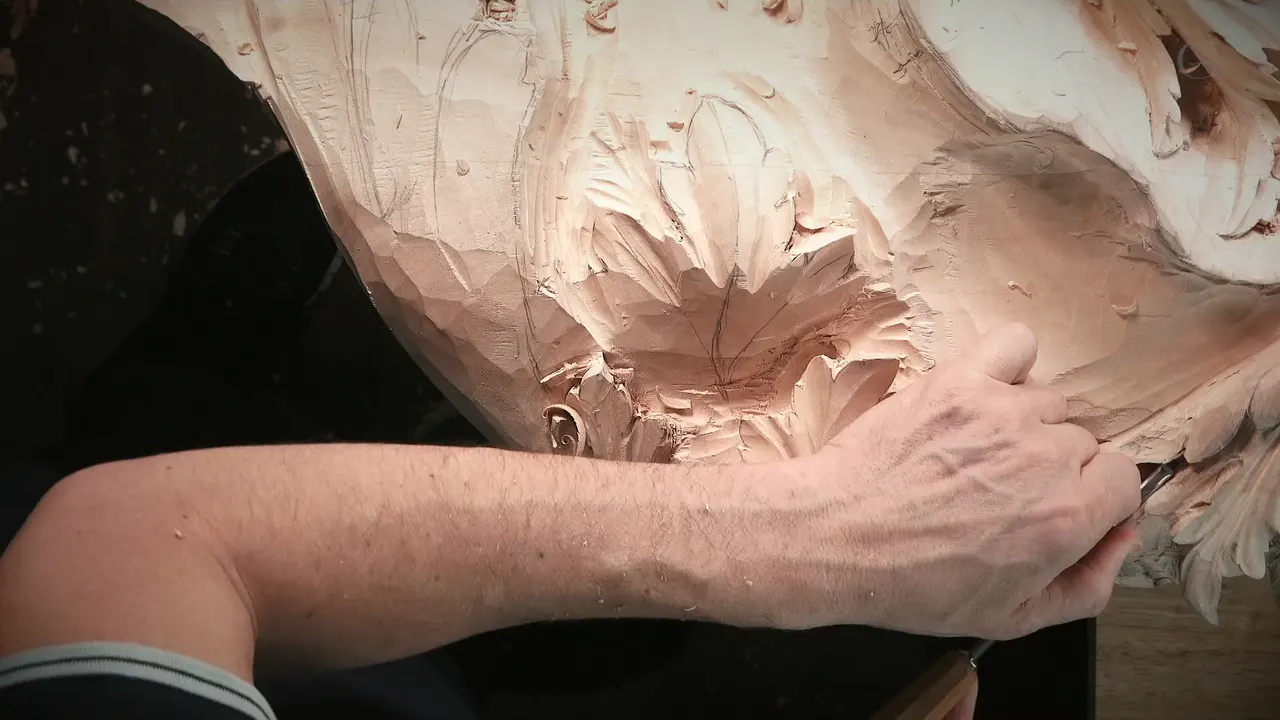

In Venice Room 64, video four, I said of one tool that it "has thick walls." In other lessons I name a favorite knife, mallet and wood, a favorite nine and 11, and a favorite way to clean a spot.
This part comes first, in the order I said things. After it come the lessons where I name another favorite, each with the size I gave.
What did I say about a favorite in workshop 64, part 4?
The part opens in the middle of the shadow work, and I said, "And I create even deeper shadow." I was using a back bend, and I called it "number two, so almost flat. Less than number three, and that's quarter inch" (6 mm). Then: "And I'll just go all the way to the hole again."
Next I said I would take "two millimeters again, number 11 veiner" (0.08 in) and "dig out whatever I just created," the mess I had just made. And "maybe just shovel out a little bit, blend in inside, even if you don't see it, but I can blend it little more." I asked, "can you see how deep that shadow is?" and called it "just gorgeous shadow."
A plan came next: undercut "that way," because "I need to develop that side." The other side would wait for "later on," because "right now it doesn't look too good." I had "an eye to do," I said, and "some divisions to do." Then a worry: "I have to keep going, and since I'm doing a live stream, I'm just falling behind for some reason. It just takes so much time."

Then: "Preparation, checking all the equipment and stuff like this." Live streams are still "really good," I said, "but I need to figure out what is going to be the best approach." While we were on a lockdown I would "probably do a little more." Then "later on, I doubt I'm going to do a lot." And "I don't need to," I said, "because I still have to get the production work done, and I do have other projects waiting on me."
About the project itself I said it is "not the project you're going to repeat." A step back followed: "there's a lot of different sections you can repeat." The project is "a really good project to develop 3D thinking," with "a lot of different techniques you can practice just on a small pieces of wood."

A different tool came next. I would use "just a long bend number 11," after "Let me get different tool." A few seconds later: "this long bend number 11 has thick walls. It's not my favorite, by the way, although the brand is my favorite, but that's not the favorite number 11."
After "Okay, let me think," the tool I weighed was "slightly bended one, one-eighth of an inch" (3 mm). My verdict: "Yes, this one works much better for me. Even if I have to carve toward myself, it is still okay."
Depth had a limit. "I can excavate a little deeper. I don't have to go too deep, again, for the reason I just said multiple times." On that side, "there's not going to be any casting shadow" because of the light, so "I don't really need to work on my shadow on that side."

Next, a plan to clean "my canvas" a little bit, and then "I can start working on my divisions and make it more beautiful, more logical if you wish." Eye next: "it is time" and "So let me excavate the eye." There are "multiple ways to do the eye," I said, and I would start with "a small 16th of an inch number 11."

I wanted it "much closer," and I said, "that is number 11, and that's one 16th of an inch, 1.5 millimeters." My plan was to "go that direction and attack that from the opposite direction also." Then: "I can actually excavate, like shovel it out, okay? Start in, then move it slightly that way."
Which of my number nines did I call the favorite one?
Part 9 of the same workshop begins with a concave upward that would "pop really beautiful shadow." Next: "this number nine is dull now, my favorite number nine is dull, so let me use a different one." Number eight was an option ("I could use actually number eight"), and then: "Well, I'll use nine."
Part 7 has the opposite case. If the tool is too big, "I can always switch to smaller one and start excavating with the smaller one." The farther you get, "smaller tool you should use because otherwise it's not going to look nice if people are going to look inside and see not so beautiful finish."
Then: "switch to my favorite, a quarter inch. Number nine" (about 6 mm). Later: "maybe even I can get with the number nine and one-eighth of an inch, like three millimeters, and get even deeper."

Workshop 67 adds a bigger one. "I'll get my favorite," I said, then "number nine." Next: "I could actually do a bigger one, I guess. I think there's plenty of space for me to do a bigger one." My words were, "There is a big space. I don't have to waste time. So I'll just take half an inch" (12.7 mm). Then a limit: "I have a limitation with this tool. It actually has a tendency to go deeper, and I don't really need to go deeper."

A plug cut with a nine was the plan in workshop 54: "I'm using little different number nine. This one is my favorite one, okay?" The tool: 6 millimeters, a quarter inch, "that has a really short end. It's a beautiful tool." After that: "This one is my favorite from quarter inches, and I have multiple quarter inches, of course. But I like it for some reason, this one, a lot."

Where does a number 11 come up in Grape Onlay?
Grape Onlay 12 starts with it: "My favorite tool is always, is gonna be probably number 11." Then, "doesn't matter what size, it's depends." Size, in my words: "probably about, uh, six, maybe seven millimeters" (0.24 to 0.28 in).

Again in Grape Onlay 11: "I'm gonna use, uh, as always my favorite number 11. In this case, you're gonna use five millimeters" (0.2 in). Workshop 64 sits on the other side of that line, with a number 11 that I did not call the favorite.
Roman Acanthus 16 has a pair. A number 17 "just gives me a little softer look," I said. Then: "Well, I use both." And: "Number 16 is actually also my favorite." Then: "But this number 17, just because of that, I like it, okay? In this case, at least."

Which ways did I call a favorite?
One way sits in Furniture Panel 21: "couple ways I could attack and clean it. One of my favorite ways is take a one millimeter number 11 and remove whatever is a waste." (1 mm is 0.04 in.) "With this tool, I can go a little deeper, slightly deeper."

Workshop 60: "I really want to see a really deep shadow." Then, "there is a couple ways I could approach and create a deep shadow. And one of the ways, I think it's my favorite way anyway, just to get my plug cut." Then: "the only problem is the angle of this plug. I can't go in underneath of this leaf with a straight tool." Still, I would "start at least."

The approach in Furniture Panel 22: "my favorite approach would be just to use number 11, any number 11." The size: "three millimeters" (0.12 in). For the first pass I would not "lean on the side."
Furniture Panel 19 puts a favorite under a leaf: "a couple ways approach, but my favorite in this type of carving would be half a millimeter, number 11." I said I would "lay it on the side and carefully going to go deeper," and "Not much." (0.02 in)

One way was the opposite. In Hashemi Flowers 48: "I am working absolutely not in my favorite way, so against the grain. But that's okay." That work ran against the grain. Next, "I'll cut as deep as possible."

Does a favorite tool change from one carving to the next?
The answer sits in Hashemi Flowers 33. Number five was in my hand a lot, "And maybe some of you already think this is my favorite tool, but it's not necessarily. It can become favorite tool today with this carving, and the next project, it will be absolutely different tool that I'm going to use a lot more."

Workshop 76 has the line "Let me clean that little bit." Then: "You know what? I should use now my favorite tools." And: "I never resharpened them because they're just that good out of box." A back bend would wait for "the final shape."

My lesson on back bent tools says it about a whole group. So many of them, I said, are my favorite tools, some of them "huge." And in Roman Acanthus 2 I called a number seven a favorite: "it's three-quarter of an inch or 20 millimeters" (0.79 in). "And it's unbranded, so you can't buy that. My teacher gave it to me."

A large number seven turns up in workshop 74, "one of my favorite big tools," for cleaning. Then: "I could take it to extreme and clean it even better if I wanted to." And: "The question, do I need to or not?"
Workshop 82 has "I need probably just number three," and a favorite number three to go with it. The size: "about 5/8 of an inch, about 16 millimeters." And in workshop 83 I named a skew a favorite tool, and said "Get rid of some of that."
Another favorite is a big skew chisel in workshop 111: "my skew chisel, big one, one inch." (1 inch is 25.4 mm.) "It's going to help me to blend nicely."
Which knife, mallet and wood come up as favorites?
A knife first. In Furniture Panel 17 the knife was "number 12," and I said, "by far is my favorite one." The reason came with it: "my favorite even in this application, because I can hold it really low to the surface and that's not digging as deep. It doesn't give me as much resistance." Then: "it's all about maneuverability."

Hashemi Flowers 2 calls a number 12 a "cheap carving knife," and a favorite knife. The knife "has a flexible metal, and that helps a lot actually." In Beginner in Woodcarving 1 the line was, "I do have multiple knives, but this is my favorite knife, and that's number 12." And: "this knife lasts 20 years on my shelf already." And "I'm still using it every day."
Lily Box 10 gives its limit for the same knife. Number 12 was "by far" my favorite knife "from all of the knives I have," and "I can get actually a lots of done with just this knife." But, "I'm not able to do really extreme undercutting and give a really nice gradual transition on inside."

A brass mallet next, on my live stream about mallets. "That is the reason why I like those rubberized mallets. The second, probably my favorite mallet after that rubberized mallet, is a small guy like this. And that's made out of brass." Lighter, at "maybe half a pound" (about 0.23 kg), and "this one gets noisy."
And a wood, when a viewer asked on another live stream, with this answer: "My favorite for carving, it's limewood, which is the best wood." I added that we call it "lipa" in Russia, and that the second after it is walnut: "I really love walnut."
Which lessons name a favorite, and with what size?
Twelve places sit in one table, this part first. Some rows carry no size, because the lines I quote give none.
| Lesson | What I named, with its size | Used for |
|---|---|---|
| Part 4 | A slightly bent tool, picked after one with thick walls | Slight bend |
| Part 9 | My nine had gone dull, so I picked another one | Nine |
| Part 7 | Favorite quarter inch nine, 6 mm, to excavate a little more | Number nine |
| Workshop 67 | Plan: a favorite nine, then a bigger one, half an inch (12.7 mm) | A nine |
| Workshop 54 | A nine I like a lot, from my quarter inches, 6 mm (0.24 in) | Short end |
| Workshop 76 | Tools I never resharpened because they were good out of the box | Clean-up |
| Onlay 12 | Number 11, probably six or seven millimeters (0.24 or 0.28 in), a favorite tool | Channel |
| Onlay 11 | Number 11 as always, a favorite, five millimeters (0.2 in) for outlining | Outline |
| Panel 21 | Clearing the waste with a favorite way, 1 mm (0.04 in) | Waste |
| Panel 19 | Half a millimeter (0.02 in) to go under a leaf, a favorite way | Undercut |
| Panel 22 | Three millimeters (1/8 in) for my favorite approach to the first pass | First pass |
| Roman Acanthus 2 | Number seven, 20 mm (0.79 in), unbranded, a favorite from my teacher | Unbranded |
Where can you watch the full video of each lesson?
Each size on this page comes in millimeters and in inch, with the figure I said first. Every lesson named above is on my site. This lesson holds all of workshop 64, workshop 60 holds the plug cut, and workshops 62 to 73 are in Venice Room Part 6. The wood carving lessons I quoted are linked where I named them, and each one shows the work in real gouge strokes. To watch the full videos, start here.
How it's done
- Check the walls of the tool. I said the long bend I picked had thick walls, and the next tool, bent only a little, suited me better.
- Switch when it goes dull. My nine had gone dull in part 9, so I chose another nine.
- Go smaller as you get deeper. The farther you get, I said in part 7, the smaller the tool you should use, or the inside will not look nice.
- Say what a favorite covers. In lesson 33 of the Hashemi course the number five was my pick for that carving, and the next project would be a different tool.
- Know where a knife stops. Lily Box 10 has me naming number 12 a knife that does a lot, but not really extreme undercutting.
Frequently asked questions
Is a long bend a favorite of mine?
In the fourth video of workshop 64, I said the long bend I picked first had thick walls, and I did not call it a favorite, although I named its brand as my favorite. The next tool, bent only a little, suited me better.
Which nine is a favorite of mine?
In part 9 I said a dull nine was the favorite, so I used another. Part 7 had me switching to a quarter inch nine, 6 mm. Workshop 54 had me picking one from my quarter inches, and I said I like it a lot.
Is the favorite tool the same on every carving?
Not necessarily, I said in the Hashemi course, lesson 33. Number five could become the favorite that day, and the next project would have a different tool that I use a lot more.
What to carve next
- Workshop 64 lesson
- Workshop 62 to 73 course
- Workshop 67 lesson
- Workshop 54 lesson
- Grape Onlay lesson 12
- Grape Onlay lesson 11
- Furniture Panel lesson 21
- Workshop 60 lesson
- Furniture Panel lesson 22
- Furniture Panel lesson 19
- Hashemi lesson 48
- Hashemi lesson 33
- Workshop 76 lesson
- Back bent tools lesson
- Roman Acanthus lesson 2
- Furniture Panel lesson 17
- Lily Box lesson 10