

Alexander Grabovetskiy, woodcarver, School of Woodcarving · Published 2020
What does a wood carver mean by "dome effect"?
Quick answer: In Venice Room 64.8 I picked a 7 millimeter number 11, a little bigger than a quarter inch, for an undercut with a dome effect. Other lessons use dome effect for a volute, a keel, small flowers and a wall.
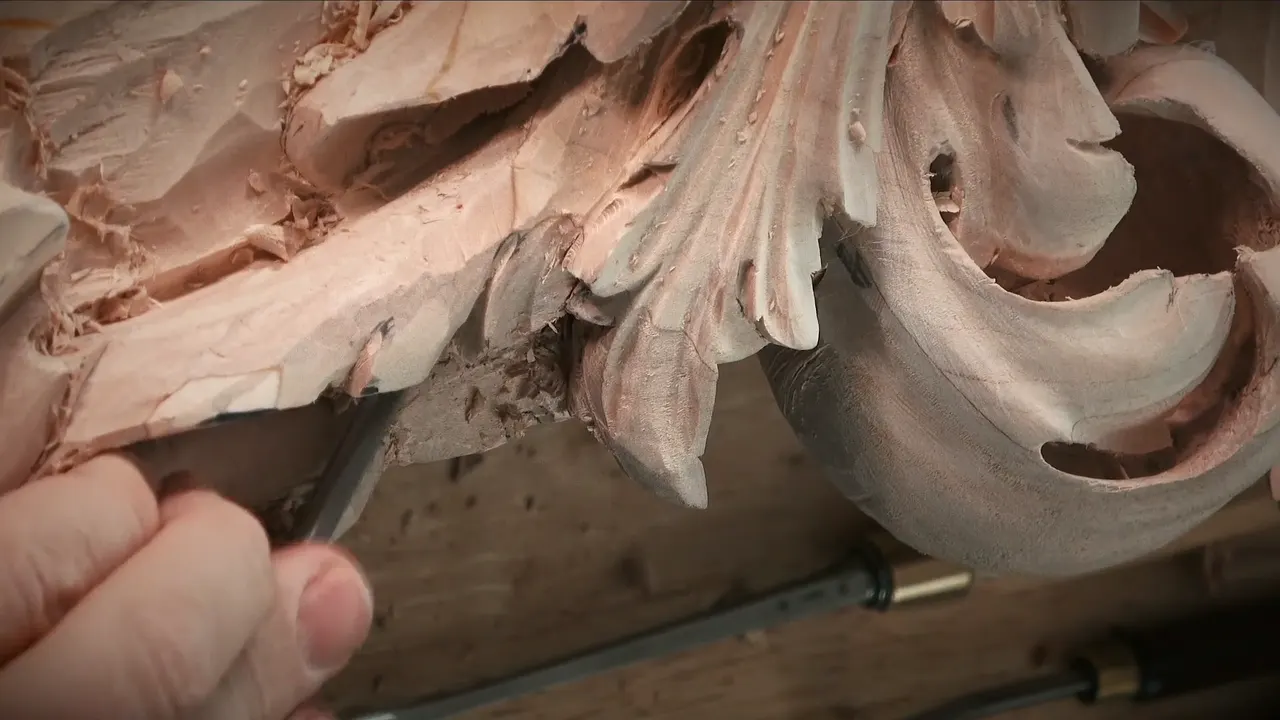

In part 8 of Venice Room 64, I said I would use a number 11 at 7 millimeters (0.28 in) to create a dome effect undercut, and that I really need that shadow. Other lessons use the same words for a volute, a keel, small flowers and a wall.
Below is that line in context. After it come the lessons where the same words came up. On Wikipedia, see wood carving for the craft in general, and dome for the building shape.
What did I say about a dome effect during part 8?
"I'm completely underneath," I said. I could "now connect those two cuts." Earlier I had said I did not have to, but "I already did it." The work was out of sight: "you don't see what I'm doing, but I'm just trying to dig out underneath whatever."

For cleaning this area I picked a spoon, "maybe number four," and the tool had "a bit long bevel." That long bevel "slices through the fibers really easily." My size for it: "5/8 of an inch, about 16 millimeters bevel." Wikipedia explains the bevel.

Now the line. "Right now, I need to excavate little bit of this mess, which you don't see." One worry was my own approach, and I did not want to make a mistake in how I attack it. As for the tool and the cut, I said, "I'll use just a number 11 and 7 millimeters, a little bigger than a quarter inch, and create a dome effect undercut." Seven millimeters is 0.276 in, and my reason follows right after it: "I really need that shadow."
Depth had a limit: "about maybe three millimeters right there left," I said (3 mm is 0.12 in), and I wanted no more taken there. Going further would be "a big mistake," or in my next words a "huge mistake." Another direction stayed open, though, one I could take "much deeper." My verdict was short: "Okay, that is good."

Mess was still on my list. I planned to get all of it out, and a smaller tool was a maybe, "like four millimeters" (4 mm is roughly 0.16 in). One chunk had to wait for later, a chunk that stays out of your sight. It sits "on the side and it's invisible," and it is "just a stem coming from that detail."
About where that stem goes, "right underneath of this leaf." Then I fixed my own word, "Or division, I should say," and "Underneath of that division." Maybe I could clean a little there and "create deeper shadow." After that I turned to you with a question, "But can you see that?" My answer: "It casts shadow now. Beautiful shadow."

Pipes came into the talk. "Logically, I do have a pipe," I said, and there is "supposed to be a pipe because I have eye." I wanted to "exaggerate my pipes," with another pipe on the way. As for order, "before I do the convex, I need to create concaves"; I would take the concave "right to that point" and go "along that pipe."

I had not cleaned everything near that eye, and I told you why: "now you understand why I did not clean everything in this area when I was working on that eye, because I didn't need to yet." I went on, "Because I still have to create other movements of the same detail."
A small tool was in my hand, by the way: "Number 11, three millimeters." Right after that, "One-eighth of an inch." Care mattered in that cut, "because I don't want to slip and mess up with my cut." There was room too: "I could excavate even deeper."

There was another eye: "I've got another eye." I would "take all the way maybe to here" and "excavate with the same tool." It is "a lot of lines," I told you, and then you would see the form.
Which lines about shadow sit in parts 7 and 9?
Part 7 of workshop 64 is about a hole. A "really deep hole in this section" would "give me a really good shadow, a really beautiful shadow," I said. The wood looked "kind of dull," just "a chunk of wood." Above it, "it's already kissing dark shadow." My pick for the digging was a nine: "Number eight will work also, but I kind of like number nine."

Angle came up too. "The angle supposed to match." Digging that way would be "too close to undercut," I said. For size: "maybe about three-eighths of an inch" (about 9.5 mm). And a rule for small tools: "farther you get, smaller tool you should use." My favorite was "a quarter inch" (about 6 mm), "Number nine." I added "maybe even I can get with the number nine and one-eighth of an inch, like three millimeters, and get even deeper."
Two holes sat close to each other. "I don't have to meet those two holes because it's going to give me the strength." The shadow stays: "beautiful shadow around."

Back in workshop 64, part 9, I said I had to "concave upward," and that would "pop really beautiful shadow in this area," giving "extra frame, if you wish." A different tool was needed, since "I'm carving against the grain." The tool "has to be super sharp." Out came a number two at six millimeters (0.24 in). "I did hone it on a 6,000-grit sandpaper," I said, and I "didn't want to round this." See sharpening on Wikipedia. One more line from part 9: "I really need a smooth transition."
Could a number seven give a dome in a volute?
In workshop 46, in part 4, I was shaping a volute, and that is where I said it. "I can create beautiful dome effect on inside," I said. That was "number six." The plan for "waste chips I don't need" was a number 11 veiner at two millimeters (5/64 in). See volute on Wikipedia for the plain shape.

On a straight number seven I said it is possible to do those volutes with no problem, but the effect would be different. I described a dome underneath that "gives just a deeper shadow." The limit: with number seven, "I could get just to the certain point," and "I could not create that dome on inside."
What about a keel cut?
Part 11 of workshop 58 puts the words next to a keel. One option was to "bring that cut all the way like this," and "that is called like a keel," "A keel of a boat cut." It would still "cast some shadow." Then, "maybe I'm able to do on inside like a dome effect." The shadow would be "beautiful shadow underneath of right here," and so "beautiful shadow on both sides."

Later in that part I named a switch "to number seven and 14 millimeters, about half an inch." It "just tears my grain." The caution that came with it was not to overdo it.
Which tool did I name for it in other workshops?
Workshop 15, part 12, has a short one: "maybe even with the number seven and create a little dome effect." Workshop 40, part 8, named a "back bend sweep number five at half an inch" (about 13 mm), for "the upper part, a ceiling part of my detail." On the dome itself: "beautiful dome if I wish to."

Three parts of workshop 95 carry it. The number seven turns "upside down" in part 7 for "that dome effect," with "Careful, careful approaching this area" beside it. Seven returns in part 9, and a deeper excavation at number 11 was needed "otherwise I don't get it." One dry line follows: "I'm talking about the dome I'm not talking about my understanding."

Back to that workshop, part 4. "I can get maybe a #7 gouge and get my cut." A few words on, I say "some kind of dome effect." It would look "much cleaner and nicer," with a limit: "I cannot do it too deep, just slightly." That part, I said, is "going to cast some of the Shadow."
Workshop 145, part 2, uses a back bend: see the lesson. "I could actually also use the back bend to excavate some of that stuff out," I said, and "a dome underneath." I also said "Attack from two sides," and later, "I already see a deep shadow."

Can a skew make a dome effect, or do you need a back bent?
In the April 2020 live Q&A, a skew came up. A skew has limits, I said, whatever kind it is. Even so, "it's actually a really good idea to use a skew to the certain degree." For "a really deep and beautiful dome effect on inside right there," I said, "you have to use a back bent."

My reason for the back bent: "nothing is in my way, and I can actually cut really nicely underneath," at "any angle undercut." The plain tool is on Wikipedia as chisel.
Grinling Gibbons Maine class 16, part 1, has a number five that is "over an inch" (over 25 mm), with the tool upside down. I wanted "even deeper shadow cast because of the Dome effect," and I also said not to overdo it. Then I said, "let me get number 11 again," at 1 millimeter (0.04 in). See Grinling Gibbons on Wikipedia.

Does a small flower get a dome effect too?
In Chamomile and Bow Rosette lesson 4, part 1, I said, "The center part is raised up, and that would be like a dome effect, and everything else going downhill." The first cut: "we need to create that cut first." My tool was "number 11 and 2 millimeters" (0.08 in), and "It's actually 2.5 to be exact" (about 0.1 in). On a number seven instead: "I don't want to lose that edge."

Two pieces had to match. "I want to make sure that middle part is exactly the same." The border was a rule: "I need to establish that border, so I cannot go beyond that border." Over in lesson 2 of that course, one part would "go lower," with a "dome shape" as the reason.
Lily Box lesson 12, part 1, plays with the phrase. "Those petals, they must be lower than the middle section," I said, and the word is "dome effect, I should say." Then, "Or effect of a dome." A "2-millimeter number 11" (5/64 in) went to "a cut around this future dome." The cut in that dome would not be as deep.

Small parts need care: "You can't make too rough cuts," I said, and the box would be seen really close to the eyes.
Is there a dome feel or a half dome in my lessons too?
Furniture Panel lesson 23, part 6, uses the word feel. I thought we can get a "dome feel" with the same tool, and that it would give "a lot more." I also planned a "rotation movement," and I wanted to "raise that middle part." And on looking: "I really want to see it, like I will really around it from all of the points of view. It's got to look like it's half around."

In lesson 24, part 1, I move to half a dome: "create my center half dome, half a sphere." A hedge follows. "Not really half a sphere, but still." The piece is tiny, in my words: "it's only about 10 millimeters, about three-eighths of an inch point to point." Wikipedia has the sphere.
Over in Flower Rosette lesson 3, part 2, the center is "dome-like." My plan there: "rotate and establish my dome." The advice with it, "Barely remove anything." In lesson 6, part 5: "refine a little better that dome shape," and "reestablish my dome form of the inner part." Venetian Flowers Rosette lesson 2, part 3, has "the center itself is just like a pretty much dome," and "Just like a button pretty much." The gouge was small: "It's pretty much just a 1 millimeter gouge" (0.04 in). See rosette on Wikipedia.

How did a dome effect show up in Byzantine acanthus?
Carving Byzantine Acanthus lesson 5, part 2: "And inside also, we're going to create today a dome effect. So it's really easy to gold leaf." Another line from that part: "No details, not too many details." See gold leaf on Wikipedia.
Byzantine lesson 7, part 2: the dome effect goes "on inside of that wall." The wall: "leave approximately five millimeters, 3/16 of an inch on this side." A reminder: "Remember always concave, convex, concave."

Byzantine lesson 6, part 1: on a second layer the plan was to start "from the backside" and make a "dome on inside." And lesson 9, part 2: "go toward that dome inside." The payoff: "a lot easier to work on this leaf." On how close to go to the edge: "as close as possible to the edge, but not too close." And "about five millimeters, six millimeters, about quarter inch" (about 6 mm). Learn about the plant at acanthus plant on Wikipedia.
Where else did the word dome come up? A table of fifteen parts
The table holds fifteen parts, with workshop 64 first. The middle column names the tool, and the last gives the setting. Where I named a size in millimeters, the inch figure sits beside it.
| Where | Tool | What was going on |
|---|---|---|
| 64.8 | Number 11, 7 mm (0.28 in) | A mess to clear out of sight, and a shadow I said I really need |
| 64.7 | A nine | A deep hole in one section, to give a good shadow |
| 64.9 | Two, 6 mm (0.24 in) | A pipe with two sides to take care of, and an edge honed on sandpaper |
| Volute, 46.4 | Six | The inside of a volute, where number seven could get only to a certain point |
| Keel, 58.11 | A keel cut | Shadow underneath and on both sides, plus a caution about overdoing it |
| Ceiling, 15.12 | Seven | A thought about taking a little more in from the opposite side of the ceiling |
| Detail, 40.8 | Back bend, sweep number five | The upper part of a detail, and care about how much to excavate |
| Upside down, 95.7 | Seven, over | One area that called for a careful approach, with a cleaner cut to follow |
| Almost undercut, 95.4 | A #7 gouge | A cut that is almost undercut, for a cleaner and nicer look underneath a part |
| Underneath, 145.2 | Back bend | A shadow I could already see, after a note to attack from two sides |
| Livestream | Back bent, not a skew | A question about skews, and a reason the back bent could reach underneath |
| Gibbons, 16.1 | Five, over an inch (over 25 mm) | A deeper shadow, with the tool upside down and a caution against overdoing it |
| Chamomile, 4.1 | Eleven | A raised center, the rest going downhill, and a first cut around it |
| Lily Box, 12.1 | Eleven | Petals set lower than the middle section, and a cut around a future dome |
| Byzantine, 7.2 | A wall, 5 mm (3/16 in) | The inside of a wall, with approximately that much left on one side |
Where can you watch the full videos?
Every lesson named above is inside one of my courses. This lesson holds all of workshop 64, and workshops 62 to 73 are in Venice Room Part 6. The gouge, Venice and shadow pages linked here are for reading. To watch the full videos, start here.
How it's done
- Work underneath. I was completely underneath, and I could connect two cuts.
- Pick the tool. My plan was a number 11 in the 7 millimeter size (0.276 in) for the undercut.
- Say what the cut is for. Right after I named the tool, I called the shadow something I really need.
- Watch the depth. About three millimeters (about 1/8 in) were left there, so I did not want to do any more. Another way could go much deeper.
Frequently asked questions
Which tool did I name for the undercut in part 8 of workshop 64?
A number 11 in the 7 millimeter size (a little over 0.27 in). Four millimeters (0.16 in) was only a maybe, for a smaller tool that would get the mess out.
What did I say about depth in part 8?
Right there, about three millimeters (0.12 in) were left, and going deeper in that spot would be a huge mistake. Another way could go much deeper.
Could a number seven reach the dome effect of workshop 46?
Not fully. I said a number seven could get just to a certain point and could not create that dome on the inside. A number six was named for the dome, and the waste chips called for a number 11 veiner at two millimeters (0.079 in) in my plan.
What to carve next
- Workshop 64 lesson
- Workshop 62 to 73 course
- Workshop 46 lesson
- Workshop 58 lesson
- Workshop 15 lesson
- Workshop 40 lesson
- Workshop 95 lesson
- Workshop 145 lesson
- Livestream April 2020
- Grinling Gibbons Maine class 16
- Chamomile and Bow Rosette lesson 4
- Chamomile and Bow Rosette lesson 2
- Lily Box lesson 12
- Furniture Panel lesson 23
- Furniture Panel lesson 24
- Flower Rosette lesson 3
- Flower Rosette lesson 6