

Alexander Grabovetskiy, woodcarver, School of Woodcarving · Published 2020
What does a wood carver mean by "smooshing"?
Quick answer: In my lessons, smooshing means wood fibers pushed down or pressed together instead of sliced. In workshop 64 I said some wood was smooshing and my tool needed to be sharper. Other videos name a dull edge, a heel, and a knife pressed deep.
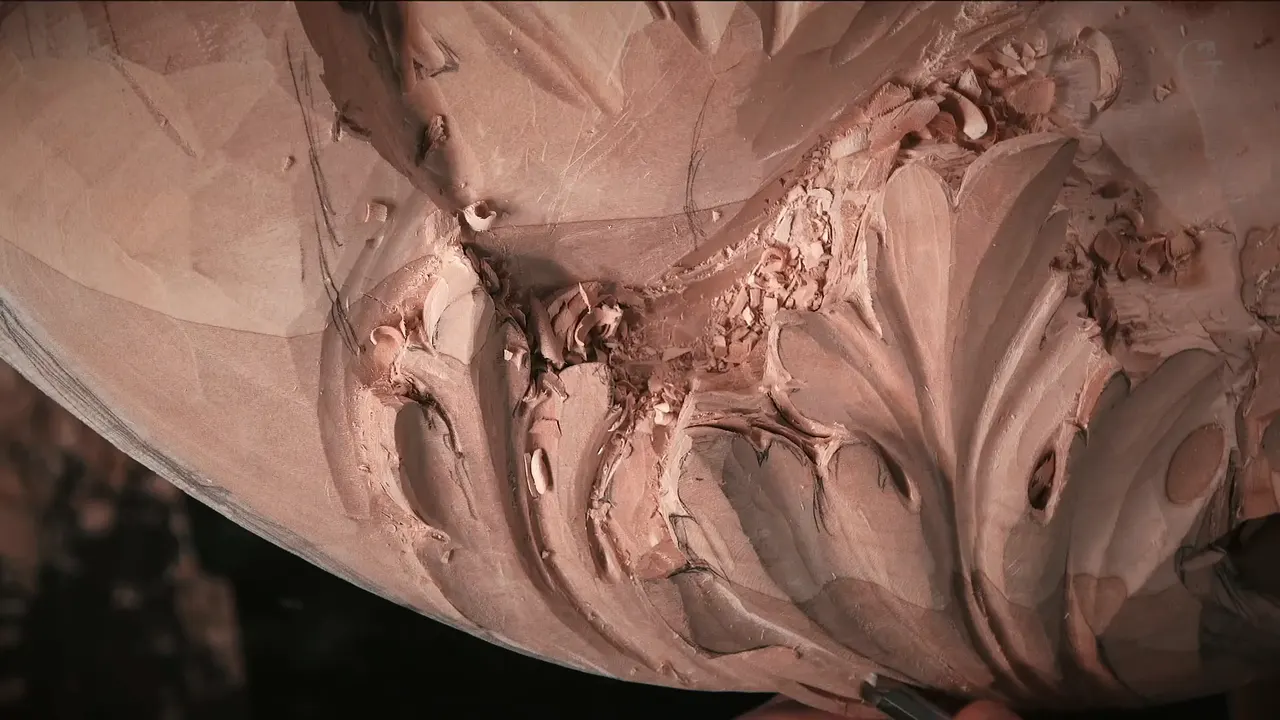

In Venice Room workshop 64, part 1, I called a spot of wood smooshing and said my tool needed to be sharper. I use that word in other wood carving courses too, for fibers pushed down or pressed together where a clean slice should be.
Ever carved a hollow and seen the wood come out mushy where a clean slice should be? Here is what I say about it in this video, and in my other courses.
What did I say about smooshing wood in workshop 64, part 1?
The spot came with a verdict, "It's not bueno," and a need, "I need to get another number nine cut." My reason was "Because I have the same thing right here." Then I named it: "Same smooshing wood."
For the tool, my words were "looks like this tool needs to be sharpened a little better," and the next words were "And that is good, I think," and a request, "Let me know what you think."

Next came a plan, "Let me get a little deeper excavation right here," and a possibility, "I think I could get that extra division, extra curliness."

What else did I do to the wood in part 1?
My words about a surface: "maybe I can take care of this surface also a little better" with "the back bend." Another verdict followed, "that is not bueno because I done it wrong direction," and a remark, "when you're doing it the wrong direction, sometimes that stuff happens." My plan after it: "Now, I need to do it deeper."

The damaged side is a different matter. "I am damaging this side, but that is absolutely okay because I can clean that," I said, and for the clean-up I named "the number nine" and "Just super sharp number nine." A small section was showing up, and that was "absolutely okay" too. I also said "Wonderful, and that makes me happy, and a couple more spots to clean up."

Near the end of the part came one more thought: "I need to actually give extra division right here because it does not make too much sense." With it came "Just chop a little section off here," and "Get relief cut."

Did the word come up again in part 5 of workshop 64?
It did. "It's a dangerous operation sometimes because you are cranking against or leveraging against that shape of the eye. So you've got to be careful. Watch not to smoosh it too much, okay?"

The next lines were "See what I just did" and "That is exactly what I just did," then "I get a little on inside" and "I'll take care of it." About that: "It's not a big deal, but I wish I didn't do it," and "So I just did what I explained not to do." Then "that eye gives me beautiful shadow." For the mess I said "Maybe just with the back bend, I'm going to be able to attack it and blend that." All twelve parts of that workshop wait on the workshop 64 page.
Does a dull tool smoosh wood?
A story about my teacher sits in Venice Room workshop 58, part 2. "That's really important to have your tools really sharp, especially for the operations like that," I said, and without that you would "just think it's the wood, not good." Earlier in that part I had said "Maybe I can use number nine," and about my tool, "the tool is really sharp. That's why even the left side is also clean."

I told a story there. My teacher would "always say to me, and everyone would probably think it's not good wood, when they had a challenge like that, and the wood is smushing." The captions spell my word "smushing" there. I would complain to him, "My wood is not good." His answer was "There is nothing to do with the wood. It's tools. You have to sharpen your tools."
Sharpening comes up again in Venetian Flowers Rosette 1, part 2. "Maybe I need to sharpen it little bit, and that's what I'm going to do because it's somewhat mooshing, and I don't like it." After that, "That's much better."

To you I said "some of you experienced that before, the material looks like sponging or mooshing," and "it's not because of the wood." I allowed that it "has to do sometimes with the wood itself, but most likely, if you're going to sharpen your tool," and I said that gets rid of the problem.

In Roman Acanthus 13, part 3, I pressed hardly at all, and still "the fibers are so close, and if your tool is dull, it's going to just smoosh together those fibers, and they're not going to look nice." The spot "looks a little messy right here."

An undercut in Furniture Panel 19, part 16, is where I said "Your tools, they must be really sharp," and that otherwise the result would be "all smooshy." And I said "micro chamfers is what I'm talking about."

Lily Box 5, part 8, brings a squeak: "I know this sounds like an old door," then "That's just really tight grain" and "Really tight grain," and last "See that squeaking" and "It's trying to smush my tool."
Can the shape of a tool smoosh wood?
In the livestream on sharpening a spoon gouge, I said "if you look closer to this tool, see this is a heel."

"When you're trying to carve with this tool, and if it has a heel like this, it's actually smooshing your carving. When you dig in, it's okay, but when you're trying to escape, this heel is actually pushing down on the fibers, and you're getting that smooshing effect."
It "looks okay at the beginning," I said, but "later on, like a day later or two days later, those fibers, they're puffing back." Sometimes "you can see even tore apart, so it's no bueno."
My fix was rounding, "even if I'm not making long bevel, I'm always rounding it." "Just get rid of that heel," I said, or else it will smoosh the carving. Later in the video I said "You can probably see it's already rounded, so I don't have a pronounced heel. It's not going to smoosh anymore."
A straight tool comes up in Venice Room 46, part 3, where I said I have to be really careful in some spots, "because it's a straight tool," and "when you rotate and you smooshing the edge." Then "So that is one of the things I have to keep an eye and not do that."
Can I stop wood from smooshing before my tool goes in?
Antique Style Rosette, workshop 3, gives my reason for relief cuts: "when you place your tool and if it would be solid, you can understand it pushes wood both sides, both directions, and the fibers are just smooshing." With the cut in place, "my fiber is going this way, and those fibers staying almost untouched."

In Corinthian Acanthus 3, part 1, I said "We removed some section, some material from inside. And once we place our gouge, you can see the fibers on this side is weaker than on that side. That means this is going to be remaining really nice without smooshing together those fibers."
I also said "Always, wherever it's possible to do relief cut, especially if you have time," and when there is no time, "you can just work directly without making relief cuts. But I try to do as much relief cuts as possible."
In Furniture Panel 32, part 2, I made relief cuts "because you really need to relieve." Without the cut outside, "my weak spot would be going towards my center," and "just smooshing those fibers and I would just break 'em."
My first cut in Furniture Panel 37, part 1, came with a reason: "I don't have to create a lot of stress in the fibers." And "I'm not smooshing down anything."
Does a knife cut smoosh wood when it goes deep?
My plan in Furniture Panel 18, part 8, was to outline first, with a knife, and maybe a smaller one. "Really no need" to dig deep, I said, and "I would actually say try not to dig too deep because you really don't want to smoosh your fibers inside." My aim was "just creating initial spot outline to get your gouge in."

A walnut comes up in Furniture Panel 16, part 11, with a reason to keep the knife shallow: "I don't want to struggle with the harder wood." Then "a walnut is a little harder than lime wood and basswood, although it's not as hard, but still it's harder." Pressing, I said, makes "those fibers going to smush both ways," and "even if you're going to clean nicely, those fibers are going to pop back." All we need, I said, is "just this line to place a gouge later on."
What do smooshed fibers do a day later?
The beginner lesson Curly Kitchen Cutting Board 12, part 4, shows it. "When you cut, you just imagine, especially around the curved lines, so you're actually pressing fibers on inside, and once you cut, it looks really nice and curly, follows the line. But a day later, you come back and you see actually there's a lot of different ridges left."

"What happens actually when you're pressing with the knife, you're making those fibers smooshing on inside, and later on, it's just like a sponge, just opens up again, and you have to come back and just refine little bit with the knife." I added "So nothing wrong with that. You did not do any mistakes," and "it's just nature of the wood. It's like a sponge, just a little harder than just regular sponge. It shrinks and it expands." Last, "if you press down the fibers, after a couple days, they open up again."
When do I press the fibers down on purpose?
In some lessons I do not say smoosh at all, and I want the fibers pressed. Carving Flower Rosette 7 has a background that was "about 1/32 of an inch lower than the border" (about 0.8 mm). I did not lower it all the way. My reason was "once we're going to apply that punch, and we're going to do the background, it's going to press down the fibers of the wood, and that's going to give us exactly 1/32 of an inch lower background."
In Byzantine Acanthus 10, part 4, I said "We can burnish this stuff" and "Let me get the burnisher from the same piece of wood." Then "what you do, you're actually pushing down on the fibers. And that's going to become really shiny, almost like you applied some finish on it."
Modern Acanthus 7, part 2, is about grain that raises after a first coat of stain or shellac. "You don't smoosh anything you slice that thing," I said, and with the finish it raises less.
Is smooshing only about wood?
Far from it. In Lily Box 11, part 9, it was a marker mark: "I got the mark right there, and I can just scratch slightly, and it's gone." Of that marker I said it "doesn't create any smooshing or any smudging like a pencil would."
Ink comes into it too, in the plastic livestream. "I'm using right now just normal ball pen," I said, and "it just stays right there. So it's not smooshing anything." Then "this is little smooshing" and "it's not dry yet," and after that "here it's dry." My verdict on the permanent markers: "actually stays without smooshing. That is good." With the paint, "once it's dry, you can see, you don't have to smoosh it or anything."
Which lessons did I list?
Each row below is a lesson, the word I used for the wood, and what I said or did next.
| Lesson | What the wood did, in the words I used | My next step |
|---|---|---|
| Workshop 64, first part | A spot of wood I called smooshing, beside a tool that needed sharpening | Sharpen the tool |
| Venice Room 58, part 2 | The wood is smushing, and everyone would probably think it's not good wood | Sharpen your tools |
| Venetian Flowers Rosette 1, part 2 | Somewhat mooshing, and a thing I said I did not like | Sharpen it a little |
| Roman Acanthus 13, part 3 | A dull tool smooshes the fibers together, even with almost no pressure | Really sharp tools |
| Furniture Panel 19, part 16 | A result that is all smooshy, when the tools are not really sharp | Sharp tools |
| Spoon gouge livestream | A heel smooshing your carving when you try to escape | Round the heel |
| Venice Room 46, part 3 | A straight tool smooshing the edge when you rotate it | Keep an eye |
| Antique Style Rosette, workshop 3 | Solid wood pushed both ways, and the fibers just smooshing | Relief cuts |
| Furniture Panel 32, part 2 | A weak spot, and smooshing fibers I would break | Relief cuts |
| Curly Kitchen Cutting Board 12, part 4 | Fibers smooshing on the inside, and ridges a day later | Refine it later |
Where can you watch the full videos?
Every lesson above sits inside one of my courses, and some of them carve acanthus leaves while others carve a rosette or a panel. Workshops 62 to 73 are in Venice Room Part 6. To watch the full videos, start here.
How it's done
- Sharpen the tool. When wood was smooshing in workshop 64, I said the tool needed sharpening.
- Round the heel. A heel pushes the fibers down as the tool leaves a cut, so I round it off.
- Cut a relief first. Taking some material away first leaves the fibers on one side weaker, so the gouge does not press them together.
- Outline shallow. A knife outline only has to give the gouge its start, and a deep one can smoosh the fibers inside.
- Come back to it. Pressed fibers can reopen, so I return and refine a little bit.
Frequently asked questions
Can a dull tool smoosh the fibers?
Yes. I said a dull tool presses those fibers together and they do not look nice, even when I hardly press at all.
Is it the wood or the tool?
In that Rosette lesson I said it is not because of the wood, though sometimes the wood itself plays a part, and that sharpening most likely removes the problem. My teacher put it shorter, and the short version was that it is the tools.
What does a heel do to the fibers?
On the spoon gouge livestream I said a heel pushes the fibers down when you try to escape the cut. After I rounded it, I said it will not smoosh anymore.
What to carve next
- Venice Room workshop 64
- Venice Room Part 6 course
- Venice Room workshop 58
- Venetian Flowers Rosette, lesson 1
- Roman Acanthus, lesson 13
- Furniture Panel, lesson 19
- Lily Box, lesson 5
- April 2020 livestream
- Antique Style Rosette, workshop 3
- Corinthian Acanthus, lesson 3
- Furniture Panel, lesson 32
- Furniture Panel, lesson 18
- Curly Kitchen Cutting Board, workshop 12