

Alexander Grabovetskiy, woodcarver, School of Woodcarving · Published 2020
What does a wood carver mean by "I don't really care"?
Quick answer: In Venice Room 64.9 I let one transition on a pipe go, with a tool mark still showing, and said I might leave it. Later I said I needed a smooth one. Other lessons use the same words for a clean cut, the grain and a flower.
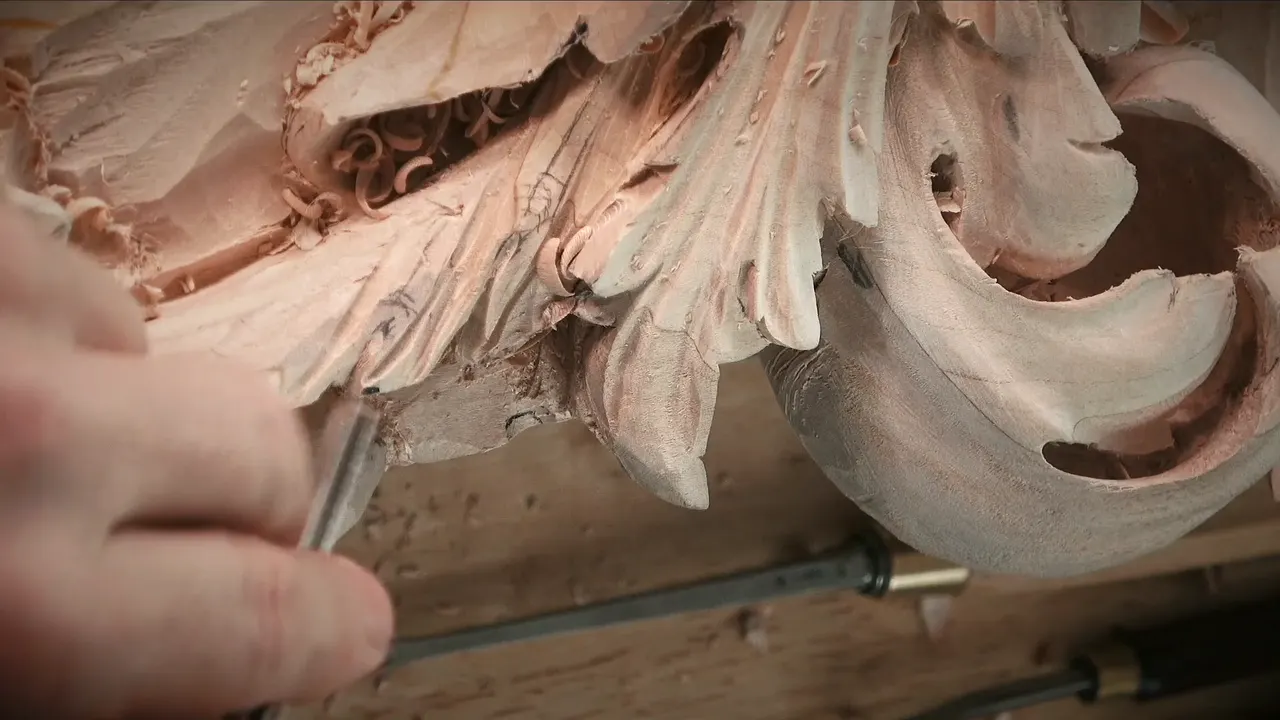

In part 9 of workshop 64, I said I needed to make a transition kind of smooth, and in the next breath I said I did not really care. Further on I said "I really need a smooth transition." Other lessons carry the same words.
Below is that spot in context, with the carving that came before it. After it come the lessons where I let a pass or a spot go, and the lessons where I held on to a smooth transition or a clean cut. See wood carving and shadow on Wikipedia.
What came before the words?
The part opens with "Careful, go down all the way down." I did not want to slip. Right after, I said maybe I could "excavate little deeper right here," and that one more spot "could be little deeper, too."

I asked why I was doing it that way. The answer was shadows: "I'm really after shadows."
My plan was a back bend, "number five sweep and six millimeters," and right after it, "Quarter inch." Six millimeters is 0.24 in, and a quarter inch is 6.35 mm. My plan was to hit the pipes with it. A deeper cut was a thought too: "I could use a little deeper cut. I think I should. And I will." The result, I said, would be "a beautiful movement, beautiful motion for the human eye."

The convex came next, with a little cleaning: "And convex it. And clean it little bit." Only one side was done: "I've got the convex on this side, I did not do yet on that side." For the other side, "I have to concave upward," and that is "going to pop really beautiful shadow in this area." Extra frame, I called it, "if you wish."
How did the transition come up?
First, a tool. "Let me use a number nine," I said, and next, "this number nine is dull now. My favorite number nine is dull." Using a different one was my plan, and I could use "actually number eight." In the end, "Well, I'll use nine." The full lesson is workshop 64.

I told you I was "kind of breaking rule," because I could not attack from that side. I said everything was in my way, but "the tool must be super sharp." A micro tool came next. "That's actually giving me a nice cut."
And here is the line: "I need to make that transition kind of smooth. Well, actually I don't really care." The next words were "Maybe I should just leave it," and then, "There is an extra line left from tool mark."

"So I took care of one of the sides of this pipe," I said. Next: "Now we're going to take care of other side."
Did I care about anything on the other side of that pipe?
The tool had to change, I said. My reason is in the following line: "Again, because I'm carving against the grain my tool has to be super sharp." I grabbed "number two and a six millimeters," which is 0.236 in, and said "Maybe I just have to touch it up little bit, sharpen it."

"I stropped a little bit," I said, and I fixed myself right away: "Actually, I did not strop it. I did hone it on a 6,000-grit sandpaper. That's what I did." About the edge, "I didn't want to round this, so I really needed a really super sharp edge." See sharpening and sandpaper on Wikipedia.
"Looks like it works really good, okay, wonderful," I said. Next, "So I round it, I can eliminate that middle, get it somewhat clean." The pipe "is going to go all the way," I said, and "that is the goal."

With the same tool, I planned to "create that type of effect." I called it "like a concave," then, "Well, convex. I apologize." About the direction, "it's going downhill," and there's "going to be also maybe concave or convex. Let me think." Deeper excavation was on my list, "probably deeper excavation right there."
"But my goal is to create a really smooth transition like that, okay? So follow that form, go up, but really slowly." The same idea is here, I said, a convex before the concave.

Now I could work on a concave on that side. "Okay, let me think which one," I said, and my size was "Maybe one-eighth of an inch. Three millimeters." An eighth is 3.2 mm, and 3 mm is about 1/8 in. The orders were "clean little more" and "clean this side also."

"I really need a smooth transition," I said, and next, "I don't need too many lines right here, okay?" Then, "I need smooth transition, really need smooth." Fitting inside was the limit: "number 11 will, but not number eight or number nine."

The last lines are "Carefully right on the side of that pipe" and then a plan, "Going to recreate that cut."

Does Venice Room 30 have a cousin of it?
The workshop 30 lesson has it in part 4. "The only reason why I like to use number 11 because it gives me really nice smooth transition," I said. The turn follows. In some spots the transition did not matter to me, and my line was short: "All I care about is just the deep shadow."

Next came a back bent: "I need to use a back bent again and get little deeper cut right here." A plan followed, "later, what I could do, and that's probably what I will do, I could connect very much two sides," and a stop for the moment, "Okay, let me leave it like that for now."
Earlier in that part I said "the only reason I'm doing it is just for the shadow." My tool there was a "number 11 spoon" at "3 millimeters" (0.12 in), and "hook out whatever the mess I just created." On depth, I said "I could actually go really extreme, but I don't need to."
A little later, "it doesn't have to be number 11, it could be number nine, number eight, number seven," and "Even sometimes number seven will work even better."

Can a cut be less clean if the next step covers it?
In the Greek Acanthus lesson 2, part 3, I said "It's always better to work against the grain, just like that." Then, "Of course, it's not going to be looking as clean, but who cares?" Next, "Because we're going to undercut anyway later on."

Later on I warned, "Be really careful also when you're going toward the areas when you have a detail too small," and "finish before you hit the wall." One more line is "I do know it looks messy," and I said it would not look messy once it was done.
Workshop 77 has a scroll saw in it, in part 2. A scroll saw was an option, I could take it "to a scroll saw. Why not?" plus a question, "Can I change the blade right now to a spiral blade?" My reasons follow: "I usually don't like the spiral blade, but in this case, I did use the spiral blade because it's, like I said, I don't care about how clean the cut I'm creating." The rest of it: "it's a lot easier to create the movements without changing the position." The tool is the scroll saw on Wikipedia.

Before the blade change I had said "I don't have to be a really straight line," and "There's absolutely no reason." Later, "That's the result, what I'm after," and from it, "I can work right now my details and all the waviness."
Does grain direction matter on a piece that gets painted?
The Venetian Flowers Rosette lesson 1 opens part 2 with "I've got my stock ready, a couple pieces of wood." Then, "You can see probably the grain direction running this way." It was "just the leftovers from other parts," and I didn't want "to use the new board."

The piece was to be painted gray, I said, and "really, I don't care about the grain direction as much." On the outside I already had a molding, "just a normal Roman ogee," and "I used router." See ogee and grain on Wikipedia.
I even said, "Yes, I cheated little bit because I need to finish this project, and I can't afford of losing time, not anymore at least." After that, "the profile is simple."

Did I ever say the opposite?
Yes, in part 3 of Carving Plate with Butterflies lesson 10. "This spot I need to cut a little deeper and I don't want to rush it," I said. After that, "I don't want to see that flat. Okay? So I want to do slanting a little bit. Not much, but a little bit."

About that, I said I want to see it because of what it does to the shadow. Then, "I think it's going to look really good just like that. And that is what I'm after. I care how it looks, see that slanting?"
The same workshop has words close to it in part 8: "Because I need that shadow. I really need that shadow." Only about maybe three millimeters were left in that spot, which is 0.118 in, and "that would be a big mistake." Before that I had said "I can actually now connect those two cuts," and then, "I said previously I don't have to, but anyway, I already did it."
Over in part 10, "I really don't need that ridge, and I'm going to just blend it." Then, "maybe I could create more exaggerated concave on this side."
That part holds a line about the details I love: "I really love those details," and "Not simple stuff." Not too much movement was my plan for that piece, "because it's more Venetian style." The French, I said, "took it to extreme," with "Beautiful movements."
What about a flower I did not like?
Grinling Gibbons Maine class 15 starts part 1 with an area I did not like. Further along I called the flower "Childish," and said, "Okay, so I really don't care how it looks and I want to make changes also." See Grinling Gibbons on Wikipedia.

I also said that part was "not really really interesting to me." About "replicate original work," I said "Can express yourself," and "you can probably just get some more details and even potentially make it little better."
Near the end of Maine class 14, part 3, I said "we still have to attack few flowers, which I kind of don't like even now this flower." Then, "Maybe we're gonna develop something else this flower." The word "care" is in the line right after that one.
And when other people do not care?
In part 2 of workshop 30 I talked about other carvers. A lot of them would leave a hole as it is. "They don't really undercut too much," I said, and only wood carvers will see it. They do not really care about it. "Which I think it's okay," I added, "it's just a business standpoint. They have to make a living."

In workshop 39, part 10, I said some people do not care if they break anything. "All they care about how much work they've done in one day." My own side of it: "of course, it doesn't mean I don't care how much work I've done, but between the quality and speed, I would still probably choose quality."
The relieving cut comes up in workshop 50, part 7: "relieving cut, even if it sounds funny for some of you." The name does not bother me, I said, and "It's just the right thing to do."
Which nine parts carry the line?
The table below lists nine parts, the spot in each, and what I said there. Where I named a size in millimeters, the inch figure sits beside it.
| Where | Spot | Said |
|---|---|---|
| This part, 64.9 | A transition on one pipe | A tool mark could stay, and later I asked for a smooth one |
| Venice 30.4 | A transition in some spots | Only the deep shadow mattered to me there |
| Greek Acanthus 2.3 | How clean a cut looks | It was to be undercut later on anyway |
| Rosette 1.2 | The grain direction | Gray paint was coming for the piece |
| Scroll saw, 77.2 | How clean a cut is | The movements came a lot easier that way |
| Butterflies 10.3 | A spot left flat | I care, and I wanted some slanting |
| Gibbons Maine 15.1 | One flower I disliked | Changes were what I wanted there, and I called the flower childish |
| Before it, 64.8 | A shadow I really need | Only about three millimeters were left in that spot |
| After it, 64.10 | A ridge I did not need | I planned to blend it, and maybe add a more exaggerated concave |
Where can you watch the full videos?
Every lesson named above is inside one of my courses. This lesson holds all of workshop 64, and workshops 62 to 73 are in Venice Room Part 6. The gouge, bevel and relief pages linked here are for reading. To watch the full videos, start here.
How it's done
- Ask what the cut is for. I asked why I was doing it that way in part 9, and my answer was that I am really after shadows.
- Pick a sharp tool. Everything was in my way, I said, but a super sharp tool was a must.
- Name what you let go. I told you one transition did not matter to me, and then I said I might leave it.
- Name what you need. Later I asked for a smooth transition and fewer lines.
Frequently asked questions
Which tool did I pick for the second side of the pipe in part 9?
A number two in the six millimeter size (about 1/4 in). The first tool would not work there, I said, and the grain called for a really sharp edge.
How did I sharpen it?
Stropping came first, I said, and I fixed myself: I honed it on a 6,000-grit sandpaper. A rounded edge was not what I wanted, which is why it had to be really super sharp.
Did grain direction matter in the rosette lesson?
Not as much, I said, since the piece would be painted gray. The stock was leftovers from other parts.
What did I say about a clean cut in Greek Acanthus lesson 2?
What to carve next