

Alexander Grabovetskiy, woodcarver, School of Woodcarving · Published 2020
What does a wood carver mean by "I know for a fact"?
Quick answer: In Venice Room 64.10 I used "for a fact" about the big difference a half millimeter would make to a dark spot, with a number 11. Other lessons use the same words about depth, height, a straight line and the history of carving.
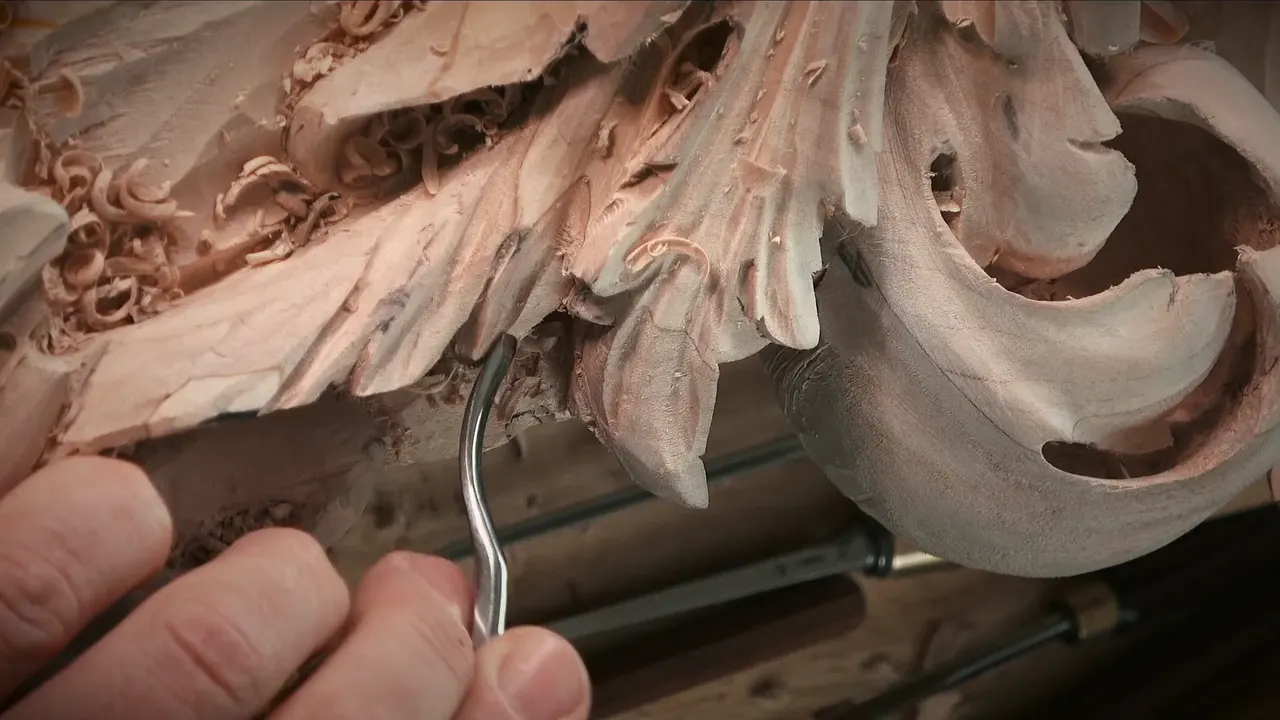

In part 10 of workshop 64, I used the words "for a fact" about the big difference a number 11 at a half millimeter would make to a dark spot. Other lessons carry the same two words, from a depth on a furniture panel to glue on a small flower.
The spot sits near the end of the part. A run of passes with a back bend comes first, and a few lines about how dark the spot turned out follow it, with the other lessons further down. Wikipedia covers wood carving and shadow too, for anyone who wants the background.
What came before the words in part 10?
The part opens with "Are you able to see? Now I'm going to do exactly the same, what I've done before right here." Next, "Don't pay attention right here yet." A back bend was one option: "I could probably just hit that with the back bend," and "move it downhill because I need that movement down."
Another thought was a micro tool. Blending was a plan for later: "later on, I'll just blend that cut, but it's still not the end, I'm still going to do micro separations, by the way."

Rounding came next: "I'm carefully kind of rounding everything up, see? Little by little, just not forcing anything." A need came next: "Got to stop around this side first of this pipe." Then "now I have to attack left." A pencil mark was part of the plan: "get rid of that pencil mark and carefully attack that side."

A judgment followed: "Okay, and that's good, except I just don't like that point when casting the shadow." A "more pronounced half-round pipe" was one idea, with "maybe number nine almost" to "hit little bit the sides," a "number nine back bend, I mean." The warning was "kind of dangerous because it's against the grain on one side." So "I got to stop, don't want to overdo it," and the verdict was "Okay, that is good, that is actually really good." See grain on Wikipedia.
A ridge came up next: "I really don't need that ridge, and I'm going to just blend it." A thought about the concave followed: "maybe I could create more exaggerated concave on this side," "just to give extra pop." Another line was "got to be mindful about my material, how much material I have."

Further on I said "It's actually beautiful detail, I really love those details," and "Not simple stuff." About the movement, my plan was not to do too much of it on this piece, "because it's more Venetian style." Then, "French people took it to extreme, beautiful movements, it's what they did, gorgeous movements." See Venice on Wikipedia.
My next tool was still a plan: "now I need to use maybe number eight, number eight and little bigger, about half an inch, I would say." Half an inch is 12.7 mm. The reason I gave was "Because I really need to pop that pipe."
The eyes were next on my list: "Yes, I did not divide yet anything, but I will, absolutely, I will, first of all, I need to excavate a little more pronounced eyes." Then, "as always," I planned to "relieve it first," with "one and a half millimeters, a sixteenth of an inch, number 11, of course." A sixteenth of an inch is 1.6 mm, and 1.5 mm is 0.06 in. "Carefully going to go downhill like that."

A knife was an option after that: "just like that." Next, "I've got another section," and "I need to get some dark spot, so I need some shadow." For it I planned "Half a millimeter, number 11, of course," which is about 0.02 in. See millimeters and inch on Wikipedia.

What came right after the words?
The line is "And if you would ask me if it's going to make a big difference, I know for a fact it will. It will." Next, "Without even make my, well, not my eye of acanthus wider, I'm able to create a really dark spot. See how dark it is, isn't it beautiful?" The part ends there.

How did parts 9 and 11 treat the shadow?
Part 9 has "I'm really after shadows." Near its end come tools that will not fit: "So number 11 will, but not number eight or number nine." In part 11 the same number 11 comes back as "a tool of choice now," and with it I thought I could "get small notch cuts, not big, just the small ones."

What did I say in the Furniture Panel lessons?
Lesson 16 has the words, in part 10. I said "for a fact it is close to the 90 degrees." Next, "now I need to chop just straight down," and "a straight line." I planned "a little bigger inch and a quarter double bevel, number one," and an inch and a quarter is about 32 mm. See bevel on Wikipedia.
For the start I said "probably with number five." After a "Nope," came "Let me try number two," and then "Yep, number two is perfect here." Later in that part came "That's exactly what I want to see." I put "for a fact" on the depth: "it's for a fact, it's the same depth in this area."

Chips open part 5 of lesson 17 in that course. The words were "keep those chips, okay? Just in case if there is another spot with a crack, so I can always use those ones." The next words were "for a fact that this is a really nice straight line, beautiful."

Lesson 15, part 12, has me floating an idea about grinding "a heel part," so that something would "travel only on that section," with "a lot more maneuverability." And "I never saw anybody, I should say, anybody who done it, but I think it makes sense." Afterward came "for a fact," and "that is equal depth to this one."

A final pass sits in part 4 of lesson 19: "Let me just final pass with the grain." "There is absolutely no tool marks left," and "for a fact it is the same depth because I can see that, okay?" Afterward, "take care of this, which is going to be only 1/16 of an inch depth," about 1.6 mm.

What about the rosette and the molding lessons?
"I'm not forcing it," I said in lesson 2, part 1, of the Floral and Molding course, "trying to just dig in slightly, but without too much force." The words "I don't really want to take too much material at once, no reason to" came next, and then "for a fact that surface is absolutely the same height." For small spots, "we can take a lot smaller blade if you do have different blade options on a router plane."
A warning comes in lesson 4, part 2, of that course: "I want to make sure I'm not undercutting, so that would be a big mistake if I would just place it and just go like that." The advice was "just make sure you're just doing the 90 degrees down." I also used "for a fact" about "this part," which would be lower, and "I need to measure again." And "Let me get again, my pointing machine."
In lesson 3, part 2, of the Venetian Flowers Rosette course, I said "It looks really beautiful and just gets a beautiful shadow, and from above, it looks actually awesome." Next came a plan for "little more curvature" in some areas, and "once we're going to undercut, it's going to look even better." Afterward, "I know that for a fact, those are not the first flowers I make, and I've done a lot of flowers."

Which other Venice Room workshops have it?
Workshop 82, part 7, has "I think it's looking more or less uniform." Another spot was an option: "I can also create prolonged cut in this section and this area, too." It would be "really good once it's done," I said, ending with "for a fact."

A spot confused me in workshop 79, part 8: "I don't really understand what is going on right here." I needed "to figure out what I did because" "for a fact this section has to go down also, and this section." Afterward, "it is kind of deep, going all the way to that point because it has to repeat the shape."
Over in workshop 77, part 7, I put "for a fact" on how something would look. Then, "For me, probably it's a good idea not to rush it, not to rush it whatsoever because that would be a big mistake."
Tools show up in workshop 21, part 8. For one job I named three: "I could clean it with the small number 11, or number nine will work, number eight will work." Then, "Multiple tools, actually, can do exactly the same operation." If I listed all my tools, I said, I knew "for a fact" you would not buy them, because "they're going to use lots of different sweeps of the same tool." My example was "different sizes of the same sweep, let's say number 11 from half a millimeter all the way to 30 millimeters." That runs from about 0.02 in to about 1.2 in.
Rasps come up in workshop 24, part 6, and I said "For a long time, I tried not to use rasps or even buy them." I thought "it would not be authentic to the wood carving world, but it's not true." I went on, "for a fact that other master wood carvers, they're using those tools, they're using rasps." And "I don't think it's anything wrong with that."
And in the Lily Box, Roman Acanthus and beginner courses?
In Lily Box lesson 11, part 6, I said "I'm pretty sure it's not going to be as obvious, okay?" and "for a fact, actually." Next came "Let me just lower this down a little bit, slightly," and "bring this one downhill like that," then "just give that a more round movement, because you're going to see that from the sides also, so it cannot be just the two dimensions."

Glue comes up in lesson 12 of that course, part 3: "I could actually glue this one in place pretty much right away and clean that right in place, that way, I don't have to hold." Dowels came next: "I don't really need to do any dowels with this small, tiny flower." Afterward, "for a fact" and "no problem just to put some glue." If it squeezed a little, "I am absolutely okay with this squeeze-out."

A curl is the subject in lesson 5, part 2: "Be careful when you're working on those curls, it's really fragile." Following that, "for a fact that I don't have any glue underneath, because if you remember, I glued only center line, so it makes it even more fragile." For the curl, "logically I have to give a radius to that side," and "I need a small gouge, and I'll use just a number three." See gouge on Wikipedia.

Old carvers open part 5 of Roman Acanthus lesson 13: "for a fact in history, there are different types of wood carvers." My list went on, "it used to be boat carvers, they would carve for the big boats in the 18th, 17th, 19th century, there were other carvers outside carving for the vehicles, and there were inside carvers for the houses." See boats on Wikipedia.
Roman Acanthus lesson 7, part 4, has this: "The true master can use only one gouge, and I've done it." Then, "But it still limits you." My example was "for a fact the famous wood carver, which is one of my, should I say, heroes in the wood carving world." That carver "constantly would collect the tools, and you can just see the progression of the designs and ability to execute much more complicated work, what he couldn't do before he got some tools."
The beginner Curly Kitchen Cutting Board course has the words in another order, in lesson 16, part 2: "Now, for a fact, I know that is deep enough," and then I planned to rotate and repeat it. A warning follows on the end grain: "I would not suggest you do a couple cuts right away, because you can snap the grain, you can just snap it and break it."
Which lessons carry the words?
The table lists eight spots, the lesson for each, and what I said there. Figures in millimeters sit beside the inch figures above.
| Where | What I was looking at | Said |
|---|---|---|
| Venice Room 64.10 | A dark spot made by a number 11 tool | Big difference |
| Furniture Panel 16.10 | A spot just before the plan to chop down | Close to 90 |
| Furniture Panel 19.4 | A final pass with the grain and no tool marks | Same depth |
| Floral and Molding 2.1 | A surface where I was not forcing it | Same height |
| Venetian Rosette 3.2 | Rosette flower still waiting for its undercut | Looks better |
| Venice Room 24.6 | Rasps, a tool I once did not want to buy | Others use them |
| Lily Box 12.3 | Plan to glue one flower in place right away | No dowels |
| Roman Acanthus 13.5 | Old carvers for boats, vehicles and houses | Different types |
Where can you watch the full videos?
Every lesson named above sits inside one of my courses. This lesson holds all of workshop 64, and workshops 62 to 73 are in Venice Room Part 6. The gouge and bevel pages linked here are for reading. To watch the full videos, start here.
How it's done
- Relieve the eye first. My plan was to relieve it first, as always, with a number 11, one and a half millimeters (about 0.06 in).
- Go downhill. Go downhill with care, I said.
- Pick the small tool for the dark spot. A number 11 at a half millimeter was my plan, for some shadow.
- Look at the spot. I was able to create a really dark spot, I said, without making the eye of acanthus wider.
Frequently asked questions
Which tool did I plan for the dark spot in part 10?
A half millimeter, number 11 (about 1/50 in), for a dark spot and some shadow, as I planned it.
Where do the words about 90 degrees come up?
In Furniture Panel lesson 16, part 10, the words were "close to the 90 degrees." I added that I needed to chop straight down, and I found number two was perfect there.
Which lesson talks about dowels and glue?
Lily Box lesson 12, part 3. Dowels were not needed for that flower, I said, and glue would be no problem.
Why did I avoid rasps for a long time?
What to carve next