

Alexander Grabovetskiy, woodcarver, School of Woodcarving · Published 2020
What does a wood carver mean by "I don't know yet"?
Quick answer: A line I said in Venice Room workshop 73, part 11, over the eye on my carving. I asked "Should I do that or not?" and named another way for the eye, "this way, and that way." Later I said "I'm going to do a bigger eye" and "Let me use 3 millimeters" (about 0.12 in).
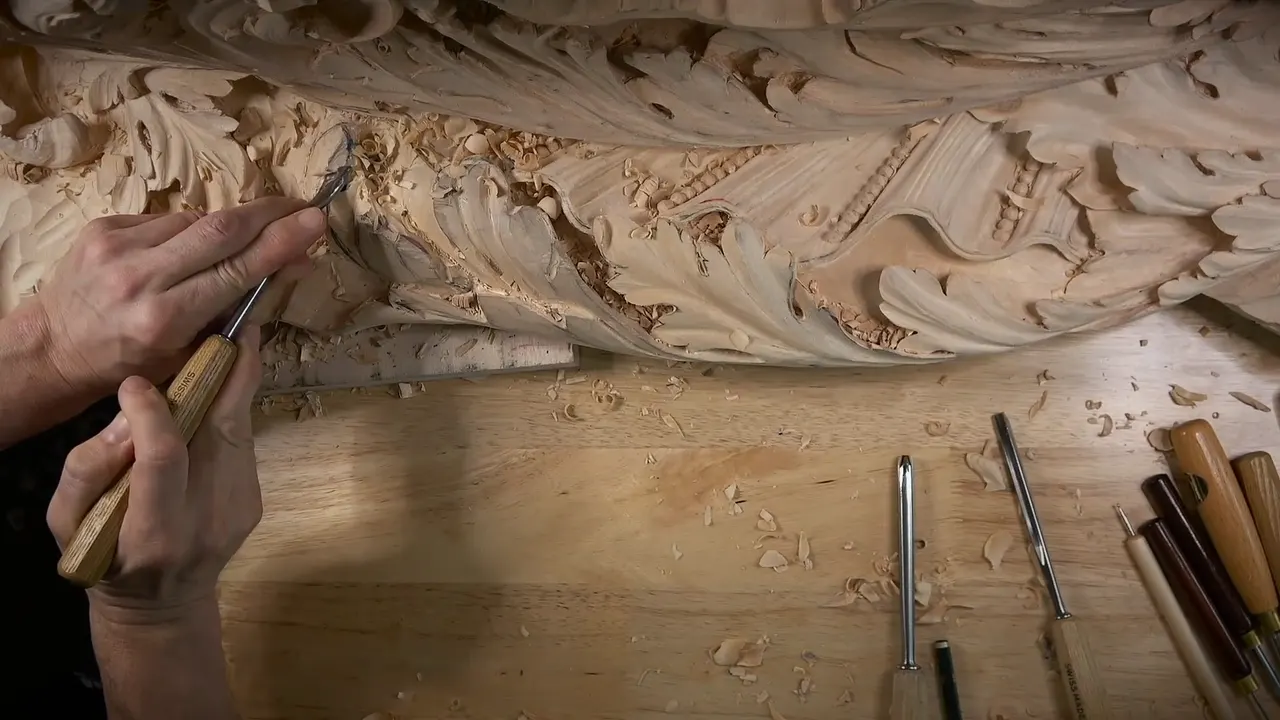

I said "I don't know yet" in Venice Room workshop 73, part 11, with a number 11 gouge in my hand and an eye on the carving still to decide. I say the same words in my Furniture Panel, Lily Box, Grape Onlay and vase lessons, and in other Venice Room workshops.
Ever stood at a carving with a tool in your hand and no answer yet? Did you keep working anyway? Come through part 11 with me, then through the lessons where I said it out loud, and see what I did next each time.
What did I say about the eye in part 11?
"So I want to see that eye, but I don't want to see that big opening," I said. Right after those words came "Should I do that or not?" I gave myself another way: to bring the eye "this way, and that way create something really nice," with "extra separation right there." I added "Maybe that's what I have to do."

Before any of it, I needed the whole view. "I need to see that in the overall how it looks, right?" Then came the pencil lines. "I got too many marks, pencil marks," I said, then "I need to take out those pencil marks, and you will understand much better what I'm talking about."
About the movement, I thought it would make a lot more sense, and that there would be an eye. Next came a plan for the tool, "just 1 millimeter right now and start little by little" (about 0.04 in), and a word on depth: "I don't need too deep excavation in this area, but just something."

The question came back. "I really don't know if I should do, and I probably should do a much bigger eye because this curvature, it does not look good yet." Then my answer, in my own words. "Yep, I'm going to do a bigger eye. Let me use 3 millimeters" (0.12 in), and "3 millimeters, number 11, of course."

The last lines of the part were plans too: "I can blend in with the same back bend," and "maybe even bring that little this way," followed by "create curvature like that." I gave the curvature as my reason for a bigger eye.
What was I sure about earlier in the same part?
Plenty. The part opens with a plan for "exactly the same on another side." A bit later I said "I've got an overall movement, and now I can work probably again with the number 11," then "remove whatever I don't need to see."

On the tool, "a little too small. That was number 11.5, but I'll take 10 millimeters" (close to 0.4 in). I needed a gradual transition, convex to the concave, and I said "I don't really need the really sharp concave." Then "That is actually really good. You can already probably detect that movement. Yeah, I've got lots of junk in it, but that's okay."
After that I said "let me figure out where the end" of the movement sits, and said it was probably "somewhere right here." Then "all that is just waste," and "I safely can dig this out."

For that job I said "I'm using number 11 and 5 millimeters, 3/16 of an inch." Then "Or pretty close to 3/16 of an inch because it's not exactly like it's marked." Worked out, 5 mm is about 0.2 in and 3/16 in is about 4.8 mm, so the two figures sit close together.

Then the open spot: "I need to make the decision how this part going to look." As a whole, I said "I am somewhat happy with overall development," and that "this part could go downhill and develop something else."
Did parts 10 and 12 carry the same doubt?
Part 10 opens on a plan for depth, "less excavation, much less," and "much deeper excavation" the closer I get to the end. Then it asks the question straight out: "Am I doing the right thing? That's the question I have." Part 10 also has "I still have doubts if I'm doing the right thing." Earlier in that part: "I have to be really careful when I'm approaching my main body."

In that part I named tools out loud: "just the number 11 now. But I'll use, let me think, maybe five-eighths of an inch. Or maybe no, maybe I can use just about half an inch, about 12 millimeters, number 11 veiner." Then "I probably should use even smaller. Maybe even just a seven millimeters." For another spot I said "I'll take a number five and half an inch back bend" (about 13 mm). (12 mm is 0.47 in, and 7 mm is 0.28 in.) Why smaller: "I can always clean what needs to be cleaned," and that way "a lot less resistance."
In part 12 I named a smaller tool, "number 11 and 7 millimeters, a little bigger than a quarter inch" (0.28 in). And I said "I think it looks good, but a lot of small details. I need to do something inside right here, too." About one section, "That is going to be right on the ceiling." On thickness, "Got to be careful." Then "Don't have too much thickness left, not much material left."

How did it sound in the Furniture Panel design lessons?
In lesson 8 I was working on the design, with my negative space on my mind. The words came out, and I went on: "it doesn't feel really good because everything else just goes to the narrow."

Then what I said I had to do: "fix this and make law of repetition," narrow to wider, "even on negative space." The next lines were about the space: "Then I kind of unite this space and I unite the movement." And "Hope it does make sense."

In lesson 17 of the carving stage I was giving depths, and said "five millimeters deep" (about 0.2 in). Between two lines, the same words returned, and I went on: "so I have to make the decision yet." Why different depths: "it would be more authentic because if you look at 18th-century panels, you can see a lot of times different depth in different areas."

Lesson 11 of the design course has a shorter version, "how it's going to develop yet." Straight after it, "I kind of like the idea of repeating the details everywhere." Later, "I think that is a good development, but I'm still not too happy because I still would like to unite maybe like that those two details, this and that."
What about wood that can still change on you?
Lily Box 7, in part 13, has me naming a tool I might start with, "the number nine and a quarter inch" (about 6 mm). Those words came again, with "because I do have lots of voids in wood."
I weighed a fix. "I could use super glue and fill it, those voids." Next, "I don't know if I should or not. We'll see later on. If I don't like how it looks, I'll do that." And "maybe I'll just use plastic wood." And one more way: "if I would use hide glue, then I would just mix some of the chips together with the glue and just fill it." My word on it: "hide glue is not as stable. Of course, it's just my opinion, okay?"

The eighth Lily Box lesson, part 3, was about cracks. "I have a lot of cracks inside of the wood, and one of the micro crack I see below right here, the main leaf." Whether it runs on inside the wood, I said, "I just don't see that on the surface." On the crack drying more: "that, I kind of afraid of."
A finish was one idea. "If I going to apply some kind of stable finish and penetrate that with a stable finish, we'll see." My words came again, and I gave a reason for the finish: "stabilize the movement, and wood is not going to move too much."
What did I leave alone in the onlay and the vase?
In Grape Onlay 6, part 1, I said "I am not gonna touch my left hand side leaf." The shape is why: "what kinda shape I gonna give." And on the leaf: "I did not finish this leaf yet, but it has a curl, it just curls back." The curls came next: "I'm gonna introduce those curls," and "all around."

Then, "that is why I am leaving a wall. So I'm not doing anything to this side yet." The first vase lesson, in part 12, had me talking about the background. "I think it's going to be ebonized," I said, repeating those words and adding "Maybe I'll change my mind."

How does it sound in other Venice Room workshops?
In workshop 56, part 2, I said "Going to create a little bigger opening for the shell." Next, "Maybe shell," and I might "stick something else there." Same words again. Then, in one run, "Or maybe shell, why not, why not, maybe shell." The section had "a lot of empty space," I said. Then "I do not want to lose my movement, but I also want to do a division."

Workshop 26, in part 2, has me making a shallow concave: "I could actually create a deeper concave if I wish. It would look also really nice." For the ridge, "To raise it even higher, this ridge. Do I need to?" Same line again, and then "let me take this concave all the way here." My pipe was getting lost, and "I'll be able to fix it."

The background in workshop 9, part 10, needed work: "I need to clean my background. It just doesn't look too good." I did not want the background too deep, "because I still want to make some really good development of acanthus somewhere right there." The same words came before "how deep," and then "But little bit of cleaning, not going to hurt."
In that same part I said I could just use a straight gouge and then undercut, "and that would create a really sharp transition. But I don't want to do that." Instead I wanted "really smooth transition for a couple of reasons."

In workshop 88, part 8, I said I have to "lower down the whole thing," and an extra detail was "growing from underneath," and I said maybe I would get rid of "this one." I used the same words once more, and then: "for now, I'll just concentrate on creating the main shape, so that way I'll be somewhat close to the final design."

Over in workshop 97, part 9, I asked "how deep do I want to go?" My answer began with the same words, then "Maybe about quarter inch or so," and "Six millimeters or so." A quarter inch is about 6 mm. After that I would take "number seven again" and blend it. Still in part 9: "I don't need to worry about this. That's all waste. I can just probably excavate that."
Workshop 140, in part 1, has the same words too. Of two acanthuses I said I thought to do something different with "those acanthuses," and added "I don't have enough depth."
Where does each open question sit next to the others?
Each lesson here, what I had not settled, and what I said next.
| Lesson | Open question | Next |
|---|---|---|
| Venice Room 73.11 | The eye, but not that big opening | Bigger eye |
| Designing Furniture Panel 8, part 1 | The negative space | Make law of repetition, narrow to wider |
| Furniture 17.1 | What goes between those two lines | Make that decision |
| In Designing Furniture Panel 11, part 4 | Its development | Not too happy, unite two details |
| Lily Box 7.13 | Whether to fill the voids in wood | See later |
| In Lily Box 8, part 3 | The micro crack | Maybe a stable finish, to stabilize it |
| Onlay 6.1 | What shape the left leaf gets | Leave a wall |
| In the vase with grape leaves, 1.12 | The ebonizing | Maybe I will change my mind |
| In Venice 56.2 | Shell, or something else in the opening | Why not |
| Venice Room lesson 26, part 2 | Raising the ridge | Take the concave all the way here |
| Venice 9.10 | How deep to go with background | A little cleaning |
| In Venice Room lesson 88, part 8 | Extra detail | Concentrate on creating the main shape |
| At Venice 97.9 | How deep do I want to go | Quarter inch? |
| From Venice Room 140, part 1 | Those couple acanthuses | Lower the section between those two elements |
Where can you watch part 11 and the lessons on this page?
You can watch part 11 in Venice Room 73. Workshops 62 to 73 are in Venice Room Part 6. The other lessons on this page have their own pages, linked above, and each is open to you with school access. A workshop number means the Venice Room, and every other lesson carries the name of its own course.
Want to hear me say it in my own voice? Start here.
How it's done
- Name the eye and the opening. In part 11 I said I wanted to see the eye but not the big opening, and I asked myself whether to do it or not.
- Look at the whole carving. The overall view mattered, I said, and the pencil marks had to come off so you would understand.
- Start with a small tool. My plan was probably just 1 millimeter right now, starting little by little.
- Choose the bigger eye. The curvature did not look good yet, so I said I would make the eye bigger, using number 11 at 3 millimeters.
Frequently asked questions
What came right after the open question in part 11?
I asked whether I should do it or not, then named a second way for the eye, plus extra separation right there. Maybe that is what I have to do, I said. Before any of it, I said I needed the overall view, and to take out the pencil marks.
Which tool sizes did I name in part 11?
A number 11, which I called a little too small, and then 10 millimeters (close to 0.4 in) as my pick. Another number 11 came at 5 millimeters. My plan was 1 millimeter (0.04 in) to start, and 3 millimeters (a little under an eighth of an inch) for the bigger eye.
Was part 11 full of doubt?
Not all of it. "That is actually really good," I said, and "all that is just waste" after saying where the end of the movement probably sits. I also said I was somewhat happy with the overall development. My doubt was the eye.
What to carve next