

Alexander Grabovetskiy, woodcarver, School of Woodcarving · Published 2020
What does a wood carver mean by "prolong"?
Quick answer: In my Venice Room workshop 73 video I said I needed to prolong a separation, and I use that word in many other lessons, about cuts, lines, pipes and a few shapes. Each lesson is below, with what I said and the tool I named near it.
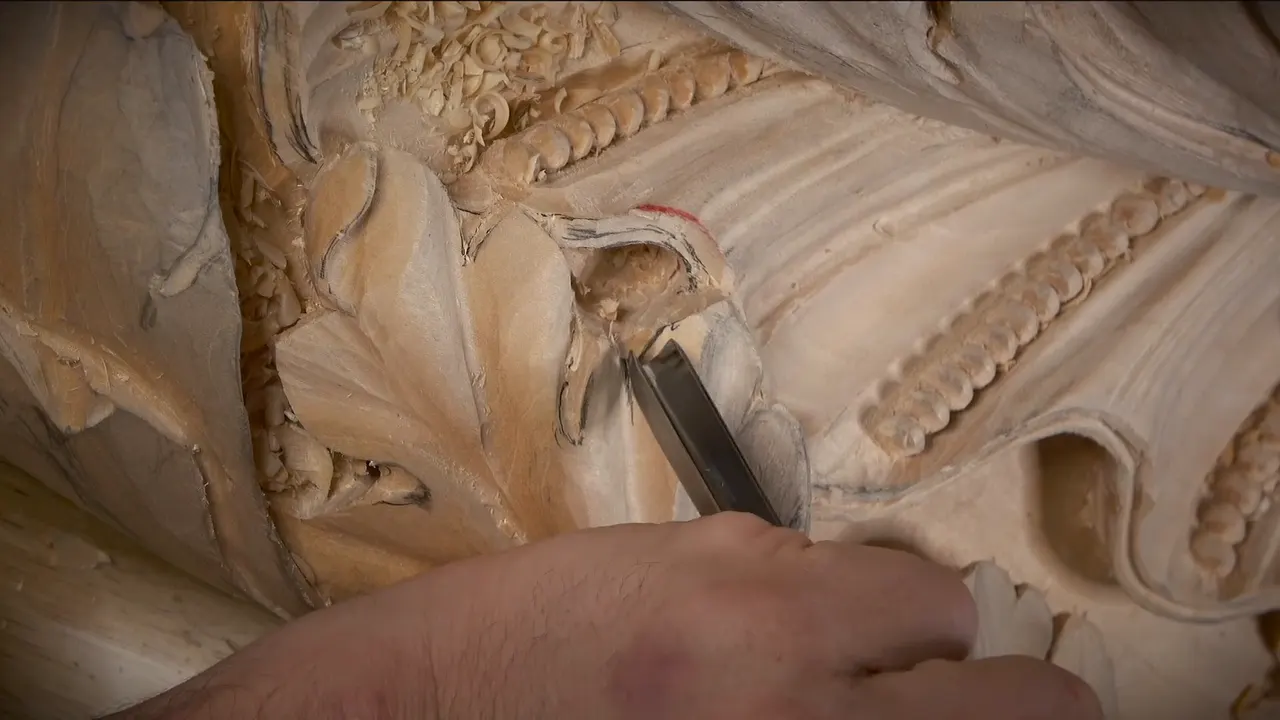

In Venice Room workshop 73, part 4, I had a separation I wanted longer, and I said so. I use that same word in other lessons, about cuts, lines, pipes and a few shapes. Each one is below, with its lesson.
Does a line of yours ever stop a little short? Do you ask yourself how far to take it, and with which gouge? Here is what I said about it in this video, and in my other wood carving courses.
What did I prolong in workshop 73, part 4?
The part opens with "That's not good. Okay, that is good." Then: "I can see that I don't like this separation yet, so I need to prolong it and make it a little longer."
"There is going to be an eye, so I need to create a much deeper excavation," I said, and of the next section, "in this section, I'm much safer." The number 11 "would be probably a little too big, and I should use a smaller one."

Which tool did I name for the curvature?
I named the same number five for the curvature. "Not too quick." "I cannot do that too quick." My plan was "Let me use number five, the previous number five, what I used."

How did I plan to fix it?
"Oh, no, that is not good," I said, and "So I said I have to be careful. I wasn't too careful." Then "It's not like end of the world." What I would do was curl it: "I'll just curl it. It's still going to be visible." It would be okay, and I would go "right to the shell," I said.

Which area did I leave for now?
One area needed my head close to the camera, and "I really don't want to do it," I said. I would leave it for now. The mess on the side: "don't need to worry about it."
What about the section I did not like?
The next section "just doesn't look too good," I said, and about the movement, "I want to keep that movement." "It's really important for me." But it's only overall. As for the flow, "it's really important to keep that flow. So it's like an invisible line going all the way."
Of the section itself I said it "is not too appealing in my opinion," and "it doesn't make too much sense." On an opposite side there is an eye, "and that has to be a symmetry." Then "This is a big eye," and there would be "a lot smaller eye."
For the two eyes I gave an example, and I said I would not get too "mathematical or geometrical." Take "that space and that space" together, I said, "and let's say it would be equal, just as example, 10 square inches, let's say, just example, or 10 square centimeters, if you wish." Then "this part would be about 6 out of 10 centimeters." The other part: "only four parts." That, I said, "would be really pleasing to the eye."

How did part 4 end?
"I think it's more logical," I said, and "if I don't like it, then it's a problem. I have to live with that if there is a problem."
Then the tool: "I'm using 3 millimeters, number 11, of course, number 11 and one-eighth of an inch veiner." That is 3 millimeters (0.12 in), and one-eighth of an inch is 3.2 mm. "And carefully."
One more line closes the part. "I have a limitation, really a big limitation, pretty much. I cannot create the right angle, okay, because that's already my workbench. But it's okay. Little by little."
The next video comes back to it. "Of course, I could pull that piece toward the edge, and then I would eliminate that limitation." I did not want to do it: "Just too much movements."
Where else in the Venice Room did I say it?
In part 1 of workshop 112, I had cleaned inside, and the light was going through. At a triangle edge, with "one millimeter, number 11," I would "prolong that slightly." One millimeter is 0.04 in. "Not much, but a little bit." Next: "It's going to give a little more pop to that detail."

Part 3 of workshop 137 had cuts in it, and my plan was 1 millimeter (1/25 in) to prolong them, then "let me also do 2 millimeter cut right here" (0.08 in), and "I could actually use 3 millimeter" (0.12 in). "Create a little bigger shadow or deeper shadow." A little later, I planned to blend everything.
In workshop 82, part 7, I did not know yet whether I liked it: "Let me actually do prolonged cut right here." I added "I can also create prolonged cut in this section and this area, too." And "that's looking not bad at all."

Part 8 of workshop 83 has "overall, I'm happy with that movement." Next came "Of course, I need to prolong that cut. I mean, this cut. And this cut." Number seven was my plan for "a better outline of this," and then "Numbers 11 and 7 millimeters" (0.28 in), "and I can refine." And "the 10 millimeters on the opposite side" (0.39 in).
A pipe was in my plan for part 2 of that workshop: "I've got a bunch of leaves," I said, and "Everything goes to the center." And "Maybe I can actually prolong that pipe." The pipe would run "this way," and "Even more."

Workshop 95, part 10, has "Get inside of that triangle and move it carefully," and "I will use a small, tiny tool to get rid of this left over." And "with the 1/2 mm tool, what I can do, I can prolong a little bit." Half a millimeter is 0.02 in. Of small separations, "although it's not easy," I said, and "on the end grain just a little bit."

A concave came up in workshop 59, part 12, where I wanted "a little longer concave between," and "right here, too." "That way it's going to look more finished, I would say." A smaller tool was in my plan, "a little later," and "Although it's not that finished look and all, because I still have to work around, and I don't want to make it too fragile yet."

Workshop 37, part 3, has "Look, it's just simple but beautiful, I'd say." Then came "give that movement a little better shape also," and "make this a little longer." I said I think it will look better, too.

Did I say it in my other courses?
Yes. In Carving Vase with Grape Leaves 3, part 5: "wherever I have some separation, not all of them, but some of the separation, I'll take number 11 and 1 millimeter, and I can prolong that." That is 0.039 in. My tool needed sharpening, and "I can do it with half a millimeter." Then "Make it just slightly longer." "Not everywhere, but some spots."

In Hazelnuts 3, part 3, I said "even V tool will work in this area really well," and "See how it gives me the shadows already?" Then "Even without creating full details yet, I still already see some of the shadows." Next: "with the V tool, I'm probably going to prolong those separations." "Not much, but still." I wanted to "overlap some of it," and "I'm not going to go all the way to the center, but still." "Somewhere like halfway or something." About the tool: "You can do it with the number 11s." "And I've done a lot of work with just the number 11s."

In Carving Greek Acanthus Leaf 5, part 4, I said "I do like what I see," and that right between those two leaves, with a V tool, "I might prolong cut just like that."

Can a line be prolonged with a pencil?
Floral and Molding 5, part 2, says it can: "Let me create the line first," I said. "I need my pencil. Make it sharp." "I'm going to just prolong that line." After that a part had to go, and I had a choice: "place my tool straight like that and create just a cut straight down, or I can actually attack this way." Attacking "this way" was impossible, I said: "you can see the grain runs that direction." Attacking from there, I would catch the grain and break it. The other way was "the tool really straight," and a cut "downhill until I hit the line."
Furniture Panel 33, part 1, has "I'm gonna follow the movement of that paddle." Then "Actually I can prolong that almost from nothing and blended somewhat." "I don't wanna make it like screaming."

Furniture Panel 9, part 1, is a design lesson: "I really didn't like what I saw," and "I wasn't 100% happy." Next, "make it longer move," and "maybe I can even subdivide that in a couple more movements."

In the Curly Kitchen Cutting Board lesson, part 1 of workshop 12, I said "Make it deeper," and "about 3/16th down in this case," which is 3/16 in (4.8 mm). "I need to refine this line, make it little longer." A warning followed: "Keep an eye, again, the edge of the knife for it's not digging too deep underneath." And "If you create little undercut, it's okay, too."

What about a V tool in other classes?
Grinling Gibbons class 12, part 3, has "exaggerate that leaf," and "I can create a prolonged concave cuts." "That would be a v tool and I'll just create prolong Cuts." "I mean it's not gonna be as deep, but just to direct the eye." The size was "about six millimeters" (0.24 in), at "couple spots." "See those prolong cuts." And "blend it right underneath." My question was "Can I say that I like it?" and the answer was "Yes, I do."

Class 14, part 2, of the same course had a short one: "I can probably use the same tool and make that cut prolonged." And "obviously number 11 would look much better, but it's okay."
In Venetian Flowers Rosette 2, part 3, the word went to petals: "how this petal going to look in an overall," I said, and "Please don't make them the same." "They all have to be a little different." "In my case, I'm going to prolong them a little bit." "And that waviness." Then "Number 11, like a small one." I added "Make sure you create some kind of waviness on the outside also."

Does the word fit a shape too?
It does, in the grapes lessons: Grape Onlay 2, part 1, says "you have to prolong slightly those grapes." In Grape Onlay 3, part 1, I asked "how I gonna prolong that?" and said "It's gonna prolong this way, okay?"

Over in Hazelnuts 5, part 2, I talked about a nut that "has a prolonged shape somewhat," and said "It should be like an oval." In Grinling Gibbons class 3, part 3, I said "grapes gonna be prolonged slightly."
Which lessons are in the table?
Each row below is a lesson, what I wanted longer, and the tool that came with it.
| Part (Venice Room unless named) | What I wanted longer, in a few words of mine | Tool named |
|---|---|---|
| 112.1 | A separation at a triangle edge, taken slightly and no more than that | A number 11 |
| 137.3 | Cuts I planned to prolong, with three sizes named right after them | One millimeter |
| 82.7 | A prolonged cut, then the same in this section and this area | None named |
| 83.8 | A cut I needed to prolong, and another cut I pointed to | Number seven |
| 83.2 | A pipe running toward the center line, and even more than that | None named |
| 95.10 | Small separations on the end grain, with a tiny tool for leftovers | A 1/2 mm tool |
| 59.12 | A concave between two intersections, with a smaller tool a little later | A smaller one |
| Vase 3.5 | Separations, some of them but not all of them, and slightly longer | The number 11 |
| Hazelnuts 3.3 | Separations I did not want to lose, overlapped about halfway or so | A V tool |
| Floral 5.2 | A line, made first with a sharp pencil, before the part had to go | Pencil |
| Gibbons 12.3 | Concave cuts to direct the eye, about six millimeters or so | V tool |
| Rosette 2.3 | Petals I wanted a little different from each other, with some waviness | Small number 11 |
Where can you watch the full videos?
Every lesson above sits inside one of my courses, and some carve leaves while others carve flowers or fruit in relief. The workshop 73 page holds all twelve parts of that workshop, and workshops 62 to 73 are in Venice Room Part 6. To watch the full videos, start here.
How it's done
- Name what you want longer. Separations, lines, pipes, concaves and petals all had the word in my lessons.
- Pick a small tool. I named a number 11, a V tool, and at times a tiny one.
- Take only a little. In workshop 112 I said it was a little bit.
- Blend it. In the Gibbons class I said to blend it right underneath.
- Look at the result. In Gibbons class 12 I put a question to my own result and said yes, I do.
Frequently asked questions
How much did I take in workshop 112?
Only a little, and it was for a little more pop on that detail.
Which tool did I name in Hazelnuts 3?
A V tool. In that same part I added that I have done a lot of work with just the number 11s.
Which way did the grain run in Floral and Molding 5?
One way was impossible, since the grain runs that direction. For the other I named my tool placed straight, with a cut going down until it hit the line.
Did I check the result in the Gibbons class?
What to carve next