

Alexander Grabovetskiy, woodcarver, School of Woodcarving · Published 2020
What does a wood carver mean by "somewhat"?
Quick answer: "Somewhat" is a word I said in Venice Room workshop 73, part 12, about a section planned as convex and then "somewhat concave", and about a concave I called "somewhat gradual". Other lessons use it before an undercut, a deeper cut, a wave, a raised side and a style.
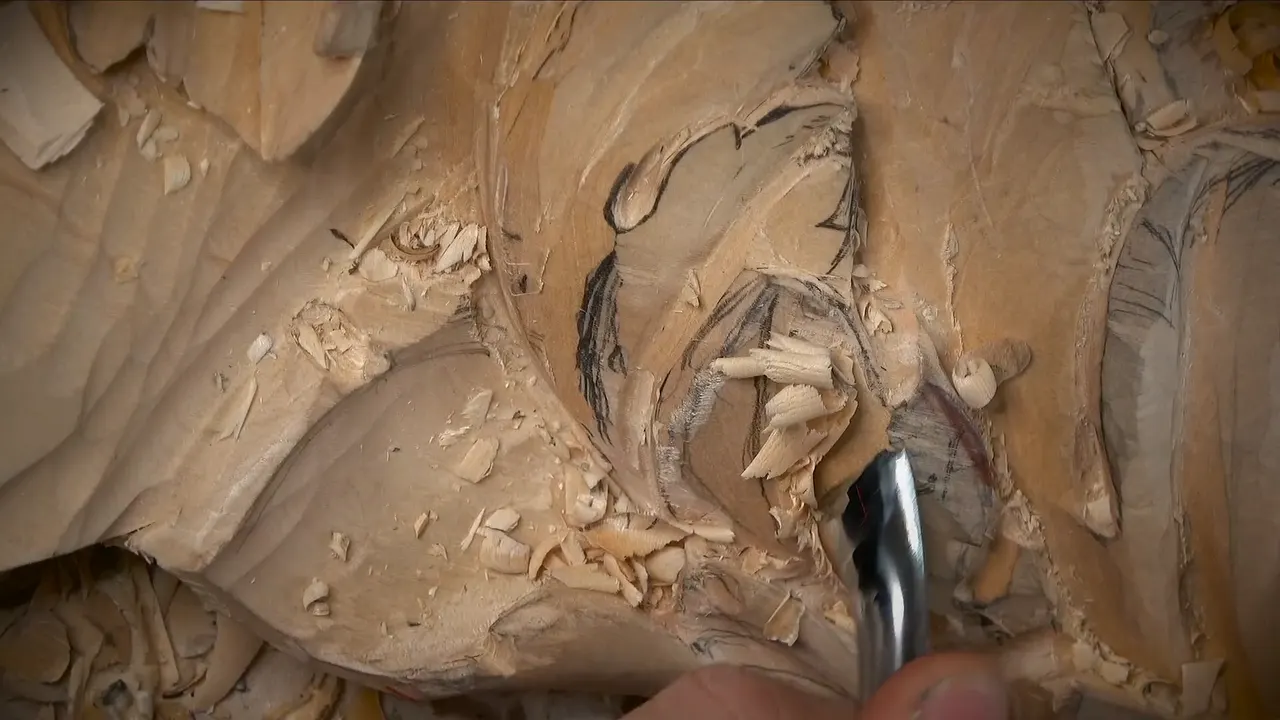

"Somewhat" is a word I said in Venice Room workshop 73, part 12, about a section planned as convex and then "somewhat concave", and about a concave inside another section. In other lessons it came before an undercut, a deeper cut, a wave, a raised side and a style.
Ever planned a pass with the gouge and told yourself it would go a little deeper, not a lot? Did you stop to ask how little? Come through part 12 with me, then through the lessons where I put the same word in front of a shape, and see what I did next.
Before the word came, what was I doing?
"And yes, that way I can actually create this section a little bigger," I said. "It's going to look nicer, and I'm safe now to remove that all the way down. And this one also, the same thing."

Next came the overall look. "I think it looks good, but a lot of small details," I said. Something inside needed work too. Of course, I could attack that section also, and "I think it's a good idea to attack that right away, pretty much."
What shape did I plan for this section?
A convex one, with about the same idea as "what I've done on other areas." Just not a concave there. "I don't want to do a concave on the edge of this, which I've done on the main body, on the main view."
My reason came next. This spot would be visible from different points, right on the ceiling. "I want to make sure it looks really good from all points of view. So that is really important. So that's why I'm going to do a little different from the main body."

Then came the word. The section would still be "the main convex," I said. "And then it's going to be somewhat concave."
For the start I said, "Let me take smaller, like number 11 and 7 millimeters, a little bigger than a quarter inch." That is 0.28 in, and a quarter inch is 6.35 mm. I added, "Although I could start, actually, like I did previously, just with the back bend."
How was the second section planned?
Exactly the same would go on that side, I said. Then "I've got another section with the eye, which means I need to do somehow just a concave on inside and still not lose that section." The same tool was my plan for it.

The word came again. "And that's going to be somewhat gradual," I said, which meant "less cut, less deep, closer to this end." Then, "closer we get here," it would be "much more exaggerated, much deeper, I should say, in a simple English."
After that I looked ahead: "Especially, I'm going to excavate inside later on." Also, "Somehow I need to show to you what I'm doing."
Which tool closed part 12?
A back bend gouge, a number five sweep. "Got to be careful. Don't have too much thickness left, not much material left," I said. "Okay, I'll take, again, number five sweep, half an inch back bend" (12.7 mm), and I would "work my way in."

The last lines were about the grain. "Hit that ridge. Yes, I am cutting against the grain. But in this case, it's the only way I can work." That grain comes back below, in a wavy line from the Greek acanthus course.
Did the word show up in other parts of workshop 73?
In part 1, yes. "All right. So now I'm happy with that, even if I've got somewhat like a concave on inside, but that's okay," I said. One section "does not go to the center line," so I needed to "create the right movement."
Part 11 also has it. "I am somewhat happy with overall development," I said, "except this part could go downhill and develop something else." Both parts are in Venice Room 73.

Which shapes got the word in other Venice Room workshops?
A curly separation, in workshop 62, part 3. "So I've got the eye, and I need to create a separation or division, whatever is the best to call it," I said. "And it has to be somewhat curly. And yes, I will do S curvature, letter S curvature." Part 10 of that lesson has "I have to somewhat repeat on this side about the same movement."

Workshop 70, part 1, has a big convex. My concave would start right there, with the same effect "like a bigger pipe. Not bigger," I said. Then came "the convex will be somewhat kind of big," and "I can actually pre-establish my convex if I wish to."
What other forms got the word?
A rounded body on a butterfly. In Carving Plate with Butterflies 10 I said "I can create the shape of that body somewhat rounded, but for now it's good," and "always refine that little later." After that I planned to attack the wings.

The butterfly course has more. Butterflies 9 has "We're gonna introduce somewhat 3D. It's not gonna be really really really 3D."
A raised side, on a panel with a molding, comes from Floral 12.1: "I can't do it too deep because I do have a molding right there," and "one of the sides has to be a little raised up just like that." My words for it: "the side which is somewhat raised up."

A high spot is in Floral 14.2. I said I needed to measure first, and that I would "keep it somewhat high." Then "I'll still measure it to the highest spot."
Is somewhat wavy good news or bad news?
Both, depending on the lesson. In Grinling Gibbons, Maine class 18, part 3, the idea was a micro tool on the edge. "I can kind of work my edge bit by bit and make it somewhat wavy," I said. "Like I said, I don't really like to see any straight lines." I wanted to "introduce some kind of waviness."

The Grinling Gibbons class has one more line. The wave belonged "on a level of that surface" too, I said.
In the Greek acanthus course the same words meant trouble. "This line not too even, and I'm not really like how it looks. It's somewhat wavy, just like that, and that's not good," I said in Greek Acanthus 11, part 4. "I'll take just the number three and kind of little by little, although I'm doing against the grain, which I'm not supposed to, but I have more control on a flow."

How much is a somewhat undercut?
Little, if I go by my own words. In Acanthus over Moldings 7, part 1, a petal would go underneath the one on the right. "And I can undercut somewhat not much," I said. "My flute is no more than 11 o'clock."

In part 2 of that lesson it comes again, with "I can probably undercut right away," then "Somewhat," then "not gonna do final undercut yet," and "I still have to work on those leaves."
Hazelnuts is another course, lesson 7 in Carving Hazelnuts. The direction of the grain needed care, I said. I could probably "flip my tool upside down with the flute to 6:00 o'clock and start somewhat undercutting." Then "Not much undercutting, but still somewhat." I gave a reason: "much easier for me to see later on what is going on."

Grinling Gibbons class 16 has a placement. "I'm gonna place my tool somewhat in undercutting position," I said in Maine class 16, and "again, I have to be really careful how I create my cuts."
A bigger one is in Venice Room 85. I would have to undercut "somewhat a heavy undercut underneath of this drop," I said. It would cast a beautiful shadow, "at least I'm planning on that." Short of the line, "I'm leaving about six millimeters" (0.24 in). "I think it would be much safer for me to just get clean cut later," I added.

On furniture, in Acanthus over Moldings 9 I said "You really can't do too deep undercut." A deep one is okay with "a smaller half a millimeter number 11" (0.02 in), "as long as you keep the mass of the detail." Then "Somewhat thick I should say then you're gonna be okay."
How deep is a somewhat deeper cut?
Floral 13 gives a size in part 3, "1.5 millimeters" (0.06 in). My plan was to excavate "a somewhat deeper cut." Then "I want to create some shadow."

In workshop 82, part 11, I said "Here is my separation," and "somewhat deep cut, deep shadow." Then "Let me attack that right away." My tool for it was a number 11, 3 millimeters (0.12 in), and I would start.

In Grinling Gibbons, Maine class 11 I said "Maybe let me jump on inside," and "I need to excavate and create. Somewhat deep, you know deep shadow." Then "Maybe maybe I can excavate" right through, to "create a darker spot in this section."

Why was a part somewhat weak and a way somewhat safer?
Grape first, in Carving Grape Onlay 5. "I'm gonna start undercutting," I said, with a number 11 at two and a half millimeters (0.1 in). "This part is somewhat weak." It was twisting slightly to the left, and "there's gonna be a too short grain. So you gotta be careful." Then "But I like that." I thought it was "gonna give me really good look."

Then the side of the tool, in part 2 of Floral 13. Attack "with the side of the tool, pretty much the left side in my case, like a left wing, and carefully just go with the grain until you hit the line." It is "a legit way," and "actually safer somewhat."
Then the reason. "Safer because you don't push anything. With straight-down cut, you still have to create some kind of stress."

Can somewhat describe a whole style?
Greek acanthus, in Greek Acanthus 1, part 3. "In ancient Greece, they would keep it somewhat simplistic and it is simplistic," I said. "I know maybe it looks not that simple, but it's still somewhat simple because later on you'll see we're going to work on a really complicated acanthus leaves, and you will understand why I'm saying it's a somewhat simple one yet."

Style came up once more, in part 1 of Floral 13. Talking about chalk paint, I said "All over Europe, you go to Italy. This project is somewhat like a Venetian style." Right after, I took the word back: "I shouldn't say somewhat. It is Venetian style from Venice."
Did I pull a statement back with somewhat?
In Venetian Flowers Rosette 6, part 2, I said "And that's going to give me the shape I'm after. Yes, it's not the final shape." The transition had to be smooth, I said, the whole way. Then I corrected myself: "Not all the way, but somewhat."
Next came "I'll just smooth everything, just go all around and create somewhat like the shape I'm after." A good idea, I said, "to fillet it at first," with a quarter inch (6.35 mm) number three.
Where does each somewhat sit next to the others?
Each lesson here, the phrase I said in it and the next thing I named.
| Lesson | Phrase | Next |
|---|---|---|
| This video, 73.12 | Main convex first, and somewhat concave after | Number 11 |
| Same part 12, the second section | Somewhat gradual concave | Less cut, less deep near this end |
| Workshop 62.3 | A separation that was somewhat curly | Letter S curvature |
| Room 70.1, where I start a concave | Somewhat big | Pre-establish the convex, if I wish |
| Moldings lesson 7.1 | Undercut somewhat, as a petal goes underneath | 11 o'clock |
| Hazelnuts 7.1, flute at 6 o'clock | Still somewhat undercutting | Same number 11, five millimeters (0.2 in) |
| Venice 85.4 | Somewhat a heavy undercut, shadow planned | Six millimeters left |
| Floral 13.3, the cut of 1.5 mm | Somewhat deeper | I wanted some shadow, 0.06 in |
| Gibbons Maine 18.3 | Somewhat wavy edge, made with the microtool | Introduce waviness |
| Greek Acanthus 11.4, an uneven line | Somewhat wavy line | Number three, little by little, more control |
| Greek 1.3 | Somewhat simple, with complicated leaves later | Keep it simplistic |
| Moldings lesson 9.1, thick detail on furniture | Somewhat thick | Then a deep undercut is okay |
Where can you watch part 12 and the lessons on this page?
You can watch part 12 in Venice Room 73. Venice Room Part 6 holds workshops 62 to 73. Every other lesson on this page has its own page, linked above, and each is open to you with school access. A workshop number means the Venice Room, and every other lesson carries the name of its own course.
Want to hear me say it in my own voice? Start here.
How it's done
- Plan the section. A convex shape came first, with no concave on its edge, as on the main body.
- Pick the small tool. A smaller number 11 was my plan, with the back bend as another way to start.
- Plan the inside. The second section needed a concave inside it, and still not lose that section.
- Be careful with thin wood. With not much material left, my plan was a back bend of half an inch (12.7 mm).
Frequently asked questions
What was to be somewhat concave in part 12?
A section that would start convex. It would be visible from different points, right on the ceiling, so I wanted it a little different from the main body. For the start I named a number 11 at 7 millimeters (0.28 in).
What went with somewhat gradual in part 12?
The concave on the inside of the section with the eye. I said it meant less cut and less deep "closer to this end," and much more exaggerated and much deeper "closer we get here." I needed it without losing that section.
How much undercut went with somewhat?
The moldings course has "undercut somewhat not much," with the flute no more than 11 o'clock. For Hazelnuts the idea was to start somewhat undercutting. Workshop 85 has a heavy one, with about six millimeters (0.24 in) left.
What to carve next
- Venice Room 73
- Venice Room Part 6
- Venice Room 62
- Venice Room 70
- Venice Room 82
- Venice Room 85
- Floral and Molding 13
- Floral and Molding 12
- Acanthus over Moldings 7
- Acanthus over Moldings 9
- Grinling Gibbons, Maine class 11
- Grinling Gibbons, Maine class 18
- Grinling Gibbons, Maine class 16
- Greek Acanthus 1
- Greek Acanthus 11
- Grape Onlay 5
- Plate with Butterflies 10