

Alexander Grabovetskiy, woodcarver, School of Woodcarving · Published 2020
What does a wood carver mean by "trusty"?
Quick answer: "Trusty" is a word I said in Venice Room workshop 73, part 9, for a skew chisel, just before I chopped around a section. Other lessons use it for my pointing machine, router plane, hair dryer, blower, vice and wood glue.
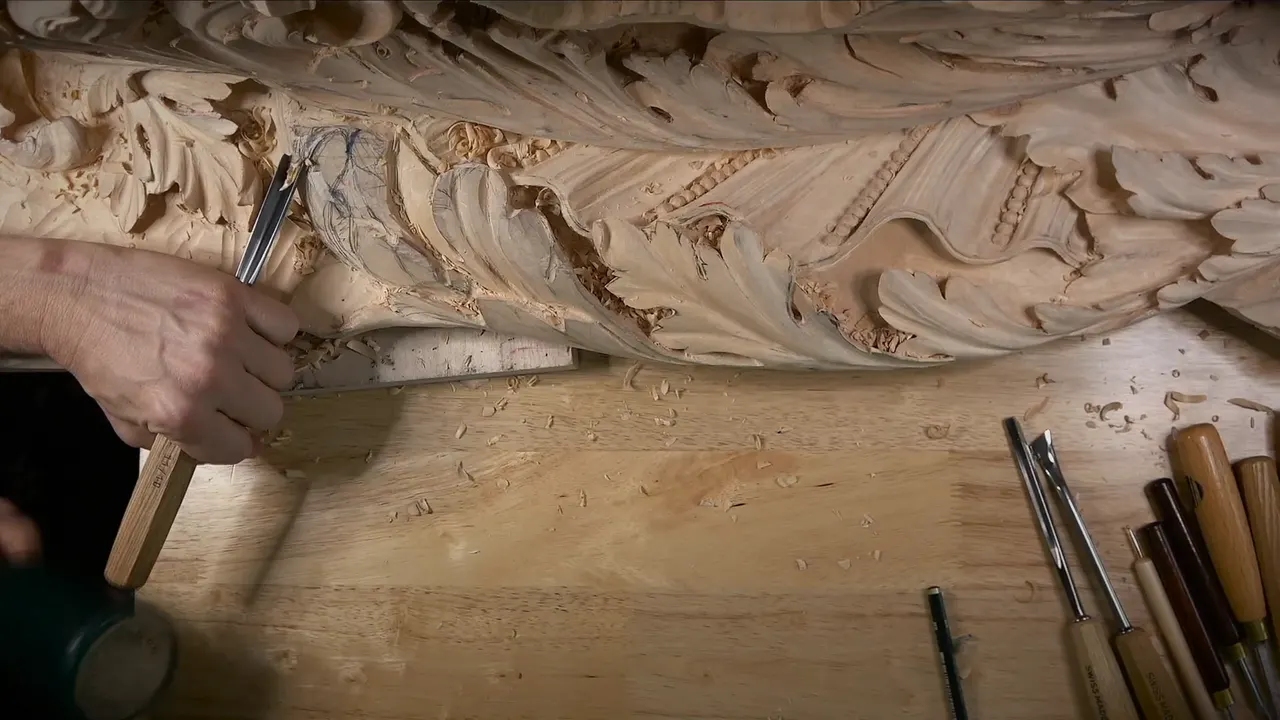

"Trusty" is a word I said in Venice Room workshop 73, part 9, for a skew chisel, right before I chopped around a section. In other lessons it came before a router plane, a hair dryer, Veritas vice, a blower, a pointing machine and wood glue.
Ever reached for the same tool without thinking about it? Did it sit in your hand like it belonged there? Come through part 9 with me, then through the lessons where I named my trusty things out loud.
Which words came with the chisel in part 9?
"I'll use just old trusty skew chisel and kind of chop around preliminary," I said. "See, I have to create a roundness, otherwise it's not going to make sense." Then came "So that is good. And yes, I will keep that section right here and excavate around."
Before that I was still picking tools. "Well, I could use number nine. Number nine will work exactly the same in this section." About the other tool: "Number 11, it's also going to work really good." Next, "Let me use 3/4 of an inch, 20 millimeters, number nine."

I stopped there. "And see, I'm stopping before I hit the wall," I said, then "I stop before I hit this section. I really don't want to damage any of this. Okay. Really don't." Next, "harder to clean," and "if you damage it, it's usually deeper than you want."
Where was I before the skew came out?
A tight spot. "Really hard to fit my tool in. It's not impossible, but it's kind of hard," I said. I named the tool as "number five sweep" and added "that tool is little too big, but I don't want to mess up my curvature, my sweep." The sweep, I said, "gives me beautiful movement." Then "Okay, so at least I'm happier with that section."

I called "the biggest decision" this section, and then "maybe I should curl it somehow." A plan and a doubt traded places. "I will curl it, and I'm going to open up this section." Right after, "Or maybe not." Another thought: "a little too much excavation." About a wrong call: "If I don't like it, it's going to be a little too late."

"Although I could probably just start with the number 11 veiner and excavate around first," I said. "That would make probably more sense, I think, just to get around." Near the shell: "Again, got to be really careful." After that, "I think I like what I see right now." A curl, if I went that way, would give me the "ability to create much deeper shadow in this section."

How did part 9 close?
With a slow plan. "Let me think first before making too quick decisions, how much I should take out. So how much I should keep. Maybe I'll just keep a little bigger section right here."
A veiner came next in my plan: "again just number 11 veiner." Then "But in this case, I'll take probably seven millimeters or so, a little bigger than a quarter inch" (7 mm is 0.28 in). The start was to be "little by little."

Last, a warning. "For me, it's almost impossible to undercut this way because I have the main body on the way, but it's going to be visible, so I have to be really mindful how I'm doing it. So it has to be gradual." Then "It's got to be really gradual."

Which tools did parts 8 and 10 of workshop 73 name?
In part 8, my plan was "number five back bend this way," and "carefully start creating if I'll be able to get underneath." After that, "I need probably a smaller one."
Part 10 has a number nine, and I said "little by little" about it, with "shave my way in." Later, "I need to use probably just the number 11 now," and about half an inch, "about 12 millimeters" (0.47 in), then "even smaller. Maybe even just a seven millimeters."
That part also opens on depth. One section would get "less excavation, much less," I said, and the end would get "much deeper excavation." Soon after: "Am I doing the right thing? That's the question I have." Later, "I still have doubts if I'm doing the right thing." Then "I'm getting really close to the slope," and "I'm already actually pretty much on a slope."
Near the main body: "Again, I have to be really careful when I'm approaching my main body," I said. After it, "So I've got to make sure I'm not doing the wrong thing, okay?" A wrong move there "would be a big mistake." Next, "That's why I didn't do the detailing yet on inside. There is a little groove."
A back bend came up too. "Don't panic. So you really don't need to. So any back bend will work. In my case, back bend, that is the only solution because I do have a bench already." Both parts sit in Venice Room 73.

Did I call a skew trusty anywhere else?
In Hazelnuts 4, part 1, I said "there's two of them," and I did not want to "lose a picture of it," and "So I still have to keep some meat." I called a tool "my trusty skew chisel" and said I would "create a somewhat appealing shape for myself." As for the tool itself, "it's a skew chisel number one, and I believe it's 25 millimeters or about one inch" (1 in is 25.4 mm). On brands, "It could be any brand. Or you can make it yourself."

The word comes up again in workshop 31, part 10. "Right now it's just a little too far, and I need to move it closer," I said. Then "And use my trusty skew. And carefully bring that much closer to this line." The slope would wait: "no, I'm not going to do a complete slope right there because we're going to create some beautiful movement here." My aim was "not just a flat wall, but something nice."

What was my trusty tool in the Lily Box?
A number 11. Part 2 of Lily Box 5 has "this fillet on this side, we need to give that the same slope this way," I said, and I needed a relief cut beside it. Then "the same trusty tool, number 11 and 3 millimeters" (0.12 in), and "also exactly the same right beside that line."
"I'll just kind of angle it little bit that way, not much," I said. Next, "I'm cutting mostly with the left side of the tool." A gap in the grain turned up: "which is okay, I guess." And "What can you do about those, right?"

Which plane did I love?
"To clean it, I'll get my trusty router plane," I said in Acanthus over Moldings 1, part 3. "And like I mentioned before, I really, really love it, okay? I love that Veritas router plane."
Soon after came "Let's do it. Carefully again." Next, "I lost the position. I'm working right there. So I guess that was a long day today." After it, "So obviously, I have to work right here. And again, carefully."

Which machine did I measure with?
In Floral and Molding 3, part 2, the words are "the previous piece" and "measure the depth of this section." Next, "So let me get back to my trusty pointing machine," and I would measure with it.
"So that would be the lowest spot," I said. Then "And I am almost there," and then "So really dangerous. So almost messed up. I didn't mess up, but pretty close." Of the line itself: "So there's my line, and that's going to go just really nicely."

The same course has a different trusty tool. "it's about maybe five millimeters, I would say. Close to five millimeters" (0.2 in), I said in the Floral panel course, part 3. "And I'll use my trusty tool to draw that. It's just my finger."
I would "place that line right there just by using finger again, just as a reference." And "So I've got my line," I said. Then, with one fix of words, "that would be my waste. Not my waste, but waste line."

Which small helpers did I name?
A blower. "I've got too much mess on the side," I said in Floral 10, part 3. Then "my trusty blower," and "Going to clean it." About the job, "Small detail. Really small tiny detail." It was quick: "Took me a couple seconds, maybe three seconds," I said, and "If I wouldn't talk, it would be only couple seconds."

A hair dryer, in workshop 56, part 4. I was after a "beautiful transition on inside," and then "Good and enough for now." Next, "my trusty new tool, my hair dryer." Later, "See how deep and nice shadow I created?" Another line: "I need to make sure I'm excavating really nicely around that glue." Also "Although there is a glue because I dug inside of the first layer." And "I just created a framework around this piece, but I need to continue my framing all around."

What did I do my trusty way?
Part 1 of Lily Box 1: I spoke of a peel and stick roll made for shelving, and said "It's much cheaper." Then "But I'll just do it my trusty way, with the tape. I'll just cut excess, which I don't need."
Then the knife: "And yes, I am using a carving knife, and I'm okay with that." Then, on dulling: "if it will dull it, I'll just resharpen it."

The vice came in the Schaaf tools lesson of the All About Tools course. The block was "approximately six inches wide and approximately eight inches long" (about 152 by 203 mm), and I said it was basswood or limewood, if you wish. "And we're going to mount that to my trusty Veritas vice."
"There's different ways, different approaches how you can fasten your piece of project which you're going to work on," I said. Then "I'm going to show you probably a different approach."

Was a glue trusty too?
Yes, in a lesson on back cutting in my Techniques course. The simple approach was to "attack that from above." The better idea: "to flip that piece upside down, okay, and attack that from backside. And that's called back cutting." On a bench, "if the piece is really fragile, it does have some petals, you can break them," I said, and "we have to stabilize it." "I know multiple ways, but the three ways or three methods probably the best," I said. "Before we flip that piece, we have to penetrate with something." Then "Number one, you can use just trusty Titebond wood glue." Any wood glue would work, I said.
"So in my case, I really like the Titebond. But what you do with that, you actually dilute that 50/50 with the water." Next, "And brush it on. Okay? What happens, it sucks. It penetrates inside those resins, they go inside of the fibers, and it becomes more resin-like."
"That method is good only, only if you're not planning to stain," I said.
Where does each trusty thing sit next to the others?
Each lesson here and the item I named in it.
| Lesson | Item | Next |
|---|---|---|
| In workshop 73.9 | Skew chisel, with a section to round | Chop around |
| In the Floral panel course, 3.2 | My pointing machine | Measure the lowest spot, almost messed up |
| Hazelnuts 4.1 | Number one skew, about 25 millimeters | An appealing shape |
| From Lily Box lesson 5, part 2 | Number 11 | Angle it a little, not much |
| Venice Room 56.4 | A hair dryer, after the inside transition | Deep shadow |
| The panel course, Floral lesson 2.3 | Just my finger | To draw a line, about five millimeters |
| Venice 31.10 | A skew, to bring something closer | Not just flat |
| Acanthus over Moldings lesson 1, part 3 | Router plane | Clean it, and I love it |
| Lily Box 1.1 | Doing it with tape, not a roll | Cut excess |
| Techniques Q and A, back cutting | Titebond wood glue | Dilute it 50/50 with water, brush it |
| Floral 10.3 | A blower, for too much mess | To clean it |
| In All About Tools, the Schaaf lesson | Veritas vice | To mount a block of wood |
Where can you watch part 9 and the lessons on this page?
You can watch part 9 in Venice Room 73. Workshops 62 to 73 are in Venice Room Part 6. The other lessons on this page have their own pages, linked above, and each is open to you with school access. A workshop number means the Venice Room, and every other lesson carries the name of its own course. The pointing machine lesson is in the same school.
Want to hear me say it in my own voice? Start here.
How it's done
- Choose the tool for the next move. In part 9 I talked about a number nine and a number 11, then I named a skew chisel to chop around.
- Stop at the wall. I said I was stopping before the wall, and that I really did not want to damage any of that section.
- Think before taking it out. Before taking the section out, I said I should think first and not make too quick a decision about how much to remove.
- Go gradually. A veiner at seven millimeters (0.28 in) was my plan, and I said the work had to be gradual.
Frequently asked questions
Which tool did I name in part 9?
A skew chisel, with the word trusty in front of it. I said I would chop around preliminary, and that I had to create a roundness. Earlier I had named a number nine, "3/4 of an inch, 20 millimeters," and said I could start with a veiner and excavate around first.
Which other tools got the word?
Skews in Hazelnuts 4 and workshop 31, a number 11 in Lily Box 5, and a router plane in the moldings course. A pointing machine, a blower and a hair dryer got it too, along with my own finger as a tool, in other lessons.
How big was my skew number one?
In Hazelnuts 4 I said I believed it was 25 millimeters, or about one inch (25.4 mm). As for brands, I said any brand will do, or you can make the tool yourself.
What to carve next