

Alexander Grabovetskiy, woodcarver, School of Woodcarving · Published 2020
What does a wood carver mean by "leave it"?
Quick answer: In Venice Room workshop 73, part 3, I looked at one spot in the design, voiced a doubt about it, and kept it anyway. My other lessons have me saying leave it about spots that are good, fragile, or open. Each is below with its lesson.
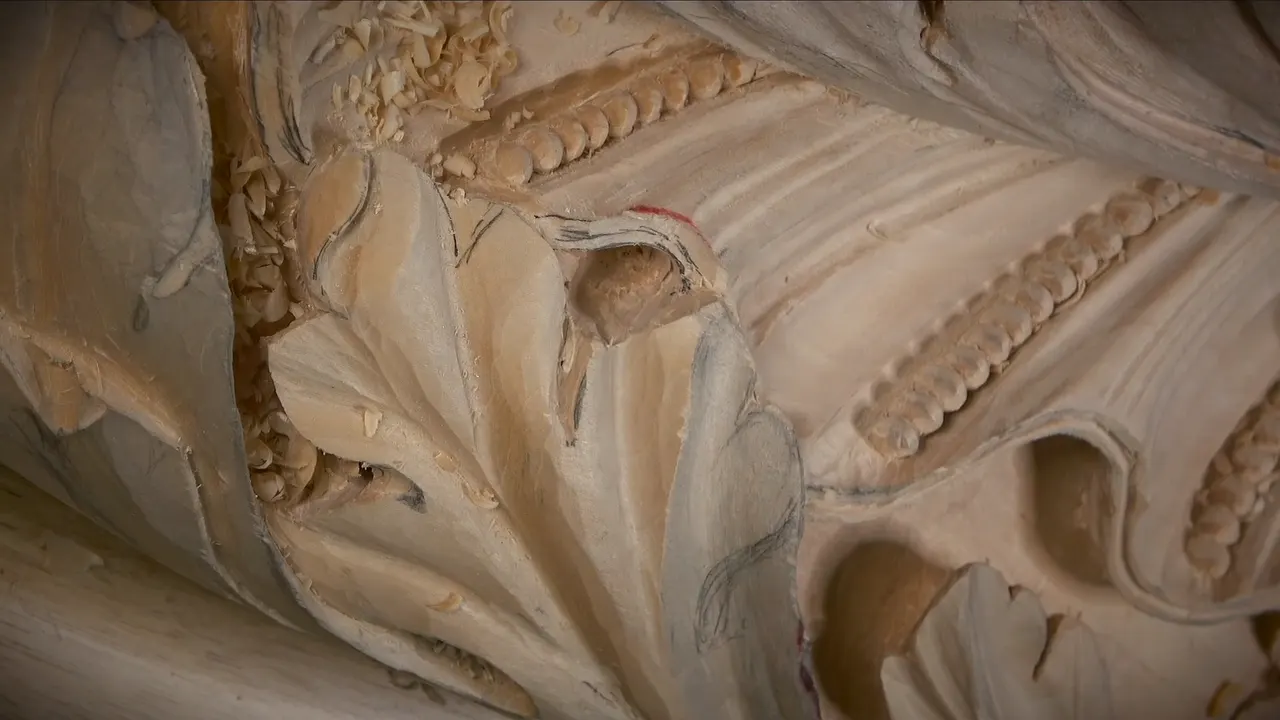

In Venice Room workshop 73, part 3, I looked at one spot in the design and said, "Maybe I shouldn't do that, but still, I'm going to leave it." My other lessons have me saying it about spots that are good, fragile, or still open.
Ever stopped a gouge over one small spot on a leaf and wondered if it needs more? Did you decide to keep it, and then doubt yourself? Below are lines from this part and from my other courses, each linked to its lesson.
Which spot did I keep in workshop 73?
Here is how the part begins. "But little by little," I said, and "I think it's probably already giving me a beautiful shadow." Not much more to do, I added, "although I still need to blend a little better this section."
The previous tool was a number eight, 5 millimeters, or about 0.2 in. Then this: "And see, again, limitation. But it's okay."

Next, a tool change: "Let me use a little shorter version of 1 millimeter. Number 11, of course." (1 mm is about 0.04 in.) The verdict was plain: "it needs to be blended a little better, but I kind of like the overall idea."
"And in the overall design, a little something right there." That is how I named the spot, and I doubted it, then said "Okay. I'm going to leave it like that, okay?"

Divisions were next: "Now we're going to work on divisions and blend a little better." Next, a verdict: "Wonderful. I think it's wonderful."
What did I carve once the spot was settled?
The job was a big triangle. "I do have a big triangle I need to remove, so that is important to relieve it first." For that I planned "3 millimeters, number 11" (about 0.12 in), and I called the area "a kind of dangerous area right here, because a part of my shell going underneath."
Care was needed: "really extra careful," I said. The line "goes underneath, and it's pretty much continuous right here," so the full depth was not what I wanted. One small section would show as the "exposed edge of a shell." Its depth was supposed to be "equal to this side."

Next I planned a number five, "about 12 millimeters or so" (about 0.47 in), "just to try to match whatever the curvature I have." I liked it. "I could use just a knife or anything else for this method, but I really love the idea. It gives me perfect curvature."
Next, an admission. "Not that I need that perfect curvature, but I think it just helps a little." Not too deep, I said, since I did not want to mess up the triangle and the edge.
One side needed a hit from an opposite direction. I wasn't sure I had a tool for that, and then: "Yes, I do have a tool, of course." A small spoon gouge, "number three in one-eighth of an inch," which I named as 3 millimeters.

With that spoon gouge I said "I can probably hit a little bit this way, and the opposite direction too."
Then the line. "Of course, this line needs to be fixed." It was "supposed to be about a sixteenth of an inch that direction" (about 1.6 mm). I planned "number three or so," a micro tool, "really carefully without damaging."
It would "go all the way down to the shell." And my verdict: "So now I'm happy with this line. Really happy with this line."

The shell was a different job. "I need to fix, not fix, but finalize that shell." Filming had a limit. Not on a camera, I said, because my head would be in the way.
Where else did workshop 73 say it?
A side with enough thickness came up in part 2, and I asked myself whether to "leave it flat like that" or make "some kind of curl." I added that I could just leave it. After that: "But let me see," and a plan to take the same tool again, a back bend.
Part 4 has one more: I said I would probably leave one area, because I had to stick my head close to the camera and wanted to avoid that. Of a mess on the side I said "don't need to worry about it."
On curls, I said in part 2: "I didn't do too many curls on this carving." Still, "I think it would look really nice."
That part also opens with a separation I did not like yet. "And I can see that I don't like this separation yet, so I need to prolong it and make it a little longer."
Part 4 has a note on speed. "Not too quick. I cannot do that too quick."
The slip is in there too: "Oh, no, that is not good." And right after, "I wasn't too careful." Then the fix: "All I'll do, I'll just curl it. It's still going to be visible."

Is a spot ever good enough to stop?
In part 2 of Venice Room 62 I was using a number 11, 7 millimeters (about 0.28 in), on a place I still did not like. I planned to outline it. "Okay, that is good" came next, with a plan to stop there.

The same plan shows in part 3 of Venice Room 64, after a call of "wonderful." Right after: "Maybe just slightly clean. Just a little bit more."
How do I treat a spot I am unsure of?
Over in Venice Room 83, part 2, one spot is not settled. "Not bad in all, except this area is still not too happy," I said, and then a thought: "Maybe I just have to get rid of the whole section right here and just keep this part."
Then: "I'm not sure yet." That was the reason the spot waited for now.

A second way shows up in Venice Room 82, part 10: "I am not happy yet, I should say," I said. Then, about a movement downhill underneath, I said "I'm not sure if I wanted to or not." The plan: "Let me try it, and if I like it, I'll leave it."
A middle convex needed to come down in Venice Room 76, part 8, or become a better version of itself. Leaving it for now was my call. The concave, I added, could go all the way like this, since that would give a long movement.
A petal is the subject in Hashemi Flowers 46, part 2. How extremely to go on inside, I was not sure. Maybe just leave it, I said. "I think it looks good already like this."
Hashemi Flowers 7, part 6, has a piece and a leaf. I wanted to keep a connection between them. This one could wait, I said. Touching it was not in my plan for now.
Furniture Panel 8, part 2, is about a design. "No, I don't like it." Next came "But I do like this, and I can actually develop even more this side."

Is a push ever too risky?
The backside would be all undercut, I said, in part 10 of Venice Room 74. "I have to be careful. I don't have too much space to work around," I said. Then: "And maybe I just have to probably leave it." My reason: "Otherwise, it's going to be a mistake" if I push it too far.

Another one sits in Hashemi Flowers 22, part 2. "I'm not too happy with that," I said, and "it's okay." The spot stayed because "it's too fragile," with no wish to overdo it, and I named a tendency of mine, "to overdo stuff."

My reason shows in Furniture Panel 17, part 6. No overdoing the straight down, I said, "because even in a small area like that, I'm still going to undercut." And: "I don't want to see those marks later on," and stopping there was "probably better," I said, "as of now."
What about a spot I could keep, but want to make better?
The shape in part 6 of Venice Room 75 "just looks like almost Rectangle, which is no good." I had to "create more tapered look, skew it little bit this way," I said. Then: "So that's going to continue." Leaving it there was possible, I said, "but I think it's going to look much better."
In Hashemi Flowers 45, part 1, I was thinking about what kind of movement to make. "Well, actually, I could leave it," I said, and "I just make it more wavy, the edge of it." Then: "Kind of happy with what I see, but let me make another concave right here."
A question to myself opens part 9 of Venice Room 78. "What should I do? Should I take it more?" Later, maybe I would leave it as it is, but "this doesn't look too good, this side." I wanted to open up the section, maybe, and I added "Again, I really don't have to." I just think it will look really good.
Floral and Molding 7, part 3, turns the same way. "Okay, now it looks really good." The choice was to stop there, but "I really like to create the extra concave on inside."

A background in Furniture Panel 19, part 16, got this: "I don't want to see the flat surface. It's got to be roundsy." Stopping there was an option, but "I want to make sure it just rounds inside," I said.

Furniture Panel 20, part 5, has a quick one. While I cleaned from one side, "Carefully," I said. Then I said I could keep it, "actually," and "It's also looking really good. Just to clean and make it look nice."
The options in Venice Room 82, part 6, were to leave it, or use "riffles or rifflers just to create nicer shape." Then a reason: "it's a paint grade, so why not?"
Does a spot ever bug me enough to go back?
"Actually, no, I can't leave it alone. Still bugs me." This comes from Venice Room 41, part 10, a few seconds after "Got to be careful this time." Number eight was next, I said.

Mess is another case. Some of it sits in Venice Room 43, part 6, and I planned to remove it. Most of it, I said, would be covered "with the leafage, with the flowers." Even so, I said it would not stay rough. Cleaning it was the plan.

A drawing gave a different answer. In Furniture Panel 14, part 6, "I believe I found one spot I don't like." The element went away, "I'll just get rid of it," and then I planned to leave it empty.
Which way do I keep it when I am torn?
The question is in part 6 of Venice Room 71. "Should I do the big convex, not really big, but still convex, or should I leave it as a concave? That's the question." "Both ways, okay, but one is logical and another one is not," I said.
A number 11, 7 millimeters (about 0.28 in), was the plan, and I added "if I don't like it, then that's a problem."

What did I tell students about the line on film?
The Hashemi course has the plainest talk about it. In lesson 49, part 4, I said "I know you probably noticed that when I'm doing my carving and I'm filming my lessons, and I said many times, 'That's it. I like it, so let's leave it like that.'"
What came after: "But next time when you tune up again, and you're watching the next lesson, so the carving looks actually much cleaner and more finished." I also said that "the cleaning is actually the easiest part," and "it's exactly the same what you do when you're carving."

Which lessons say which, side by side?
The table below lists each lesson under its course, with the words I used.
| Lesson | What I said right there | The spot |
|---|---|---|
| Workshop 73.3 | Maybe I should not, but kept it | Kept |
| Room 62.2 | Called good after a number 11 | Good |
| Venice 83.2 | Unsure, so it waited a while | Open |
| 74.10 in Venice | A push could be a mistake | Risky |
| Hashemi 22.2 | Too fragile, with a tendency to overdo | Fragile |
| Venice 75.6 | Could stay, but I thought better | Went on |
| 41.10 in the Venice Room | Could not let it be | Not kept |
| Hashemi 49.4 | The next lesson looks cleaner | Cleaner |
Where can you watch the full videos?
Every lesson above sits inside one of my carving courses, so a full video stands behind each quote. This workshop holds all the parts of workshop 73, and workshops 62 to 73 are in Venice Room Part 6. To watch the full videos, start here.
How it's done
- Look at the spot. Workshop 73 names it as a little something in the overall design, with a doubt about it.
- Make the call. Then comes the decision to keep it, still in workshop 73.
- Name what makes it risky. Venice Room 74 calls a push too far a mistake.
- Check your own habit. Hashemi lesson 22 names my tendency to overdo stuff.
- Go on to the next job. Next in workshop 73 are divisions.
Frequently asked questions
Which place in the design did I keep?
One place in the overall design, in the third part, and I doubted it out loud before I kept it. Right after came a plan: divisions.
Was there a spot I could not leave alone?
A spot in Venice Room 41, part 10, still bugged me, and number eight was my next tool. A mess in Venice Room 43 would not stay rough, and I planned to clean it.
Why did one spot stay in Hashemi lesson 22?
It was too fragile, I said, and overdoing it was something I wanted to avoid. I also called it a tendency of mine, and before that I had said it was okay.
What to carve next