

Alexander Grabovetskiy, woodcarver, School of Woodcarving · Published 2020
Are facets okay on a wood carving?
Quick answer: In Venice Room workshop 73, part 2, I looked at my carving and said, "Although you can see those facets, but it's okay." My other lessons say which ones I do not want and when I leave them for later. Each is below, with its lesson.
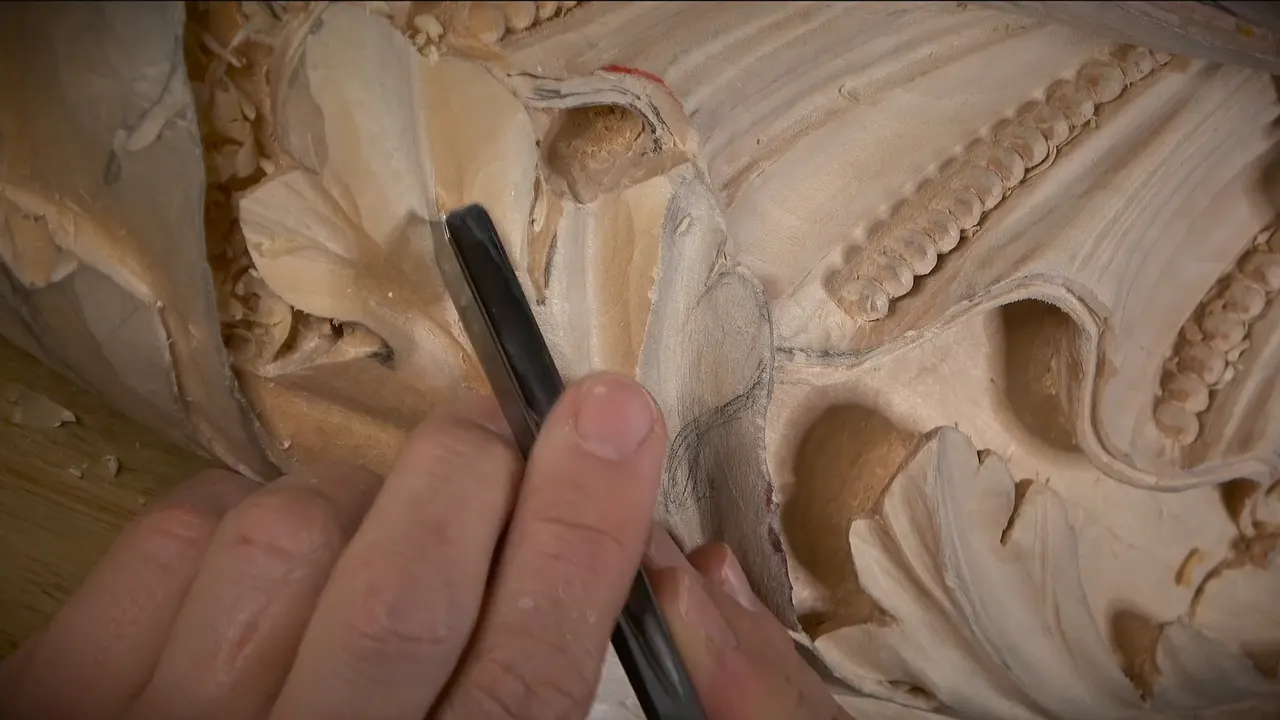

Part 2 of Venice Room workshop 73 has me looking at the carving and calling the facets okay. My other lessons say how many I leave, which ones I do not like, and when I wait.
Ever felt the small flat steps a gouge leaves on a carved leaf? Did you wonder if every one of them has to go? Here are my own words from this part and from my other courses, each linked to its lesson.
What did I say about facets in workshop 73?
The part opens with "much better." Then, about the marks on the leaf: "Although you can see those facets, but it's okay. That is absolutely okay." After that came "So now it looks much more appealing, I'd say."
The next line was a plan. I was "ready to create the extra divisions" on "pretty much all of them," and I fixed my own word right there: "Separations, I should say."

One side of the leaf gave me a choice. "I do have enough thickness on this side," I said, and I asked whether to leave it flat or create "some kind of curl." That question has its own page in workshop 73.
Further on I named a tool: "That's 5 millimeters, 3/16 of an inch." About it I said "It's going to give me a chance to do little by little." For a smaller one I planned a 2 millimeter, number 11 veiner (2 mm is about 0.08 in).

Which other word do I use for the same marks?
Ridge. In Venice Room 72, part 3, I named one disadvantage of knives and one more tool: they leave "so many facets or ridges, if you wish." "For me, ridge makes more sense," I said next, and "Ridges of tool marks or tool marks, whatever."
A bigger number five has its reason in Venice Room 58, part 12. By my own words, "that way I'm going to eliminate the lots of carving marks, tool marks, facets." It "just gives me really long, consistent cut."

What else did I call okay in parts 1 and 3?
Part 1 says it too. One section was "looking messy," but "that's okay. So I can always clean it with no problem." Later I was happy "even if I've got somewhat like a concave on inside, but that's okay."
A small chamfer was an option too, "which was really common also." Then: "Maybe just a little more gradual."

Two sides did not match. The "left side is much cleaner cut than the right side." I could not attack from the opposite direction, since "there is a main body." My answer was "to make my tool a lot more sharper," and a skew helps too: "skew also helps to make it much cleaner."

In part 3 I planned "a little shorter version of 1 millimeter" (about 0.04 in), number 11. My judgment was plain: "it needs to be blended a little better, but I kind of like the overall idea." About one spot in the design I said "Maybe I shouldn't do that," and I would leave it anyway.
Where do I say I would rather not see them?
The shortest case sits in Venice Room 63, part 10. After "I think it's wonderful" came a short order to myself, "Clean little bit," and the reason was that I did not like seeing the facets.
A longer one sits in the Furniture Panel, lesson 23, part 12. "Let me use just number three," I said, to "knock down a little bit." After that I corrected the rule I had just stated: "I should say I don't want to see really sharp facets." What followed was "Facets are okay, but not really sharp on the flowers."

Next, in Venice Room 76, part 1, I corrected myself. I planned number seven, 4 millimeters (about 0.16 in), and began with tool marks I disliked. Then came "I want to see them, but not as much, okay?" and "I still like those facets."

My reason shows in workshop 6 of the first Venice Room course, part 1. "Depends how the light hits," I said, and "Even small facet, even small cut creates the shadow." For that reason "I have to be really careful," and the look I wanted was "authentic, but not rustic."
Floral and Molding, lesson 6, has me stopping mid-sentence with "I shouldn't say that." I said I like those facets, though not as much. Soon after: "I really have to be mindful how much facets I'm leaving." The piece was to be covered with paint, but "if it's too sharp ridges, just a little destructive, I'd say." My plan was to blend it, and "I will spend a little later more time cleaning."

A size comes up in Lily Box 12. "I really don't like big facets," I said, and added "Not on small flowers." Then came "Good. See? It looks not bad at all."

When do I tell you not to worry about them?
In workshop 67, part 6, I blended a little nicer and then said "Don't pay attention to those facets." Next: "I have no problem to clean them little later." Cleaning could wait, I said, since "Once I going to establish overall movement, I can hit that again with the same tools."

The same advice sits in Furniture Panel 29, part 1. "Let me get my tool upside down," I said, and then "don't worry about those facets." The stage I called "just preliminary."
Acanthus over Moldings 9, part 3, repeats the call. "Don't pay attention or whatever," I said. Then "I will have a chance to clean that for now. It is important for me to just establish over all feel of that."
The Maine class has a final assessment, and it opens with me calling the piece done. You could work on it longer, I said: "You can take care of all of those facets if you wanted to but I gonna leave it like it is." Those words are in the Grinling Gibbons final assessment.

Why do I leave tool marks on a flower?
My answer is in Hashemi Flowers 30, part 4, where I was leaving my tool marks on the piece, "because depends how you look at it. It creates beautiful shadows." Soon after I said "every facet, every tool mark makes a beautiful look," and finished with "At least in my opinion. You don't have to agree with me."
One more thing sits next to it: "I don't like to use a sandpaper. It just doesn't look the same." In lesson 31 the thought returned with a hope: "every facet, every tool mark will make this flower more beautiful. Well, at least I hope so."

The Furniture Panel background lesson has a plain line on the same thing. I called my cuts semi-final and said they are part of the design, "because we are not sanding it." So every facet is one "which is left by the tool, it's going to be part of a design."

Grape Onlay has two cases. Lesson 12, part 3, has me saying I kinda like "to leave some of the facets" on the leaves, "almost like vines," and "if it bugs you, that's what you do." Another line: "Obviously not everywhere you should do that technique." About some spots, I said "it's better to adjust a cut just on its own, gives a finished look."
By spot, the answer is in Grape Onlay 5, part 3, where I said I would like to see them "on the vine itself, but not on the tendrils." The tendrils, I said, would be "a little nicer and not tiny."

And a clean convex in Venice Room 74, part 8, needed nothing. "That's beautiful and gradual," I said. Next: "I don't have too many tool marks or facets." I did not need to sand it or use roughers or rasps.

What do I do when they bug me?
Byzantine Acanthus 4, part 2, has me asking for most of them to go: "try the best to eliminate all the facets. Not all of it, but most of them." And if you cannot, "it's okay." A plan followed: "do a movement like this, okay, to blend it," "little by little, but much quicker." Then: "And I'm taking out those facets."

One way comes from Hashemi Flowers 49, part 4, where I worked on a petal. "I've got a lot of facets right here on this petal." "What I'll do, I'll just blend it," I said, and that I could take "just the number three, move it upside down, and make my rotating movements like this." I called them "just the micro moves." Then "It's still facet. I'm not sanding anything. But it's just not as rough-looking one." About the smallest ones I said "many times, what I'm doing, I'm doing this off camera because it just takes so much time, and there is no reason just to watch it."

People had asked about it in the Furniture Panel, lesson 33: "how would you take care of those facets?" First I said I don't worry about too much cleaning, because "once you're gonna apply some finish, it's gonna make it little smoother." I look at the facets as "painter's brush, but just in case if it bugs you," I said, you put "your tool upside down." That was number three, "a quarter inch, six millimeters," and in real life, I said, "it's actually much faster."

Two more tools come from Grape Onlay 12. One was a flatter gouge, and the other "just a skew chisel," the number one, with a circular motion and "almost no material is taking out." In Grape Onlay 3, part 3, a number seven was a "really good tool to just clean up," and I named the "really weird facets, big ones." With it, "until I don't see any facets left, you're still gonna have some of it."

How far do I take the cleaning in the Venice Room?
Cleaning first. "I also clean a little bit those extra facets I don't need," I said in workshop 67, part 3. The rest, I said, "could be done just off camera." Then: "Don't really have to watch hours of cleaning," and "cleaning sometimes takes actually the longest."
A plan for later sits in part 8 of that workshop: "Later on, I'm going to attack that with a bigger tool, like one inch or so" (about 25 mm), "to eliminate too many facets, tool marks."
At work in workshop 65, part 4, I said "What I'm doing, I'm taking care of those facets." Then "It's much quicker in real life," and later "I'm really controlling."
Workshop 68, part 9, has a number five back bend I considered, "and that way, I can get rid of all of those facets right away." Further still, in workshop 72, part 11, I said: "I can always make it to the perfection and take out those facets completely." Right beside it sits "I don't worry too much yet about that inside."
Does paint or gold leaf change how many I leave?
Paint changed my cleaning in Acanthus over Moldings 9, part 2: "I used some of the Sandpaper just because like I said, it's gonna be covered with the paint. And I didn't want to spend too much time to clean my facets and so on which I don't usually use. Okay, so don't get an idea that I'm using some paper all the time."
My scraper video gives the other side. For a piece to be gold leafed, "I do have to make it smooth." And then: "personally, I kinda like them, okay? So they create the veins and they look more natural."
Which lessons say which, side by side?
The table below lists each lesson under its course, with the words I used.
| Lesson | What I said right there | The facets |
|---|---|---|
| Workshop 73.2 | I looked at the leaf and called the result okay | Facets accepted |
| Furniture Panel 23.12 | I corrected a rule about flowers as I spoke | Sharp ones |
| Venice 76.1 | I caught myself and said I still liked them | Tool marks |
| Lily Box 12.6 | I named a size I did not like | Big ones |
| Venice 67.6 | A call to pay no attention for now | Cleaned later |
| Hashemi Flowers 30.4 | I left them for what they do to light | Beautiful shadows |
| Grape Onlay 5.3 | I named where I wanted them and where not | A vine |
| Byzantine Acanthus 4.2 | A reminder that it is okay if you cannot remove them | Most gone |
Where can you watch the full videos?
Every lesson above sits inside one of my carving courses, so a full video stands behind each quote. This workshop holds all the parts of workshop 73, and workshops 62 to 73 are in Venice Room Part 6. To watch the full videos, start here.
How it's done
- Study the marks. My first look at the leaf in workshop 73 ended with calling the result okay.
- Decide how many you leave. Venice Room 76 has me still liking some of them, with fewer wanted.
- Wait while the shape is not set. Venice Room 67 had me cleaning them later, after the overall movement is in.
- Blend the ones that bug you. Hashemi Flowers 49 names number three held upside down, for rotating micro moves.
- Think about the finish. The Furniture Panel course, lesson 33, says a finish makes the surface a little smoother.
Frequently asked questions
Did I call facets okay in workshop 73?
Yes, in part 2. After seeing the carving I said it looked much more appealing. Right after, I said I was ready to create the extra divisions on pretty much all of them, and I also called those divisions separations.
Which facets did I not want on flowers?
Really sharp ones, said in lesson 23 of the Furniture Panel course, where I called facets okay on flowers. Big ones on small flowers were the problem in the Lily Box course, lesson 12, where I said I really don't like them.
When did I say to ignore facets for a while?
Lesson 67 of the Venice Room has it. I said I have no problem cleaning them a little later, once the overall movement is established. Lesson 29 of the Furniture Panel called that stage preliminary and said not to worry about them.
What to carve next