

Alexander Grabovetskiy, woodcarver, School of Woodcarving · Published 2020
What does a wood carver mean by "exaggeration"?
Quick answer: Exaggeration is a word I used in Venice Room 73, part 8, for what a deeper dig could do for me. In the Furniture Panel I paired it with shadows. Other lessons use it for pipes, concaves and a knife.
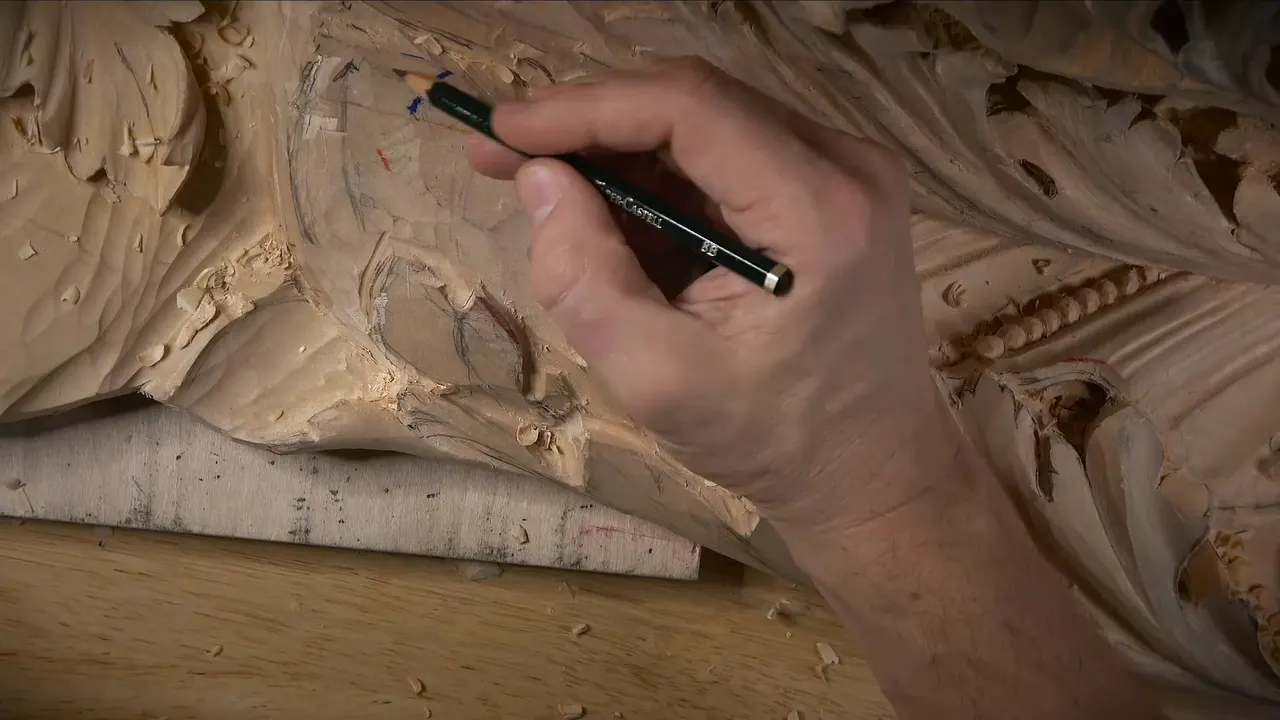

In Venice Room workshop 73, part 8, I said a deeper dig in one section would let me create exaggeration. My other lessons carry the same word beside pipes, shadows and concaves, and beside a knife on end grain. A Furniture Panel lesson puts wood carving and exaggeration in one sentence.
Ever studied a carved leaf and felt the movement was there but the shadow was not? Did you reach for a smaller gouge and wonder how far to push? Come through part 8 with me, then through the lessons where I used the same word.
What did part 8 of workshop 73 say about exaggeration?
Near the end came a close call, and "Oh, got to be careful," I said. "Almost messed up, and that would not be forgiving." A turn followed: "But on the other hand, I could actually excavate deeper in this section also, and that's going to give me much more ability to create exaggeration."
Those words are a plan, since the verb is "could." What came after it was "Maybe I've got little too deep."

Which choice came before that line?
Early in the part came a decision. "So the biggest decision I have to make, the movement," I said, and I asked where my end point should be. About the best idea, "I don't know." Of one spot, "That is a really good taper area."
A shape plan followed. "Which means this part is going to be concave, and that part is going to be convex." I planned to start with the concave and convex, and I called that number one, what I had to work on.

How did I want the section to look?
"But I really need to get something three-dimensional in this area," I said. I compared two spots: "that has a three-dimensional movement, and this one is little too dull." I added "So I need to do something also more dimensional."
One more idea was to "Soften up a little bit this area, remove completely that section, and soften up and just to get the curl this way." That seemed "logical to do," I said.

Which tool did I reach for in part 8?
"Let me remove some of it with the number five back bend this way," I said, and "carefully start creating if I'll be able to get underneath." A smaller one was a need: "I need probably a smaller one, and I need to clean this section right here."

On depth, "But I don't want to undercut too much because I still have to establish some movements on top of that section, so don't want to remove too much."
Where do parts 7 and 9 of workshop 73 mention shadow?
Part 7 of the same lesson has "I think it gives beautiful shadow. Extra small triangle, but huge difference."

In part 9 I turned to a curl. "Maybe I should create some kind of curl in this way," I said, and "I will curl it." Then "Or maybe not." Later I said "if I'm going to curl it this way, it's going to give me ability to create much deeper shadow in this section."
Where did the Furniture Panel put it?
I liked a concave "by number six from this point down, but I don't think it's enough on this part right here." The lesson is Furniture Panel 19, part 8. A micro tool came into my plan: "Let me use a micro tool," and "one-eighth of an inch," and "it would be by Dockyard. Three millimeters" (0.12 in).

Then I explained. "It has to look natural, but a wood carving is all about exaggeration, okay? So we're actually exaggerating natural movements. And the reason why, because we're really after shadows." Of the result, "I think it looks much, much better that way."
What do I call an exaggeration cut in the Hashemi flowers?
From the middle, "not everywhere, but some spots to make exaggeration cuts," I said in Hashemi Flowers 6, part 4. A tool was a plan there, "just about quarter-inch number nine" (about 6 mm), "and I'll make a cut inside of the cut."

I gave them a name: "That's how I call them, exaggeration cuts." Those cuts, for some reason, make "leaves more realistic," I said. And of the cuts, "those are simple cuts. Anybody can do that."
How does nature fit with exaggeration?
A book comes into Byzantine Acanthus 3, part 1. "I was reading a book about old masters of 16th, 17th century," I said, with two men talking about artists who carve stone and wood. One asked whether the artist tries "to be as good as nature." The master said no, "and be even more than nature." Then I said "Because in nature, not everything connects to the same line." And "So it's actually exaggeration process of nature."

"It's more exaggeration of the nature," I said in the Tray of Blessing course, lesson 3, part 3. Of pipes and veins, "You exaggerate those pipes, you exaggerate those veins." You do not see "huge pipes like that" in real life, I said, and "it looks natural on the wood carving." Later, "You have some certain rules like a rule of flow, so you exaggerate that flow."

Where else did I mention carving beside exaggeration?
Of a middle part I did not worry about losing, I said "And pretty much carving is an art of exaggeration." Workshop 61, part 4, goes on with "It is an art of exaggeration."

"So we really need to exaggerate," I said in Vase with Grape Leaves 1, part 4, and we were going to do eyes and pipes, the same as an acanthus leaf.
I thought a deeper concave would look really good, and number eight was one I could use. In Lily Box 3, part 10, I said "And of course, it's exaggeration of the real life, but carving is always exaggeration." I added "I do not want to overdo it."

About light, workshop 15, part 4, carries "just a light and shadow from what point the light is going to hit that detail, and you want to create that exaggeration. The wood carving is actually pretty much all about exaggeration."
In real life they are a little smaller, I said in Lily Box 11, part 8, "and I am aware of it." Carving is about exaggeration sometimes, I added, and making it too small would be "absolutely unpractical." My line was "I have to find a compromise" on this flower.
Which part of a leaf did I exaggerate?
Two pipes were done and another needed work: "I've got two pipes exaggerated," I said in workshop 62, part 5, and another pipe "I need to exaggerate also." My reason was "I don't have a lot of depth to give a frame, but I still need to get about the same amount of shadows." Then "Just exaggerate those pipes. They're going to cast some shadows. Really big movements." And "Even if I have to lower down my middle lines, that's okay, too."

"My goal is to exaggerate," goes the line in workshop 60, part 4. Then "Exaggeration of pipe. That's what I'm working on."
For workshop 74, part 8, "the main goal is exaggerate the future convexes," I said, and "actually, I can exaggerate even more." Of the eyes, "It was a big thing, those around the eyes exaggerations."

A plan in workshop 16, part 7, was "to exaggerate that pipe even more and even get a little bit in and create some shadow." If the light at night comes from the ceiling, I said, "I really want to see that exaggeration, that shadow right here." On going deeper, "I'm not sure if I should or not, get even deeper."
"I'm gonna raise up. You know that pipe. For me, it's really important to see that really exaggeration. I mean exaggerated pipe I should say," I said in Moldings lesson 2, part 3.

"This part, that part right here. It's kind of raised up," I said in Acanthus over Moldings 7, part 1. I also said "So it's gonna be exaggeration."
How deep did I take it?
In part 6 of Lily Box lesson 3, my plan was "1 millimeter in this area," and "a deeper exaggeration." After it, "I'll follow with the half a millimeter and go even deeper" (1 mm is 0.04 in, half a millimeter is 0.02 in).

Deeper could work near one spot: "closer I get to this part, I could get much deeper probably." The tool in workshop 22, part 1, would be "number nine and 5 millimeters" (0.2 in). Then "A little exaggeration going to help."
Hazelnuts 3, part 2, carries "the more dramatic I going to do, the more exaggeration I'm going to introduce, much nicer it's going to look."

In workshop 115, part 1, the plan was a big number 11, 20 millimeters (0.79 in), "to create a deep concave." I said "So I'm about just the shadows, okay? So that's all about the shadows and exaggeration of real life."
"I like to see that extra shadow," I said in workshop 116, part 1. Inside bigger concaves, "I'll take small, like number eight tool," for another concave. Then "It's just exaggeration, pretty much, the real-life exaggeration." A little wider concave followed in my plan, "7 millimeters" (0.28 in).

For an eye, I could "make that eye exaggeration and create just the concave cut," I said in Furniture Panel 20, part 2, and then "I'm sorry, number 11 and one millimeter." About the size, "It's almost micro cut. I know it looks huge on the screen, but it is not."

How much exaggeration did I want?
After "slightly better shape on this side," I said "No, not too much," and "But little exaggeration." Workshop 18, part 1, is where I said it.
"A little more exaggerated concave right here" turns up in workshop 88, part 5. And "I don't know if I should or not, but I want to see a little more exaggeration."
On carvers of the 15th century, workshop 9, part 2, has "so they exaggerated a lot. Okay. They did exaggeration a lot. So all those lines, they would put extra lines and so on."
Leaves differ: "Not all acanthus leaves we're going to work on are going to have that much exaggerations because like I said before, there's absolutely different styles of acanthus leaves." The lesson is Roman Acanthus 15, part 3.
Did a knife or a small touch use the word too?
On end grain in Roman Acanthus 16, part 3, I said "Make sure you're slicing with the knife. You don't push knife. What I'm doing, if I going to exaggerate, I am moving like that and forward, just like this. Okay? That is my exaggeration, what I'm doing." And "I'm shaving little by little."

I wanted my shadow on the right side in Greek Acanthus 6, part 3, so I had "to move to the right, to the higher side slightly." That way "it's just like a exaggeration of a shadow line."

"I'm not too happy about the overall shape," I said in Gibbons Maine 16, part 2. Then "Maybe a little more exaggeration," I said, and "It's gonna look better."
"Kind of refine that to make it exaggeration right here," I said in Corinthian Acanthus 4, part 2. And in Acanthus over Moldings 10, part 2, "I could a little more probably exaggeration that movement, and get more concave and inside."

Where does each line sit next to the others?
Each lesson here and the words I said in it.
| Lesson | Moment | Words |
|---|---|---|
| Venice, workshop 73.8 | Digging deeper in that section, a plan | Create exaggeration |
| Hashemi Flowers, lesson 6, part 4 | Cuts inside cuts | That's how I call them, exaggeration cuts |
| Hazelnuts 3.2 | Another concave, then a flatter tool | The more exaggeration |
| In Furniture Panel lesson 19, part 8 | Micro tool | So we're actually exaggerating natural movements |
| Furniture Panel 20.2 | A number 11 veiner at one millimeter | Eye exaggeration |
| Byzantine Acanthus, lesson 3, part 1 | Old masters' book | So it's actually exaggeration process of nature |
| Greek 6.3 | Move to the higher side slightly | Look more 3D |
| In Roman Acanthus, lesson 16, part 3 | A knife | Moving forward, that is my exaggeration |
| Lily Box 3.10 | A deeper concave with a number eight | Always exaggeration |
| Venice Room, workshop 115, part 1 | Big number 11 | That's all about the shadows and exaggeration |
| Venice 62.5 | Exaggerated pipes that cast some shadows | Really big movements |
| In Corinthian Acanthus, lesson 4, part 2 | Refine that | To make it exaggeration right here |
Where can you watch part 8 and the lessons on this page?
You can watch part 8 in Venice Room 73. Workshops 62 to 73 are in Venice Room Part 6. The other lessons on this page have their own pages, linked above, and each is open to you with school access. A workshop number means the Venice Room, and every other lesson carries the name of its own course.
Want to hear me say it in my own voice? Start here.
How it's done
- Decide the movement first. Part 8 opens on the biggest decision I had to make, the movement, and on where my end point should be.
- Keep wood for later movements. With a back bend in my plan, I said movements still had to be established on top of that section.
- Weigh a deeper dig. Near the close of the part I said I could excavate deeper there, and exaggeration was the word I used for what it would give me.
- Go after shadows. In the Furniture Panel I said we exaggerate natural movements, and the reason why is that we are really after shadows.
Frequently asked questions
What did I say at the close of part 8?
Digging deeper was a plan, and I said it would leave me much better able to make exaggeration. Just before it, I said I almost messed up and that it would not be forgiving. After it came a line about maybe being a little too deep.
Which tool did I name in that part?
A number five back bend, as a plan: let me remove some of it with that one. After that I said I needed probably a smaller one. I also said I would hold back on the undercut, since movements still had to go on top.
Did I say carving is about exaggeration?
My words put carving and exaggeration side by side in the Furniture Panel and in Venice Room 15. The Lily Box lesson adds the word always, and Venice Room 61 calls it an art. Each page above carries my exact words.
What to carve next