

Alexander Grabovetskiy, woodcarver, School of Woodcarving · Published 2020
What does a wood carver mean by "expedite"?
Quick answer: In part 2 of workshop 86 on the Venice Room I gave my reason for a downhill cut, and then my plan was a flatter gouge to clean the surface. My other lessons use the word over a knife, a drill bit, rasps and machine sharpening, and a few say it can't be done.
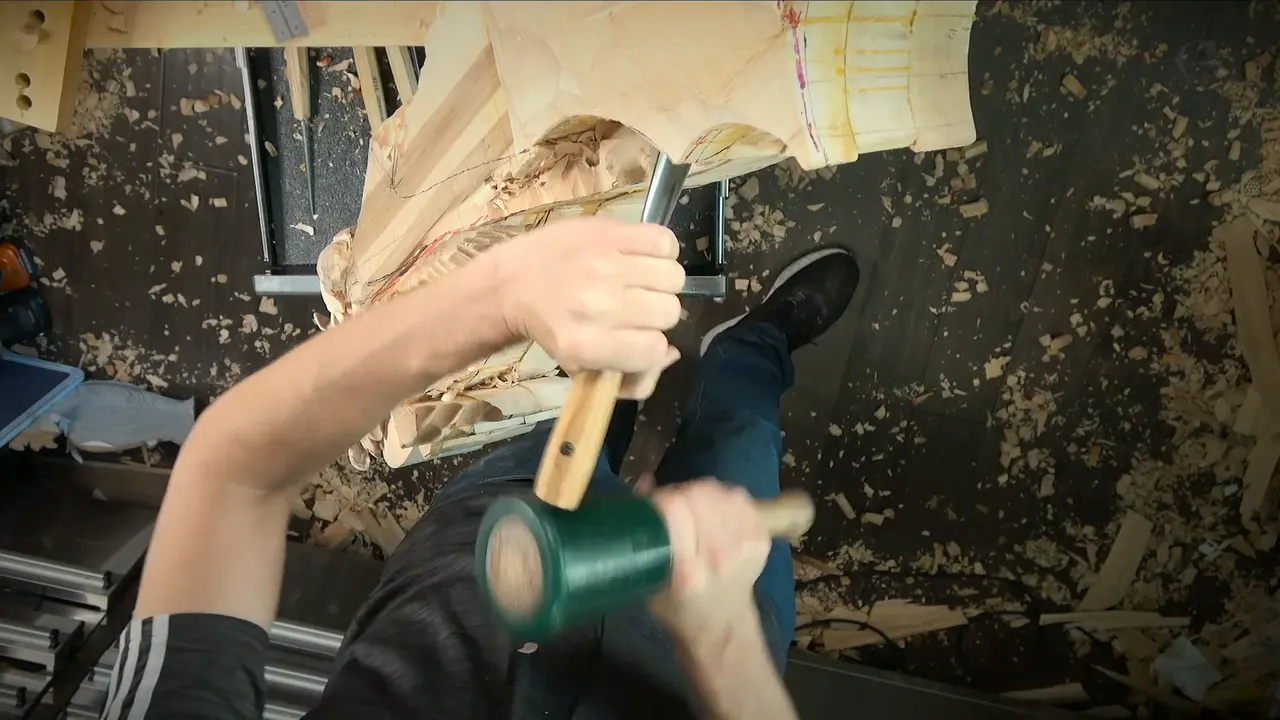

Expedite is the word I used in Venice Room workshop 86, part 2, in a line about a downhill cut. My other lessons use it over a chip knife, drill bits, rasps and gouges, and in places I say you can't expedite at all.
Have you ever wanted a faster way through one stage of your carving? Would you like to see where I took the quicker road, and where I turned it down? Then come through workshop 86 with me, and after that through my other wood carving lessons, each one linked.
Six notes from this part
- A downhill cut, with my answer on why.
- A flatter gouge for cleaning that surface.
- One chunk to remove, and it comes off the backside.
- Maybe a number seven for the side.
- A corbel that is not from a big box store and not made on CNC.
- Power sharpening, rasps and a drill from elsewhere, and the places where I say I can't.
What did I say around the word in this part?
Part 2 opens with "Let me do it this way." My reason came next: "If you would ask me why I do that, it's going to be a lot easier for me to create the downhill cut." Then "Just like that." And the word itself: "I can pretty much expedite my process."

The drop came next in my words, "Here you go," and then "So I've got the drop going all the way down." Then "That is good." My plan after that was "let me now get that with the flatter gouge. Clean that surface."
"Okay, and that's it, pretty much," I said, and "I've got wherever I want to be." One chunk was the exception, the only one I had to remove, and it was "almost impossible to show on a camera." That removal was to come from the backside. I can probably clean this side also a little more, to number seven, I said.

Then I described the run. Starting at the backside, it would go "up, up, up, up, up, wrap around," and again "all the way to the back." There would be "beautiful acanthus movement," I said. A need stood in front of that: "I really need to figure out my drop because it's a part of it," with "a reach and even more movements right there."

The corbel got lines of its own. I called it "a really interesting corbel," not the first of its kind in this style, but "a unique one." You can't buy it in a big box store, I said, and it's "not made on CNC."
About CNC the word was "almost impossible," and not for all of them: "maybe 4-axis, 5-axis are able to do that," but the work would "lack human touch." In the last lines comes a plan, "Let me do some of the stuff off camera." Of the backside removal I said "it's almost impossible for me to show that on the camera."

Which tool size came up in part 3?
Tool size appears in part 3 too. "I could use big tools, but I really don't need to." For that operation the best tool "would be just probably number seven," I said. A bigger gouge, "probably bigger," could make it "a little quicker."

Which tools were quicker in other lessons?
Greek acroterion lesson 3, part 1, covers a cheap carving knife. "I'm using that actually a lot to expedite my work because I can remove a lot material in just a single cut." I did a coffered ceiling with one knife, I said, and some fireplace mantels with just the one knife too. About how it looked I said "I don't think it looks that bad and all."
A plan from lesson 2, part 4, reads "let me kind of expedite it," then "I'll just take most of it with my knife, and I'll help with the gouge." It would go "much quicker," I said.

Greek acanthus lesson 4, part 1, has ways into the eyes. One of the easiest, I said, was "just to take small gouge," maybe a number 11 at three millimeters (about 1/8 in). Then "Approach from different angles," "digging little by little," and "That probably would be the safest way to do." The faster line: "Of course, if you want to expedite, so we use the number 11." A second approach was "just the knife, a chip carving knife." I called that "really quick approach" and "really saving time," though "we're still going to have to clean with the gouge."

Hashemi flowers lesson 11, part 6, found me with a small gouge, a 16th of an inch (about 1.6 mm), and "really careful not to pry too much." The need was "excavate as much as possible to create that feel of the eye," in "both directions," and "that direction is actually more important." A drill stayed an option: "I could actually expedite that and take a drill bit and just a drill. That would be much quicker."

My Lily box course, lesson 2, part 3, has the same offer, after "I'm not going to do the detailing yet." My words: "you could actually expedite this process. I should say, I could expedite this process." A number five or six, "like a quarter-inch gouge" (about 6 mm), could get "chunks of wood out." I also said "Even number seven would work in this case, because I need to remove the background." "I am going across the grain, because it's the safest way, actually," I added.

In my Grinling Gibbons class in Maine, lesson 18, part 2, I said a number 11 works too, but I just think "number 16 and 35 millimeters" (about 1 3/8 in) "expedites the job" and makes it "much quicker for me."

Design is where workshop 3 of the Venice Room, part 1, puts speed: "when I was designing it, I had in mind the tool I have." My need was "to be able to do this job quickly and efficient." Then "if you are designing a certain job, keep in mind what tools you have," and with a tool "which fits perfectly to the job" you can "really expedite the process."

Did a rasp expedite the work?
The rasp gets a mixed answer. In workshop 137, part 3, I planned to clean everything later and "maybe even use a rasp," which I said would probably expedite things. "I hope it's going to expedite my work," I said, and "It's not always the case, though. Sometimes it creates a lot more problem."
"I still don't use it a lot, by the way, even a year later." I bought them about a year ago and "still kind of have doubts." Then "Not really doubts, but I think I am able to just do with my normal tools, sometimes better job than rasp."

The other way shows up in workshop 144, part 3: "What I've done right here, I used some rasps. It just expedited my work, made it little quicker." Then "I'm probably going to do the same thing from now on." The reason was a paint grade: "I really don't have to worry about those tool marks." About the deadline: "the deadline is coming sooner than I wanted to, but it's okay."

Rasping comes back in workshop 145, part 2, where I said "I think it's looking good, like a double movement." Then a plan to cheat: "I don't know if it's cheating or not, but I'll take some rasps and I'm going to rasp it." My hope, "I think it's just going to expedite," came with "At least I hope so." After "Which you really don't want to see, probably," came "I can do it all this off-camera just to take care of it."

What about scraping, a buffing wheel and machine sharpening?
Furniture panel lesson 20, part 3, says "some of the woods, they're not forgiving about that scraping. But that scraping actually sometimes expedites the things, makes it much quicker."

The V-tool sharpening lesson 3 turns to a machine. By hand "you're usually moving the tool on the stone," while on a machine "you hold the tool and machine just rotates, and those movements, exactly the same movements, just expedited." My numbers: "It's like 20x speed," and "I'm saving at least 20, 25 minutes when I'm sharpening by machine." I added "Some people, they can control sharpening by hand a lot more than on machine."

A saw gave me a second example. A coping saw for a cope on crown molding takes "about five minutes," and a jigsaw "just a few seconds, half a minute maybe, maybe a minute," with "the same results." Then "saving five times of your time, and time we know is money."
Where did I say I can't expedite it?
A different tool turns up in workshop 8 of the Venice Room, part 8: "I wish I could expedite, but that would be a big mistake." The back bend was "probably a good idea to use a back bend right here for undercutting." "With the back bend, I can go really deep and nothing is in my way." Strength mattered, too: "I still have to keep it strong because I can go to the extreme and make this too weak." Later "number 11 and maybe five millimeters" (about 0.2 in) took waste that was "controllable now."

My curly kitchen cutting board workshop, part 3, has "I need to make sure that cut is clean," and "really important not to force anything." Then "I know it's tempting, just expedite and just pull it, but you can't do that." The fix was to "maintain that same angle and clean this cut right here."

Byzantine acanthus, lesson 5, part 2, has "I'm carving for living, and it just creates a lot of tension. So deadlines, and so on." Then "you can't expedite with carving," and "That's the difference."
The Hashemi course goes further, in lesson 24, part 1. "It's exactly the same approach like 2,000 years ago," I said, and "there's no way to expedite that if you really want to do the hand-carved product." Machines came in: "Yes, there is CNC machines, computerized routers, but they are limited." While using "just a V-tool to make those two berries," I said "there's no CNC machine on planet Earth can do the complicated carving, what we're doing right now." A 3D printer, I said, suits a person after form and shape, and not one after art.

The shadows session of my April 2020 livestream has "wood carving is actually the only one thing you cannot really expedite." Before it came "custom woodworking, furniture making, cabinet making, and so on." Beyond that, "it takes the same time, pretty much what those people took back then." Some people would argue with me that CNC machines are much quicker. My answer was "CNC machines actually really limits it."
Were machines part of the Venetian room?
The questions session of that livestream gives my answer to a viewer. Asked whether I use machines, I said "I do not use any machines to expedite the carving." Then "First of all, machine cannot get underneath in those cavities."
For that room I said "I have to be authentic to the Venetian style," in "wood they used" and "tools they used." I don't want to use machines, I said. A correction followed: "I did use machines at the beginning stage." It was "a huge planer, 25 inches" (about 635 mm), for "preparation of wood for the lamination, for gluing." As for the carving: "no, I did not use machines at all. All I used is just the authentic tools."
The wood movement session asks it again. "Do I use any machines also to expedite my process? I don't. I absolutely don't. Because machines, they don't make me carve quicker." "I can do a lot quicker sometimes just by hand," I added.

Furniture panel lesson 22, part 6, gives a different answer for a different job. Someone asked "why can't we use the router, okay, to remove the background and just expedite the process?" My answer was "Of course, you could," then "It's up to you. So nothing wrong with that." And "I've done it also on some projects, but my goal was to show you the more authentic way, what they did back then."
Which of my lines came from which lesson?
| Where I said it | What came with it |
|---|---|
| Downhill cut, second part of workshop 86 | reason given |
| Cheap carving knife, Greek acroterion, part 1 | a single cut |
| Knife with a gouge, Greek acroterion, part 4 | much quicker |
| Small gouge or chip knife, Greek acanthus, part 1 | saving time |
| Drill bit, Hashemi flowers, lesson 11, part 6 | only an option |
| Number five gouge, Lily box, part 3 of lesson 2 | chunks of wood out |
| Rasps, Venice Room 144, part 3 | a paint grade |
| Rasp doubts, Venice Room 137, part 3 | doubts after a year |
| Machine sharpening, V-tool lesson 3, part 3 | 20x speed |
| Router question, Furniture panel 22, part 6 | nothing wrong |
| Hand work only, April 2020 livestream questions | authentic tools |
Is there a stage on your own carving where a quicker tool is tempting? Would you like to watch me reach for a rasp or a drill bit, and hear what I say about it? You'll find workshop 86 inside one tuition plan, with the rest of Part 8 of the Venice Room.
How it's done
- Start with the downhill cut. The reason for the downhill cut comes right before the line with the word expedite.
- A flatter gouge for the surface. My plan was to get the flatter gouge and clean that surface, and I said I've got wherever I want to be, pretty much.
- The chunk to remove. The only chunk I have to remove, I said, is "almost impossible to show on a camera," and it comes off the backside.
- The drop before the acanthus. Before the acanthus movement I said I really need to figure out my drop, because it's a part of it.
- Stuff to do off camera. A plan in the last lines is to do some stuff off camera, and the backside removal is "almost impossible for me to show."
Frequently asked questions
How did the downhill cut come up in part 2?
I gave a reason for the downhill cut, and the next line has the word expedite. After that I planned a flatter gouge to clean the surface, and I said one chunk had to come from the backside.
Was a knife quicker for me?
The cheap kind of knife removes a lot of material in a single cut, I said in the Greek acroterion course. In the Greek acanthus course I called a chip carving knife a quick approach, though the gouge still has to clean up afterward.
Do rasps always make my work quicker?
Workshop 137 says no, and sometimes the tool makes more problems. In workshop 144 I said rasps made my work a little quicker on a paint grade piece, where tool marks matter less.
What to carve next
- Venice Room 86
- Venice Room Part 8
- Greek acroterion, lesson 3
- Greek acroterion, lesson 2
- Greek acanthus, lesson 4
- Hashemi flowers, lesson 11
- Lily box, lesson 2
- Grinling Gibbons class, lesson 18
- Venice Room 3
- Venice Room 137
- Venice Room 144
- Venice Room 145
- Furniture panel, lesson 20
- V-tool sharpening
- Venice Room 8
- Curly kitchen cutting board
- Byzantine acanthus, lesson 5