

Alexander Grabovetskiy, woodcarver, School of Woodcarving · Published 2020
What does a wood carver mean by "too late"?
Quick answer: In Venice Room workshop 86, part 1, I said it would be too late if I did not take wood down to my line, and I kept the cuts light there. Other lessons use the phrase in plans, after mistakes, and over spots I could not change.
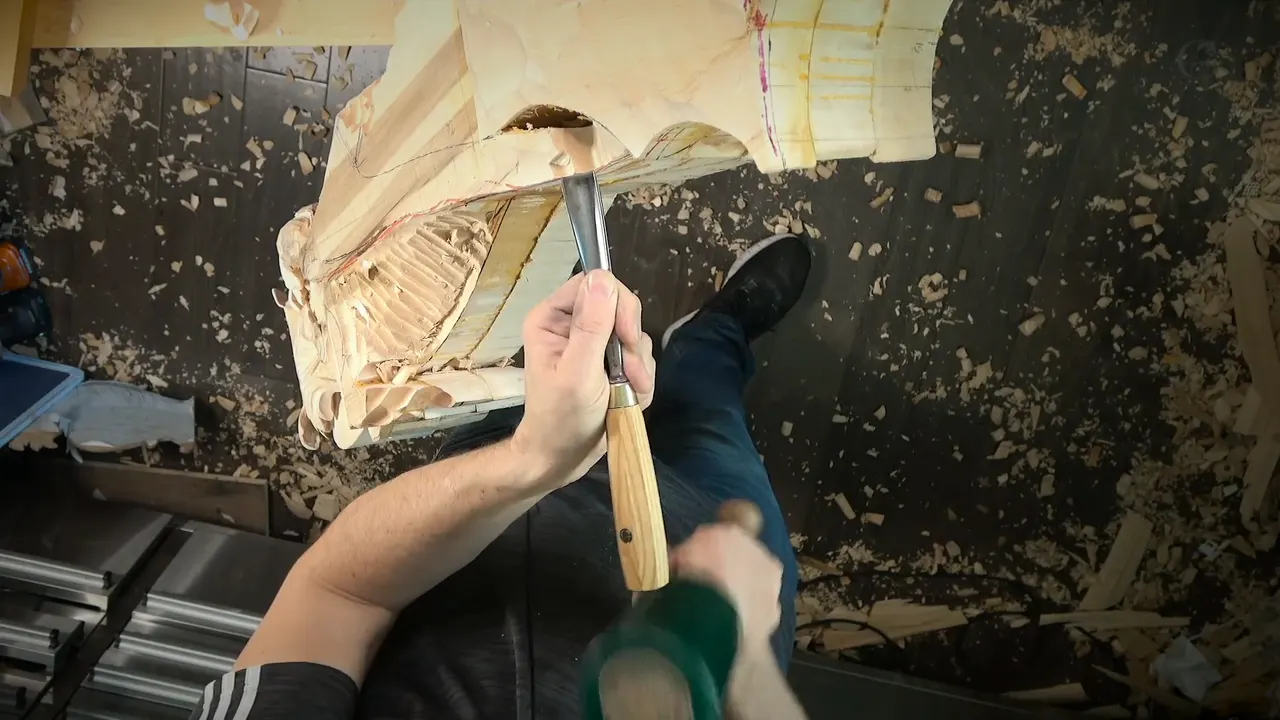

Too late is what I said in part 1 of Venice Room workshop 86, over a mark of my main body that you can't see. The wood had to come down to that line right now, in my plan. My other videos use the same words ahead of a step, near a mistake, and over a spot I could not change anymore.
Have you ever carved right up to a line you needed to keep? Would you like to see where I stopped myself in time, and where a mistake still had a fix? Then come with me through workshop 86, and after that through my other wood carving lessons, each one linked.
Six notes on the main body line
- A mark of the main body was already on the wood, and I said you don't see it.
- Wood off to that line.
- Light cuts came with my reason.
- An angle check followed, with the answer "absolutely not."
- A number one carried the line across.
- Other lessons use the phrase in plans, in fixes, and over spots past changing.
Where do the words show up in workshop 86, part 1?
The part opens with "So that way I will be safe." My drop comes next, running downhill, and "at least some of it I can probably clean."

One side had a line: "I know it's safe to chop this way." After it came "So all that chunk has to be gone, so I can probably do it. Got to be careful how I do it." The plan was perpendicular to the grain, "and in this case, looks like I have to just do it this way."
Then came "Let me think. Well, actually, I got to do a little farther." One chunk was a plan: "I'm going to leave for now this chunk where I would know the boundary." My next plan was "Let me right away get the number three."

Now the line this page is named for. "Okay, what I also have, I have a mark, which you don't see, of the main body in this section. So what I want to do, I want to remove right now to that line my main body. Okay? So otherwise, it would be too late for me."
The reason follows. "So that's why I didn't do too aggressive cuts. In this area."

Cleaning was the plan: "So let me clean or I would have the wrong position." An angle needed a check. "We need to make sure it's at 90 degrees. And it's absolutely not. It is not." A little later came "It's the bad one also."
The number one came next. "Let me get actually just the number one and then put that upside down right on the surface." Then "Here you go." And "I transferred that line, so now I'm safe."

Part 1 ends with "So now I can remove it." One more line follows, a maybe: "Maybe I can just actually create a channel cut right here."
What do the next two parts of workshop 86 say?
A reason comes early in part 2: "If you would ask me why I do that, it's going to be a lot easier for me to create the downhill cut. Just like that. I can pretty much expedite my process." Later on I said my drop was going all the way down.

A flatter gouge comes in: "let me now get that with the flatter gouge. Clean that surface." Then "Okay, and that's it, pretty much. I've got wherever I want to be." One chunk was left, "this chunk which is almost impossible to show on a camera." The removal would come from the backside, I said.
Probably, I said, I could "clean this side also a little more to number seven." Late in the part, "Let me do some of the stuff off camera."
One more line in that part talks about order. "But before I do that, I really need to figure out my drop because it's a part of it." The piece is a corbel, and I said "So it's a really interesting corbel."
Part 3 starts on one section, "concentrate on this section before I go a little farther."
A little later I said how I placed a line. "I printed out the paper and marked every one, every inch, and then I just used the calipers, just the normal calipers, whatever calipers you have." The dots came next, and "then I connected that."
Depth came from the back, with "little different calipers. That type of calipers, which most of the time used by woodturners." Next: "So pretty much, I just referenced from the backside, and I got my depth."

One spot had a limit: "But this spot is exact spot, so I cannot go farther than that." Extra wood remained, "maybe about half an inch or so" (about 13 mm).
The shape was like "a crown molding," with "concave base, the crown with some details on inside." For the tool: "I think the best tool for this operation would be just probably number seven, I would say."
On that block I said "I'm going to stay away from this line approximately three millimeters, about eighth of an inch from both sides." And then "Later on, I'll get to the sharp line. But that sharp line could change."
Another line in the same part says "And yes, I am creating only preliminary movement. It's not final movement yet because I do have a detail which is going to go right on the side, and I want to make sure I'm not destroying that detail."
Which lessons use it before a step?
Workshop 5, part 6, has them in a plan for a curve. "And it is better for me to take care of it right away before it is too late."

A line comes up in workshop 9, part 7: "I also have to probably fix, before too late, overall flowing line, which is not so good as of now." Then came "So I want to make sure that has to be gone."

Over in workshop 43, part 12, I had a big eye in mind. "I could actually create huge eye. Big eye. And before too late, I probably going to excavate underneath." I wanted to do it before I forgot the idea I had in mind.

The Roman acanthus course, lesson 4, part 3, puts the same words just before a small gouge: "let me take my small gouge, number 8, eighth of an inch, and reestablish my eye." That gouge size is 1/8 in (about 3 mm).
In my Lily box course, lesson 3, part 2, small areas get the same words. "They're going to be really visible, and they make a big difference, okay?" Then the plan: "let me make an initial cut."
After the cut came "Okay. That was one millimeter. And now I'll do the half a millimeter." Those are 1 mm (about 0.04 in) and half a millimeter (about 0.02 in). Soon after: "I still have some meat, I call it."
In my Grinling Gibbons class in Maine, lesson 7, part 3, I said "We really need to start undercutting right away pretty much before it's too late." For the tool, a plan followed: "I'm gonna grab again number nine and 10 millimeters" (about 3/8 in).
Workshop 148, part 3, starts with measuring: "So I've got with my calipers approximately the distance from the line at this point."

I went on with "But it's not a big deal. I can always use plastic, by the way." The same words led into "let me get the plastic and I'll just draw on it," for "much easier to find the right position." It was clear plastic, with a permanent marker.
Which fixes were still open?
A mistake sits in workshop 65, part 8. The mistake itself: "I know I said I made a mistake right here, and yes, I did, actually." I added "But that mistake is easy to fix. Not too late to fix, I should say."

What I could do came next: "I could actually bring that slightly downhill." For a gouge I said "Maybe number nine and a quarter inch" (about 6 mm). That was a maybe.
A doubt shows in workshop 63, part 2: "Maybe I'm not doing the right thing right here. So this concave has to continue a little bit on top of it, which is okay." The fix was still open. The concave I planned next was a number 11, "like a channel and no bigger than three millimeters" (about 1/8 in).
An eye bothered me in workshop 66, part 7: "Although, I'm not too happy about this eye." A slight move was a maybe, and time had not passed yet.
Workshop 19, part 10, calls the fix still open. Beside it I put "it's better not to do that mistake what I just done. I excavated too much closer to that edge, and essentially, I lost the material, which I should not."
My note to myself in workshop 49, part 12, reads "I should pay a lot more attention what I'm doing."
A check opens workshop 160, part 2, with "Maybe I could just use a caliper." Then "Use a caliper and check that. Which side I'm off. And I hope I didn't mess up." I added "I know it's not too late yet to fix it, but I still don't like to make mistakes."
Of one side I said "This side, opposite side, is way off."

Which spots were past changing?
Some of these lines hold no fix at all. In workshop 68, part 9, I said "And if I'm not going to like it, it's too late anyway." Then "If I'm not going to like it, I have to do something."

Part 2 of workshop 12 has "Still not sure if I like it or not." Later comes "In my opinion, it doesn't look too bad at all."
Before the spot got deep, in workshop 70, part 3, I said "It looks like I'm okay with this moment." Then "It's already too deep."

The end of workshop 88, part 11, has "I'm still not sure if I'm doing the right thing or not, but that's too late anyway, so I've got to do it this way."

A softer case sits in workshop 93, part 6. I said that if I don't like some stuff, I would change it "until I like it."
Why did the order of the work matter to me?
My Byzantine acanthus course, lesson 2, part 1, says "The problem, what I see, people working on details first." Their words were "I've got the details. I don't want to cut this off."
In part 2 of that lesson I said "Don't spoon it. Okay? Don't dig like a dish in this area. Don't create any concave, okay?" Then "We need that meat. We need that material for the later development."
In lesson 6, part 1, of that course I said "Don't undercut," over an area approximately two inches (about 50 mm) from the end of the stem. Then "I'm glad I stopped".
Another order sits in the furniture panel course, lesson 19, part 3. "But then you have to work on the details, which is not as nice. Okay?" Then "you can't anymore travel without the rocking your router plane."
The same lesson goes on: "So that's why I'm actually taking care of as much as possible with the router plane, where I can have the same height everywhere, consistent."
The design stage, lesson 14, part 6, has "I think it's probably a good idea to figure out everything right now versus too late."
Undercuts have a line of their own. In workshop 144, part 2, I said "Sometimes I'm rushing and create undercuts right away, and later on, I see I want to change something, but it's already too late because I already undercut."

I also said "But I can always undercut little later." Maine class 7 says to do it right away; workshop 144 says later. Each line sits with its place.
Which lessons carry these words, and where?
| Where I said it | What came with it |
|---|---|
| A curve still coming, workshop 5, part 6 | a really nice curvature |
| Flowing line to fix, workshop 9, part 7 | overall flowing line |
| Huge eye in mind, workshop 43, part 12 | excavate underneath |
| Eye to reestablish, Roman acanthus lesson 4 | my small gouge, number 8 |
| First mark, Lily box lesson 3, part 2 | one millimeter |
| Line to find again, workshop 148, part 3 | clear plastic |
| One mistake, workshop 65, part 8 | bring that slightly downhill |
| Caliper check in workshop 160, part 2 | this side is good |
| Lower piece, workshop 68, part 9 | showing some shadow |
| Undercut timing in lesson 144 of the Venice Room | undercut little later |
Is there a line on your piece that you can't see from the top? Could you take the wood down to it with a gouge and some patience? Workshop 86 waits inside one tuition plan, with the rest of Part 8 of the Venice Room, and this page starts at that mark.
How it's done
- Chop where the line is safe. A line on one side told me it was safe to chop that way, and I said to be careful how I did it.
- Leave one chunk for now. Leaving this chunk for now was the plan, so I would know the boundary of whatever the drop I was going to work on.
- Wood off to the main body line. Wood was to come off right now down to the line of the main body, and I kept the cuts light in that area.
- Check the angle. My angle check got the answer absolutely not, and I planned to have the right line.
- Carry the line across. The number one, upside down on the surface, moved the line. Then I could remove all the way down whatever the drop is.
Frequently asked questions
What line did I want reached right now in part 1?
I wanted wood off down to the line of the main body, a mark you don't see. Too aggressive cuts stayed out of that area. My next plan was to clean, since I would have the wrong position otherwise.
Did I say a fix was still open?
A mistake in workshop 65 was easy to fix, I said. Workshop 63 calls a concave fixable, and workshop 160 does too after a caliper check, though I still don't like to make mistakes.
When did I say to undercut right away?
Maine class 7, part 3, has it: start undercutting right away. Workshop 144 carries a warning that sometimes I'm rushing and create undercuts right away, and that undercutting a little later is always an option.
What to carve next