

Alexander Grabovetskiy, woodcarver, School of Woodcarving · Published 2020
What is a macaroni tool in wood carving?
Quick answer: A macaroni tool is a number 23 with two sides and a bottom, which I counted as three chisels. In Venice Room 88.1 I wanted to work beside a volute without undercutting it, and in other lessons I said it leaves a wall close to 90 degrees.
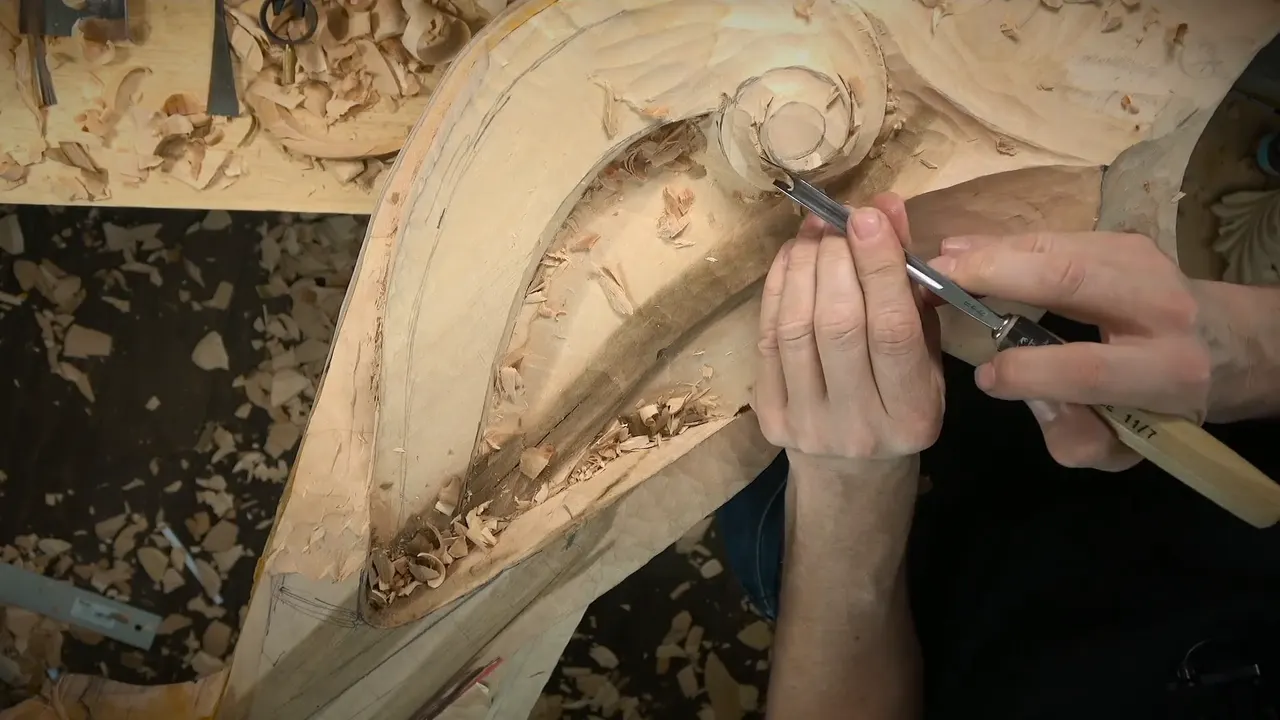

Number 23 is the macaroni tool, a blade with three sides, and in Venice Room 88.1 I said it would let me work right beside my design and create a nice wall without undercutting. My other lessons call it a furniture maker's tool and give the wall nearly 90 degrees.
Have you ever carved right up against a design and worried your gouge would dig under it? Did you stop short just to be safe? Then you know the spot I was in during workshop 88. Below is that spot, then the lines from my other lessons where I name this tool, each with its own link.
Six short lines from part 1 of workshop 88
- A number 11 went in, flute pointing up.
- The profile fit a number 5, and a number 3 could clean the sides.
- About a 16th of an inch (1.6 mm) stayed on the wood for cleaning.
- The design rose along one side.
- Number 23 would suit that wall.
- Some undercutting comes later, I said, with little of it.
What was I doing before I picked up the tool?
Part 1 opens on a number 11. "And let me remove some of that material with the number 11." "But I want to make sure I'm not undercutting, which means my flute is going up 90 degrees pretty much, or 12 o'clock."

Number five was in use right then, and it fits the profile really good. Next in line was number seven, I said, to create a "cleaner cut." Right after, "Well, you know what? I could actually use just the number three, and I clean sides little, but you don't see it."
The number five had been dragging a little bit of the material, so I need to clean it a little nicer. "And let me get again with the number 11, and I'll get little deeper excavation right here. But again, I don't want to undercut. That would be big mistake."

Here is a figure I had not said out loud. "I left approximately a 16th of an inch to my final line. I didn't mention it." That is a little more than a millimeter and a half. Before that I had told you I was very close, right there, and that a little bit stayed for the cleaning operation. "It's always good idea to leave a little bit."
Back to the 11. I was butting against one of the sides, with my flute at 12 o'clock, just trying not to undercut. One of the sides was rising pretty much on the side of the design itself, the volute part. "As of now, later I will undercut."

Why did I reach for number 23 beside the volute?
It gets me close to the design and leaves a nice wall. My exact line was "But I can get really close to the design and create really nice wall without undercutting." Just before it came the description. "Macaroni tool is just like that. So just three sides, three chisels, one chisel, two chisel, number three chisel."

Undercutting was still ahead of me. "Like I said, later on, I will undercut. But not much." A change of tool came next, and I said it plainly. "Let me switch again to number three. And clean everything right here. Beautiful."
In an aside near the end of part 1, I said the same tool could go around this part. "That way, I'm not going to destroy a wall of my volute."

What did it do in parts 2 and 6?
In part 2 I said, "And again, let me use a macaroni tool." It was going to give me a "really nice transition uphill." Further on I said, "And maybe macaroni tool." My number 11 there was seven millimeters (0.28 in), and I said I would leave on a side about the same amount of the distance.
Part 6 puts the cleaning off. "I'll take care of it off camera another time. So let me attack right now on inside with the macaroni tool." "And now it is much easier for me to get and clean a little better." Establishing the details on the inside of that section has to come a little later, I said.

Where did I first give this tool a name?
The seventh video of Furniture Panel 16 has it in plain words. I had not gone all the way to the edge, and you know the reason why, I said. "Because I don't want to destroy the edge." My plan there was number 23.
"By the way, the name for this tool is macaroni tool. Same like a product you buy to make a pasta." Macaroni is not a name I use myself, and my own preference stays number 23, but that's the name for it.

Then, "See? And it just gives me perfect cut without digging underneath." Some of that material can come off too, I said. I also probably could chop down with the same tool and make a couple of relief cuts, and be careful with those relief cuts, I said, because you really can overdo it.
What does the tool look like, and what size is it?
A cheek on each side and a bottom. In Floral and Molding for the Panel 3, first video, I got one out in case you want to buy one. "That is how it looks. It has two sides, two cheeks, and the bottom." It's actually the furniture maker's tool, I said, and if you are a furniture maker, that is the tool you probably have to invest in. It really does the job. It attacks the sides and also cleans the upper surface.

Lesson 8 of that course counts the blade out loud, and I counted it as three chisels. "It has two sides and a bottom. That's three chisels. Chisel, chisel, and chisel." Let me try six millimeters (0.24 in), I said, and if it ends up too big, I'll switch it to four millimeters (0.16 in). The six is a number 23, and the handle says SWISS MADE. That puts the maker in Switzerland, and a couple more companies make such tools too.

Roman Acanthus 16, fourth video, has the four millimeter size. In my case it's a four, and it has a wall and a bottom. A "90 degrees cut" comes automatically, and if you do have that tool, it's actually handy to have for cases like that.

Venice Room 90, sixth video, says I can take number 23 again, a macaroni tool and four millimeters (0.16 in). "Same way like what you eat." A neighbor exists too. "There is another tool called Fluteroni, pretty close neighbor. It's to make flutes."
How square is the wall this tool leaves?
Almost square, though my own lines do not all say the same thing, so here is each one where it sits. In Furniture Panel 18, second video, I could take it around and carefully shave out whatever stuff accumulated at the edge, I said. I really love that tool just because the wall comes out square. "Beautiful."
The sixth video of that lesson has me checking. I really want to see if this wall comes out at 90 degrees, I said. You could lay the tool the opposite way, I said, and create your wall at 90 degrees that way if it needs to be a little higher. Looked at from the side, it leaves a perfect wall on the inside. "That's what I'm after."

The tenth video has an apology. "When I said that it gives me a true perfect 90 degrees wall, it's not exactly 90, okay?" A little taper is there, I said, but I get 90 degrees if I lean a little bit. And it is pretty close.
Workshop 90, fifth video, says almost. "It's not 90 degrees, but almost 90 degrees wall." "That's a really nice tool to have for architectural carving," I said. "Again, that is just an indication. It's not a final cut." At that point I was about 3/16 of an inch deep, or about 4.8 mm. Video seven puts the depth at about quarter-inch (6.4 mm). Then I said I could probably use my macaroni tool again, and it will give me right away very much of all that I'm after.
On a live session in April 2020, reading comments, I said it is not the veiner. "So that is macaroni, although it's not really 90 degrees." The blade is actually a little sloped, I said. The fluteroni is really similar, but more pronounced, and it's for the flutes. Both are for furniture makers.

How did it help me get close to an edge?
In the ninth video of Furniture Panel 17 I said, let me use just a number nine and a quarter inch (6 mm), just to get a little closer to the edge. Then, "And maybe specialty tool, macaroni, if you like the name, and six millimeters will work nicely also." Six millimeters is a little under a quarter inch.
Lesson 18 of that course, fourth video, goes for number 23 again. The same can happen on this side, I said, and then I come right up to the line.
Do you have to own a macaroni tool?
Owning one is up to you, and I said so in several places. Over in Furniture Panel 15, second video, I said, this is, for example, number 23 and 6 millimeters (0.24 in). "So it's like 90 degrees on both sides, and you can get really close to those straight lines. Gives you a lot more control." My goal, I said, is to not touch the edge. I added that you don't really have to use that tool, but I think it gives really good control.
There are all types of specialty tools, I said, and pretty much only furniture makers use this one. "And yes, you could use a mallet. It would give you a little more control with this tool. I am using just a brass mallet and knocking like that."

Furniture Panel 20, second video, answers someone who asked why I didn't use a 90 degrees V tool for those walls. I used the number 23 a lot, and most of you don't have it probably. "But there is such a thing as a 90 degrees V tool, and you could use it. Okay? And nothing wrong with that."
If you are a furniture maker, I said in video seven of workshop 90, that is a really good tool to have. Attacking the wall also like this is possible, I said, and it creates a really nice and beautiful transition. Asked why I don't use a V tool at that angle, I said, "Oh, absolutely you could." And then "I just like that tool, okay?"
In Floral and Molding for the Panel 5, second video, a preliminary cut came up, and I should probably grab a macaroni tool. "You don't have to, okay, and I don't have to." It's a quarter inch approximately (about 6 mm), I said, and I'll just get a quarter-inch gouge and get right underneath there.
Venice Room 160, third video, shows the choice from both sides. I can lower one section approximately one-eighth of an inch, about three millimeters (0.12 in), and for me it would be much easier to use just the macaroni. "Maybe I will, maybe just to save time." But on the other hand, I can just use normal tools, and in this case I'm using just a 1.5 millimeter (0.06 in) veiner.

Where does a macaroni tool come from?
The molding course, lesson 8, calls the tool pretty much authentic to Italian carvers. "So that tool was made by furniture makers in Italy. So I'm okay with using that on this project." I did not use any V tools there, I said, because they didn't have one. "And I don't think they had the macaroni back then, but it's okay, I'll just use it just for the sake to show that to you."
Italians invented that tool, I said in Venice Room 90. The Furniture Panel 20 lesson mentions the 18th century. My wish to be authentic came up, V tools were not invented for a long time, and "also probably I should say macaroni tool. It wasn't the tool in the late 18th century in most of the countries."

What did I say about the macaroni tool, point by point?
| The point about the tool | Short version |
|---|---|
| How many sides this blade has, I said | three sides |
| What I call it | I just prefer to call it number 23 |
| Who reaches for it | pretty much only furniture makers |
| The shape, as I showed it to you | two sides, two cheeks, and the bottom |
| The wall's angle | a slight taper, pretty close |
| Whether you need one in your own set | you don't really have to |
| What the wall lets me do beside a design | a nice wall, no undercutting |
| How I labeled one cut in workshop 90, video five | just an indication, not a final cut |
Is there a wall on your own piece you want to carve right up to, without digging under it? Could a blade with three sides do that job for you, or would your usual gouge do? Workshop 88 waits inside one tuition plan with the rest of Part 8 of the Venice Room, and this page starts at the volute, with number 23.
How it's done
- Aim the flute up. In workshop 88, part 1, my number 11 went in with the flute pointing straight up, because I wanted to be sure I was not undercutting.
- Stop short of the line. I stopped shy of my final line, right there.
- Reach for number 23 beside the design. I called number 23 a really nice tool for the spot where the design was rising along one side.
- Switch to the number three. My next tool was number three, to clean everything right here, and then came the word beautiful.
- Keep the volute wall safe. I could use the same tool to go around that part, I said, and that way I would not destroy the wall of my volute.
- Undercut later, and not much. Later on I will undercut, I said in part 1, but not much.
Frequently asked questions
Why do you call the macaroni tool number 23?
In lesson 16 of my furniture panel course, video seven, I told you macaroni is not my own word for it and I just prefer number 23, though it's only my preference. The name matches the product you buy to make pasta.
Does a macaroni tool leave a perfect 90 degree wall?
Close to it. In video ten of panel lesson 18 I apologized, because the wall has a slight taper, though I still get 90 degrees if I lean a little. My words in workshop 90 were almost 90 degrees.
Can a 90 degree V tool do the same job as number 23?
Back in workshop 90 I said that if you asked about a V tool at that angle, absolutely you could, and I just like the other tool. In panel lesson 20 I said such a tool exists and there's nothing wrong with that.
What to carve next