

Alexander Grabovetskiy, woodcarver, School of Woodcarving · Published 2020
What does a wood carver mean by a straighter gouge?
Quick answer: Straighter shows up in Venice Room 88.5 as the tool to fetch, with plans to go around after it. In a Lily Box lesson the same word sits beside "Less sweep gouge." In a flower rosette lesson, a straight gouge is "actually straight all the way," unlike a fishtail.
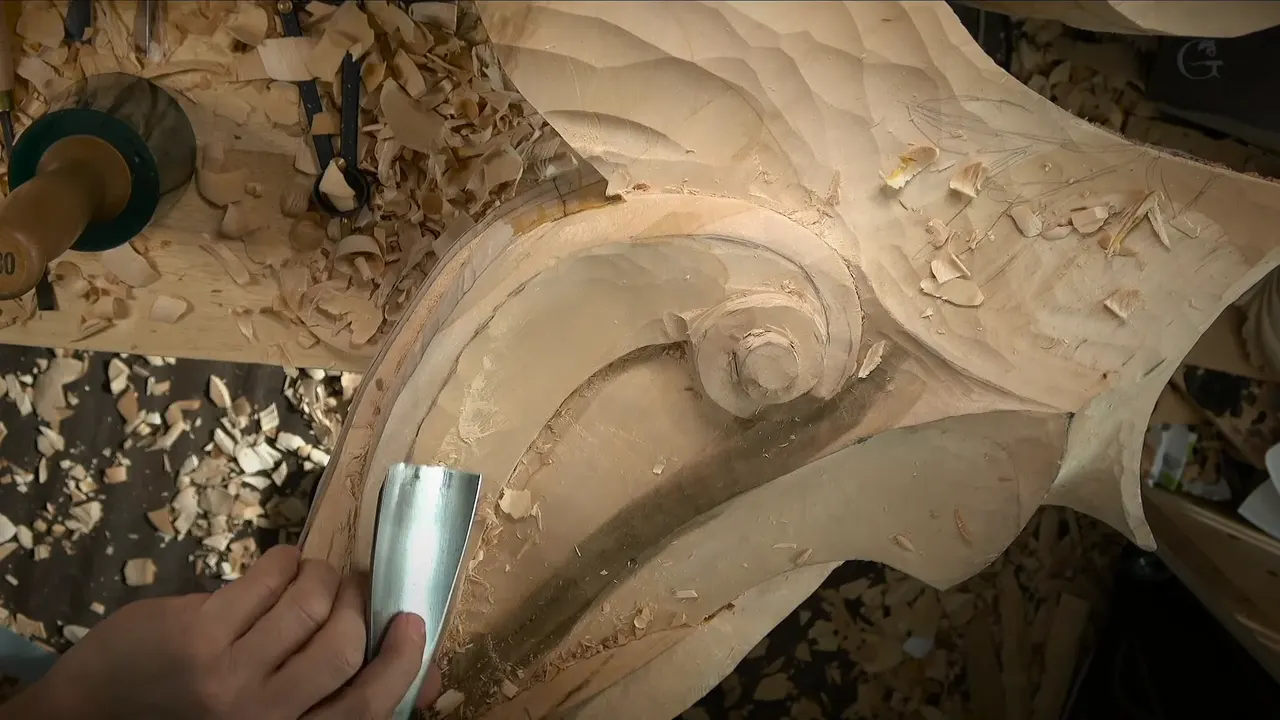

Straighter turns up in Venice Room 88.5 near the six-minute mark, not long after a plan for more depth. It reads as a gouge to fetch next.
Ever stood over a hollow with the wrong tool in your hand? Did the tool tell you before the first pass? Then you know the moment this part of workshop 88 sits in, as any wood carver does. We open with my short video. After that, one word leads us through lessons from my other courses.
Six beats in this video
- A doubt, and then a wish for more exaggeration in a concave.
- Verdict first, then a deeper hollow to come.
- The marriage line, named after a catch in the grain and a spot to blend.
- A smaller seven, plus a need for more depth.
- A planned flute position, from 12 toward 11, with a turn to the left.
- The straighter tool, and a plan to go around, with a size after it.
What comes before the straighter tool?
Four words open the captions, "More with this way." Next a wish meets a doubt. "I think I'm going to do a little more exaggerated concave right here." Then, "I don't know if I should or not, but I want to see a little more exaggeration."

"All right. So really nice and beautiful." Then the verdict is firmer, "So I think it's really good." A deeper hollow arrives next, "But now it's going to be much more deeper concave in this area."

A promise about rough spots follows, "And yes, I will take care of some of the rough spots." Then a name, "So that spot I call marriage line." The grain comes into it, "the spot where the grain actually catches." The line that closes it reads "So it's area where I have to attack from both sides and really blend that in."

Tools come next. "A smaller one, number seven, and create that concave right here." A need sits beside it, "And yes, I need to go a little deeper." Cleaning waits, "clean it little more little later."
Where does a clock face come in beside the hollow?
A position comes with a plan. "I'm going to start my concave, actually, if I position that would be a flute, which is the middle part of a tool, 12 o'clock." The turn comes next, to the left, "about 11 o'clock, I would say, and go like this."

What follows in the captions?
The caption reads "And let me get the straighter tool." Two plans trail it, "And I'll go around," and "I'll remove all around the material." Between them sits a size, "And again, number seven and half an inch." That size is 12.7 millimeters.

The part closes on a blend. "So what I'm after, it's a really nice blend." The last words are "between this concave and the upper part." Nothing in the captions gives a number or sweep for the straighter tool itself, and this page adds none.

What do the next video and the one before add?
The sixth video of the workshop has the word with "again" in front of it, "again, a straighter tool." A plan for the shape follows, "So concave, concave, convex, convex." A convex shape is the aim. One tool is only a maybe, "a straight tool a little bit and just shave it like that."

A move follows, "I have to change the position and attack from this side." Part 4 holds a move too, "Got to change the position," beside a worry that "it's going to split." Both videos live inside the workshop page linked here.
Which Panel lessons use the straighter tool?
Furniture Panel 19, third video: the hits come first, and the line that matters sits after them. "So all it does is just relieving." Then, "much easier then to get a straighter tool." Two options follow, "A couple ways I could do," and "I could take number 23 specialty tool and get closer to the wall like that."

Edges are the subject in Furniture Panel 26, first video, and the word comes up quickly. "I can attack, uh, those edges with a straighter tool." A pick follows, "Maybe number two, number three will do." It is settled later, "Maybe that will be number three," at "12 millimeters in this case" (0.47 in).

Size comes up in the third video there, "So it's a 14 millimeters, little bigger than half an inch" (0.55 in for the 14). A bigger tool stays an option, "I could use, actually bigger right here, but it's already straighter. Not really straight yet."

Placement shows in Furniture Panel 28, third video. The words are "Some kind of straighter tool, maybe number three. And in this case that would be a quarter inch number three." That quarter inch is 6.35 millimeters. Next in line is "I'm gonna just place it right on the line right here."

Furniture Panel 32, first video gives a plain line, "the flatter tool I'm using is just on number three." Later comes "And then one more straighter."

Which number goes with straighter in other courses?
The first video of Floral and Molding 10 pairs the word with a size. "just any straighter tool, any straighter gouge, maybe about number two, number three will work." Then comes "I'll get probably number two and 12 millimeters" (0.47 in), with "pretty close" a few lines later.

Third in the list is Venice Room 123, where the video begins with a verdict. "No, it's not going to work." Then, "take straight or straighter tool, like a number three." A change of design is a plan soon after, "change a little bit design."

A self-fix sits in Venice Room 25, seventh video. "Straight tool or straighter, I should say, straighter tool." The size is "just number five and a quarter inch" (6.35 millimeters), for the job "attack those corners."

Number three is the pick again in Venice Room 27, fourth video. "Now I can probably establish better form. Much better form." Then, "And I need something straighter, maybe even just number three." Beside it, "Number three if it's English-made tools." The aim follows, "just give a better shape."

Short is the line in the tenth video there, "Okay, let me use a straighter tool." After that, "I can work probably on more final details."

Does straighter go with a straight-down pass?
A need comes first in Venice Room 138, second video, "I need to make sure I'm not losing the picture." The plan is "So I will have to hit that straight down with the straighter tool. Maybe number 3 will work." A little later, after "my stem and my petals," comes "this flower is more like relief carving."

A sweep sits beside the word in Lily Box 8, twelfth video. "And again, I'll use straighter gouge. Less sweep gouge, okay?" A plan to clean the opening finishes the line, "And clean it."

Cleaning is the job in Grinling Gibbons, Maine class 4. "Those areas all is going to take just the cleaning up pretty much. And cleaning up you can do with the straighter tool. Just like that."

The April 2020 livestream has the word after a cleanup. "Can you see I'm actually getting that area cleaned up pretty much, and now I need to get some kind of straighter tool." Next come the words "maybe about a number three and a quarter-inch, six millimeters or so." A mallet comes into the next line, "I'm not afraid of using any mallet." Six millimeters is about 0.24 in.

Does straighter ever come with a warning?
It does in Venice Room 33, sixth video, where the grain gets named first. "Because of the grain's direction, you could easily break it if I were just to start poking with just a straighter gouge and just create a separation right away. That would not be the best practice." The line after it moves on, "Now, after relief, I can always go with the straight tools."
A tendency comes first in Venice Room 26, second video. "I have a tendency to move downhill, and I have to take care of this ridge." Two options follow. "I could just take a straighter tool." Another option is "And maybe actually back bend right away, pretty much right in the middle."
What does straight mean next to a fishtail?
Flower Rosette 1, third video, sets a straight gouge beside a fishtail. "You can see the straight gouge is actually straight all the way, and the fishtail, it has a shape of a tail of a fish." On the corners, "they help me to get to really tiny spots when I'm carving."
A whole short video in the questions and answers course takes up straight gouges against fishtails. "Fishtail, a longy, and a straight." On the longy, "It tapers," and "It's not straight." Then a limit, "With a longy and a straight tool, you can get inside, but you cannot rotate the tool." A corner is the second point, "I can get in some tiny spots where I can't get with a straight tool."
When is a straight tool not the one?
The plain word has a second life. Room is the reason in Venice Room 62, sixth video, "Because everything is in my way now." Next, "I can't use a straight tool." The fix is "So a back bend just helps me."
A shorter line sits in Venice Room 71, sixth video, "That straight tool is not going to be good. Have to use a long bent." The second video there has "So it's not too convenient for me right now, this area." Then comes "But let me try just the skew."
Two answers stand side by side in Venice Room 68, eighth video. First, "Maybe not even back bend. I could use a straight tool because I do have accessibility." A little later, "Although it's still not convenient with straight tool. It still has a limitation."
Venice Room 76, fourth video, gives the back bend its reason. "So that is almost impossible to do with any straight tool." Then, "the back bend allows me not to damage opposite side because it just rides above it."
Space is the reason in Hashemi Flowers 9, fifth video. "But when I'm pushing with a straight tool like this, I don't have enough space to make a slice, and with the skew one, I'm just pushing actually forward." In the seventh video the line is "the straight tool, it's impossible to get there."
Cleaning is the other use. The sixth video of Hashemi Flowers 14 has "I can always clean if I have to," and the tools named are the straight tool and the straight chisel, with a knife last. The first video of Hashemi Flowers 13 has a plan, "I'm pretty sure I could actually use just a straight gouge, like number nine," at "10 millimeters" (0.39 in). Its second video adds the grain, "when you're working cross grain, you can actually control much better."
Plate with Butterflies 12, third video, uses the word for a knife. "Again, when I get closer to this point, I make my knife a little straighter." The next words are "So it was like this, and then I just raised up."

Where did I say straighter, line by line?
Beside straighter in these lessons sit a number three, a number two, a quarter inch, 12 and 14 millimeters, a mallet, edges, corners and a fishtail. Here is a run of it in one place. Each row names its video, so you can find the line from the lesson page.
| Video | What stood beside straighter in the captions |
|---|---|
| This video, part 5 | a tool called straighter, with a seven and a size next |
| Workshop 88, sixth video | again, a straighter tool, plus a maybe for a straight one |
| Third video of room 123 | straight or straighter, after a first line that says it will not work |
| Venice 138, second video | a hit straight down, with a number 3 that may work |
| Panel course 19, third video | relieving that makes a straighter tool easier to get |
| Panel 26, first video | edges, with a pick of number three, 12 millimeters |
| Third video of Panel 26 | 14 millimeters that is already straighter, not really straight yet |
| Panel course 28, third video | a quarter inch number three, after a straighter tool |
| Floral and Molding 10, first video | any straighter gouge, with a pick of two or three, then 12 millimeters |
| Seventh video, Venice 25 | a self-fix, then number five and a quarter inch for corners |
| Fourth video, Venice 27 | something straighter, with a note on English-made tools |
| Lily Box 8, twelfth video | a gouge with less sweep, to clean an opening |
| Livestream April 2020 | a size of about a quarter inch, then a mallet |
| Flower Rosette 1, third video | a straight gouge set beside a fishtail |
| Q and A video | a longy that tapers and is not straight |
Which gouge would you reach for beside a wall you are cleaning? Could a number three be the one? Part 5 waits inside one tuition plan with the rest of Part 8 of the Venice Room, and it holds a deeper concave.
How it's done
- A doubt before a deeper concave. "I don't know if I should or not."
- A spot that catches. The marriage line is tied to a spot that "actually catches."
- A flute position, planned. The plan names two hours on a clock face, 12 and about 11.
- A straighter tool, to fetch. The next thing to get is "the straighter tool," with a plan to go around.
- A seven at a half inch, named. It comes after the tool, and a plan to remove material all around follows.
- A blend as the aim. The aim is "a really nice blend" between "this concave and the upper part."
Frequently asked questions
What do the captions plan after the straighter tool in part 5?
Two plans trail it, "And I'll go around" and "I'll remove all around the material." A size sits between them, a number seven at a half inch, which is 12.7 millimeters.
Do the captions say which gouge the straighter tool was?
The 88.5 captions give no sweep or number for it, only the seven and the half inch that follow. A Lily Box lesson ties the word to a gouge with less sweep.
Which gouge numbers stand beside the word in other lessons?
Number three comes up in Furniture Panel 26, 28 and 32, Venice Room 27, 123 and 138, and the livestream. Lesson 10 of that floral course has number two or three, and Venice Room 25 has number five.
What to carve next