

Alexander Grabovetskiy, woodcarver, School of Woodcarving · Published 2020
What does a wood carver mean by "inward"?
Quick answer: Inward is the last word of my line in Venice Room workshop 88, part 10, about a plan to excavate deeper: "the movement inward." In other lessons it sits beside barrels, curls, rolled edges and warnings about the angle of the tool.
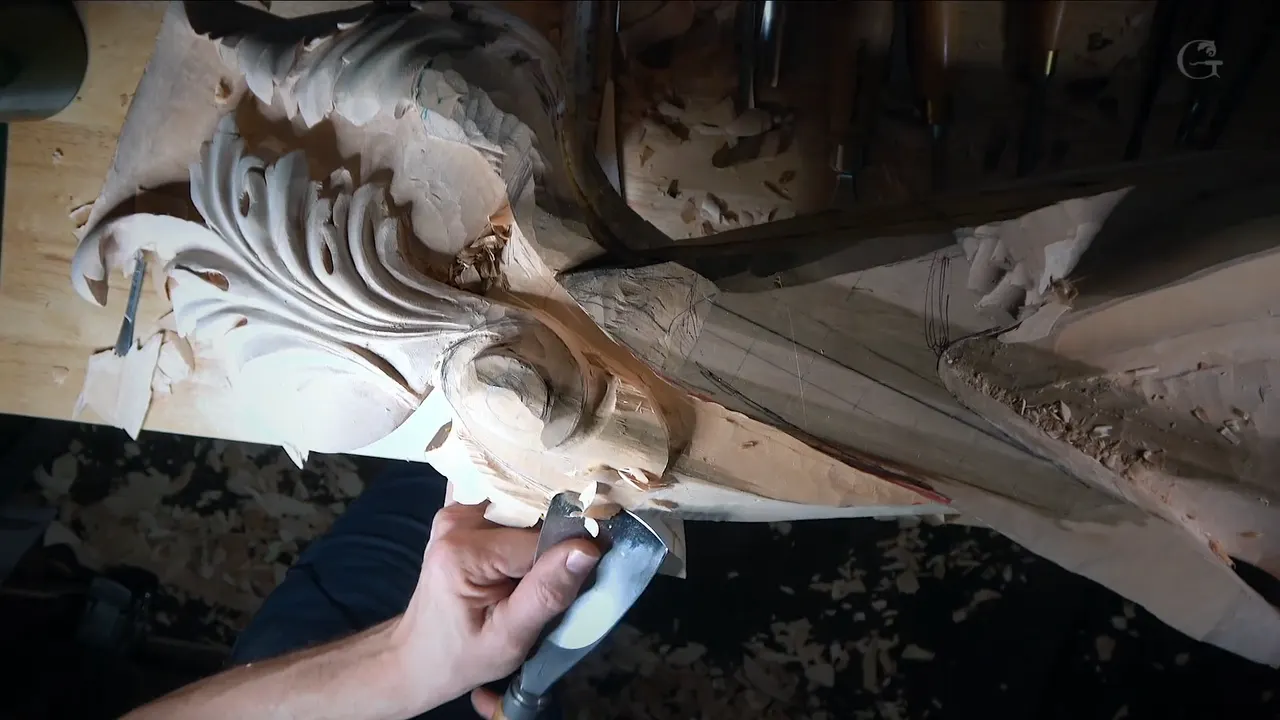

Inward, in Venice Room 88.10, is the last word of my line about excavating deeper: "the movement inward." Barrels, curls and rolled edges sit beside that same word, and so does a warning about the angle of the tool. Each lesson below gets its own lines.
Ever planned a hollow that you could not quite picture yet? Did a shape ever look right from the top and wrong from the side? Then walk through this video with me, and through the lessons where the same word turns up.
What does part 88.10 say before the word inward?
Tools come first in this video. "Number 7, that's what I need next." Then "Number 7 or number 5 will work," and a change of mind: "Well, actually, you know what? I can just do it with the big one."
The talk goes on with "With the number 7." Then "And that would be a little too big," and the decision "I'm going to use that number 7."

The view comes next. "And again, like I said, I am looking from the side view, and I want to make sure this line is actually flowing in 3D also really nice." Then "Even if it's not going to be visible," and "know if something's wrong."
A look at the lights follows: "let me reposition my lights again," then "Maybe just turn this way a little bit," and "Okay, that is good."
Which lines lead up to the deeper excavation in 88.10?
The next plan is to refine a line. "Let me refine that line because I do have a spot where my blade started, and I have some kind of rough spot." Then "Okay, so that's not too good. So let me refine that separation cut."

The form comes next: "that is exactly the form I'm after, so that has to be just from in, up, and down again." The final shape is for later: "But I will worry about the final shape of it a little later."
The tools keep coming. "Now, just a little cleanup, and I'm going to need the spoon." Then more light: "add a little more lights. Right now, just a little too dark." Then "Okay, so I've got extra lighting on, so it should be much better."

One spot gets attention: "later on, I might have to clean a little bit this section that doesn't look too good." The plan changes with "Oh, why not?" Next come "I can actually do it right now" and "I can chop some of that stuff out right away."
A curl is next. "And that is going to also curl this way. Let me chop right away." Then "So everything is pretty much just going to curl like that, all of them."
Which words in 88.10 carry the movement inward?
A decision is next. The line is "the next cut I have to do." Then "And now I have to make the decision," and "keep that part or I should get rid of it." Right behind it: "I don't know. That's kind of hard."
Behind it sits a plan for the sides: "one of the sides is going to go and continue this movement." Then "inside an inset, almost like a panel look on inside."

A part in the way follows: "But this is kind of in the way. But on the other hand, that is actually really good movement to create the starting point, and I somewhat like it."
The last lines carry the word. First "this is going to be challenging for me a little bit." And "I want to excavate a much deeper cut in this area because it's going to create the movement inward." And "It's hard for me to explain, but you'll see. Okay? You'll see."
Where else in workshop 88 does the word inward sit?
The 88.11 video holds the word in a plan: "I have to cut inward on inside." Behind it sits "almost like undercutting in this section." A tool change follows: "I need to change the tool and create that slope," with "I'm using number three right now."
The wall of the inner detail has its own line: "I still have to see the wall of that inner detail. The idea is the same what I have right here. Okay? Like a rib almost." And "it has to go this way also."

The depth line reads "I have to create much, much deeper excavation right here." Then the barrel: "I still want to keep the barrel look. That's what I call it." Then "around the barrel, I still have to create the cut."
The outline plan names "number 11" together with "7 millimeters" (0.28 in). The doubt is plain: "I'm still not sure if I'm doing the right thing or not, but that's too late anyway, so I've got to do it this way."

In 88.9 the line is "a lot more movement this way," with the view "when I'm looking from the bottom." A barrel exposed is a plan as well: "a barrel exposed," and "it's going to point just slightly this way." The whole workshop sits on the workshop 88 page.
How does inward sound in other Venice Room workshops?
Workshop 45 has the barrel too: "because that barrel is supposed to go inward, inside." The gouge is "number 11 and 12 millimeters" (0.47 in), and the slope is "a little different slope."

The same workshop holds the repair: "Now, the barrel needs to be fixed inward. That was just preliminary, like a square block is what I did, but now it has to make sense and follow the movement." The lesson is Venice Room 45.
Part 45.6 holds a plan: "I could actually take this and bring that a little bit inward like that, okay?" Then comes what I'm trying to explain: "I can actually create the feel that this one is growing from underneath of that."
An eye gets the word in workshop 49: "here is the eye." After that, "the movement's supposed to be this way, okay?" The black spot follows: "I have to excavate that black spot right here. Okay? And that then is going to feel like that moves inward." A ridge follows: "I need to blend this ridge, get rid of the ridge." That one is Venice Room 49.

A small push meets a limit in workshop 44: "a little inward cut. Not too much to the pipe. I don't want to undercut underneath of that pipe." Next: "I think it's given me enough movement."

Over in workshop 127 the lines are "I need to relieve it much better now and make it a little deeper." Then "I'll just move it a little more inward."
An edge sits close in workshop 159: "just because I've got the edge really close, it is better to attack actually from outside inward." The reason is "you can catch the edge of it."
A tool size sits beside the word in workshop 43: "number five and one inch" (25.4 mm), then "make that movement go inward." In workshop 71 the word is a question: "I'm not sure if I want to do any separation inward on inside. Maybe I do."
Part 9 of workshop 71 pairs the word with a shadow: "a shadow that I'm after. And little inward also like that." Its gouge is "number nine and one-eighth of an inch, 3 millimeters" (3.2 mm and 0.118 in).
Which other courses use the word inward?
Panel lesson 13, part 1, has "all the cuts are going to go from out inward." And "a really, really nice movement on inside."
Carving Floral and Molding for the Panel 13, part 2, has a slope: "now it's sloping outward, but I have to do opposite direction. So really have to just slope inward, just like that." Its tool is "4 millimeters number 11" (0.16 in), and the line goes on: "Like I said, I am creating movement inward, okay? But be careful not to overdo it."
Carving Hashemi Flowers 48, part 3, moves a curl: "So let me use number six and bring that curl a little more inward." Next comes "I'll take half a millimeter, number 11" (0.02 in). Then "Now, hopefully, you can see that curl's inward a little more."
In part 6 of that lesson the doubt is: "Maybe yes, maybe I just should just take out and just make it curl inward a little bit. Maybe it's a good idea." Its size is "number four, 10 millimeters" (0.39 in), and "3/8 on each" (9.5 mm).

The grape leaves vase, lesson 3, part 4, has "a cut inward, just like that." My reason is "it's not really necessary cut, but I think it just gives an extra dimension, extra depth feel-ish. Okay? So extra shadow."

Carving Roman Acanthus 16, part 4, limits the angle: "inward on the inside. Not like 90 degrees." After that, "I want to see some shadow play also." And "Don't forget to slice it."
Hazelnuts, part 7, has "I'll use this spoon gouge upside down," and then "kind of dig inward." The husk is the reason in my words: "the husk is in my way."
Carving Hazelnuts 1, part 2, marks a direction of travel: "it is good idea to just always attack from outside edge inward, to the center." Then "Don't be tempted to attack along the grain like this," and "you're going to split."

Carving Plate with Butterflies 12, part 3, has "do an inward cut like this. Okay? Exactly the same idea." Lesson 8 has "I'm gonna angle it." and "inside inward because we're gonna have the same idea."
Carving Modern Acanthus 6, part 3: "make it feel like it's a rolling inward." Then "You have to feel the grain." My tool is "number 11 and 3 millimeters" (0.12 in).

Carving Grape Onlay 6, part 1: "outside inward and I'm gonna chop some of that material." The stop is "approximately about one eighth of an inch" (3.2 mm), "three millimeters" (0.12 in), "from my outline."
Carving Grape Onlay 11, part 1, names "number eight and about 10 millimeters" (0.4 in) and the angle "maybe pointing slightly inward."
The Tray of Blessing 8, part 4, changes the angle: "My first angle was like almost flat and I was pointing toward outward. But now I'm pointing slightly inward, but still only corner of the tool."

Does inward always start at the outside edge?
Carving Modern Acanthus 7, part 2, says it plainly: "now we're gonna attack from outside inward." The big tool is "number nine in my case and 20 millimeters" (0.79 in).
Grinling Gibbons Maine 1, part 3, names the exception: "since we just sloping everything we're gonna go from the inner part toward the outside, but be careful."
The Tray of Blessing 6, part 2, turns the direction round: "we did from the outside inward, but now it's the opposite direction." The size is "number nine and 20 millimeters" (0.79 in).
Carving Plate with Butterflies 10, part 1, has "done from the outside inward." And "The knife is almost going to lay."
Carving Furniture Panel 18, part 5, has "start from triangle and go inward." Its size is "one millimeter" (0.04 in).
Carving Byzantine Acanthus 2, part 3, has "attacking from that black line inward." Then "Don't dig too deep," and "start escaping out."
When is inward a warning?
Workshop 85, part 6, has "I'm not placing my tool inward." Then "So that would be big mistake."
Carving Furniture Panel 16, part 5, has a corner: "Again, make sure you don't undercut. So what I mean, don't lean inward." Then "Not really a critical mistake, but still a mistake." The plan names "quarter-inch number one" (6.4 mm).

Carving Hazelnuts 6, part 2, warns about depth: "don't try to dig too deep because what can happen, you can roll it inward, and it's not going to look right because there is some kind of center somewhere." Then "you have to make sure it feels like this hazelnut grows from the center."

One line there reads "Don't take less than three-eighths of an inch or 10 millimeters" (9.5 mm or 0.4 in).
Which lesson holds which line?
Each row below names a lesson, so you can find the line on that lesson's page and read the lines around it.
| Where | His words | Then |
|---|---|---|
| The workshop 88 video, part 10 | create the movement inward | It's hard for me to explain, but you'll see |
| Next video | I have to cut inward | number three |
| Venice 45.9 | that barrel is supposed to go inward | different slope |
| The eye in 49.2 | going to feel like that moves inward | I need to blend this ridge |
| Venice 85.6 | I'm not placing my tool inward | big mistake |
| Hashemi Flowers 48 | you can see that curl's inward | an undercut |
| Furniture Panel 16 | what I mean, don't lean inward | a critical mistake |
| Roman Acanthus 16 | a little bit inward on the inside | shadow play |
| Hazelnuts 6 | you can roll it inward | grows from the center |
Which part of your own piece needs a hollow you can still plan? This video waits inside one tuition plan, with the rest of Part 8 of the Venice Room.
How it's done
- Pick the tool. "I can just do it with the big one."
- Check the line. "I want to make sure this line is actually flowing in 3D."
- Find the rough spot. "I do have a spot where my blade started."
- Name the form. "That is exactly the form I'm after."
- Plan the depth. "I want to excavate."
Frequently asked questions
Which sentence in 88.10 holds the word inward?
The sentence ends on "the movement inward," and right behind it come the words "You'll see." In 88.11 the plan sits beside "almost like undercutting in this section."
Which tool does 88.10 start with?
The video opens on a tool pick, and the line right after it reads "Number 7 or number 5 will work." A plan for "the spoon" sits beside a plan for "a little more lights."
Is inward always a good direction?
Venice Room 85.6 puts the word beside "big mistake." In the Furniture Panel course, part 16.5, it sits beside "still a mistake," and 88.10 marks a plan with "the movement inward."
What to carve next
- Venice Room 88
- Venice Room Part 8
- Venice Room 45
- Venice Room 49
- Venice Room 44
- Venice Room 43
- Venice Room 71
- Venice Room 85
- Venice Room 127
- Venice Room 159
- Floral and Molding for the Panel 13
- Hashemi Flowers 48
- Carving Vase with Grape Leaves 3
- Roman Acanthus 16
- Carving Hazelnuts 1
- Plate with Butterflies 12
- Modern Acanthus 6