

Alexander Grabovetskiy, woodcarver, School of Woodcarving · Published 2020
What does a wood carver mean by "plenty"?
Quick answer: In Venice Room 88.4, plenty follows a quarter-inch gap (6.35 millimeters) at the lowest part: "I think, plenty." Next the gap moves to "Ten millimeters," with a shadow as the reason beside it. Other lessons use the word for depth, thickness, room, screws and a micro bevel.
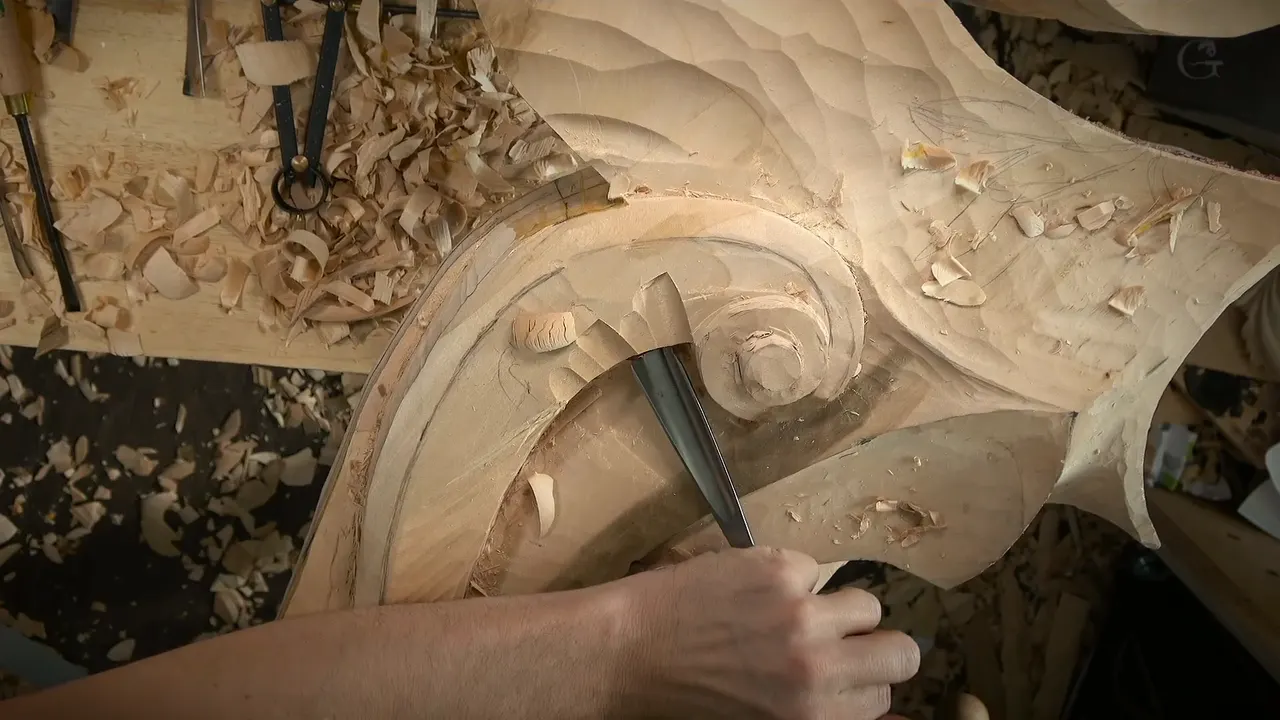

In Venice Room 88.4, plenty comes right after "maybe quarter-inch space between the lowest part right here." Then the number moves. A shadow sits beside the last one.
Have you ever hollowed a spot and then stopped to ask how much wood to leave under it? Did the number in your head change while you looked? Then you know this part of workshop 88, as any wood carver does. We start with my short video. After that, this one word walks us through lessons from my other courses.
Six things around plenty in part 4
- A change of direction, put as a need.
- Two lines to see, from a side that is hard to see.
- A starting point, with "at least" in front of it.
- A big concave to create, and a number seven that is only a maybe.
- A gap that starts as a maybe quarter-inch, is called plenty, and lands on 10 millimeters as a plan.
- A new position, because of a worry about a split if the work continues.
What came before the quarter-inch space?
The captions open with "Okay." Then comes a plan, "And I need to change direction this way now." Close beside it sits "And go all the way in." A worry follows. "Unfortunately, I don't see if I'm attacking from opposite side."
One more plan sits behind it, "So I need to make sure I see both lines." Next the captions give "That is good." Then a half line, "So it has a nice-", with a "Yes." right after it.

The stretch ends on two plain lines, "But at least that's a starting point" and then, said again in fewer words, "It is a starting point."
How did plenty turn into 10 millimeters?
Next up is a concave, and a big one. "Okay. So now I need to create a beautiful concave toward that side, and it's going to be a big one." A tool is only a maybe. "And maybe I'll be able to use number seven."

Next comes the space. "And what I want to do, I'm going to leave maybe quarter-inch space between the lowest part right here." In millimeters, a quarter inch is 6.35. The verdict arrives still hedged. "And that's going to be, I think, plenty."

Then the number moves. "Quarter inch or, I don't know, maybe little higher." And again, "I don't know what I should do. Maybe a little higher, maybe about three-eighths of an inch, 10 millimeters or so."
A decision lands. "Ten millimeters, that's what I'm going to do." Its reason is right beside it, "Because I still need to see a shadow, okay?" And once more, "I still want to see a shadow." Ten millimeters is 0.39 in. The three-eighths I named is 9.5 millimeters (0.375 in), and my own words join the two in one breath.
What did the tools do around the gap?
The gouge talk stays a plan. "Well, in this case, I probably should use number seven smaller one and go little by little." Then, "And maybe I have to attack from this side right now and go upward and use number nine." The job is named in the next words, "To remove chunks of it."

Another plan follows. "All right. Let me get the big again." Then a warning, "Got to change the position," with the worry that "it's going to split" and a "big mess" at the end.

The video ends on shadows. The words are "it's about shadows and light," then "a really nice beautiful 3D movement," and last "beautiful shadow and light." One word stands alone before them, "Enough." The "again" in "See, again" has something to point back to, because shadow came up earlier in the same video, beside the 10 millimeters.

What do parts 3 and 5 of workshop 88 add?
The third part has a figure of its own, "Exactly half an inch" (12.7 millimeters), with a wish to do it "everywhere."
Part 5 of the same workshop also speaks of depth, and the captions say "much more deeper concave in this area." Then, "And yes, I need to go a little deeper." A figure returns near the end, "And again, number seven and half an inch."
Does plenty mean depth or thickness?
thickness is the setting in Venice Room 75, third video. "Maybe that section is a little too deep, but I'm okay. I still have plenty of thickness right here." A figure sits near it, "maybe about three millimeters down section" (0.12 in).
Small is the figure in Furniture Panel 18, eighth video. "I would say a couple millimeters thickness is what I left right here. So it should be plenty." A couple of millimeters would be about 0.08 in for two. In the eleventh video of that lesson comes a second check, "Double-check. Oh, I have plenty of room yet." Then, "I'm safe."
Hashemi Flowers 28 keeps it short, in the third video. "Okay, that's plenty deep, and let's work on the last one."

Room is the topic in Venice Room 4, ninth video, and talk of a "variation in three-dimensional world" comes first. Then, "I have plenty space to work with."

A bigger tool is weighed in Venice Room 67, seventh video. "I think there's plenty of space for me to do a bigger one." Then, "There is a big space. I don't have to waste time." The size is a half-inch number nine, 12.7 millimeters, and "I'm pretty sure it will" fit.

Room for a tool gets made in Venice Room 56, third video. The job is "creating space for myself," and the aim is "For the tool to work." Then, "plenty of space right there." A narrow neck on the tool comes up next, "this particular tool has a really narrow neck."

A depth with a number lives in Furniture Panel 19, fifteenth video. The background could go "to the right depth, which is one-eighth of an inch" (3.2 millimeters). That stretch ends with "plenty of meat, plenty of material, I should say."
What does plenty sit beside after a number?
A quarter inch comes back in Venice Room 40, eleventh video. "I've got about a quarter inch in, which in this case, I think it's plenty." Then, "I could go a little deeper than a quarter inch, but I really don't need to." Between them sits a leaf, "It's just leaf flipping over." Converted, that is a bit over 6 millimeters.
Two figures sit side by side in Hashemi Flowers 5, second video. "I'm not going to go 3/16, maybe about eighth of an inch. I think it should be plenty." The eighth is 3.2 millimeters, and the 3/16 is 4.8 millimeters.

Undercutting later is the plan right before a fraction in Venetian Flowers Rosette 5, third video. "So, about maybe two-thirds of the way, that's what I want to do. No more than that. I would say it's plenty. It's enough."
Thinking comes first in Venice Room 122, third video. "So let me think if I should go deeper than that." The line that follows is "I think that's plenty," and a figure turns up soon after, "three-quarters of an inch, about 20 millimeters or so" (0.8 in for the 20).

A fit is the topic in Greek Acroterion 5, first video, "The only part I can fit it, it's from this point to that point, and I think it's plenty." The third video of that lesson has the word again. "And the big gouge I used, that did not create a really deep line, but it still gave me plenty for where I can place my knife in."

Outside lines get it too. The same lesson opens its fourth video with "Looks like it's plenty for outside." Next comes a plan, "Let me start digging." Then, "Just establishing that outside line."
Brief lines count too, and Venice Room 9, eleventh video has one, "So that is probably plenty." Right after it, a plan, "And now I need to clean around the eye."

The seventh video of Venice Room 12 gives "I don't really have to go too deep," and the next line ends on "plenty."
Carving Hazelnuts 2, second video holds a stop, "plenty for me now." Alongside it is a plan to "leave approximately an inch or so" (25.4 millimeters).

Can plenty be about shadow?
Shadow is where the word lands in Venice Room 61, sixth video, after a note on pressure. "That's why I barely create any pressure." Then, "Barely any pressure." After it, "I think I've got plenty of shadow right now. Hope you can see that, too." An earlier line is "Against the grain."
The size is tiny in Lily Box 8, thirteenth video, with "It was one millimeter, now it's a half a millimeter" (0.04 in, then 0.02 in). Soon, "I got deep enough, okay. Got really deep enough." Then comes "plenty for casting shadow," and a plan, "And let me undercut this area."

Does plenty come with a worry?
Sometimes it does. Hashemi Flowers 27, second video has "See? That's what I was afraid of," and then "plenty of the material." For the wood, a plan stands by it, "this piece, I have to approach differently."
A different mood goes with the word in Lily Box 5, sixth video. "Plenty of meat, and I'm not afraid." Next in line is a plan, "Let me get a bigger gouge."
The tone changes inside Lily Box 11, second video, where the material is "5/8 of an inch" (15.9 millimeters) and "looks like it's plenty of thickness." A caution comes right behind it, "But you're running out of the material, of the thickness, pretty quick."
Venice Room 19, twelfth video has "I don't worry about losing the background," beside "plenty of the material," and further on, "I can excavate a lot more if I need to."

A time limit rides along in Lily Box 6, eighth video, "plenty of undercutting, at least for now."
Is plenty ever about something other than depth?
The word counts screws in Hashemi Flowers 10, third video. First comes "And maybe I don't even need the three screws all the time," and then "Should be able to use just a screw, I mean, couple screws." One word closes the thought, "plenty," and "Even one is holding it pretty good" follows.

A pattern goes on the wood in Flower Rosette 1, second video, with "Right now, it's the time to actually apply the pattern." Soon after, "it's plenty if I'm just using my hand," and a check follows, "If it's not sticking, that means it's ready."

Sharpening uses the word too, in Sharpening a Fingernail Gouge. "My buffing wheel actually created the micro bevel on inside, and that's plenty as I see. And I don't need more than that."
Work still to come is the subject in Venice Room 3, seventh video. "What I could do now, I could actually work a little bit on this side," and then "plenty for me to start developing more finalized details, I would say."

Where did I say plenty, line by line?
Beside plenty in these lessons sit depth, thickness, room for a tool, screws, a pattern going on the wood and a micro bevel. Here is a run of it in one place. Each row names its video, so you can find the line from the lesson page.
| Video | What stood beside plenty in the captions |
|---|---|
| This video, part 4 | a quarter-inch space, then 10 millimeters, and a shadow to keep in view |
| Venice 40, eleventh video | about a quarter inch of depth, beside a leaf that is flipping over |
| Room 4, ninth video | room to work with, and a variation in three dimensions |
| Venice 19, twelfth video | material, with more to excavate if needed |
| Sixth video, Venice 61 | shadow, said with a hope that you can see it |
| Venice Room 56, third video | a space made for a tool with a narrow neck |
| Panel course 18, eighth video | a couple millimeters of thickness that I left |
| Hashemi course 28, third video | a hollow called deep, with the last one to work on |
| Second video, Hashemi 5 | an eighth of an inch, set beside a 3/16 that is not planned |
| Lily Box 8, video 13 | a depth called deep enough for casting shadow |
| Lily Box 11, video 2 | five-eighths of an inch, then a worry about running out |
| Fingernail gouge sharpening | a micro bevel on the inside, and no need for more of it |
Where in your own hollow is a gap you could call plenty? Could 10 millimeters leave you a shadow? Part 4 waits inside one tuition plan with the rest of Part 8 of the Venice Room, and this page began with a quarter-inch space.
How it's done
- A direction, said as a need. "And I need to change direction this way now," and "And go all the way in."
- Two lines to see. The need is to see both lines, put after a worry about the opposite side.
- A quarter-inch space. A gap at the lowest part, and "I think, plenty."
- A reason for 10 millimeters. A shadow stands behind "Ten millimeters," and the wish returns in the next words.
- A smaller tool, planned. A number seven that is smaller, only as a plan.
- A new position. A move to a new spot, still only a plan, beside a worry about a "big mess."
Frequently asked questions
Was a quarter inch my last number in part 4?
No. The quarter inch came with "I think, plenty," and then "maybe little higher." The number after that was "Ten millimeters."
Why 10 millimeters in part 4?
The reason is a shadow, said twice in nearly the same words. In inches, 10 millimeters is 0.39, and the three-eighths I named is 9.5 millimeters.
How sure does plenty sound?
In 88.4 the line is hedged, with "I don't know what I should do" soon after. Over in Venice Room 40 it is firmer, with "I really don't need to" go deeper.
Can plenty be a count and not a depth?
What to carve next