

Alexander Grabovetskiy, woodcarver, School of Woodcarving · Published 2020
What does a wood carver mean by "the original design"?
Quick answer: In Venice Room 88.7 the words sit beside a drop I may make a lot lower, and a verdict on the look. Other lessons put them beside a Roman acanthus leaf, a lily leaf, a Greek acroterion and an iPad.
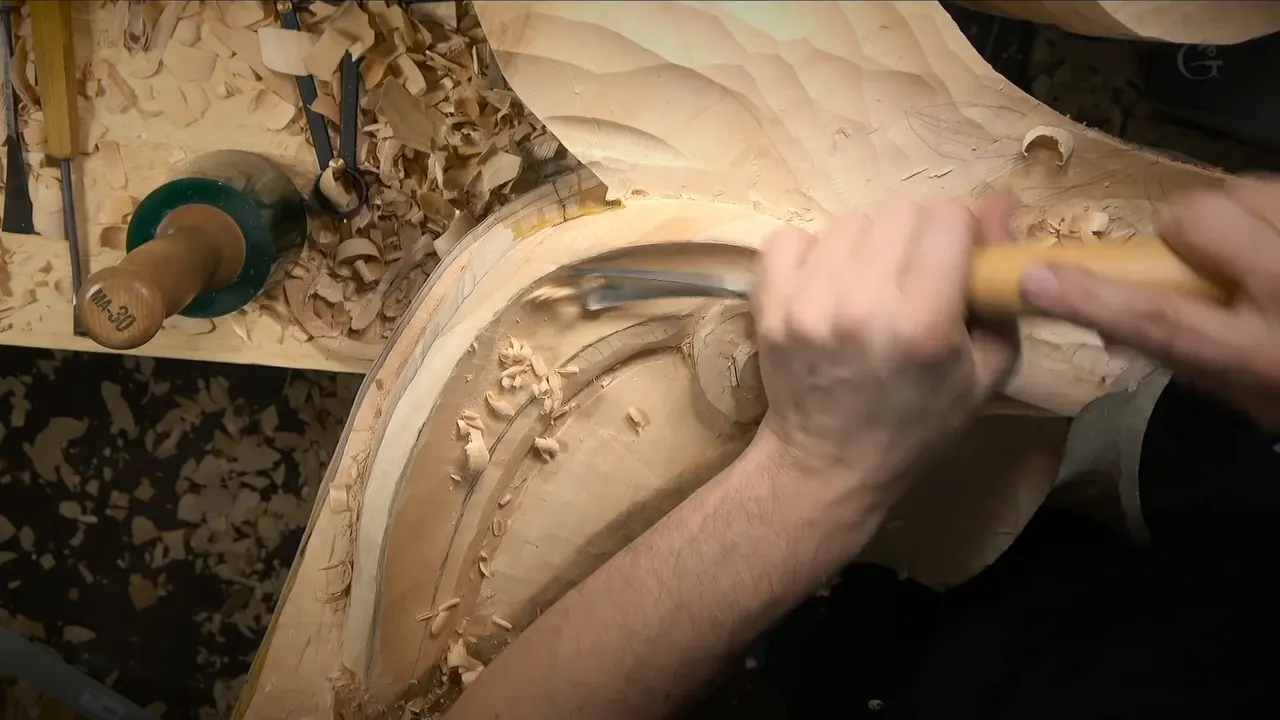

In Venice Room 88.7 the words come after a look at how it all looks overall: "Now it just doesn't look as nice. So which means I have to change the design, original design, what I intended to." In my other lessons the same words sit beside a Roman acanthus leaf, a lily leaf, a Greek acroterion and an iPad.
Ever drawn a leaf on paper and then watched the wood say something else? Did a hollow look right from the side and wrong from above? Then you know the spot this part of workshop 88 sits in, as any wood carving does. We start with my own short video. After that, the words lead us through the lessons where I follow my drawing and the ones where I leave it.
Six beats in this part
- The marriage line, and a tool brought in from the opposite direction.
- A concave with a shadow in it.
- Smaller tools as I get closer to a future drop.
- A bigger picture, and a rough stage.
- A drop ahead, and a part to redo.
- A change to the design, and a part you do not see.
What do I say before the words in part 7?
The part opens with "Here you go. That is again, marriage line." A move follows, "And now I have to attack from opposite direction." Then "let me blend little nicer right here."

In turn, the shadow gets a line of its own. "So that is a really nice concave. You can see the shadow." I add "And the shadow is beautiful right here," and then "now I need to blend from this side." Later the marriage line is back, and "blend it" comes with it.
A note on tool size follows: "closer I get to my future drop, lesser or smaller tools I should use."

More moves follow, "Let me get from this side again," and "attack from opposite side." The stretch ends on "So that is the concave I'm after." Then "Wonderful."
How does it look overall in part 7?
First a doubt about showing "a bigger picture." After "Let me try," the picture arrives with "That is how it looks overall. Of course, it's rough yet. We're still in the roughing stage."

Plans follow. Ahead sits a drop, and "I probably have to redo this part." Beside it, "I think I'm going to drop it a lot lower." Each line is a plan, and "much better" is what I think it will look like.
After the plans comes the verdict, "Now it just doesn't look as nice." Next come the words from the top of this page. The last line of the part is "Unfortunately, you don't see this part, but here it is."

Video 8 of the same workshop starts on another spot. There "the camera is just right above." The view is "not the true view." "it's actually made to be visible from the bottom, okay? From downhill up." One doubt sits in it too, "Maybe I'm going to get rid of this one. Okay? I don't know yet." Further on in that video I wonder about a slope, "Maybe I have to slope it somehow. I don't know if I should or not."

When do I change the drawing?
Over in Venice Room 81, the seventh video gives the place: an acanthus that starts from a volute, and I say "change little bit the idea from the original design." Close by is a promise, "I'm not going to change the main movements, of course."

Lily Box 3, first video, shows the same give. I want to stay close, but "if I'm a little off, I'm okay also." This leaf will be "slightly different." The paper gives the reason. "sometimes you have to change that design, which you design on the paper, slightly on a piece of wood, because when you see how it looks in real life." And I think it will be "a better-looking one." In the second video I say "I went little bit inside," and then "I'm okay with that."

Panel areas in Venice Room 92, eighth video, call for a change. The design was made on a computer, and "it looks okay on a computer, but it doesn't really look good in real life." The trouble is size: "a little too small, and I have to just make it bigger."
Two ways are named. I could "redraw that right in place." Or I use what I have, "my phone," "my iPad," "this piece of paper." Later the iPad sits "close by," and I say "that way I'll see exactly what is going on, not going to be as far from my original design."

In Greek Acanthus 5, first video, being "slightly off" is, in my words, not "a big deal." Before that comes an idea for you: "print the same paper and look at the paper and redraw on a piece of wood again all the lines, how they're supposed to look." Me, I "just eyeball." On one leaf a change is planned, "a little more underneath," and the check afterward is "Overall, I didn't lose too much of the details."

Nature gives the reason in Lily Box 10, in the sixth video of that lesson. "I just curled it all the way this way." Next, "I need to chop a little bit off," and "that's okay. For me, it's more important to be more accurate to nature."

A number seven goes with "a better shape to that leaf" in Lily Box 8, tenth video. Then "Even if" the leaf will be "a little smaller than original design, but it's okay. As long as it just looks good."
Fourth video of Roman Acanthus 10: on "this boundary, I can create the movement," and next come the words "Even if it's a little different from the original design, I'm okay with that."

Venice Room 10, eleventh video: "I do have to think on the way, okay, while I'm carving. I'm making some improvements of the original design." Said again with one small change: "improvements with the original design."

A crack gives Lily Box 9 its turn, second video. "People not even going to know that is not a part of original design." Later, "Please don't tell nobody that wasn't part of original design." Between them I say "we'll take advantage of this crack." One part waits: "Originally, it was supposed to go below, but it's good that I left that to the last moment." Then "Right now, I can actually utilize that as a part of this upper movement."

Eleventh video of Venice Room 15: I say "nobody's going to know that is not the original design," then "It is original because I'm still creating it, but sometimes it happens."
A redraw is needed in Lily Box 7, fourth video, for the movements. Mine are "just approximate, okay?" and not "exactly how I drew that." The limit follows, "I still have to be accurate to the original design I've got." And "nothing wrong with some variations, okay?"
The next separation in Venetian Flowers Rosette 4, third video, is to be "pretty close to the original design. Maybe I moved slightly, but it looks more authentic, I'd say."
In the first video of Greek Acanthus 14, a section waits "until I fix whatever I broke before this piece." And "I kind of like it, the original design."
When do I hold to it?
Roman Acanthus 5 gives an order, in its fourth video. "I take number 3, half an inch, and recreate my outline. Just around. Follow the original design." Next, "It doesn't have to be number 3, though. You can check what you have, and if it fits really close, it should work." Half an inch is 12.7 millimeters.

A size sits in the same video. I'm leaving space "from top down, about 10 millimeters down, actually," and then "Three-eighths of an inch or even a little deeper if you wish." Ten millimeters is 0.39 inch, and 3/8 inch is 9.5 mm. A warning follows: "Don't go too deep, because original design, this section of the leaf goes underneath of that section."
Second video of Roman Acanthus 4: I watch the grid lines, and I say "I want to be as close as possible to the original design."

The tool is named in Venice Room 58, fifth video. To be "true to the original design," I plan "to fillet this side and that side, just to create the fillet effect." Then "the best tool would be for me, at least for me, it would be a back bend. Okay, let me see. Maybe about 10 millimeters, a number five back bend." That size is 0.39 inch.

The order of work sits in Lily Box 2, sixth video. "We are not undercutting yet." The reason follows, "because we still have to work on those surfaces and those leaves," and "if you already undercut, you messed up with overall design." It may look fine, but it will not be "to the original design." Beside it, "about 1/8 of an inch deep right here" (3.2 mm).

Hashemi Flowers 6, first video: "And I almost lost my original design, although I'm not that worried. I can always reestablish it."

What about a design that is old?
Carving Dining Table Apron, workshop 5: "I love the original design. It has acanthus leaf."
Fifth video of Venice Room 5: a shell is to be "actually interesting shell," and "authentic to the original design," the one from Venice. If you "travel to Italy, to Venice," you can still find its detail "on original carvings." The one unique detail is beads, "on one of the sides of inner concave."

Points get their turn in Venice Room 8, third video. "Italian work, on those acanthus points, they never had the sharp points." They had "more like a roundy." This is a detail to "pay attention" to, if the work is to be "really close to the original design." Also "not every acanthus design has a sharp point."

Venice Room 9, fifth video: "I studied little more the original design of this period, 15th century, and I really want to be authentic to the design." The shape: "this part, in my case, is going to have a little convex."

The acroterion in Greek Acroterion 4, second video, has a depth: "I'm not going deeper than 1/16 of an inch right here." That is 1.6 millimeters. The source is "I looked at online the original design of those acroterion, and they're not going deep also."

Carving Plate with Butterflies 10, second video: "we are designing right on the fly." I correct it next: "I shouldn't say that we are designing on the fly because those butterflies used to be carved for centuries." And "it's not like original design. It is historical, I'd say, design."

Third video of Modern Acanthus 6 names a year: "this design is not original design. This is based on a sculpted piece in 1903."

Furniture Panel design lesson 4, first video: I speak of "the original designs of 18th century," then correct it: "Or should I say end of 18th century."
And Furniture Panel design lesson 2, second video, puts the edge in your head: your eye keeps "catching the edge of the original design." With it sit "the golden ratio Fibonacci number" and a ruler, "approximately 50 millimeters from the edge" (1.97 inch).

Where did the words sit, lesson by lesson?
Next to these lines sit drops, leaves, panel areas, fillets, shells and cracks. Here is one run in one place. Each row names its lesson, so you can find the line from the lesson page.
| Item | Words | Where |
|---|---|---|
| A lower drop | the roughing stage, with a drop ahead | Workshop 88, Venice |
| A changed idea | the main movements stay, a slight change | Workshop 81, Venice |
| One different leaf | a little off is okay with me | Lesson 3, Lily Box |
| A bigger panel | a design I did on the computer | Workshop 92, Venice |
| Leaf going underneath | one leaf set to go more underneath | Lesson 5, Greek Acanthus |
| Accuracy to nature | a curl, and a little to chop | Lesson 10, Lily Box |
| Drawing to follow | an outline to recreate with number 3 | Lesson 5, Roman Acanthus |
| A back bend | a fillet on this side and that | Workshop 58, Venice |
| Undercutting must wait | surfaces and leaves still to work on | Lesson 2, Lily Box |
| Shell with beads | a shell with beads in its concave | Workshop 5, Venice |
| Shallow acroterion depth | a depth of 1/16 in (1.6 mm) | Lesson 4, Greek Acroterion |
Which line on your own piece looks right on paper and wrong in the wood? This video waits inside one tuition plan, with the rest of Part 8 of the Venice Room.
How it's done
- Try to show the whole carving at once. "Let me try."
- Name the stage you are in, even when it is rough. "We're still in the roughing stage."
- Name the redo. "I probably have to redo this part."
- Keep the main movements. "The main movement's still going to be there."
- Hold to the drawing in the places where it holds. "Follow the original design."
- Allow some variations, but not too much off. "nothing wrong with some variations, okay?"
Frequently asked questions
What comes just before the words in part 7?
An overall look, with "it's rough yet." Plans follow: a drop ahead and a redo, with the drop set to go lower.
Does part 7 finish the change?
Part 7 ends on a need rather than a finished change. The next video starts on another spot and says "I don't know yet."
How far off the drawing can a leaf go?
For a leaf a little off, the line is "I'm okay also," in Lily Box 3. Greek Acanthus 5 says slightly off is not "a big deal." In Lily Box 8 the line is "As long as it just looks good."
What did the panel in workshop 92 need?
What to carve next