

Alexander Grabovetskiy, woodcarver, School of Woodcarving · Published 2020
What does "sloping" mean in wood carving?
Quick answer: Sloping is the word I used in Venice Room 88.3 for the start of taking a flat area toward a roll, in my words "flat to roll it this way." Right before it sat a redraw, and a plan to readjust the camera sat next to it.
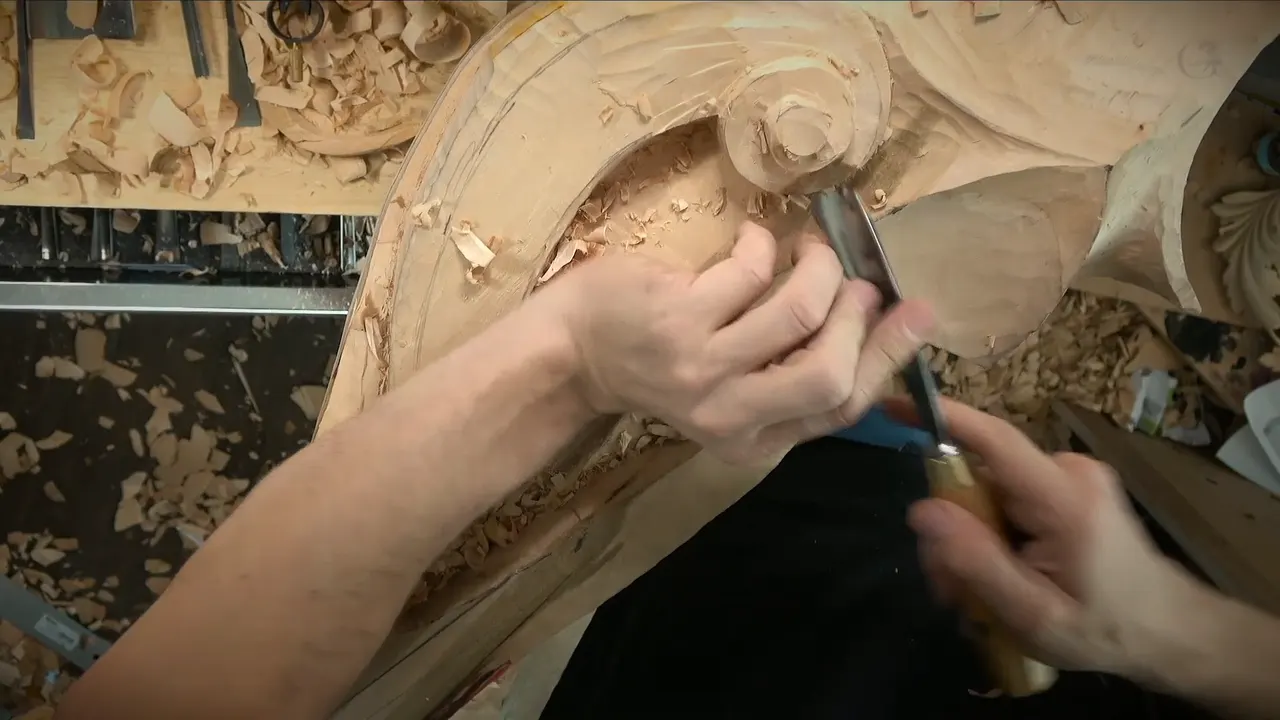

Sloping, in Venice Room 88.3, is the start of taking a flat area toward a roll. A redrawn line sits right before it in the video, and a plan to readjust the camera sits next to it.
Have you ever carved a flat top and wondered how far down to take it? Did a camera ever hide the slope you were looking at? Then you know my spot in workshop 88. We begin with my own short video. Then this one word leads us through lessons from my other courses.
Six things sloping touched in part 3
- A flat area, on its way to a roll.
- A redraw first.
- One slope runs one way, and a concave sits on the other side.
- A boundary to check.
- A fillet or a chamfer, still open, and a highest spot that a planned concave downhill would set.
- A camera plan.
What was my plan before the first slope?
The captions open with two short work lines, "Number nine." and "Something like that." Soon after, a decision to wait comes up. Leaving it "for now like that" is the plan, with the cleaning planned for later "because who knows, maybe I'm going to just change a little bit some stuff."
One thing is settled. "I've got the main movement," and what is left is to "figure out what I'm going to do right in this area." A moment later the same worry returns in a plainer shape. "It's really important for me to figure out what I want to do."

The plan names "a really nice transition going up." Next the slope itself gets described, "sloped this way," with a "concave that side."
Connecting the lines has to wait, because "Well, actually, you know what? I need to clean that first." Cleaning the area comes ahead of the slope in my order. The reason is short, "much easier for me to see what is going on."
Why did a redrawn line come first?
Before the sloping comes a drawing step. "So let me redraw." A distance follows it, "let's say half an inch or so," and a second look makes it firmer. "Exactly half an inch, and I want to do it everywhere." That is 12.7 millimeters.

Here is the line this page hangs on. "I apologize if you don't see that. Let me a little bit readjust my camera, and you will understand that."
Then the slope arrives in the same breath, and a hope rides along with it. First "start sloping this way," then "flat to roll it this way," and last "Hope it makes sense."

What did the boundary and the fillet have to do with it?
An outside edge matters too. "I need to make sure my boundary, the outer part is also really nice." My plan for it is a number three, in the words "attack that with that number three." A check follows, "Okay, double check. And this part needs to be fixed also."

Then a shape gets named, and I am not sure of it. "I want to create a fillet." Close behind, "I'm not sure," with "a fillet or maybe a chamfer" as the options. One condition goes with a chamfer, "look good on this side."

Where does the highest spot sit?
A concave is planned there, one that goes "downhill this direction." Its meaning comes next, the "highest spot."
"Okay, let me start sloping it." Sloping starts again right there, and a tip about position comes soon after, "a good idea to always attack from the right position."

The last lines of the video are about the camera, just as the first slope was. "And I hope you can see that. Let me move it this direction and you'll see it." So in this part, sloping comes with a wish to show it, and a plan to move the camera when it does not show.
How does the rest of workshop 88 use the word?
The twelfth video of the same workshop has it in plain view. "Number 3, that's what I'm using." Then, "you should be able to see I'm establishing that sloping movement on this side," and last "catch it." A repeat is planned, "do exactly the same right here," and a check goes with it, "I need to make sure I'm happy with my movement."
The eleventh video carries a condition with the word, "sloping" at the front and "I still have to see the wall of that inner detail" at the end. Number 11 at 7 millimeters (0.28 in) is the plan there.
How careful is a first sloping pass?
Other lessons use the word with the same warning in front of it. Over in Floral Molding 5, first video, the word shows up as "Let me carefully start my sloping," and the next line is "And the key word is carefully." A plan sits after that, "I need to take a look again my previous piece, how deep it goes."

One slope in that video is planned to run underneath. Another line says "It's already sloping," with "even better" still ahead. For one spot the plan is "only about one eighth of an inch," or 3.2 millimeters, and a check of my own sits near it, "let me confirm I'm making the right thing."
Beside the word in Venice Room 63, first video, sits a tool plan. "Going to start sloping from all the way here" has "got to be careful how I do it" right behind it. "One inch," or 25.4 millimeters, is the size of a big skew, "probably again, just a skew."

A warning sits behind that tool, "That would be mistake if I would just do it wrong way." A kind promise follows. "Even if it doesn't look too good yet, it will be good."
A number sits beside the word in Venice Room 105, second video. Number seven, about 20 millimeters (0.8 in), "three-quarters of an inch" in my own words (19 mm), is the tool. Next is "And I'll start sloping carefully."
One shape is to be avoided. "I don't want to make it just a straight down like this." What I want is "gradual movement, more like arc, if you wish to say that. Just really smooth and nice transition."
A margin sits at the edge, too. "Because when you carve, you dig inside of the wall." The figure is "approximately three millimeters" (0.12 in), and the word for the gap is "a safe zone."
Does sloping stop somewhere?
It does in Floral Molding 3, first video. Right after "one mil and a half the distance" comes "going to create some sloping." A number seven at 14 millimeters (0.55 in) is named for it.

A limit comes in the next words. "Not everywhere, because for example, where I scrolled that, so it's impossible to slope it." The size stays modest, "somewhat."
In Venice Room 36, second video, a choice comes first. "Should I give a slope or not? Or should I keep this movement just like that?" The answer starts with "I think" and runs on to "wise for me to keep," and last, "the overall movement without sloping too much."

Venice Room 62, twelfth video, has the slight kind. "This part has to slope this way, and maybe some of it, I going to do a concave inside. But overall, I still have to give a slight shape of sloping, " and an inner part follows.

Later comes "maybe start sloping." Before it sits "Just kind of encouraging words to myself," and after it "main idea is this chunk."
A slope can stay visible without going deep. Furniture Panel 21, fifth video, gives "It's still sloping, but not as much, but it's still visible." A mallet is on the list, "Maybe I can use a mallet and get that slope a little deeper." A viewing note comes next, "Hopefully, you can see what I'm trying to achieve." After it, "if you look how you're supposed to look at it, it should look fine."

A stopping point follows, "some thickness to finish this movement."
A blend is needed in Furniture Panel 20, sixth video. "Going to continue my sloping motion." Then, "And almost no slope at this point because it's going above the main molding movement."
Carving Hazelnuts 2, second video, shares the worry about size. A measure comes first, "I know the distance." And after it, "I don't want to extend sloping this way too much, but I want to go a little deeper."

Which way does a slope run?
At times it runs up. Venice Room 56, tenth video, says "you understand that's a sloping, and that's sloping upward like that, okay?" A feel is at stake, the "overall feel of what I'm talking about." Then comes the picture, "raising up, raising up, raising up, and going all the way to the ceiling, okay?"

At other times it runs down, and a wall is too high. Lily Box 7, seventh video, has "this region right here is going to be the highest," then "sloping downhill, because right now what I see, this wall is a little too high."
The picture has to work in three dimensions. "We have to look in three-dimensional world, and it has to have a really nice curvature, or sloping, overall." The plan is a "rough sloping," and then "recreate that detail." After it, "Downhill like this."

Lily Box 8, ninth video, begins with a look. "Now I need to look from above and see how it blends all together. And also, I have to take a look from the sides." A repeat follows, "I do have a slope on this side, and I need to give that slope right here, too." The next plan is "preliminary sloping with the same number nine."

Sometimes the slope is a whole group. The Venetian Flowers Rosette 2 course, first video, says "my goal is to create a sloping all those flowers." A result comes next, "just because I sloped that, it became more roundy than it used to be. It used to be like an oval, but now it's much, much better."
Then the camera comes up again. "I know it doesn't show on the camera, but it's actually sloping smoothly. It's just going around, and it looks really good."

Grinling Gibbons, Maine class 7, first video, has a plain one. The area is "going to be lowered down." Then "gonna be just sloping down." The next plan is to "drop this area" to "about quarter inch," or 6.35 millimeters, said in the Grinling Gibbons course.

Fifth video of Venice Room 89 keeps a slope small. "I want to see some of the sloping right here, but not as much. So this could be a little more straight down like this." A plan follows, "going to start undercutting in." One more line sits in Venice Room 86, sixth video, "I kind of like the sloping down, so I can continue to work on that."
Where the piece goes can change the answer. In Venice Room 72, third video, "give a sloping downhill" sits next to "visible" and next to the spot where the piece is to be installed.
Across a piece, a slope can carry on. Chamomile and Bow Rosette 3, second video, has "I have to recreate the slope from outside on inside." Then, "It's sloping the same direction. And that's what gives me the look of reality, like in real life."
Why is sloping hard on a ceiling piece?
In the April 2020 livestream the hard part of the volute gets named. "But the difficulty of this, it's a sloping. Okay? Because it's going from horizontal, vertically, just like that. That is a ceiling part."
Two views came up. "When you're staring at it from the bottom and look at it, and also when you're staring that just straight from different point of view and so on." The same worry about seeing the slope shows up in 88.3.
Where did I say sloping, line by line?
Here is the whole run in one place. Each row names its video, so you can find the line from the lesson page.
| Where I said it | What I said |
|---|---|
| The video this page starts from | the word sloping, then a camera to readjust |
| Twelfth video, workshop 88 | a sloping movement you should be able to catch |
| Second video, workshop 36 | a thought of keeping the movement without sloping too much |
| Video twelve, workshop 62 | a slight shape of sloping before an inner part |
| Video one, workshop 63 | a big skew, one inch, and a warning about the wrong way |
| Video two, workshop 105 | sloping carefully, as a gradual arc and not a straight line down |
| Molding course 3, first video | sloping that skips the places that are already scrolled on the piece |
| Molding course 5, first video | the key word carefully, then a slope that is already sloping |
| Panel course 21, fifth video | a lesser slope that is still visible on the piece |
| Box course 7, seventh video | a highest region, a wall that is too high, then rough sloping |
| Rosette course 2, first video | sloping on all those flowers, and a rounder look after it |
Where on your own piece does a flat area need a slope? Could a redrawn line help you see it? Workshop 88 waits inside one tuition plan with the rest of Part 8 of the Venice Room, and this page began with the first slope in part 3.
How it's done
- The line, a redraw first. "So let me redraw," I said, and a distance followed.
- The first sloping, announced. A camera plan came with it, close behind the announcement itself.
- The camera, in the plan. Next came "Let me a little bit readjust my camera, and you will understand that."
- The boundary, to check. My plan for the "boundary" was a number three.
- The edge shape, still open. The options were a fillet and a chamfer.
- The highest spot, and a concave. A concave planned downhill in one direction pointed to the "highest spot."
Frequently asked questions
Does sloping mean the whole piece goes downhill?
Not always. In the Floral Molding course I said "Not everywhere," because the scrolled places would not work. In lesson 36 I said "should I give a slope or not?" and then "I think" it was "wise for me to keep."
Did the camera matter while sloping in 88.3?
Yes, twice. "I apologize if you don't see that," came first, and near the end of the video came "Let me move it this direction and you'll see it."
Why clean the area before sloping it in 88.3?
The words were "I need to clean this area first," and then "much easier for me to see what is going on." Next in line was a redraw, and then the first sloping.
What to carve next