

Alexander Grabovetskiy, woodcarver, School of Woodcarving · Published 2020
What does a wood carver mean by "replicate"?
Quick answer: Replicate, in Venice Room 88.8, is the word before a number 3 gouge, said about a slope the piece already has. In other lessons it names lines, miters, moldings and petal movements. Sometimes it is the thing I advise against.
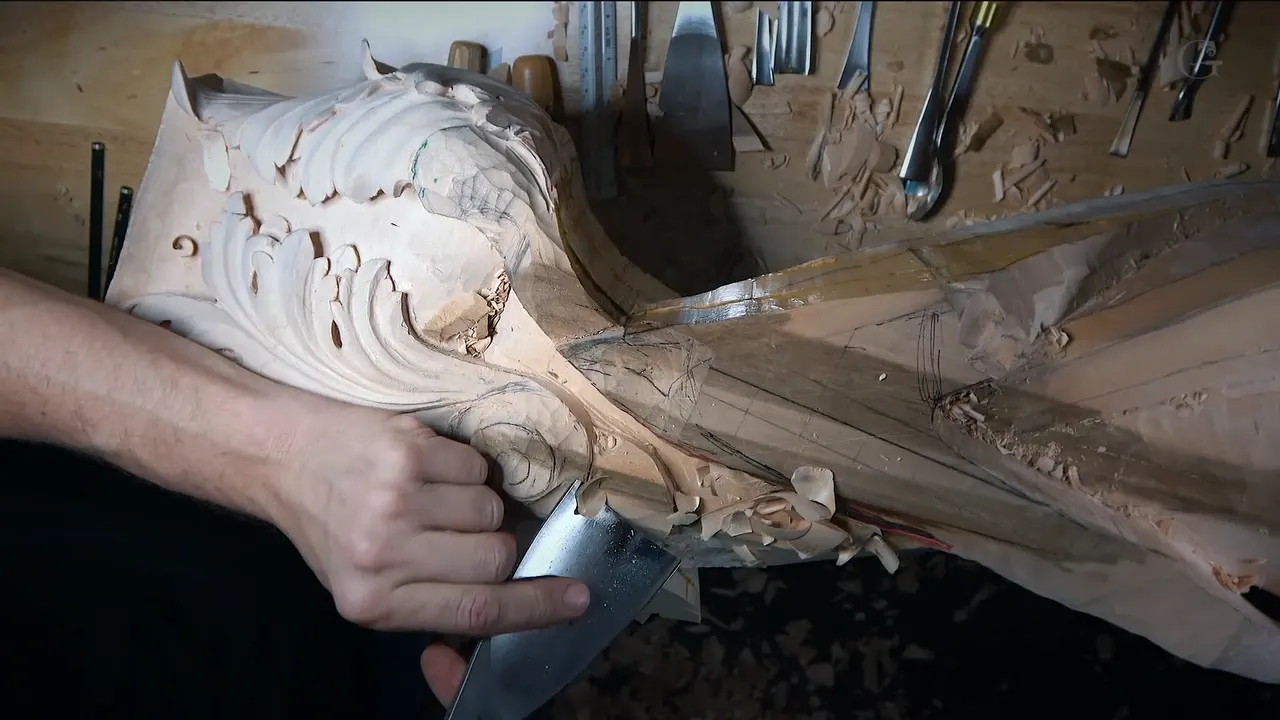

Replicate, in Venice Room 88.8, is the word before a number 3 gouge: "let me replicate the slope that I have right here." In my other lessons the same word goes with lines, miters and moldings. Petals and a butterfly wing get it too. A few times I argue against doing it at all.
Ever carved one side of a volute and then looked at the blank side beside it? Did your hand ask whether the second side would match the first? Then walk through one slope with me, and through the lessons where I use the same word.
What did I want to replicate in part 8?
A slope I already had on the piece, with a flatter gouge. The part opens with a plan for a leaf. "A leaf in this area, like flapping," I say, and "just going from inside out like this." One section would go one direction and another section the other direction. There would also be "something right here, which you don't see right now."
Then the camera gets a line. "It's not exactly what in real life it looks because you're looking straight to it," I say, "because the camera is just right above." The piece is "actually made to be visible from the bottom," from "downhill up."

At 01:09 the words are "I preserved the chunk," and then comes the next move: "now I'm going to just develop the idea." The edge around it is "the same edge as this one." So, in my words, "I have to lower down the whole thing." Another extra detail would grow "from underneath," and about that one I say, "Maybe I'm going to get rid of this one. Okay? I don't know yet."
The heavy work is a plan before it is a pass. "I can probably just chop right now with the big gouge with three inches," I say (76 mm), "and I'll take big mallet." The mallet comes next in that plan. After a quiet stretch the next line is "Here you go. That is plenty."
The volute gets a title. It is "the biggest idea" of this section, and "the highest spot." It "still has to blend in overall." My plan for the outline is a number 11, "10 millimeters or even bigger" (0.39 in), maybe "12 millimeters, like half an inch" (0.47 in).

Then comes the slope. "Maybe I have to slope it somehow." My other thought is that I "continue the slope," and "I think it's going to look much better." On the other hand, it is "sloped anyway this way."

The question follows: "should I slope more this way or not? Maybe yes, maybe I should." The plan after it is the one this part ends on: "Okay, let me take a flatter gouge. And in this case, I'll take just number three, and let me replicate the slope that I have right here."
So here the word names a slope that already exists on the piece. A number 3 carries it on. Part 9 keeps the idea, and the center, in my words, will slope "the same way like this one." The rest sits on the page for this lesson.
Which line or slope do I replicate on the second side?
The Venice Room lessons lean on a line that already exists, again and again. Eleventh video of Venice Room 4 is a check on how low a section can go. "An inch or so" (25 mm), and "at least three-quarters of an inch I could go lower, no problem" (19 mm).
Here is the worry in my words: "I don't want to lose that detail. But I do have lines on both sides." The way out is short. "I can always just replicate those lines." The depth is "about 20 millimeters deep, about three-quarters of an inch right now deep" (0.79 in), and then "I think I could go even deeper." My plan before the next pass is to place lines. After that comes "Attack from opposite side."


A line has to run a long way in Venice Room 155, first video. "I need to extend that line all the way here and go with this line all the way up." At the end of it comes "a 45": "And again, I need to do a 45. Just replicate whatever the miter are supposed to be." The eye does the work: "just try to eyeball it."
Later in the same video the word returns, this time for a whole division of the piece. "I need to do exactly the same on the opposite side, just kind of replicate that division." There is room for one more thing, "an extra movement somewhere right here." I also allow that "this part could be a counterpart of this part."

Molding is the subject of Venice Room 148, first video, and it starts with a building. "One of the buildings in Venice is still there." I copied the shape from a picture, and "I didn't go there right now." "Not looking straight," I say. When I replicate moldings, "I'm looking at the two spots."
One spot is at the bottom of the molding, "right when it touches floor." Then the miter, where "the two pieces" "meet together." There, "you can detect much better the profile." I "actually checked from multiple points of view" and "I've got an idea approximately what they've done." The profile reads "just a bead and bead," then "some kind of ogee," which is "close to the Roman ogee, but it's not pure Roman ogee."
A plan for later work sits in Venice Room 36, second video. "In the future, I have to do a side corbels." About those: "there is a specific type of volute with the multiple line work. So probably for me, it would be really wise to replicate that right here, too." I could "estimate everything and just to go with all the numbers, which is also ancient tradition to figure out the tension and so on." Then: "I'm just going to eyeball it."

A copy does not have to be a twin. Fifth video of Venice Room 72 has one division that answers another across the piece. "That's going to be like a dynamic symmetry," I say, and "it's not like a static symmetry." He points to the golden ratio. The numbers are "five parts out of eight, two parts out of three." If one detail is a little smaller, "I have to make on opposite side a little bigger."
Does a leaf or a flower need its movement replicated?
I repeat the overall movement and leave out the exact copy of every curve. Furniture Panel 14, first video, puts the movement first. "Really important to just follow the main movement." The petal is "a round section," and "I really want to replicate the overall movement." Then: "Just want to repeat the law of repetition." The payoff, in my words, is "I believe it's going to look more organic."
Lesson 38 goes deeper. In the third video the target is a point. I want to keep "really sharp points," "just replicating this side." Whether a tool will reach is open: "I doubt I can get it in, but some of the sections I probably could." Then: "who knows? We'll see."
Second video of Tray of Blessing 3 is about a curl. I have "a curl this way" and "a low repetition," so "I have to do something to indicate the same movement." The word follows: "I'm gonna replicate this" movement. Tray of Blessing 2 opens with a plan of stepping back, pass by pass, and the line is "As long as I'm pretty close on this line, I can replicate later this side."


On the grape onlay, lesson 11, first video, comes a second thought. "I think I have to rethink." The main one will go "even lower," and about the two separations the line is: "Gonna be replication of this side." And the reason is short, "I think it's gonna be more logical."

Butterflies 10, first video, repeats a wing. "As far as the details inside, we're going to replicate exactly the same what we've done on that butterfly." The angle is "approximately 90 degrees," and it is "the detail of the wing," so the work is "only about one millimeter deep" (0.04 in). "You really don't want to do too deep."

A flower asks for less. Grinling Gibbons Maine 13, first video: "You don't really have to replicate exactly every movement."
Can a picture, a clay model or calipers replicate a side?
Three guides turn up in my lessons: photos on a phone, lumps of clay and calipers. First video of Venetian Rosette 5 makes the picture the guide. "Make a picture later on and you can replicate that." The idea is "the same as far as those leaves," and "this side is just going to go downhill just like that."
Venetian Rosette 4, first video, brings the calipers, a tool for the eye. "I have other side as a reference," I say, but "just to show you the option if you don't have really good visual skills," and "with the calipers, you can actually replicate pretty much any picture."

Floral and Molding for the Panel 3, second video, uses a phone. A leaf sits above, and "I want to make sure it just replicates the previous piece." The trick for a flip: "you can use just your phone." You "make a picture of the piece you're working on," then "go to that picture and flip it." "Just hit edit." And the result, "Boom, and that's done."

Clay is the guide in Chamomile and Bow Rosette 2, third video, because a bow is 3D and "you can use clay." It is plastilina. "In my case, it's a plastilina." "And whatever the detail you're working on, you can really quickly replicate with the clay." You don't need a perfect shape. The clay "can show you a twist." Then: "just by looking at that plastilina model, now I can work on that with no problem."

When do I tell you not to replicate?
When the piece should be yours. Carving Hazelnuts 3, second video: it "doesn't have to be a perfect shape like you see on a pattern." Then "Don't try to replicate." And: "We are going to create a unique, never-been-carved."
Hazelnuts 2, first video: a copy of the hazelnuts drawing sits near you. "Keep one of the copies right by you on a workbench," then "you can always reference and see exactly what is going on." Then: "Please don't try to copy exactly. It's not necessary." I did the drawing "quite a few years ago for another class."

Grape Onlay 12, third video: "In fact, it's better to develop your own. At least you don't have to replicate anything." And "create your own movement's gonna be a lot easier for you." In Grape Onlay 4, first video: "feel free not to replicate the whole thing." Third video: "I don't like to replicate" work of others, and "I don't have enough freedom to create."
Hashemi Flowers 47, first video, says the same about flowers. "Trying to replicate the same flower, it's not going to be the same every time you do." "That's the beautiful thing, actually, of carving flowers," I say, and every flower is "absolutely different flower."
Hashemi Flowers 6, second video, adds a rule for copying nature. "You still have to exaggerate some movements, some shadow lines, and so on. Make it more 3D look." Lily Box 10, second video, aims at a real petal. "They're all wavy," and "that is what we going to try to replicate."
What does replicate mean when the original is old?
It means I follow what the old maker did, down to the tools and the numbers. Venetian Rosette 1, first video, starts a drawing: "it's probably the most ancient way to draw. It's by hand and by eye." Then: "But I'm trying to replicate, remember, end of 15th, beginning of 16th century, and I doubt they had that technology to do that." The kit is plain: "some kind of twine," "some nails, small ones," "about 5/8 of an inch" (16 mm).

A tool is the test in the first video of Acanthus over Moldings 2. "I really like the tool for undercutting." Then "I tried not to use it in all." My reason is "somewhat replication of original workmanship," and "they did not use those V Tools in Venice." For the area I'm working on, "it's not going to leave the true tool Mark. So for me, I'm safe."

The strictest case is Dining Table Apron, workshop 8. "If you create a piece from scratch and you're not matching anything, it is less problem." But "if you do match existing piece, it's really important that you replicate exactly what the original carver did." On that piece "he didn't go deeper" than an eighth of an inch (3.2 mm), though some spots go "up to 3/16th, up to five millimeters" (4.8 mm, and 5 mm is 0.2 in), "only a few spots, not everywhere."
Where did I say it, lesson by lesson?
Each row names its lesson. Find the line on that lesson's page.
| Item | Words | Where |
|---|---|---|
| A slope | a flatter gouge, then number three | This very video |
| A detail | but I do have lines on both sides | Workshop 4 Venice |
| A miter | whatever the miter are supposed to be | Room 155 Venice |
| A division | just kind of replicate that division | Same video, 155 |
| A molding | the two spots, the bottom and the miter | Room 148 Venice |
| Petal movement | the overall movement, this line and that line | Lesson 14 Furniture |
| Second side | two separations right here, more logical | Lesson 11 Grapes |
| Wing details | the details inside, about one millimeter deep | Butterflies, lesson 10 |
| Flipped picture | you can use just your phone | Floral Molding 3 |
| Clay twist | a plastilina to show a bow | Chamomile lesson 2 |
| Old way | by hand and by eye, twine, small nails | Rosette lesson 1 |
Which side of your piece is still waiting for its twin? This video waits inside one tuition plan, with the rest of Part 8 of the Venice Room.
How it's done
- Match an edge. "The same edge as this one."
- Place your lines first, before the next pass. "Let me place lines."
- Read a molding at the floor and at the miter. "You can detect much better the profile."
- Flip a photo. "Go to that picture and flip it."
- Leave room for your own movement. "Create your own movement's gonna be a lot easier for you."
Frequently asked questions
Which tool was next in part 8?
A flatter gouge, the number 3. My words are "let me take a flatter gouge," and the last line of the part is about that slope.
Does replicate mean copy?
Both ways. It can mean copy, and it can also be the word I use against copying. For a molding I read two spots, and for flowers you need not copy every movement.
How can you replicate a side you cannot picture?
Flip a phone photo to see how it will look, in lesson 3 of the molding course. Clay shows a twist in Chamomile 2, and calipers help in Rosette 4 if your eye is unsure.
Which lessons argue against replicating?
What to carve next